Skinic
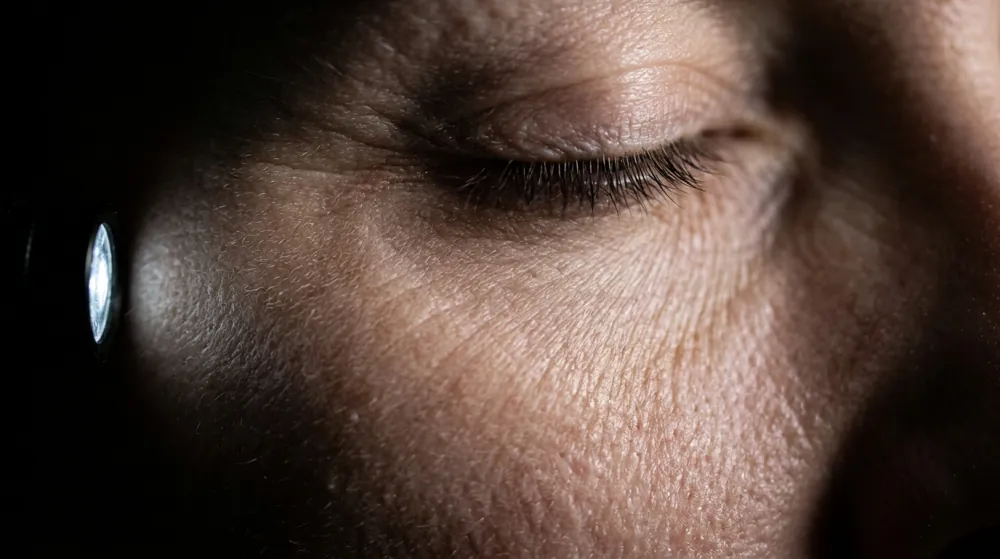
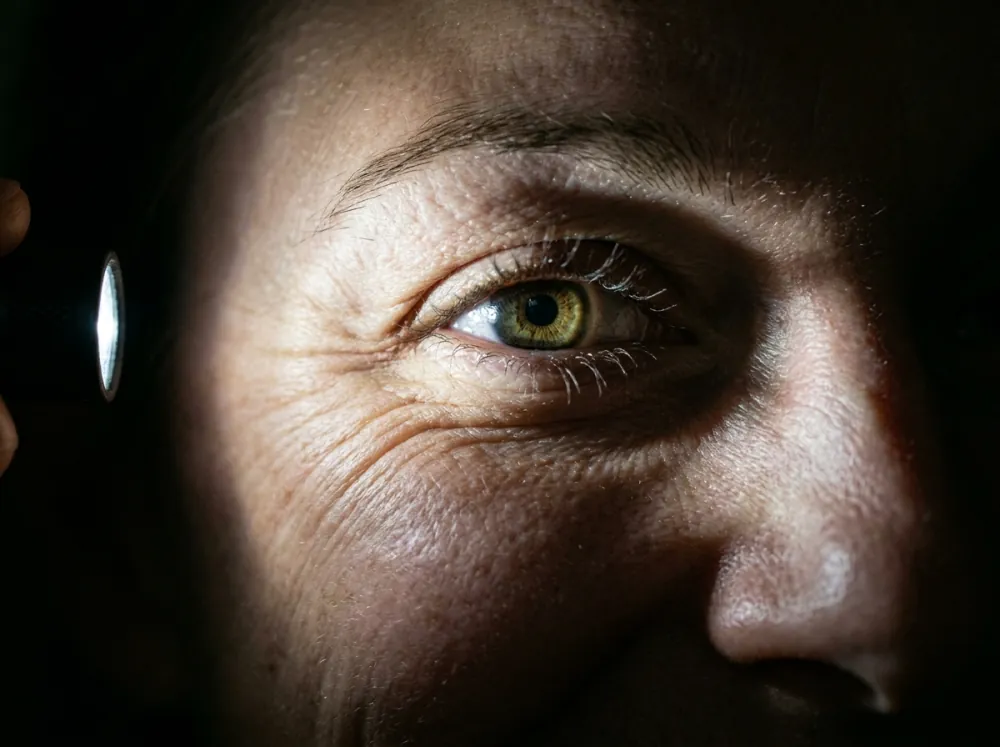
Wrinkles under the eyes are not one thing. Fine surface lines from dryness, thin crepey skin that has lost its spring, and creases made by smiling and squinting look alike in a mirror and have different causes. The skin they sit on is the thinnest on the face, and thin under eye skin shows every change first.
The claim this article tests is that eye cream is different from face cream. The skin is different. Whether the cream needs to be is a separate question, and the evidence is thinner than the marketing. This article covers the thin skin, the three kinds of line, a smile test and a pinch test for sorting them, what topicals can reach, and what procedures report. It describes and evaluates. It cannot tell you which kind you have.
The Thinnest Skin on the Face
A high-frequency ultrasound study of 45 women mapped 38 facial sites. The upper eyelid was the thinnest, at a median of 573.5 μm, against 1,907 μm at the tip of the nose, and the lower eyelid was next thinnest. Where on the face a site was explained about half the variation in thickness, and age less than 1%. Our article on the layers of skin sets out the numbers.
An expert framework on lower eyelid dark circles adds that the lower eyelid is thin, inelastic, low in collagen, elastin and glycosaminoglycans, and dry because it has few sebaceous glands. With age, loss of elasticity brings folds, laxity, edema and wrinkles. That framework was developed with support from a filler manufacturer and is expert opinion, not a trial. Our article on dark circles uses it for the colour and shadow side of the same skin.
Three Kinds of Under-Eye Lines
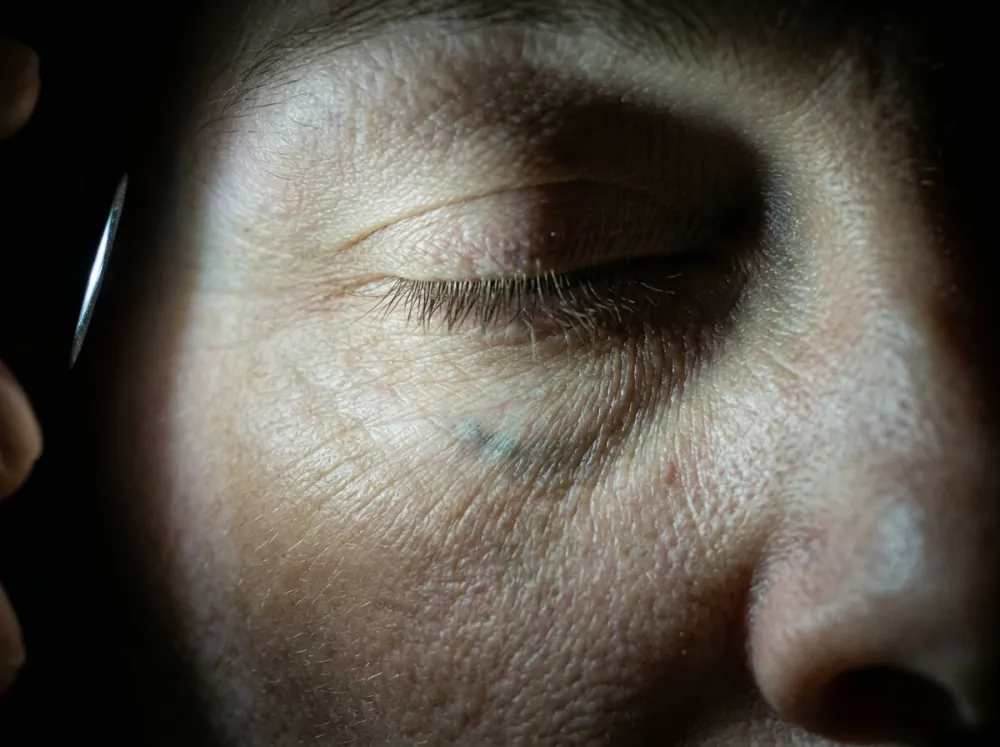
"Dehydration lines" and "crepiness" are lay terms, and none of the sources opened defines them as a clinical category. What the sources do describe maps onto three groups.
| Kind | What is going on | What it looks like | Source basis |
|---|---|---|---|
| Dryness lines | Too little moisture in the outer layer; dull, rough surface | Fine, shallow lines that look worse when the skin feels tight | DermNet on dry skin |
| Crepey skin | Thin, inelastic skin that folds finely and lacks spring | Fine crinkling across the lid and loss of spring | Framework paper, thickness study |
| Creases | Folding made by smiling and squinting that becomes etched | Lines that deepen with a smile; at rest they may persist or fade | Botulinum toxin anatomy review |
The "what it looks like" column is descriptive reasoning and not a sourced classification. DermNet defines dry skin as skin lacking moisture in the stratum corneum, giving a dull surface with a rough, scaly quality and, when severe, cracks. Its listed causes include low humidity, excessive bathing, contact with soap and frictional irritation, which are things that change, unlike age.
The Pinch and Smile Tests
Telling wrinkles under eyes apart by cause is the first step before any treatment. Neither test below is validated in the sources opened. They are ways of looking that the sources support in part.
The Smile Test
A review of botulinum toxin anatomy recommends assessing lines at rest, in a gentle smile, in a maximum smile and in a squint. Lines that appear only with animation are dynamic and are more toxin-responsive, while etched static lines may need skin-directed treatment or filler-type support. The paper concerns the lateral canthal lines (crow's feet) and is written for injectors, so it supplies the way of reading lines and not advice for readers.
For under-eye lines the same logic can be applied as a mirror check, as reasoning and not a validated test: lines that exist only in a smile are creases from movement, lines that are there at rest are static, and a flat lid that crinkles finely without any expression points to crepey skin or dryness.
The Pinch Test
Gently gathering a fold of lower eyelid skin shows whether the lines are fine surface crinkles or the folds of loose skin. As reasoning, lines that flatten when the skin is stretched or plumped are consistent with dryness, and lines that remain or a fold that stays gathered are consistent with laxity. No source opened validates a pinch test for under-eye lines. Clinicians use a different test, the snap-back test, to grade lower lid laxity before surgery: the lid is pulled away and timed for how long it takes to spring back. That test grades eyelid support and is not a way to classify wrinkles.
The Figure Audited: "Eye Cream Is Different From Face Cream"
Verdict: the skin is different, and no source shows the cream needs to be. Findings:
- The skin differs, measurably. The upper eyelid is about 30% as thick as the nose tip (573.5 against 1,907 μm), and the lower lid skin is inelastic and dry.
- Eye creams were not better than face creams in the one comparison found. Two split-face studies of periorbital wrinkles measured with 3D imaging (abstract) tested a day lotion with SPF 30, a night cream, an eye cream and a wrinkle treatment for four weeks. In Study 1 the day lotion, night cream and eye cream all improved crow's feet smoothness, and the day lotion and night cream, but not the eye cream, improved the maximum roughness measure. In Study 2 the night cream, eye cream and wrinkle treatment improved both measures, but the day lotion did not. Pooled, all three tested products beat no treatment. The abstract does not state who funded the work.
- No periorbital retinoid trial was found. Searches for trials of retinol or tretinoin on the eye area returned face-wide studies only. The tretinoin systematic review in the next section covers photoaged skin, not eyelids, and whether eyelid skin tolerates retinoids differently from cheek skin was not compared in any source opened.
The audit therefore splits the claim. Gentler is reasonable for thin skin, as our article on the 10-step Korean routine argues. A different cream that does more is untested.
What Topicals Can Reach
Dryness
DermNet names moisturisers or emollients as the mainstay for dry skin and lists reducing bathing, lukewarm water and replacing soap with a gentler cleanser as prevention. If under-eye lines are dryness lines, that is the lever, and our articles on dry skin treatment cover it. The 3D-imaging abstract above shows moisturising products improved periorbital smoothness over four weeks, which fits.
Retinoids and Sun Protection
A systematic review of seven randomised trials found topical tretinoin improved wrinkling, mottled pigmentation, sallowness and lentigines in photoaged skin from one month and for up to 24 months. It reports that the studies were not uniform in formulas or outcome measures. Our article on tretinoin and retinol covers the two, and the one on SPF and wrinkles covers prevention. A topical cannot restore thickness or deep structure, and no source opened claims it can. The wider ranking of what has evidence for lines on the face is in anti-aging treatments, ranked by evidence.
Procedures (Reported)
Under eye wrinkle treatment depends on the cause, and the reviews say so. A 2026 systematic review of 50 studies of under-eye treatments (abstract) organises them by cause. Fillers remain foundational for volume loss, lasers address melanin, vascularity and skin laxity, microneedling and polynucleotides target texture and fine rhytides, peels and topicals are effective for superficial dyschromia, botulinum toxin benefits orbicularis oculi hypertrophy, and surgery is preferred for herniated fat and poor lower eyelid support. Its conclusion is that infraorbital concerns are multifactorial and need individual strategies depending on fat pad integrity, skin quality and eyelid support. Choosing among these belongs with a clinician.
Conclusion
Wrinkles under the eyes are dryness lines, crepey thin skin or creases from smiling, on the thinnest skin of the face. A smile test separates movement from rest, a pinch test is a reasoned aid and not a validated one, and moisture, sun protection and retinoids have the evidence for lines, with procedures for structure. Eye cream is justified by the skin, and nothing opened shows it works better than face cream.
If you want to know whether anything is changing, photographing the area at rest and mid-smile in the same light each month, in an album or in an app like Skinic, shows more than a mirror. For lines you want to discuss treating, ask your own clinician.
Frequently asked questions
5 questions · tap one to open the answer
What causes wrinkles under the eyes?
What are dehydration lines under the eyes?
Do eye creams work better than face creams?
How can you get rid of wrinkles under the eyes?
Why is the skin under the eyes so thin?
Medically reviewed by
Dr. M.M Hanaei
Aesthetic Physician, Dermatology Fellowship
- MD — Shahid Beheshti University of Medical Sciences (SBMU)
- MCC Licensure (Medical Council of Canada)
- Dermatology Fellowship, Switzerland
- Certified in advanced aesthetic procedures
Last reviewed 15 October 2026