Skinic
Quick answer
Anti-aging treatments are not equal. Daily sunscreen and prescription retinoids have the best evidence, clinic procedures have trial data for some jobs, and collagen drinks have the weakest.
The full evidence is belowYou stand at the pharmacy shelf with a dozen jars that all promise younger skin. They cannot all be equal, and they are not. Daily sunscreen has a randomised trial behind it, and prescription retinoids have good evidence for wrinkles. Clinic procedures have trial data for some jobs. Collagen drinks and most other supplements have the weakest evidence of all.
This guide ranks the options by the strength of the best evidence we could open. A rank is not a verdict on you. It tells you how much proof sits behind a claim, and who paid for that proof.
What does "anti-aging" actually change?
What makes skin look older?
Two things age skin: time and genes, and the sun. A recent review calls the sun the main outside driver of ageing skin, and says UV light breaks down collagen, the protein that keeps skin firm. It adds that even one dose of UV can start that breakdown. The review is a narrative one, so it gives no exact share of ageing that the sun explains. Its authors report no conflicts of interest.
What can a treatment honestly promise?
A treatment can change how skin looks and feels, by softening fine lines, smoothing texture or evening out colour. It cannot stop the clock, so be wary of any label that says it "reverses" age. Look for what was measured instead: wrinkles on a scale, skin moisture on a probe, or a score from a doctor.
How do the options rank side by side?
Here is the ranking in one place. The sections below explain each row.
| Tier | Option | What the best evidence we opened shows | Weak spot |
|---|---|---|---|
| 1 | Daily sunscreen | 24% less skin ageing than discretionary use over 4.5 years | One trial; some data missing |
| 2 | Prescription retinoids | Most trials show better wrinkles over months | Small trials; no pooled result |
| Unranked | Retinol and shop creams | Little direct trial data in our sources | Mostly cosmetics claims |
| 3 | Botulinum toxin (reported) | Frown lines clearly better than placebo at four weeks | Most trials paid for by industry |
| Unranked | Fillers, lasers, devices (reported) | Not ranked here | Our sources gave no firm numbers |
| 4 | Collagen drinks and supplements | Gains vanish in higher-quality and independent trials | Funding splits the results |
Which everyday habits have the strongest evidence?
What did the Nambour sunscreen trial find?
The best evidence for any anti-aging step is a sunscreen trial. In the Nambour trial (abstract), 903 adults under 55 were split into groups. Some used a broad-spectrum sunscreen every day. Others used it only when they chose to. Assessors who did not know the groups judged skin texture after 4.5 years.
The daily group had no detectable increase in skin ageing. Compared with the group who chose when to use sunscreen, their ageing was about a quarter lower (24% lower, with a range of 2% to 41%). The trial also tested a beta-carotene pill. It made no overall difference.
The limits matter: some outcome data were missing, and the study was too small to spot moderate effects. The money came from Australia's national health research council. Our article on whether sunscreen really prevents wrinkles goes through the trial in more detail.
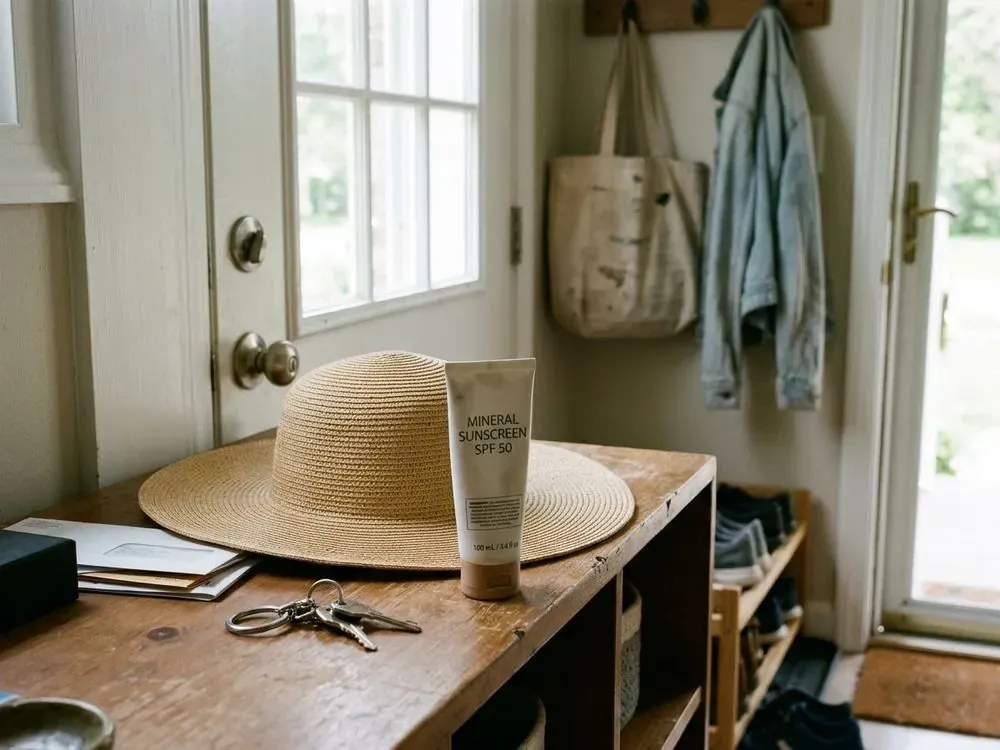
Nothing else we opened has a trial that matches this. The review on sun damage says an SPF of 30 or higher is generally enough for daily use. That is a general rule from a narrative review, not a trial result.
Which creams and serums have trial data?
What do prescription retinoids show?
Retinoids are relatives of vitamin A. The best-studied one for sun-aged skin is tretinoin. A review of seven randomised trials with 739 people found that most trials showed better wrinkles. The trials ran from three months to two years, and in the two-year trial the gains showed by month four and lasted to month 24.
The trials were too different to pool into one number. Side effects were common, including redness, peeling, itching, burning and dryness, but few people dropped out because of them. The review was paid for by an Indonesian government research ministry, and its authors reported no conflicts.
DermNet, a doctor-written skin site, says benefits for sun-aged skin usually take more than six months. It says tretinoin is the most irritating retinoid and adapalene the least. It also warns that some retinoids must not be used in pregnancy. A prescriber decides which one, if any, suits you.
What about retinol and other shop creams?
Retinol and a close relative are common in cosmetics, according to DermNet. Our sources gave no trial result for them that we can quote here. Read what retinol does, week by week and the difference between tretinoin and retinol for the detail.
Peptide creams are a similar story. Read what has trial data in our article on peptides for skin. The review on sun damage backs antioxidant creams and says peptides and retinoids "may help". It gives no trial results for either claim, so we leave antioxidants unranked.
What do clinic procedures actually show?
This section reports what trials found. It is not a guide to how a procedure is done. A licensed clinician makes those calls.
What does the evidence say about botulinum toxin?
A Cochrane review pooled 65 trials with 14,919 people. Most looked at frown lines between the brows. At four weeks, people were far more likely to call their lines improved than people given a dummy shot. Depending on the product, they were roughly 19 to 67 times as likely.
The review also says the treatment probably raises the risk of a drooping eyelid. Most trials were paid for by drug companies, and none had a low risk of bias on every check, so the numbers should be read with care. Long-term results and repeat treatments were poorly studied. Fillers were compared in only a few trials, so the review draws no firm line between the two.
What about fillers, lasers and devices?
The sources we opened gave no firm numbers for these, so we do not rank them. Our article on non-invasive skin tightening reports what radiofrequency and ultrasound trials measured. Lifts there are counted in millimetres, not in the dramatic terms an advert may use.

Do collagen supplements reduce wrinkles? The claim, checked
The claim: "Collagen supplements reduce wrinkles." We checked whether trials paid for by industry and independent trials reach the same answer.
What did the pooled trials find?
A 2023 review pooled 26 trials with 1,721 people. Trials ran two to twelve weeks, and collagen beat a dummy powder for skin moisture and springiness on measuring tools. We read no pooled wrinkle result in it. The authors reported no conflicts. The review did not split the 26 trials by who paid. It flagged concerns about missing data in 13 of them, and some trials had fewer than 40 people.
Does who paid for the trial change the answer?
Yes, according to a 2025 review of 23 trials with 1,474 people (abstract). All trials together showed gains in moisture, springiness and wrinkles. But trials without drug or supplement company funding showed no effect on any of the three. Higher-quality trials also showed no effect. The authors say there is no clinical evidence to support collagen supplements for preventing or treating skin ageing.
The two reviews disagree in tone, not in data. The earlier one pools everything and finds small gains in moisture and springiness. The later one asks who paid and how well each trial was run. The gains shrink when it does. For wrinkles, no review we opened shows a lasting benefit. We read only the abstract of the later review, so we cannot say how it handled each trial.
How do you choose where to start?
Start with the claims, not the jars, and ask three questions of any anti-aging product or procedure.
- Is it a drug or a cosmetic? The two are treated differently, and the claims they may make differ too. Our article on what separates a drug from a cosmetic explains the gap.
- What was measured? A wrinkle score from blinded doctors counts for more than a happy customer survey.
- Who paid, and did independent trials agree? The collagen story shows why this matters.
Visit our aging hub for every article on this theme. Some, like under-eye wrinkles, look at one area in depth.
Conclusion
Anti-aging has an order. Protecting your skin from the sun has the clearest trial behind it. Prescription retinoids come next for wrinkles, with side effects to plan for. Clinic procedures have good data for some jobs. Collagen and most supplements sit at the bottom, especially once you ask who paid.
If you want to see what is changing, keep dated notes or photos in the same light, in an app like Skinic or a notebook. See a clinician about a mole that changes, a sore that will not heal, or any prescription option.
Frequently asked questions
5 questions · tap one to open the answer
What is the best anti-aging treatment?
Does sunscreen really prevent wrinkles?
Do prescription retinoids work for wrinkles?
Do collagen drinks and supplements reduce wrinkles?
How do I know if an anti-aging claim is trustworthy?
Medically reviewed by
Dr. M.M Hanaei
Aesthetic Physician, Dermatology Fellowship
- MD — Shahid Beheshti University of Medical Sciences (SBMU)
- MCC Licensure (Medical Council of Canada)
- Dermatology Fellowship, Switzerland
- Certified in advanced aesthetic procedures
Last reviewed 23 October 2026