Skinic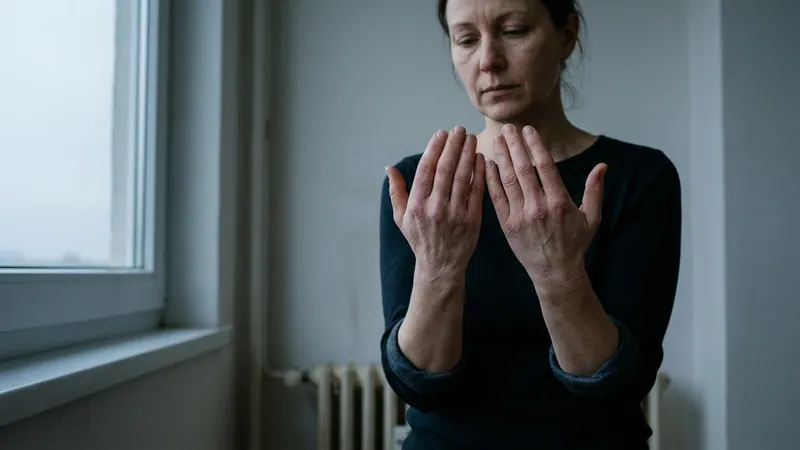
Dry skin gets treated as one problem with one answer: add moisture. Drink more water, use something hydrating, repeat.
Two things are wrong with that. The first is that dry and dehydrated are different deficits — one is short of lipids, the other short of water — and they do not respond to the same thing. The second is that the most-prescribed remedy for both, a hydrating product, can under common conditions make the problem worse rather than better.
And the advice everyone opens with has been tested directly against a moisturiser. One of them worked.
Two Different Deficits, One Word
Dry skin, clinically xeroderma, is defined as inadequate hydrolipids in the skin, producing roughness, tightness, flaking and scaling. The word to notice is hydro-lipids. Two components, and they fail independently.
The lipid side. Ceramides are the major lipid component of the stratum corneum, and a shortage of them is a structural failure — the mortar between the cells thins out and the barrier leaks.
The water-holding side. Natural moisturising factor is a set of hygroscopic molecules sitting inside the corneocytes — lactic acid, sugars, amino acids and urea — making up approximately 10% of the dry weight of the stratum corneum. NMF is what holds water in the outer layer. Stratum corneum moisture "should ideally range from 10% to a maximum of 30%."
NMF is produced by breaking down a protein called filaggrin, which also strengthens the barrier by crosslinking keratin filaments. So the same protein does two jobs: it holds the structure together and, when broken down, becomes the thing that holds the water.
The practical consequence is the distinction nobody makes on a product label. Skin short of lipids needs lipids. Skin short of water needs something to hold water in, and something over the top to stop it leaving. Adding water to a barrier that leaks is pouring into a bucket with a hole in it.
Winter Is Not Imaginary
People assume the seasonal pattern is psychological or incidental. It is neither — the barrier is measurably a different thing in February.
A review of stratum corneum lipid organisation reports that the amount of bound ceramides in winter is around 50% of the summer level. Half. The mortar in the brick wall is thinner for several months of the year as a matter of composition, not perception.
There is a second mechanism in the same direction, and it is elegant. The depth at which filaggrin is processed into NMF depends on external relative humidity. In humid conditions the breakdown happens almost at the surface; in dry air it happens in deeper layers, where the NMF is positioned to resist desiccation.
So the skin does adapt. It simply cannot adapt fast enough or far enough against the combination StatPearls lists: cold weather, low humidity, dry indoor heating — plus the behaviour that goes with it, "repeated and lengthy hot showers and the use of harsh, alkaline soaps."
That last pairing matters more than people think. Heating dries the air, cold drives people into hot showers, and hot water with alkaline soap strips the very lipids that are already seasonally depleted. The season sets the baseline; the response to the season does the rest of the damage.
Prevalence rises with age — notably in people 60 or older — and the classic sites are the lower legs, forearms, hands and feet, which is where most people first notice it.
The Water Question, Audited
"Drink more water" is the single most repeated piece of advice about dry skin. It is not a myth. It is also not the answer, and the evidence is specific enough to say why.
What the water trial found
A 30-day study gave 49 healthy women approximately 2 litres of additional water per day, measuring at days 0, 15 and 30 across five anatomical sites with dedicated instruments for superficial hydration, deep hydration, water loss and skin biomechanics.
It found an effect. Superficial and deep skin hydration were significantly modified. But the finding that matters is where the effect sat: participants were stratified by baseline intake, with 38 consuming under 3,200 mL a day and 11 consuming more, and the results were significantly greater in the lower-baseline group.
The authors' own conclusion is appropriately hedged: higher water intake "might positively impact normal skin physiology, in particular in those individuals with lower daily water consumptions." They also note that clear, consistent relationships between hydration and the biomechanical measures could not be found.
In plain terms: if you are drinking very little, drinking more does something. If you are already drinking normally, this study does not promise you anything.
What happened when it was tested against a moisturiser
This is the more useful experiment, and almost nobody cites it.
A four-week study split 43 participants into arms receiving additional water, a moisturiser, both, or neither — with the water arms given four 500 mL bottles daily and the moisturiser arms applying cream three times a day, both at over 80% compliance. Stratum corneum hydration and water loss were measured at baseline, week 2 and week 4.
The moisturiser arms showed significant increases in stratum corneum hydration by week 4 at every site measured: left forearm (p=0.004), hand dorsum (p=0.010), shin (p=0.016 and p=0.001 in the combined arm).
The additional-water arms: "no significant changes were observed" — with a single exception at one site in one group at week 4.
The authors' conclusion is one sentence and it settles the practical question: "the application of additional moisturizers had a more positive impact on the increase in skin hydration compared to additional water intake."
Worth noting what moved in neither: transepidermal water loss showed no significant change in any group over the whole period. Four weeks of moisturiser raised the water content of the outer layer without measurably repairing how much water escapes through it. Those are different things, and the study is a useful reminder that hydration and barrier integrity are not the same measurement.
Both studies are small — 49 and 43 participants — and short. The honest verdict is that drinking more water is reasonable if you drink very little, irrelevant to your skin if you already drink normally, and clearly outperformed by putting something on your skin.
Why Hydrating Products Can Make It Worse
Here is the failure mode that produces the experience of getting drier while using more hydrating products.
Humectants attract water. The standard clinical reference is specific about where from: they can hydrate the skin if humidity is above 70%, but more commonly they draw water from the deeper epidermis and dermis. And then the sentence that matters:
Some humectants can increase transepidermal water loss and exacerbate skin dryness without concomitant use of an occlusive moisturiser.
Read that against a winter routine. A heated room sits far below 70% humidity. A watery hydrating serum, applied to skin whose ceramides are already at half their summer level, pulls water upward from deeper tissue into a barrier that leaks — and without something over the top, that water leaves.
This is the same mechanism the ten-step routine audit identified in a different context, and dry skin is where it does the most damage. More hydrating layers is the intuitive response and the wrong one.
What Actually Changes It
Three things, in order of how reliably they work.
1. Stop the stripping. Hot showers, length of showers, and alkaline soap are named causes rather than aggravators. This is the free intervention and the one people skip. The full mechanism of what harsh cleansing does to the barrier is protein denaturation and lipid extraction — exactly the deficit already present.
2. Occlude. StatPearls calls petrolatum the "most effective moisturizing ingredient", and the moisturiser reference puts its reduction in epidermal water loss at nearly 99%. If the problem is a barrier that leaks, the intervention that most directly addresses it is a physical layer that does not. Apply it to damp skin, where it seals in water that is already there.
3. Replace what is missing. Humectants — glycerin, urea, lactic acid, propylene glycol — are the NMF analogues, and they work under an occlusive rather than instead of one. Ceramide-containing products address the lipid side, with the caveat this site has made before: the lipid ratio is well described, and whether a topical reconstitutes it in your skin is a separate and less settled question.
The order is the point. Occlusive without humectant seals in whatever is there. Humectant without occlusive, in dry air, can take water out. Together they work; alone, one of them can backfire.
When Dry Skin Is a Condition Rather Than a State
Most dry skin is a state produced by weather, heating, washing and age. Sometimes it is a sign of something else, and the distinctions are worth knowing.
The Cracked-Porcelain Pattern
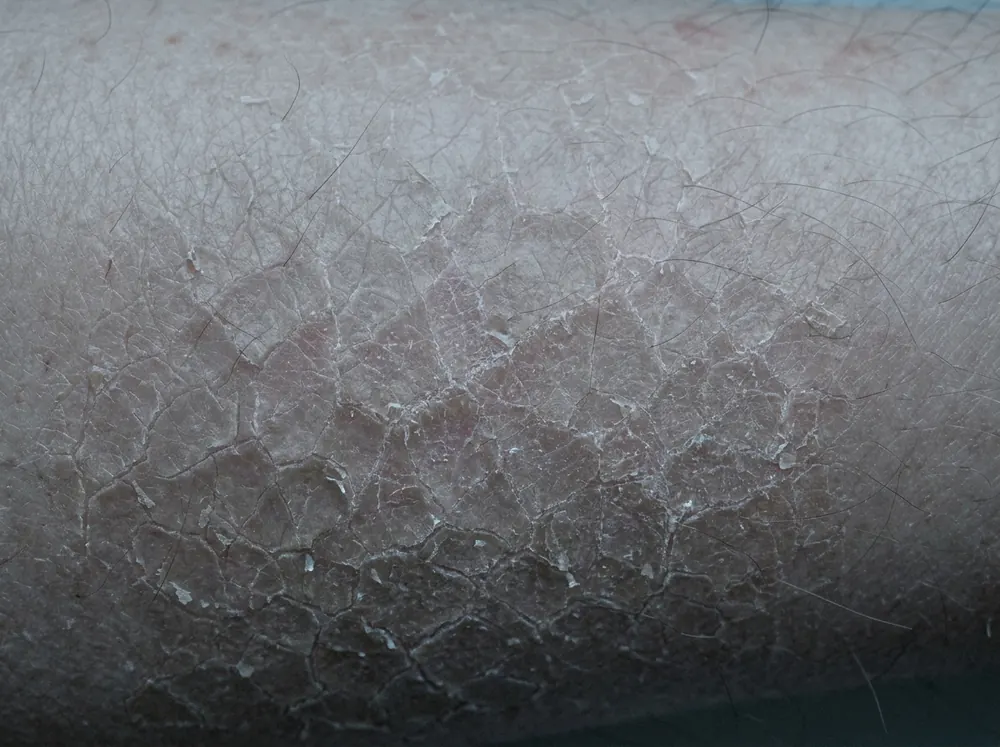
Asteatotic eczema is the severe end of xerosis, presenting with a "cracked porcelain" appearance — a fine network of fissures across the skin, most often on the lower legs of older adults. It is dryness that has crossed into inflammation.
Ichthyosis vulgaris and atopic dermatitis both sit in the differential. Distinguishing eczema from psoriasis is covered on this site; the short version is that persistent, well-demarcated or intensely itchy dryness is not a moisturiser problem.
When It Is Not Just the Weather
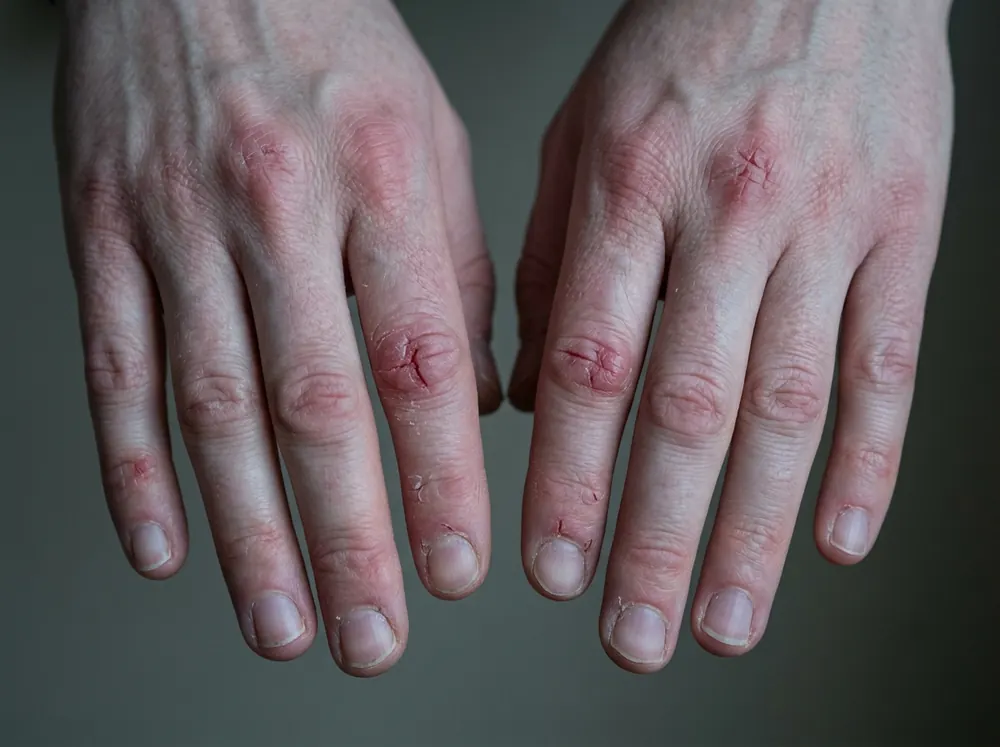
Dry skin can be systemic. StatPearls lists diabetes, hypothyroidism, renal failure and inflammatory bowel disease among conditions it may indicate. The clinical picture that should prompt a conversation rather than a product: dryness that is new and severe without an environmental explanation, that does not respond to several weeks of consistent occlusive use, or that comes with other symptoms. Hands that are red, blistered or cracked rather than simply dry are a different question, covered in hand eczema.
The appearance to recognise is specific — "dry, rough, and scaly skin with a somewhat grayish hue", with reduced elasticity, wrinkling, redness and fissures.

Conclusion
Dry skin is a shortage of hydrolipids — two components, failing independently. Ceramides provide the structure; natural moisturising factor, at roughly 10% of the stratum corneum's dry weight, holds the water. A barrier short of the first cannot keep the second.
Winter is a real variable, not a perception: bound ceramides in winter run at about half their summer level, and the skin's own adaptation — processing filaggrin into NMF deeper when the air is dry — is not enough against heating, hot showers and alkaline soap.
On drinking more water, the evidence says something narrower than either side claims. A 49-participant trial found an effect concentrated in people with low baseline intake. A 43-participant head-to-head found that moisturiser significantly raised skin hydration and additional water did not. Drink water because you should; do not expect it to fix dry skin.
And the thing most people do when their skin is dry — reach for something hydrating — can make it worse in a heated room. Humectants draw from the air only above 70% humidity, and without an occlusive over them they can increase water loss.
What works is unglamorous and cheap. Stop stripping it. Put something occlusive on damp skin. Use humectants underneath that rather than instead of it. And if it is new, severe, unexplained or unresponsive after a few weeks, that is a conversation rather than a different cream.
Frequently asked questions
5 questions · tap one to open the answer
Does drinking more water help dry skin?
What is the difference between dry and dehydrated skin?
Why does my skin get so much drier in winter?
Can hydrating products make dry skin worse?
When should dry skin be checked by a doctor?
Medically reviewed by
Dr. M.M Hanaei
Aesthetic Physician, Dermatology Fellowship
- MD — Shahid Beheshti University of Medical Sciences (SBMU)
- MCC Licensure (Medical Council of Canada)
- Dermatology Fellowship, Switzerland
- Certified in advanced aesthetic procedures
Last reviewed 7 October 2026