Skinic
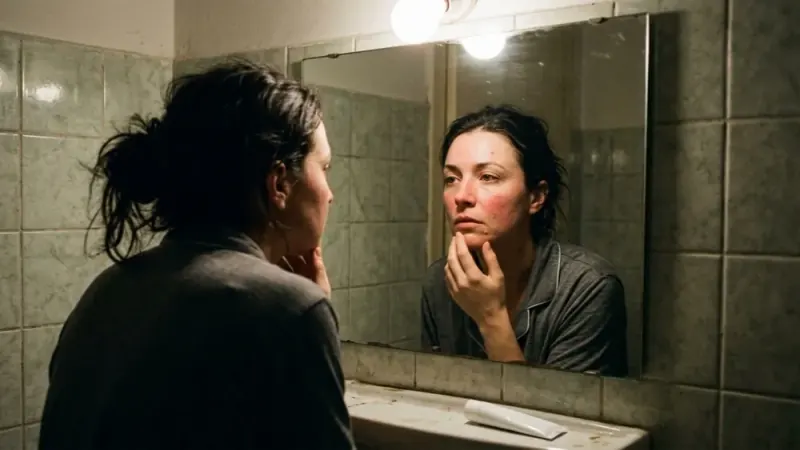
You have been treating it as acne for two months. A salicylic acid cleanser, then benzoyl peroxide, then a spot treatment applied every night. Your skin is redder than when you started, it stings when you apply anything, and the bumps have spread rather than cleared.
That pattern — treatment, then deterioration, then more aggressive treatment — is one of the most common stories in dermatology, and it usually has the same explanation. You are not looking at acne.
At least three conditions produce small inflamed bumps on an adult face. Acne vulgaris is one of them. Rosacea and perioral dermatitis are the other two, they are extremely common, and both are routinely self-diagnosed as acne. That matters because the standard acne response — strip the oil, dry the bumps, exfoliate harder — makes both of them worse. In the case of perioral dermatitis, one of the most common causes is a product people apply precisely because they think it will help.
This piece covers the single question that separates rosacea from acne, where each condition sits on the face, what triggers each one, and why the same products help one and inflame the others. It also covers where the line is: two of these three are prescription conditions, and the honest end point of this article is a referral, not a routine.
The One Question That Splits Rosacea From Acne
Start here, because it resolves a large share of cases on its own.
Do you have comedones anywhere on your face?
Comedones are the non-inflamed lesions of acne — blackheads and the small skin-coloured bumps under an intact surface called closed comedones. They are the plugged follicles that make acne acne.
Rosacea does not produce them. The absence of comedones is an important factor that differentiates rosacea from acne vulgaris; rosacea presents instead with symmetrical erythema, papules and pustules, and telangiectasia — visible small blood vessels. Look at the whole face, not only the inflamed area. If there are blackheads on your nose and closed comedones on your forehead, acne is in the picture. If you have inflamed bumps sitting on generally red skin and no comedones anywhere, that points firmly away from acne.
The two can coexist, and in adults they often do. But if you cannot find a comedone, the acne diagnosis you have been treating is probably wrong.
If you are not sure what a comedone looks like, or what else the bump might be, every bump on your face, identified works through the full visual differential.
Where Each One Sits on the Face
Distribution is the second-strongest signal, and it is something you can check in a mirror in ten seconds.
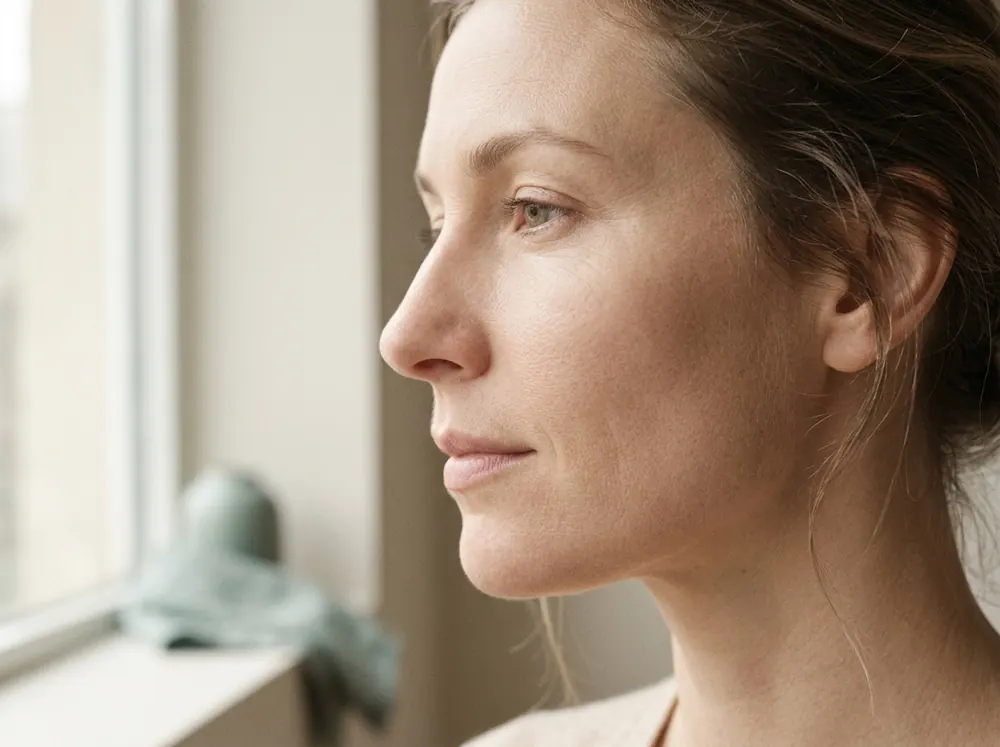
Rosacea is centrofacial. The defining feature under the current phenotype-based classification is persistent centrofacial erythema with periodic intensification by trigger factors — redness across the cheeks, nose, chin and central forehead that is present between flares, not only during them. Phymatous change, the thickening of skin most often seen on the nose, is the second independently diagnostic feature. Major features include flushing, inflammatory papules and pustules, and telangiectasia.
Perioral dermatitis is periorificial, and it spares the lip border. It presents as discrete, symmetrical pinpoint papules and pustules in clusters around the mouth — on the chin or nasolabial folds, but not on the vermilion border of the lips. That sparing is close to a signature. A clear rim of normal skin immediately around the lips, with a band of bumps starting a few millimetres out, is characteristic and nothing else on this list does it. Similar eruptions can appear at the outer corners of the eyes and around the nostrils, which is why the condition is also called periorificial dermatitis.
Acne follows the sebaceous zones. Forehead, nose, chin, cheeks and jawline, wherever oil glands are densest, and with comedones mixed in among the inflamed lesions.
| Rosacea | Perioral dermatitis | Acne | |
|---|---|---|---|
| Where | Cheeks, nose, central forehead, chin | Around the mouth, sparing the lip border; sometimes around eyes or nose | Forehead, nose, chin, cheeks, jawline |
| Comedones | Absent | Absent | Present — the defining lesion |
| Background skin | Persistently red between flares | Dry, scaly, often burning | Normal colour between lesions |
| Visible vessels | Common | No | No |
| Typical age | Usually after 30 | Commonly 20–45 | Teens onward, but adult acne is common |
| Sensation | Burning, stinging, flushing | Burning, tightness | Tenderness on individual spots |
The table is a starting point, not a diagnosis. People present atypically, the conditions overlap, and reading your own face is harder than reading a table.
The Trigger Test
If distribution leaves you unsure, what provokes a flare usually does not.
Rosacea: Things That Make You Flush
Rosacea involves neurovascular dysregulation, and the recognised triggers are reactivity to temperature change, exercise, UV, spicy food and alcohol. DermNet's list extends to hot baths, cosmetic products, vasodilating medications, and certain foods, with UV radiation identified as the most significant environmental trigger.
The test is simple: does your face visibly redden within minutes of a hot drink, a hot shower, a glass of wine, a spicy meal, or walking into a warm room — and does the redness then take a while to settle? That pattern is not something acne does. Acne does not respond to a hot shower in real time.
Perioral Dermatitis: What You Have Been Putting On It
This is the trigger list that matters most, because it is the one under your control and the one nobody warns you about.
Steroid use via all routes — topical, inhaled, nasal — is the most common association. That includes prescription creams, over-the-counter hydrocortisone, the asthma inhaler you have used for years, and steroid nasal sprays for hay fever. The other recognised contributors are occlusive paraffin or petroleum-based emollients, cosmetics and other topical products, and toothpaste.
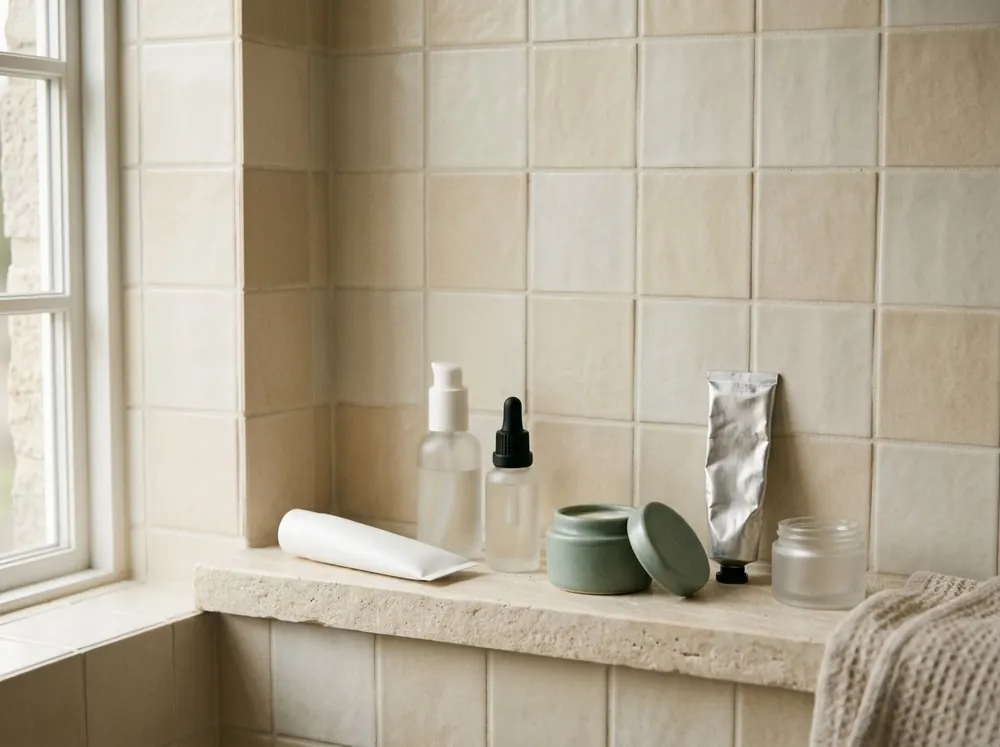
So the question to ask is not "what did I eat" but "what changed on my face, or in my medication, in the weeks before this started". A new rich moisturiser. A cream someone passed on that "calms redness". A new inhaler. Often the answer is sitting on the bathroom shelf — though in the largest recent cohort, most people who developed it had used no steroid at all, which is worth knowing before assuming the trigger list is complete.
Acne: Hormones, Friction and Occlusion
Acne flares cycle with hormones, respond to friction and occlusion, and are worsened by heat and sweat. If your bumps track your menstrual cycle, cluster where a helmet strap or phone sits, or worsen in hot weather, that is acne behaviour. We have covered the environmental side of that in acne in hot, humid climates.
Why Acne Products Inflame Two of the Three
Acne treatment is built around a specific mechanism: reduce follicular plugging, reduce bacterial load, reduce sebum. Benzoyl peroxide, salicylic acid, retinoids and physical exfoliation all work by acting on the follicle and, in the process, disrupting the surface of the skin.
Rosacea and perioral dermatitis are not follicular plugging disorders. Both involve inflamed, barrier-compromised, reactive skin. Perioral dermatitis in particular presents with surrounding dry, scaly skin and a burning sensation — skin that is already struggling.
Apply an acne routine to that and you get the predictable result: more irritation, more redness, more barrier damage, and a condition that spreads rather than settles. The stinging you feel when you apply your usual product is not the product working. It is information.
This is also why "it got worse so I went harder" is such a reliable feature of these stories. The escalation is rational if the diagnosis is right and actively harmful if it is not.
The Steroid Trap, and Why It Is Hard to Escape
This deserves its own section, because it is the single most useful thing in this article and it is almost never the opening of a piece about perioral dermatitis.
A topical steroid makes the rash look better within days. Then, when it is stopped, the rash returns worse than before — so the cream goes back on, it improves again, and a cycle establishes itself in which the treatment is sustaining the condition.
The clinical literature on this is unambiguous. A study of 200 patients with steroid-induced rosacea found that lesions characteristically flared on discontinuation of the steroid, with patients having used potent topical steroids for a period ranging from one month to twenty years — an average of nearly twenty months. Most striking is where the steroids came from: of the 200, only twelve had been prescribed them by a dermatologist. The rest had obtained them from a pharmacy counter, from a physician for an unrelated complaint, or from friends, relatives and self-prescription.
That is the trap in full. It is easy to enter, it feels like it is working, and the moment you try to leave it the skin gets dramatically worse — which is exactly the moment most people give up and reapply.
One thing to be clear about: stopping abruptly is not automatically the right move. Management guidance is to discontinue all topical corticosteroids through gradual weaning rather than abrupt cessation, because stopping suddenly can cause a flare. How that taper is handled, and what is used alongside it, is a clinical decision — which is the honest reason this article ends where it does.
If a steroid is being used for a diagnosed condition under medical supervision, that is a conversation with the prescriber, not a reason to stop.
The full version of this — what the steroid is doing to the barrier underneath, every route it reaches your face by, and why the rebound flare is so easy to misread — is in why your acne treatment made the redness worse.
Why This Is Routinely Missed on Deeper Skin Tones
Everything above leans on seeing redness, and redness is the signal that reads least reliably in richly pigmented skin.
Three of the five hallmark signs of rosacea — facial erythema, telangiectasia and recurrent flushing — are more difficult to visualise in skin of colour because of the surrounding pigment. The consequence is documented and consistent: rosacea is frequently misdiagnosed as acne in patients with skin of colour, and lower reported incidence may reflect a lower index of suspicion rather than genuinely lower prevalence.
That has a direct cost. Misdiagnosed rosacea gets treated as acne, acne treatment inflames rosacea, and inflammation in deeper skin tones is more likely to leave post-inflammatory hyperpigmentation, which is chronic and can persist for months to years. The misdiagnosis does not just fail to help; it produces a second, longer-lasting problem.
Two adjustments follow, and both come from the clinical literature on assessing rosacea in skin of colour.
Lead with symptoms rather than appearance. Warm sensations, stinging or burning with products, whether symptoms track a trigger, and eye symptoms — itching, burning, grittiness — are the history that matters when erythema is hard to see. Ocular involvement is common and frequently overlooked.
Look for the non-classic signs. Dry skin, swelling and hyperpigmentation are named as features worth examining for when redness is not visible.
If you are working out your own risk profile for pigment after inflammation, Fitzpatrick skin types I–VI sets out what your type does and does not predict, and hyperpigmentation in brown and deep skin tones covers the marks themselves.
This Is Where You Stop Self-Treating
This article can help you recognise what you are probably looking at. It cannot diagnose you, and the two non-acne conditions here are not manageable with over-the-counter products.
Rosacea affects roughly 5% of adults, typically presents after the age of 30, and involves the eyes in over half of patients — which is a good reason not to treat it as a cosmetic matter. Perioral dermatitis requires stopping the causative agent, usually with a supervised taper, and often prescription treatment alongside. On the rosacea side, the topical that topped a network meta-analysis of 19 trials is one a clinician may raise — useful context for that conversation rather than something to start on your own.
Book an appointment if:
- You have inflamed bumps and cannot find a comedone anywhere on your face
- Your face reddens within minutes of heat, alcohol or spicy food, and stays red
- There is a clear rim of spared skin immediately around your lips
- Your skin burns or stings when you apply products it used to tolerate
- You have been using any steroid on your face, from any source, for more than a couple of weeks
- Acne treatment has made things measurably worse over six to eight weeks
- Your eyes are dry, gritty or persistently irritated alongside facial symptoms
None of those are emergencies. All of them are reasons to have someone with training look at your face rather than spending another two months on a product aimed at the wrong condition.
And if the patches are on your body rather than your face — scaly, persistent, on an elbow or in a crease — eczema or psoriasis, told apart by sight works through a different comparison entirely.
What to Bring to the Appointment
A good consultation for these conditions depends almost entirely on history, and history is the thing people reconstruct badly under pressure in a ten-minute appointment.
Three things are worth having ready.
A product and medication timeline. Everything applied to your face in the last six months, everything inhaled or sprayed nasally, and roughly when each started. This is the single most useful document you can bring to a perioral dermatitis consultation, and it is the one most people cannot produce.
A trigger log. A fortnight of notes on what preceded each flare — heat, alcohol, exercise, a specific food, stress, a new product.
Dated photographs in consistent conditions. Same place, same time of day, same distance, same soft daylight, no filters. Flares are intermittent by nature, and the day you get an appointment is rarely the day your skin looks its worst. A photograph taken during a flare is genuinely useful clinical information.
Whether that record lives in a notes app and a dated album, or in something built for it like Skinic, the point is that it exists before you need it. Memory is the weakest part of this process.

Conclusion
Three conditions, similar-looking bumps, and two of them made worse by the treatment most people reach for first.
Ask the comedone question before anything else: blackheads and closed comedones mean acne is involved, and their complete absence points away from it. Then check distribution — rosacea sits centrally across the cheeks, nose and forehead; perioral dermatitis clusters around the mouth while sparing the lip border. Then check triggers: rosacea flushes within minutes of heat, alcohol or spice, while perioral dermatitis usually traces back to something you applied, inhaled or sprayed.
If you have been using a steroid on your face from any source, that is the first thing to raise with a clinician, and not something to stop abruptly on your own.
And if the redness is hard to see because of your skin tone, trust the symptoms rather than the mirror. Burning, stinging, warmth and gritty eyes are signals in their own right — and misreading rosacea as acne carries a longer bill in deeper skin, because the inflammation the wrong treatment causes is what leaves the marks behind.
Your skin has been telling you the treatment is wrong for two months. This is the part where you stop turning up the volume on it.
Frequently asked questions
5 questions · tap one to open the answer
How do I know if it is rosacea or acne?
What does perioral dermatitis look like compared to acne?
Can a steroid cream cause perioral dermatitis?
Why is my acne treatment making my skin worse?
Is rosacea harder to diagnose on darker skin?
Medically reviewed by
Dr. M.M Hanaei
Aesthetic Physician, Dermatology Fellowship
- MD — Shahid Beheshti University of Medical Sciences (SBMU)
- MCC Licensure (Medical Council of Canada)
- Dermatology Fellowship, Switzerland
- Certified in advanced aesthetic procedures
Last reviewed 12 September 2026