Skinic
It worked. That is the part nobody warns you about.
You had a patch of red, bumpy, irritated skin around your mouth or across your cheeks. Someone — a pharmacist, a friend, a relative with a cupboard full of tubes — gave you a cream. Within three days the redness had visibly settled. Within a week it was nearly gone.
Then you stopped, and it came back worse than it had ever been.
So you used the cream again, and again it worked, and again it returned angrier when you stopped. Somewhere in the third or fourth round of that cycle it stopped being a rash you were treating and became a rash the treatment was sustaining. Most people are months into it before they suspect the tube.
This piece is about that specific trap: what a topical steroid does to facial skin over weeks, why it produces a rebound flare on withdrawal, which products carry it in without anyone realising, and why the correct exit is slower and more supervised than the internet suggests. If you are currently in the cycle, the single most useful thing here is the section on why abrupt stopping makes things worse first — because that is the moment nearly everyone reapplies.
It Cleared Up in Three Days, Then Came Back Worse
The clinical name for where this ends up is steroid-induced rosacea, and it is common enough to have been studied in large series.
A study of 200 patients found a consistent picture: people had been using potent topical steroids on the face for between one month and twenty years, with an average of just under twenty months, typically for minor facial complaints. On discontinuation, the study describes a "flaming red, scaly, papule-covered face", with erythema, telangiectasia, dryness and hyperpigmentation — and lesions that characteristically flared when the steroid was stopped.
Read that last part again, because it is the whole mechanism of the trap. The flare on stopping is not the original condition returning. It is a feature of the steroid use itself. And because it arrives within days of stopping, it is almost impossible to interpret correctly from the inside: it looks exactly like proof that you still need the cream. The same trap sits under any new active: an early worsening reads either as progress or as proof the product is wrong, and telling purging from a reaction takes specific tests rather than patience.
Related conditions sit on the same spectrum. Perioral dermatitis — the ring of small bumps around the mouth that characteristically spares the lip border — has steroid use via all routes as its most common association, and its own rebound cycle on withdrawal that mirrors the one described here. If you are still working out which condition you have, it might not be acne covers the recognition side in full.
What a Topical Steroid Is Actually Doing to Facial Skin
The improvement is real. Steroids suppress inflammation, and suppressed inflammation looks like better skin. What the mirror does not show is what is happening structurally underneath, on a much faster timescale than most people assume.
The Barrier Damage Starts Within Days
Topical corticosteroids measurably degrade the skin barrier. The documented effects include increased transepidermal water loss, delayed barrier recovery, abnormal stratum corneum integrity and cohesion, and global inhibition of lipid synthesis. Longer-term use shows lower neutral lipid content, fewer corneocyte layers, and reduced numbers of the intercellular lipid lamellae that hold the barrier together.
The timeline is the striking part. In the same review, after as early as three days of application of a potent topical steroid, subclinical adverse changes in the epidermis were noted in both human and animal skin.
Three days. By the time the cream appears to be working, the barrier underneath it is already changing.
Then the Visible Changes
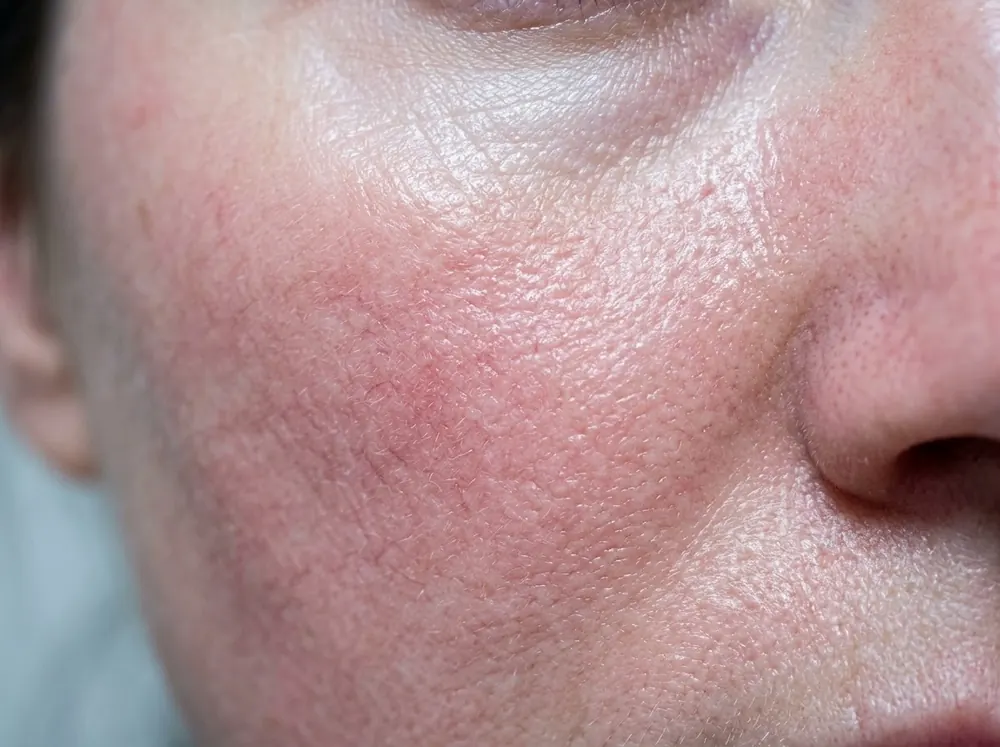
Keep going and the subclinical becomes visible. Chronic use inhibits keratinocyte proliferation and differentiation, producing epidermal thinning, and suppresses fibroblast activity, reducing collagen — which allows dermal vessels to widen and become visible as telangiectasia.
This is why the skin of someone deep in the cycle looks specific and recognisable: thin, shiny, persistently red, with fine visible vessels, and unusually reactive to everything. It is not the original rash any more. It is a different problem layered on top of it.
The Products Most Often Implicated
The reason this is so widespread is that almost nobody involved thinks of themselves as using a steroid on their face.
Prescription and Pharmacy Tubes
Potent topical steroids prescribed for something else, and mild ones bought over the counter. The over-the-counter route matters: low potency is not the same as safe on facial skin used daily for months, and at least one documented case of severe withdrawal involved an over-the-counter product.
The Routes People Forget
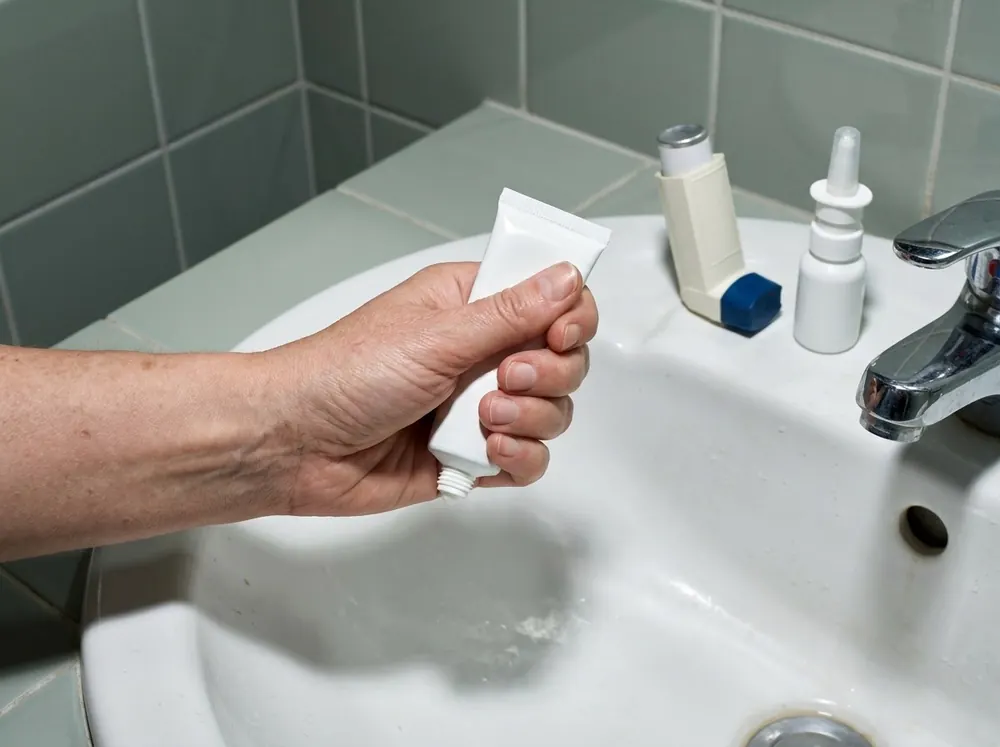
Steroid exposure on the face is not only what you rub on it. Steroid use via all routes — topical, inhaled, and nasal insufflation — is the most common association with periorificial dermatitis. That includes the asthma inhaler you have used for a decade and the hay fever nasal spray you use every spring. Neither feels like a skincare product, and neither gets mentioned in a consultation unless someone asks.
Do not stop a prescribed inhaler or nasal spray over this. That is a conversation with the prescriber about technique, dose or alternatives — not a decision to make from an article.
Heavy Occlusives and "Calming" Creams
The other implicated group is the one people reach for precisely because their skin is irritated: occlusive paraffin or petroleum-based emollients, cosmetics, and other topical products. A rich barrier balm is genuinely useful on a damaged barrier elsewhere on the body, and around the mouth in this particular condition it can make things worse.
Where the Creams Actually Come From
This is the detail from the 200-patient study that reframes the whole problem. Of those 200 people, only twelve had been prescribed the steroid by a dermatologist. Fifty-one came from a physician treating something else, fifty-one from a pharmacy counter, and sixty from relatives, friends, or the patient's own decision.
That is not a story about bad prescribing. It is a story about a powerful drug circulating informally, for "trivial facial dermatoses", among people who have no reason to think of it as risky.
Why Stopping Abruptly Makes It Flare First
Here is the section to read twice if you are currently using something.
When a topical steroid is withdrawn, the suppressed inflammation returns — and it returns amplified, because the barrier is now impaired and the skin is more reactive than it was at the start. The result is a flare within days that is often worse than the original complaint. The 200-patient study describes exactly this, with lesions characteristically flaring on discontinuation.
Two things follow.
First, the flare is not evidence that you need the cream. It is the predictable consequence of stopping it. Interpreting it the other way round is what keeps people in the loop for years.
Second, that does not mean you should stop abruptly. Management guidance for periorificial dermatitis is to discontinue all topical corticosteroids through gradual weaning rather than abrupt cessation, precisely because sudden stopping can cause a flare. How that taper runs, over what period, and what is used alongside it, is a clinical decision — and there is usually prescription treatment involved in getting through it.
This is the point in the article where the honest advice is to book an appointment rather than to follow a plan from the internet. Not because the situation is dangerous, but because the exit is genuinely difficult to manage alone and the failure mode — reapplying at the worst moment — is built into how it feels.
Topical Steroid Withdrawal: What Is and Is Not Established
You will encounter the term topical steroid withdrawal, often abbreviated TSW, and it is worth being straight about where the evidence stands.
TSW describes skin developing more severe or more diverse manifestations after withdrawal than before the steroid was ever applied. Documented cases overwhelmingly involve moderate-to-high potency steroids used daily or near-daily for more than four to six consecutive months. Reported distinguishing features go beyond redness and itch: extensive exfoliation, burning, an itch that is not satisfied by scratching, sharply demarcated erythema, and temperature dysregulation. More than a quarter of those affected report symptoms lasting longer than a year.
It is also contested. Sceptics argue the picture overlaps heavily with the underlying eczema in many reported cases, and that formal diagnostic criteria do not yet exist — which, as the review points out, creates circular logic where criteria are demanded before the research that would generate them is permitted.
The practical takeaway is not to pick a side. It is this: prolonged daily use of a potent steroid on facial skin has a difficult exit, that exit is documented well enough to take seriously, and it is a reason to involve a clinician early rather than to attempt it alone.
Why This Reads Differently on Deeper Skin
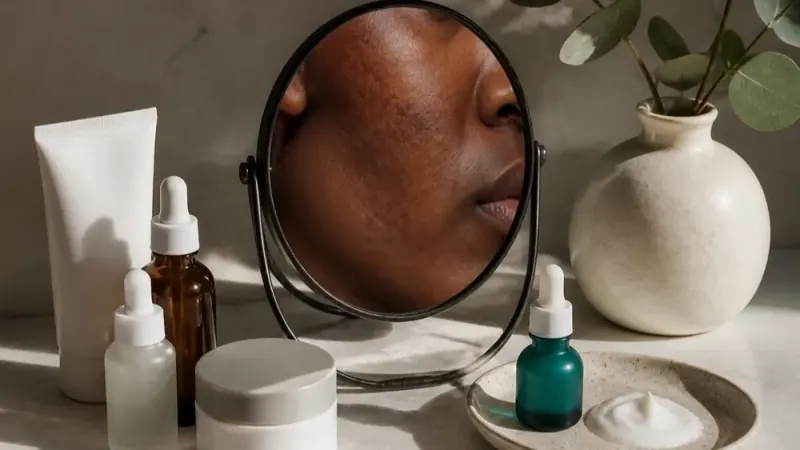
Everything above is easier to describe than to see, and how visible it is depends on your skin tone.
Three of the five hallmark signs of rosacea — facial erythema, telangiectasia and recurrent flushing — are more difficult to visualise in skin of colour, and rosacea is frequently misdiagnosed as acne in these patients. Applied to this article's subject, that means steroid-induced changes can progress further before anyone — the patient or the clinician — recognises what they are looking at.
There is a second cost. The 200-patient study lists hyperpigmentation among the presenting features, and post-inflammatory hyperpigmentation occurs with greater frequency and severity in darker skin tones, with a chronic course lasting months to years. So the same cycle that leaves one person with visible vessels can leave another with dark patches that outlast the rash by a year or more. We have covered that in hyperpigmentation in brown and deep skin tones.
If redness is hard to read on your skin, go by sensation instead: burning, stinging, tightness, heat, and skin that has become reactive to products it used to tolerate.

The Recovery Routine Is Almost Nothing
Whatever a clinician decides about the taper, the skincare side of this is defined by subtraction. The instinct — reach for something soothing, something repairing, something that will help — is the instinct to resist. This skin is reactive, the barrier is impaired, and almost every active ingredient makes it worse before it makes it better.
In broad terms, a barrier in this state wants:
- A cleanser that does essentially nothing beyond removing the day. No foaming sulphates, no scrubs, no cleansing acids. Choosing a cleanser that does not strip the barrier covers what that means in practice.
- One simple moisturiser, applied thinly — noting that around the mouth, heavy occlusives are specifically implicated, so this is a case where lighter is safer. Reading a moisturiser label sets out how to tell the classes apart.
- Daily sun protection, since UV is the most significant environmental trigger for rosacea and will make any post-inflammatory pigment worse.
- Nothing else. No acids, no retinoids, no vitamin C, no essential oils, no "barrier repair" serum with fifteen actives in it. Not for now.
Two further things worth knowing. Rosacea proper affects around 5% of adults and typically presents after the age of 30, and if that is what you have underneath, it is a long-term condition with real prescription treatment behind it — which is a much better position than an indefinite cycle of borrowed cream. And if flushing is part of your picture, the usual triggers apply: heat, sun, alcohol, spicy food and hot drinks.
What to Take to the Appointment
Diagnosis here rests almost entirely on history, and history is what people reconstruct worst under pressure in a ten-minute appointment.
Three things make that consultation dramatically better:
A complete product and medication timeline. Every cream applied to your face in the last twelve months, including anything borrowed or bought over the counter, plus every inhaled and nasal medication, with rough start dates. If a tube is unlabelled or you cannot remember the name, take the tube.
A record of the cycle. When you applied, when it improved, when you stopped, when it flared. The pattern is the diagnosis, and writing it down turns a vague story into evidence.
Dated photographs in consistent conditions. Same spot, same distance, same soft daylight, no filters. Flares are intermittent, and the day you get an appointment is rarely the day your skin looks worst. Whether you keep these in a dated album or in something built for it like Skinic, a photograph from a flare is genuinely useful clinical information — and over a taper that runs for months, it is the only reliable way to tell slow improvement from no improvement.
Conclusion
The cream worked, and that is precisely the problem. A topical steroid suppresses inflammation quickly while degrading the barrier underneath — with measurable changes in the epidermis documented after as little as three days — and when it is withdrawn, the inflammation rebounds into skin that is now more reactive than it started. The flare that follows looks like proof you still need the cream. It is the opposite.
If you are in that cycle, the useful moves are to work out every route the steroid is reaching your face by, including inhalers and nasal sprays, to write down the pattern of application and flare, and to take all of it to a clinician rather than attempting the exit alone. Abrupt stopping is the one approach that reliably fails.
And while you wait for that appointment, do less. A plain cleanser, one light moisturiser, sunscreen, and nothing else — not because minimalism is a philosophy, but because there is nothing you can buy that fixes this, and most of what you might buy will make the next few weeks harder.
The tube in your bathroom is not the solution that keeps not quite working. It is the reason it keeps coming back.
Frequently asked questions
5 questions · tap one to open the answer
Why did my skin get worse after I stopped using steroid cream?
Can a steroid cream cause rosacea?
How quickly does a topical steroid damage facial skin?
Should I stop my steroid cream immediately?
What is topical steroid withdrawal?
Medically reviewed by
Dr. M.M Hanaei
Aesthetic Physician, Dermatology Fellowship
- MD — Shahid Beheshti University of Medical Sciences (SBMU)
- MCC Licensure (Medical Council of Canada)
- Dermatology Fellowship, Switzerland
- Certified in advanced aesthetic procedures
Last reviewed 13 September 2026