Skinic
You have been treating the small bumps on your forehead as acne for months. Salicylic acid, then benzoyl peroxide, then a spot treatment someone recommended. Nothing has changed. The bumps are still there, still the same size, still not coming to a head like a spot is supposed to.
There is a good chance you are not looking at acne at all.
At least four distinct things produce small, raised bumps on a face, and in a bathroom mirror they are nearly indistinguishable. Closed comedones, milia, sebaceous filaments and sebaceous hyperplasia have different causes, sit at different depths, and respond to completely different approaches — and for three of the four, the standard acne routine does nothing useful. Two of them get measurably worse under it.
This is a guide to telling them apart by what you can actually observe: colour, size, whether there is a visible opening, whether it moves, and what happened the last time you tried to squeeze one. Work through it in order and you should end up with a single answer, plus a clear sense of when the honest next step is showing it to someone qualified.
Why Your Spot Treatment Did Nothing
Acne treatments are designed around one specific mechanism. A comedone forms when the cells lining the sebaceous duct proliferate and stick together while sebum production increases, and the resulting debris plugs the follicle. Salicylic acid works because it is oil-soluble and can get into that plugged follicle. Benzoyl peroxide works on the bacterial and inflammatory side of the same process. Retinoids work by normalising the cell turnover that creates the plug in the first place.
Every one of those mechanisms assumes there is a follicle with a plug in it.
A milium is not a plugged follicle — it is a sealed keratin cyst with no route to the surface. A sebaceous filament is not a blockage at all; it is a normal structure doing its job. Sebaceous hyperplasia is an enlarged oil gland, not an obstructed one. Applying a product designed to clear a plug to something that is not a plug is not a matter of needing a stronger formula or more time. There is nothing there for the active ingredient to act on.
So the first useful move is not finding a better product. It is working out which of these four you have.
Start Here: Four Questions That Narrow It Down
Stand in daylight rather than bathroom light, which flattens texture and hides the details that matter. Then work through these in order.
One: is there a visible opening? Look at the centre of the bump. An open comedone — an actual blackhead — has an obvious dilated opening with dark material in it. A closed comedone has no opening. A milium has no opening. Sebaceous hyperplasia has a small central dip, which is the follicular opening, but it is a dimple rather than a hole with contents.
Two: what colour is it? Skin-coloured or slightly paler suggests a closed comedone. Distinctly white or pearly, almost like a grain of sugar sitting just under the surface, suggests a milium. Yellowish suggests sebaceous hyperplasia. Grey to brown to black in an open pore is an open comedone.
Three: where is it? Milia cluster around the eyes and on the cheeks. Closed comedones cluster on the forehead, chin and cheeks. Sebaceous filaments sit on the nose and the surrounding area, in an even, repeating pattern rather than as isolated bumps. Sebaceous hyperplasia turns up on the forehead and cheeks, and overwhelmingly in people past their thirties.
Four: what happened when you squeezed it? If a soft, thin, off-white thread came out and the same thing refilled within days, that was a sebaceous filament. If nothing came out no matter how hard you pressed, that was probably a milium or sebaceous hyperplasia. If a firm plug came out and the bump went away, that was a comedone.
| What you see | Most likely | What it actually is | What makes it worse |
|---|---|---|---|
| Skin-coloured bump, no opening, forehead or chin | Closed comedone | Plugged follicle under an intact surface | Squeezing, harsh scrubs, heavy occlusive products |
| Hard white pearl, often near the eyes, will not budge | Milium | Sealed keratin cyst with no opening | Squeezing, occlusive eye creams, picking at the skin over it |
| Even pattern of tiny grey-brown dots on the nose | Sebaceous filaments | Normal follicular structure channelling sebum | Extraction, pore strips, stripping cleansers |
| Yellowish bump with a central dip, age 30+ | Sebaceous hyperplasia | Enlarged oil gland around a follicle | Squeezing, abrasive exfoliation, expecting acne products to work |
| Dark dot in a visibly open pore | Open comedone (blackhead) | Plugged follicle exposed to air | Pore strips, aggressive extraction, scrubbing |
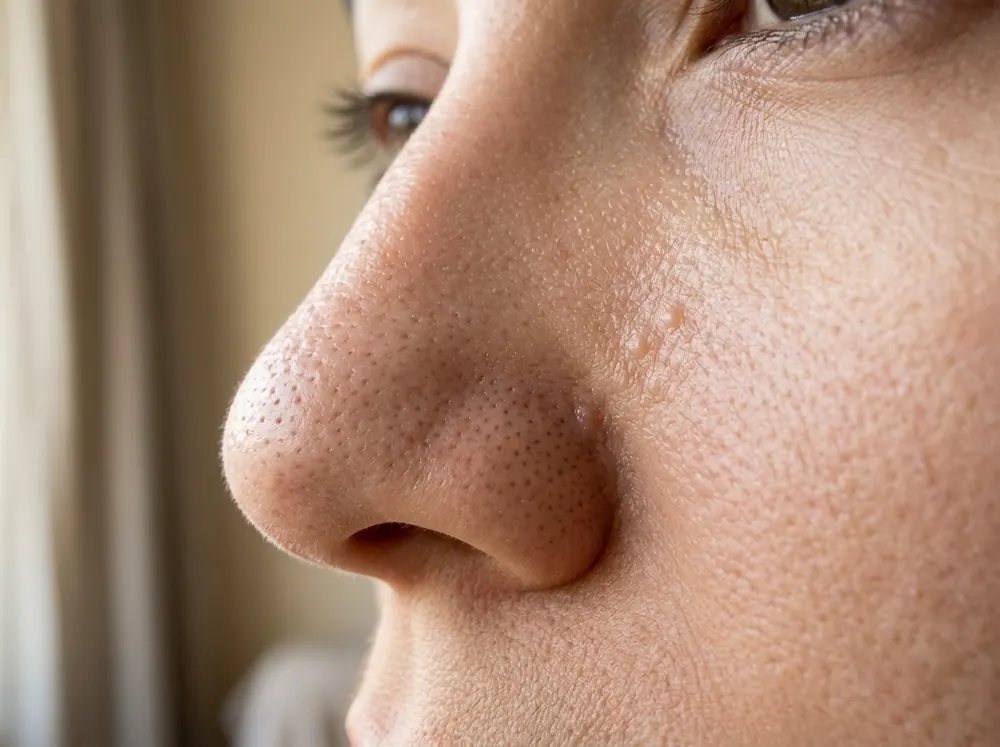
Closed Comedones: Trapped, Not Infected
A closed comedone is the one thing on this list that genuinely is acne. It forms the same way a blackhead does — cornification of the cells lining the sebaceous duct, plus increased sebum, producing a plug — but the surface stays closed over the top of it. That single difference changes everything about how it looks and how it behaves.
Because the plug is not exposed to air, it does not darken. The contents of an open comedone go dark because the open follicle exposes the keratin to air, which oxidises, and melanin granules accumulate — the colour is oxidation and pigment, not trapped dirt, which is why scrubbing has never made a blackhead lighter. A closed comedone gets none of that exposure, so it stays skin-coloured and reads as texture rather than as a spot.
These are the bumps people describe as "my skin is bumpy but I do not have spots". They tend to cluster rather than appear singly, they are usually small enough that you feel them before you see them, and they can sit unchanged for weeks. Where they cluster is itself informative — a forehead full of them usually has a transfer route behind it, which we have worked through in why you keep breaking out on your forehead.
Closed comedones do respond to acne treatment — but slowly, and not to the treatment most people reach for first. A spot treatment applied to individual bumps is working on lesions that have already formed. What actually reduces them over time is a topical retinoid applied across the whole area, because it acts on the cell turnover that produces new plugs. The catch is the timeline: a comedone takes weeks to form, so a product judged after ten days is being judged on lesions that were already in progress before you started. We have worked through that whole picture — why salicylic acid underperforms here, and what the location of the field tells you about the cause — in closed comedones: what actually clears them.
The other thing worth knowing: a closed comedone is the stage immediately before an inflamed spot. Squeezing one does not empty it — the contents have to be punctured to come out, and pressing on an intact one mostly drives the contents sideways into the surrounding skin, which is exactly what turns a bump you could barely see into one you cannot ignore.
Milia: Keratin in a Pocket With No Way Out
If you have ever tried to squeeze a small white bump near your eye and got absolutely nothing, that was almost certainly a milium.
A milium is a small cyst containing keratin, the structural protein of skin, forming an epidermoid cyst that arises from vellus hair follicles. The critical feature is structural: it is a sealed pocket. There is no channel from the inside of the cyst to the surface of your skin.
Everything follows from that. Salicylic acid cannot reach it because there is no opening for an oil-soluble acid to travel down. Benzoyl peroxide has nothing to act on because there is no bacterial component. Squeezing cannot empty it because the contents have nowhere to go. You can press until you bruise the surrounding skin and the milium will still be there — usually looking slightly angrier, because you have inflamed everything around it.
They typically appear as tiny, firm, pearly-white bumps sitting just under the surface, and they are particularly common around the eyelids and on the cheeks. They are harmless. They are not an infection, not a sign that your skin is dirty, and not caused by anything you did wrong.
Milia also come in a second form worth recognising. Alongside primary milia, which appear spontaneously, secondary milia arise at the site of injury as skin heals — following thermal burns, dermabrasion and blistering rashes, and in some cases after topical medications including corticosteroids. If a crop of white bumps appeared in an area that was recently burned, treated with a resurfacing procedure, or under a rich product you had been using heavily, that history is diagnostic information.
The honest answer on treatment is the one most skincare content avoids: there is no topical product that reliably clears an established milium. The lesion has to be de-roofed with a sterile needle or blade and the contents released. That is a procedure, performed by someone with sterile equipment and training — not something to attempt on your own face near your eye with a sewing needle. We have taken milia apart in full in why milia never respond to acne treatment, including the two origins and what the failure of each product actually tells you. Many primary milia also clear on their own within a few months, so for a small number in an unobtrusive place, waiting is a legitimate choice.

Sebaceous Filaments: The Ones You Are Not Supposed to Remove
This is the section that tends to be unwelcome, so here is the conclusion first: the tiny greyish dots covering your nose in a regular, repeating pattern are very likely not blackheads, they are very likely not removable, and the nose you are comparing yours to has them too.
Sebaceous filaments are a physiological variation of sebaceous follicles: in the lower part of the follicle, a thin granular layer sheds to produce a loose, porous keratinous core that channels sebum up to the skin surface. They are not a blockage. They are the mechanism by which oil gets out, made visible in areas where follicles are large and sebum output is high — which is why they are most obvious on and around the nose, and most obvious in people with oilier skin.
Two features separate them from blackheads. Pattern: filaments appear across a whole area in an even distribution, roughly one per follicle, because that is what they are. Blackheads appear scattered and irregular, because they depend on where a plug happened to form. Colour: a filament is off-white to light grey, sometimes with a slightly darker tip; a blackhead is properly dark.
The refill is the other giveaway. Squeeze a filament and a soft, pale, thread-like plug comes out. Within a few days, the follicle has produced more, because the follicle is doing its job. People interpret that refill as failure — as evidence that the pores are "still dirty" — and escalate. That escalation is where the damage happens.
What does genuinely reduce their appearance is modest and slow: consistent salicylic acid to keep the follicular opening clear, a topical retinoid over months, and sun protection, since follicular openings appear larger in skin with accumulated UV damage. None of it eliminates them, because eliminating them is not a coherent goal.
What is not worth doing: pore strips, which remove the visible surface of the filament and leave the structure to refill; comedone extractors used with force at home; and stripping cleansers, which drive up oil production and make the filaments more visible rather than less. We have taken the nose apart in full detail in sebaceous filaments vs blackheads, including the damage route that turns one into a mark that lasts a year.
Sebaceous Hyperplasia: An Enlarged Gland, Not a Blocked Pore
Sebaceous hyperplasia is the one most likely to be misidentified for years, largely because it is rarely mentioned in consumer skincare content at all.
It presents as small yellow bumps up to about 3 mm across, with a central hair follicle surrounded by yellowish lobules, typically on the forehead or cheeks, and mainly in middle-aged and older people. The central dip is the single most useful visual feature: a doughnut-like ring of yellowish tissue with a small depression in the middle, rather than a smooth dome.
The mechanism is completely different from anything else on this list. There is no plug, no trapped keratin, no cyst. The sebaceous gland itself has enlarged around a normal follicle — and why it enlarges runs backwards from what most people assume, because it is driven by androgens falling rather than rising. Nothing is blocked, which is precisely why exfoliating acids, spot treatments and extraction attempts all produce the same result: none.
The lesions are harmless and do not need treating. Where people do want them removed for cosmetic reasons, it is a clinical procedure — light electrocautery or laser vaporisation on individual lesions. Oral isotretinoin clears extensive cases, but the lesions tend to recur once treatment stops, which tells you something important about the underlying mechanism: this is glandular behaviour, not a one-off blockage.
There is one reason to take this identification seriously rather than treating it as cosmetic trivia. Sebaceous hyperplasia is sometimes confused with basal cell carcinoma, which can also present as a small, pale, slightly translucent bump on a sun-exposed area of the face. That is not a distinction to make from a photograph, your own or anyone else's. A single yellowish bump that is growing, bleeding, crusting, or simply new and unlike the others around it should be looked at in person by a clinician.
The Four Habits That Make Each One Worse
Across all four conditions, the same small set of behaviours causes the same predictable damage.
Squeezing and Extracting
For a closed comedone, pressure ruptures the follicle wall and pushes contents into surrounding tissue, converting a small bump into an inflamed lesion. For a milium, nothing comes out and you inflame the skin over a cyst that will still be there afterwards. For a filament, something does come out, which is the trap — it refills, you squeeze again, and the cycle continues. For sebaceous hyperplasia, you are compressing a gland.
The downstream cost is worth stating plainly, because it lasts far longer than the bump did. Post-inflammatory hyperpigmentation follows both inflammatory conditions and exogenous factors such as mechanical trauma, and once established it is chronic and difficult to treat, persisting for months to years. You can trade a bump that would have resolved in three weeks for a mark that takes a year. That trade is a bad one at any skin tone and a worse one in deeper skin, where PIH occurs more frequently and more severely.
Scrubs and Physical Exfoliation
Scrubs address a surface problem. None of these four are surface problems — they sit inside follicles, inside cysts, or inside glands. What abrasive exfoliation reliably does is compromise the barrier, which raises irritation and, in the case of already-inflamed comedonal skin, makes the pigment response worse.
Drying Actives and Stripping Cleansers
The instinct to dry out a bump is an instinct about inflamed, pustular acne. Applied to comedonal texture, filaments or milia, the result is a compromised barrier and, commonly, an increase in visible oil as skin compensates — which makes filaments more prominent, not less. If your skin is genuinely oily and you have been cleansing it accordingly, choosing a cleanser that does not strip the barrier is the more useful place to start than any of the bumps above.
Heavy Occlusive Products in the Wrong Places
Rich creams have a legitimate role, and your barrier will thank you for one where it is needed. But heavily occlusive products around the eyes are associated with milia formation, and layering thick products over comedone-prone areas adds to follicular congestion. The fix is placement, not abstinence: match the weight of the product to the area.
Why This Is Harder to See on Deeper Skin Tones
Every one of the visual cues above assumes you can see contrast, and that assumption holds less well the more melanin your skin has.
Comedones are skin-coloured lesions by definition, and open comedones present with lower contrast in darker Fitzpatrick skin types, making them harder to identify clinically — not just harder for you in a mirror, but harder for clinicians too. The result is that comedonal acne in deeper skin tones is routinely under-recognised in its early stage and only addressed once it is inflamed.
The same literature reports something more consequential: comedonal lesions in skin of colour show marked histological inflammation even when they look clinically mild, and post-inflammatory hyperpigmentation and scarring occur more frequently as a result. In practical terms, a bump that looks minor is doing more than it appears to, and the pigment consequences of provoking it are larger.
Two adjustments follow. Use raking light — daylight from the side rather than straight on — so you are reading texture and shadow instead of colour contrast. And weight the "do not squeeze it" advice more heavily, not less, because the cost of getting it wrong is higher.
If dark marks left behind by previous breakouts are already the main thing you see, that is a different problem with a different approach, and we have covered it separately in hyperpigmentation in brown and deep skin tones.
When It Is None of These
This guide covers four common, harmless things. It does not cover everything that can produce a bump on a face, and there is a specific set of signals that means stop self-identifying and book an appointment:
- A single lesion that behaves differently from everything around it
- Anything growing, bleeding, crusting, or failing to heal
- A pearly or translucent bump on a sun-exposed area, particularly in older or fair skin
- Redness with bumps but no comedones anywhere — that pattern points away from acne entirely
- Sudden onset of many bumps after starting a new medication
- Anything painful, hot or spreading
None of those are reasons to panic. They are reasons to have a person with training look at your skin in person, which is something no photograph, no app and no article can substitute for.
Getting an Accurate Read on Your Own Face
The practical difficulty with everything above is that it asks you to observe your own skin accurately, and people are unreliable observers of their own faces. Bathroom lighting flattens texture. You look at the same skin every day, which makes gradual change invisible. And you are rarely neutral about what you are looking at.
Two things help. First, photograph in consistent conditions — same place, same time of day, same distance, no filters — so you are comparing like with like rather than comparing today's harsh overhead light with last month's window light. Second, give it a realistic interval. Comedone formation runs on a timescale of weeks, so a meaningful comparison is eight weeks apart, not four days.
Whether you keep those photographs in a dated folder on your phone or in something built for it, like Skinic, the point is the record. Patterns in skin only become visible against a baseline, and the single most common reason people cycle through products without progress is that they are judging results from memory.
Conclusion
Four things that look nearly identical in a mirror have four different mechanisms. A closed comedone is a plugged follicle under an intact surface. A milium is a sealed keratin cyst with no route out. A sebaceous filament is a normal structure channelling oil to the surface. Sebaceous hyperplasia is an enlarged gland around a normal follicle.
Only the first is acne, which is why the acne routine has not worked on the other three — and why squeezing, scrubbing and drying make all four worse while resolving none of them.
Below the neck the cast changes but the logic does not: bumps below the neck, identified runs the same process for keratosis pilaris, folliculitis and body acne.
Work through the four questions in daylight: opening, colour, location, and what happened when you squeezed. Match what you find to the table. Then act on the mechanism rather than on the appearance, give it eight weeks rather than eight days, and get a clinician to look at anything that does not fit the pattern.
Your skin is not failing to respond to treatment. It is responding exactly as it should to treatment aimed at the wrong thing.
Frequently asked questions
5 questions · tap one to open the answer
Why won't my closed comedones respond to acne treatment?
How do I know if a bump is a milium or a closed comedone?
Can you pop a milium yourself?
What is sebaceous hyperplasia and how is it different from a clogged pore?
Why is it harder to spot these bumps on darker skin tones?
Medically reviewed by
Dr. M.M Hanaei
Aesthetic Physician, Dermatology Fellowship
- MD — Shahid Beheshti University of Medical Sciences (SBMU)
- MCC Licensure (Medical Council of Canada)
- Dermatology Fellowship, Switzerland
- Certified in advanced aesthetic procedures
Last reviewed 11 September 2026