Skinic
Search "Fitzpatrick skin type" and you will find a chart. Six rows, six skin-tone swatches, from very fair at the top to deeply pigmented at the bottom. Match your arm to a swatch, read off a Roman numeral, done.
That chart is a reasonable summary of the scale's output. It is a poor description of what the scale is, and matching yourself to a swatch is the most common way people end up with the wrong answer.
The Fitzpatrick scale does not measure what colour your skin is. It classifies how your skin responds to ultraviolet light — whether it burns, whether it tans, and in what proportion. Those two things correlate, which is why the swatch chart works often enough to survive. But they come apart frequently enough that a large study of an ethnically diverse population found self-reported race and pigmentary phenotype to be inaccurate predictors of individual sun sensitivity.
This piece covers where the scale came from and what it was designed to do, the questions that actually place you, the specific ways self-typing goes wrong, what your type legitimately changes about your routine — and, just as importantly, the several things it does not tell you that people routinely assume it does.
The Scale Was Built to Predict Burning, Not to Describe Colour
In 1975, Thomas Fitzpatrick, a dermatologist at Harvard, needed to solve a narrow clinical problem. Patients with psoriasis were being treated with PUVA — a photosensitising drug plus controlled UVA exposure — and the dose had to be calibrated per patient. Too little did nothing; too much burned them. He needed a quick way to predict, before the first session, how much UVA a given patient could take.
So he built a four-category system, I through IV, based on what patients reported about their own history of burning and tanning. It was a dosing tool for a phototherapy clinic. That is the whole origin.
Two features of that origin explain nearly every problem the scale has today. First, it was designed for classifying persons with white skin — types V and VI were not added until 1988, thirteen years later, which is why the darker end of the scale is compressed into two categories while the lighter end gets four. Second, it was always a self-report instrument. It was never intended as an objective measurement of pigment, because for its original purpose the patient's own burn history was the most relevant information available.
None of that makes the scale useless. It remains the standard language dermatology uses for UV response, and it genuinely predicts things worth knowing. It does mean that treating it as a colour chart is using it for something it was not built for.
The Six Types, and the Questions That Place You
The scale asks two questions, and your type is the intersection of the answers.
Question one: what happens in the first thirty to sixty minutes of unprotected midday sun, at the start of summer, on skin that has not seen sun for months? Not on holiday in week two. Not with sunscreen on. The first meaningful exposure after winter.
Question two: what does that same skin look like a week later? Not the day after — a week, once any redness has settled and any tanning has developed.
| Type | First exposure | A week later |
|---|---|---|
| I | Always burns | Never tans |
| II | Usually burns | Tans minimally, with difficulty |
| III | Sometimes burns mildly | Tans gradually and evenly |
| IV | Burns minimally | Tans easily and well |
| V | Rarely burns | Tans darkly and readily |
| VI | Very rarely burns | Deeply pigmented throughout |
Two practical notes before you place yourself.
Answer for the Skin That Is Usually Covered
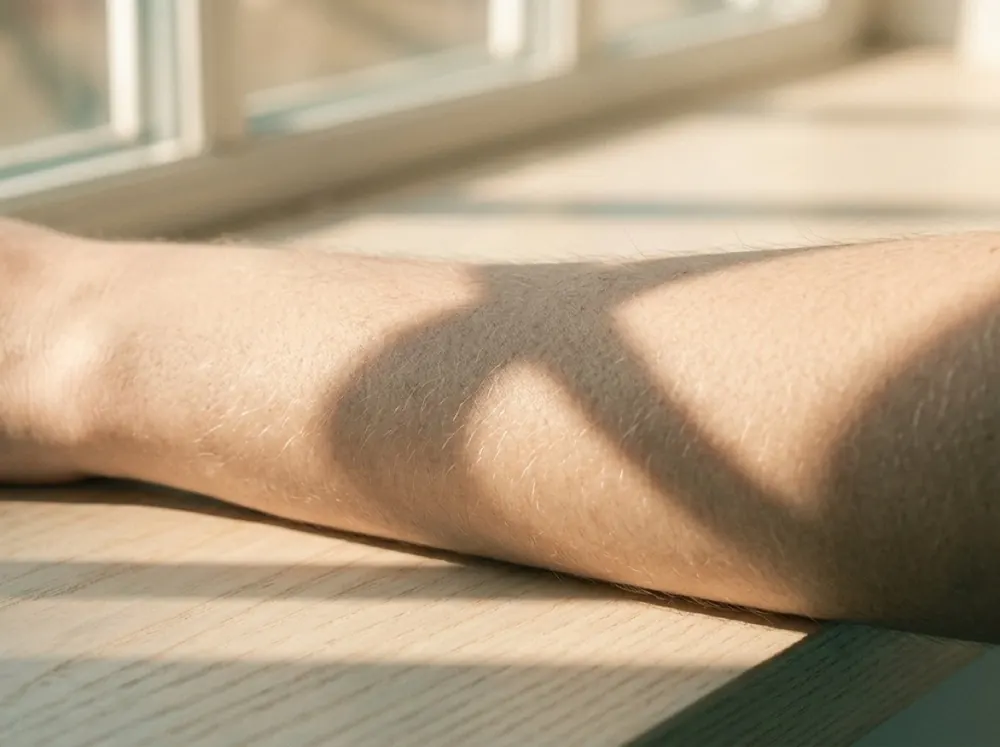
Use the skin on your inner upper arm, your torso or your upper thigh as the reference — not your face, hands or forearms. Those areas carry years of cumulative sun exposure and a standing tan, and they will read darker and more sun-tolerant than your actual constitutional skin. People who answer for their forearm routinely place themselves one type higher than they belong.
Answer for Now, Not for Childhood
Sun response shifts across a life. Many people who burned reliably as children tan more readily as adults, and the reverse happens too. The scale is asking about your skin's current behaviour, so answer from the last few years rather than from a memory of a childhood holiday.
If you land clearly between two types, the honest answer is usually the lower one. Erring toward "burns more easily" produces more protective behaviour, and the cost of being wrong in that direction is a slightly over-cautious sunscreen habit.
Why Self-Typing Goes Wrong
Self-assessment fails often, and it fails in a patterned way rather than randomly.
The most-studied problem is that appearance is a weak predictor of response. In a study of 3,386 people across diverse racial backgrounds, a model using every measurable variable — race, sex, skin colour, eye colour, hair colour — agreed with people's own reported phototype only moderately, landing within about one point on average. Most strikingly, 17.7% of individuals reporting the lightest pigmentary phenotypes self-identified as skin phototype V or VI. Looking at someone tells you less than it feels like it should — and the authors' conclusion was aimed at clinicians estimating phototype by eye, not only at patients.
Three failure modes account for most of the rest.
Answering aspirationally. Very few people enjoy identifying as the person who burns. There is a quiet pull toward the type above, especially in the III/IV region, and it produces exactly the wrong adjustment: less protection for skin that needs more.
Answering with modern behaviour baked in. If you have worn SPF 50 daily for a decade, you may not have a recent honest data point on what your unprotected skin does. That is a good problem to have, but it means your answer is about your sunscreen, not your skin. Think back to the last time you were genuinely caught out.
Answering for the wrong end of the scale. Types V and VI cover an enormous range of skin, because the scale's darker half was added as an afterthought to a four-point system. A person at the lighter end of V and a person at the deeper end of VI have meaningfully different needs, and the scale gives them nearly the same label. If you are in this range, treat the type as a starting point rather than a resolution.
What Your Fitzpatrick Type Actually Changes
This is the part that makes the exercise worth doing. Your type genuinely routes several downstream decisions.
How Much Sun Protection You Need — Everyone, Not Just the Top of the Scale
Melanin does provide a measure of protection against UV-induced damage, and fair-skinned individuals of types I–III are more prone to photoageing than people with skin of colour. Types I and II carry the highest skin cancer risk with intense sun exposure, and that is real.
What that does not mean is that types IV to VI can skip protection — and the next section is entirely about why that inference is dangerous. For now: everyone needs daily broad-spectrum protection; what changes with type is how quickly unprotected skin accumulates damage, not whether it accumulates. What also changes with type is how hard that protection is to wear: sunscreen without the white cast covers why, and what to look for on a label.
Your Risk of Marks After Anything Inflammatory
This is the most immediately practical consequence, and for many readers it will matter more day to day than sunburn does.
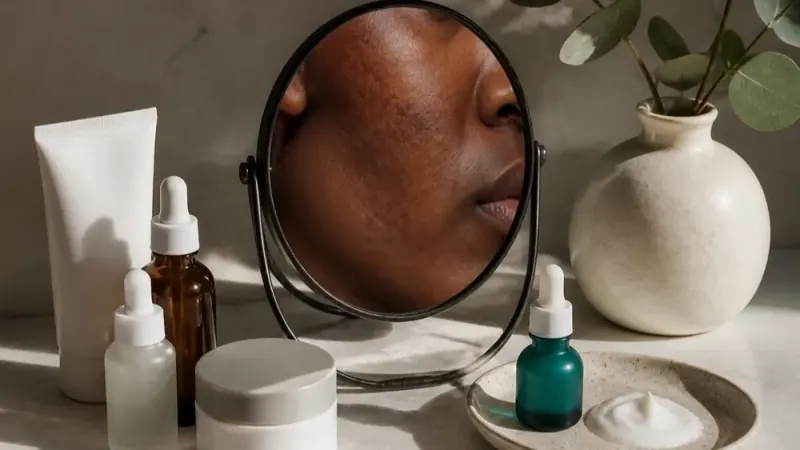
Post-inflammatory hyperpigmentation — the dark marks left behind by a spot, a scratch, a reaction, a squeeze — affects all skin types but occurs with greater frequency and severity in darker skin tones, and once established its course is chronic, treatment is difficult, and lesions persist for months to years.
That single fact should change behaviour. If you are type IV, V or VI, the cost of picking at a spot is not a few days of redness; it is potentially a year of a brown mark. It also changes how you introduce actives: an irritant reaction that leaves a type II reader flushed for an evening can leave a type V reader with visible pigment. We have gone through this in depth in hyperpigmentation in brown and deep skin tones, and the mark types themselves in dark spots on your face.
Which Lasers and Energy Devices Are Safe on You
If you are considering laser treatment, your type is not a detail — it determines which devices are appropriate.
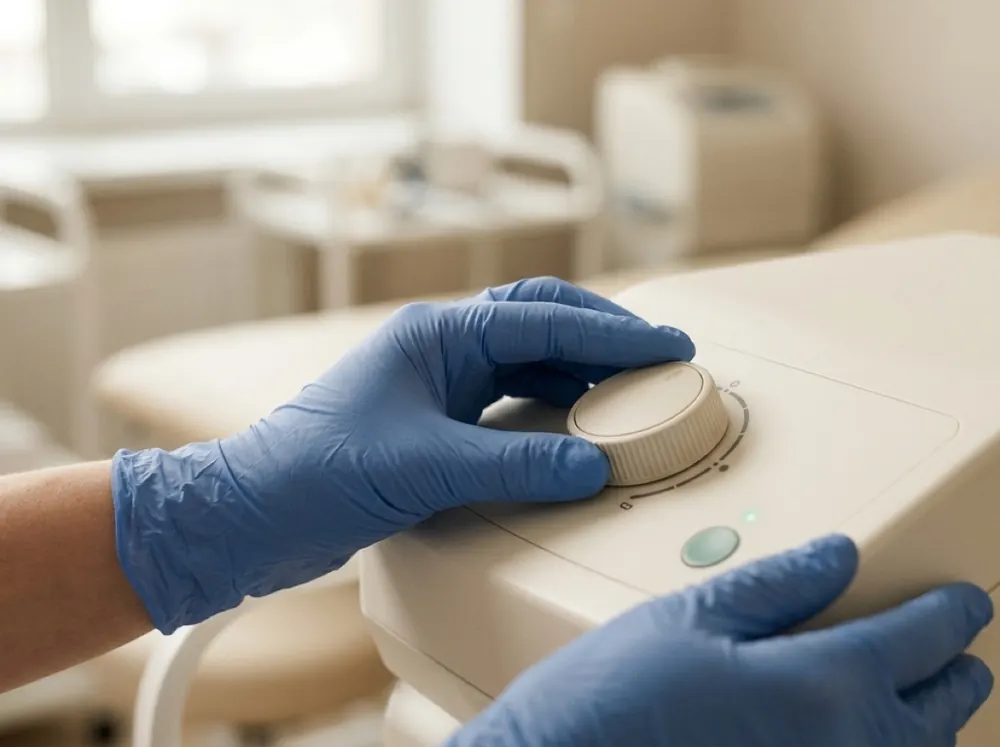
The physics is straightforward: melanin absorbs shorter wavelengths strongly, so a device that targets something else in fair skin will deposit its energy in the epidermis of deeply pigmented skin. A 2026 modelling study quantified it — at 532 nm, the epidermal thermal risk index rose from 28.2% in type I skin to 90.7% in type VI, while 1064 nm maintained the lowest risk across every phototype. Non-specific epidermal heating in types IV–VI is associated with burns, post-inflammatory hyperpigmentation, hypopigmentation and scarring — and hypopigmentation in particular can be permanent.
The practical version: if you are type IV or above and a clinic proposes a treatment without discussing your phototype, that is a reason to ask more questions, not fewer. Ask which wavelength, ask what settings they use for your type, and ask how many patients of your skin tone they have treated. The same questions apply to microneedling, which is routinely presented as the safer option in darker skin — the pigmentation data are more mixed than that reputation suggests.
How Fast to Introduce Actives
Type does not determine tolerance directly — sensitivity, barrier condition and existing conditions matter more. What type changes is the cost of getting it wrong. Pushing a retinoid too fast produces irritation in everyone; in higher phototypes that irritation is more likely to leave pigment behind. The correct adjustment is pace, not avoidance: same ingredients, longer ramp, lower starting frequency.
What the Scale Does Not Tell You
Here is the section most Fitzpatrick articles leave out, and it is the reason this one exists.
It does not tell you that you are safe from skin cancer. A 2021 paper put the problem directly in its title — does the Fitzpatrick scale give a false sense of security? — and argued that describing type V and VI skin as "usually or always tans, never or rarely burns" leads both patients and physicians to underestimate risk. Skin cancers are less frequent in darker skin types but are associated with higher morbidity and mortality, because of later presentation, delayed diagnosis and larger tumour volumes. People with darker skin use less sunscreen, report sunburn less often, and are less familiar with skin examination. A scale that reads as reassurance is contributing to that.
It does not describe your skin type in the skincare sense. Fitzpatrick says nothing about whether your skin is oily, dry, dehydrated or sensitive. Someone can be type II and oily, or type V and dry. Two completely different classification systems share the phrase "skin type", which is a persistent source of confusion — if you came here trying to work out whether to buy a gel or a cream, this is the wrong scale. The scale you want for that question is covered in combination skin is usually dehydrated skin.
It does not describe your ethnicity, and should not be used as a proxy for it. Phototype and ancestry correlate loosely and individually unreliably, which is exactly what the 3,386-person study found. Using one to infer the other is inaccurate in both directions.
It does not capture how much range exists inside types V and VI. Worth repeating, because the scale's structure hides it: four categories for lighter skin and two for everything else is a historical artefact of the 1975 instrument, not a reflection of how much variation exists.
Getting an Accurate Read Without Guessing
Everything above depends on an honest self-assessment, and self-assessment is the weak link — a large part of why is that you are being asked to recall a sun exposure you probably were not paying attention to at the time.
Two things make it more reliable.
Use the right reference area, in the right light. Assess covered skin in daylight, not your forearm under a bathroom bulb. If you have a recent photograph of yourself in consistent lighting from late winter, before any sun, that is better evidence than your memory of it.
Keep a record rather than a recollection. Photographing in consistent conditions — same place, same distance, same light, no filters — gives you something to compare against when you want to know whether a mark is fading, whether a product is causing pigment, or how your skin actually behaved this summer. Whether that lives in a dated album on your phone or in something built for it, like Skinic, the value is in having a baseline instead of an impression.
And if the honest answer is that you are somewhere between two types and cannot tell, that is a legitimate result. Take the lower one, protect accordingly, and raise it with a dermatologist if you are making a decision that turns on it — a laser course, a peel, or a phototherapy plan.
Conclusion
The Fitzpatrick scale is a UV-response classification wearing a colour chart's clothing. It was built in 1975 to dose phototherapy for white patients, extended to darker skin thirteen years later, and it has been quietly misread as a swatch guide ever since.
Placing yourself accurately takes two honest answers about covered skin: what happens in the first hour of unprotected summer sun, and what that skin looks like a week later. Use daylight, use skin that stays covered, answer for the last few years rather than for childhood, and take the lower type if you are genuinely between two.
What you get for the effort is real. Your type changes how quickly unprotected skin accumulates damage, how likely you are to be left with a mark after anything inflammatory, which laser wavelengths are safe on you, and how fast you should introduce actives.
What it does not give you is reassurance. Type VI is not exempt from skin cancer — it is the end of the scale where diagnosis comes latest and outcomes are worst. Knowing your type is useful precisely because it tells you what to be careful about, not what you can stop worrying about.
If you are here because you were trying to identify something specific on your skin rather than classify your skin overall, every bump on your face, identified is the more direct route — and if it is dark marks you are trying to shift, how to remove dark spots on your face picks up where this leaves off.
Frequently asked questions
5 questions · tap one to open the answer
How do I find my Fitzpatrick skin type?
Can your Fitzpatrick skin type change over time?
Is the Fitzpatrick scale the same as race or ethnicity?
Do Fitzpatrick types V and VI need sunscreen?
Which Fitzpatrick type is most at risk of dark marks after a breakout?
Medically reviewed by
Dr. M.M Hanaei
Aesthetic Physician, Dermatology Fellowship
- MD — Shahid Beheshti University of Medical Sciences (SBMU)
- MCC Licensure (Medical Council of Canada)
- Dermatology Fellowship, Switzerland
- Certified in advanced aesthetic procedures
Last reviewed 11 September 2026