Skinic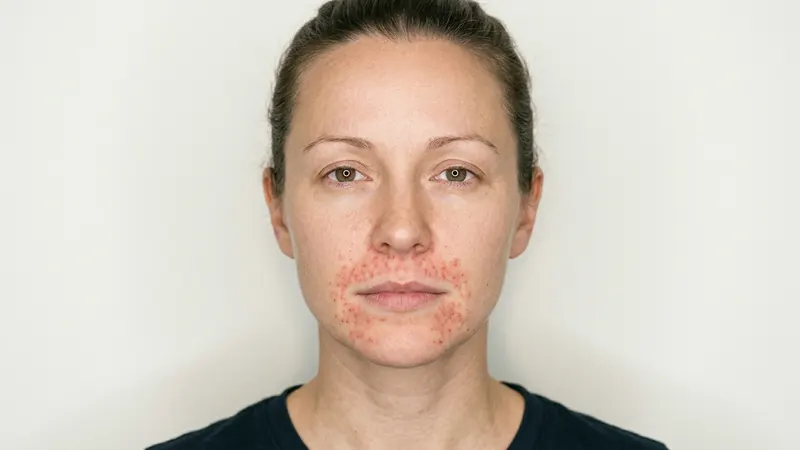
There is a pattern that almost everyone with this condition goes through at least once.
A rash appears around the mouth. Something is applied — often a steroid cream, sometimes prescribed, sometimes borrowed from a drawer. It works, quickly and convincingly. Then it is stopped, and within days the rash is back and worse than before. So it goes back on, and works again, and the cycle tightens.
That is not treatment failure. It is the defining behaviour of perioral dermatitis, and understanding why it happens is most of what makes the condition manageable.
But there is a second thing worth knowing up front, because it has changed, and almost every page about this condition is written as though it has not: in the largest recent cohort, most people who developed perioral dermatitis had not used a corticosteroid at all.
How to Recognise It
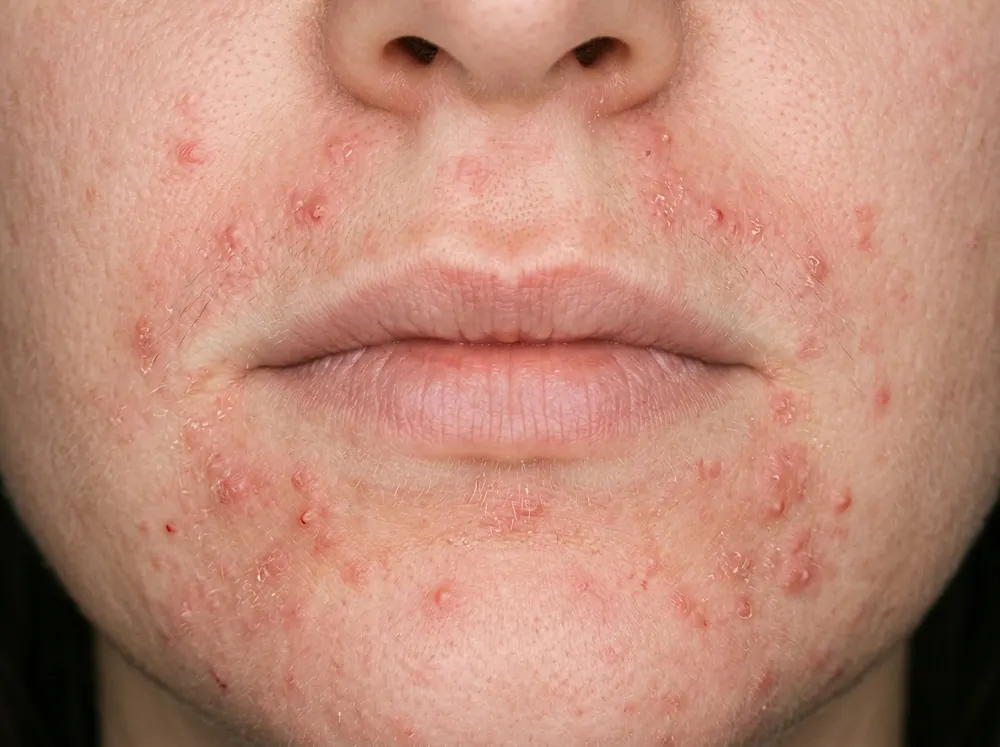
Perioral dermatitis — more properly periorificial dermatitis, because it is not confined to the mouth — presents as clusters of skin-coloured to red papules, vesicles and pustules, usually under 2 mm, on a reddened base with fairly sharp borders.
The distribution is the first clue: perioral most commonly, then perinasal and periocular, sometimes extending to the chin, cheeks, eyelids, forehead and glabella.
The second clue is the one that settles it, and it is small enough to miss.
The skin immediately against the lip border is usually spared. DermNet puts it precisely: "the immediate peri-vermillion skin is often spared, only rarely is it affected in severe cases." There is a narrow clear rim, a millimetre or two wide, between the lip and where the rash begins.
Nothing else on the face does that. It is the single most useful thing in this article for telling perioral dermatitis from the two conditions it is routinely confused with — and the distinction matters because acne treatment makes this worse and so does almost everything people reach for.
Accompanying symptoms are dryness, scaling, burning and itching. Scarring is unusual: there is normally "no scarring or disturbance to skin pigmentation except in severe and lupoid cases."
Who Gets It
Worth knowing because it is not who most people assume. The largest recent series — 451 subjects at a single academic centre over 2008 to 2023 — found 79% were women and 80% were White, with a mean age of 32.
And 32% were between 0 and 13 years old. A third of cases were children. This is not an adult cosmetic condition, which is part of why the "it's from your skincare" framing fits so badly.
The Steroid Cycle
This is the part that produces the experience in the opening paragraph.
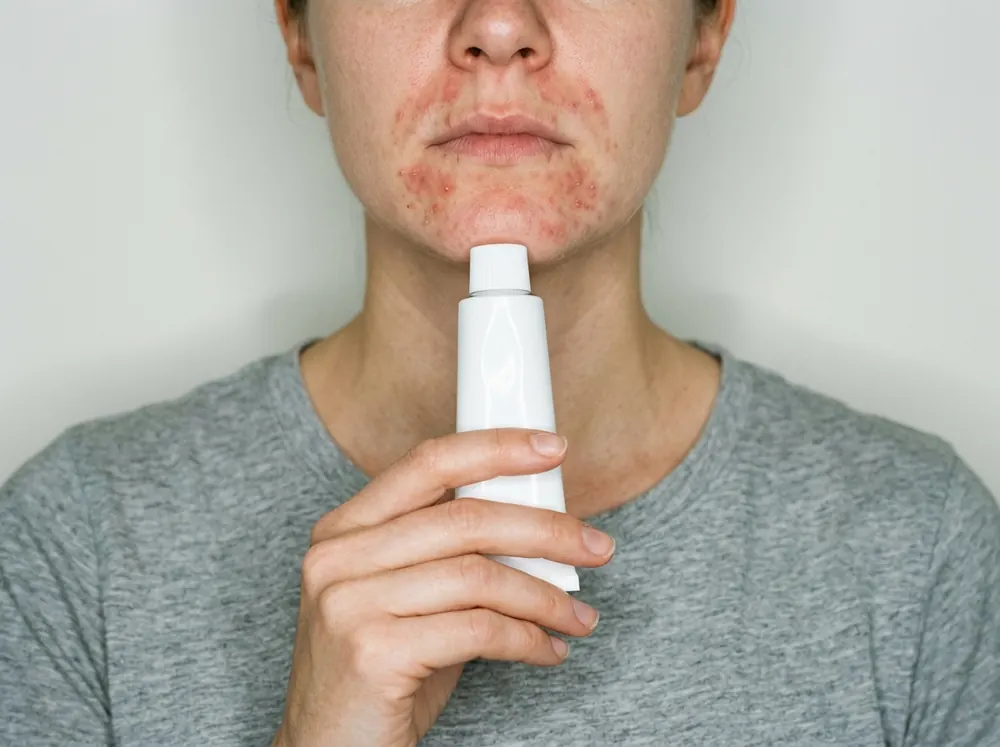
Topical corticosteroids are the strongest known trigger, and the association is old enough to be the condition's origin story: perioral dermatitis was first associated with the use of fluorinated corticosteroids in the 1960s. The proposed mechanism is barrier disruption — steroids altering the integrity of the skin barrier and the microflora of the hair follicle.
The trap is that a steroid also suppresses the inflammation very effectively. So it clears. And then, when the steroid is stopped, the dermatitis flares, and the person needs an increasingly higher-potency steroid to temporarily resolve it again.
Two things follow, and both are counterintuitive enough to state plainly.
Stopping is correct and it will look like it is not working. DermNet is explicit: "A flare may occur on discontinuation — steroids should not be restarted." The flare is the expected course of stopping, not evidence that stopping was a mistake.
Abrupt cessation is not the recommended route. The guidance is to wean slowly over weeks, switching to a lower-potency steroid before stopping, with a topical calcineurin inhibitor substituted in. That is a clinician's decision, and it is the reason this is worth a consultation rather than a resolution made alone at 11pm.
One more detail that catches people out: it is not only creams. Inhaled and intranasal steroids do it too, including when the exposure is accidental. In that 451-subject cohort, of the people who had used corticosteroids, 63% had used topical, 20% inhaled, 13% intranasal and 12% oral. If you use an asthma inhaler or a steroid nasal spray and have a rash around your mouth or nose, that connection is real and documented. Medically necessary steroids should not be stopped — but the cohort is clear that they lengthen recovery.
But Most Cases Now Are Not Steroid Cases
Here is where the standard account has gone out of date, and the numbers are specific.
In that 451-subject cohort, among records where steroid use could be established, 37% reported corticosteroid use in the six months before diagnosis, and only 23% reported topical corticosteroid use.
The authors set that against what came before: historical reports put corticosteroid use at 72 to 96%. Their conclusion is worth quoting as written — "a significant proportion of POD was not preceded by corticosteroid use, indicating further research might uncover other predisposing factors."
Turn those figures over and the implication is stark. Roughly 63% of people in this cohort developed perioral dermatitis without any preceding corticosteroid use, and 77% without a topical one.
What did they report instead? 25% named predisposing factors other than corticosteroids — facial sunscreens, whitening toothpastes and heavy moisturisers.
The Complication in That Finding
One thing in the same paper pulls the other way, and leaving it out would misrepresent the data. Among subjects with known status, preceding topical corticosteroid use rose across the study period: 15% in those diagnosed 2012–2015, 19% in 2016–2019, and 29% in 2020–2023 — a statistically significant trend at p=0.03.
So the picture is not "steroids used to cause this and now they don't." It is closer to: the overall share of cases attributable to steroids is far lower than the textbooks say, and topical steroid exposure among those cases has been climbing in recent years. Both are in the same dataset. The authors' own conclusion is that the residual association "indicates an ongoing need for education on corticosteroid risks."
This is a single-centre retrospective study, with the limits that implies — one institution, one region, records rather than prospective observation. It is also the largest recent reassessment of this question, and it points firmly away from a one-cause story.
The Toothpaste Question, Audited
"Fluoride toothpaste causes perioral dermatitis" appears on virtually every page about this condition. It is more interesting than either a myth or a fact.
The origin. The claim traces to a 1976 paper in Archives of Dermatology by Mellette, Aeling and Nuss, titled "Fluoride Tooth Paste: A Cause of Perioral Dermatitis". The authors wrote that they had "gathered clinical and historical data implicating fluoride dentifrices as an important etiologic factor in this dermatosis," and presented two cases.
What the index case actually describes. This is the part worth sitting with. The first patient was a 63-year-old woman whose perioral dermatitis had persisted for 24 months with exacerbations despite treatment that included fluocinolone acetonide cream — a potent fluorinated topical corticosteroid — along with a hydrocortisone mixture and tetracycline. In August 1973 it was established that she had been using a fluoride dentifrice.
So the foundational paper for "fluoride toothpaste causes perioral dermatitis" describes an index patient who had spent two years on topical corticosteroids, including a fluorinated one. The condition had already been linked to fluorinated corticosteroids a decade earlier. The paper's full text sits behind a paywall, so whether the steroid was stopped before the toothpaste was switched cannot be established from the abstract — and that is exactly the question that would determine what the case shows.
What the later series show. The subsequent evidence is better than its age suggests, and it does not point where the headline does. A case series of 65 patients found all had used fluoride toothpaste — but on switching to non-fluoride, only half recovered. A separate series of 20 patients using tartar-control toothpaste found all resolved on stopping, and 11 of 11 recurred on rechallenge.
Rechallenge data is unusually strong for a case series, and 11 of 11 is hard to dismiss. But notice what it implicates: tartar control, not fluoride. Tartar-control and whitening formulations carry additives and flavourings that standard fluoride toothpaste does not.
And the modern cohort agrees. Among the non-steroid predisposing factors its subjects reported, the toothpaste entry is "whitening toothpastes" — not fluoride toothpaste.
The verdict. Toothpaste is a real trigger for some people, and the rechallenge evidence supports that. But the specific blame on fluoride looks like a label that stuck rather than a conclusion that was established — attached in 1976 to a patient who had been using a fluorinated steroid, on a condition already known to be caused by fluorinated steroids, and not supported by the series that actually tested it. If toothpaste is implicated for you, the thing to change is probably the tartar-control or whitening formulation, not the fluoride.
Zero Therapy, and Why It Is Hard
The first-line approach has a name and it is almost comically simple.
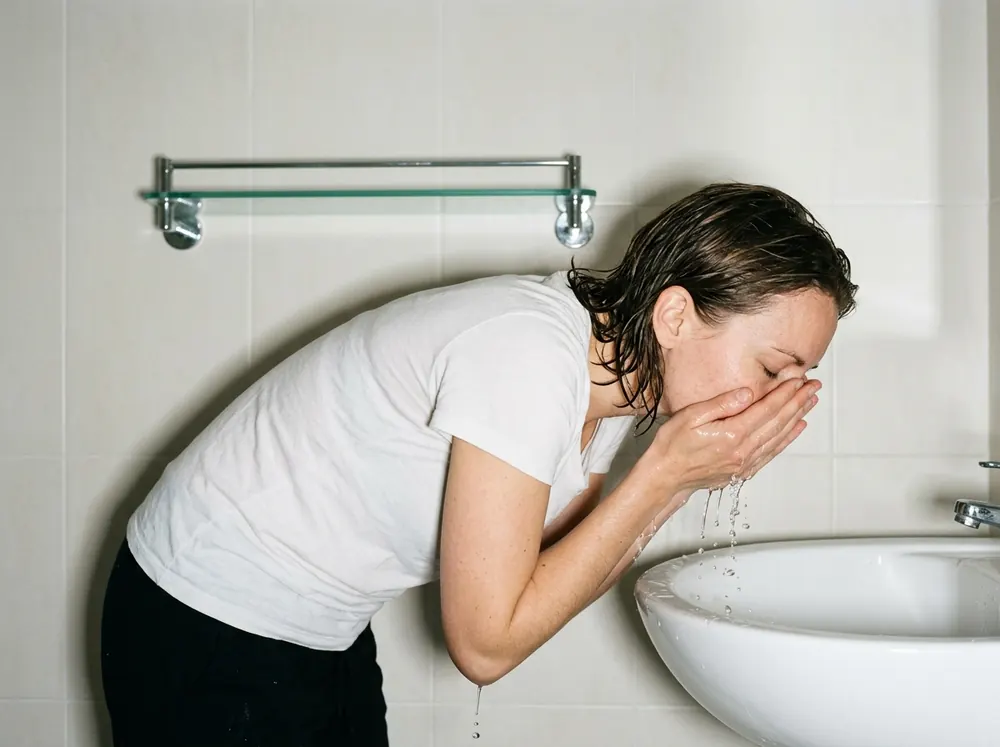
Zero therapy means stopping all facial cosmetics and topical products — including sunscreens and emollients — and "preferably wash the face with warm water alone until the rash clears." DermNet notes this "may result in complete resolution of mild cases."
Two reasons this is harder than it sounds.
It gets worse first. Anything that was suppressing the inflammation is now gone, and the flare that follows is the same rebound described above. People abandon zero therapy in week one for exactly that reason.
And it conflicts with everything else. Stopping sunscreen is uncomfortable advice to give and to take — and facial sunscreens are themselves on the list of reported predisposing factors in that cohort, which is an awkward collision between two pieces of good advice. The resolution is temporary and clinician-supervised, not a reason to abandon photoprotection permanently.
The underlying logic is the same one the site has made before about barrier damage: the reliable move is to remove what is causing it rather than add something to counteract it. Here it is simply more complete.
What a Clinician Can Prescribe
Reporting what exists rather than telling you to take any of it — the prescription decisions here belong with someone who can see your face.
Topical Options
With established use: metronidazole 0.75–1%, erythromycin 1%, and pimecrolimus 1%. Azelaic acid, clindamycin, tacrolimus, adapalene and sulfacetamide/sulfur appear with more limited evidence. Azelaic acid is one of the few that overlaps with the site's existing coverage, where its anti-inflammatory mechanism is documented.
Systemic Options, Often Preferred
Tetracycline is recommended first-line with a response that is usually quick; erythromycin is first-line in pregnancy and in children under 8; azithromycin is an alternative; isotretinoin has low-level evidence for refractory cases.
In practice, topical antibiotics were the most prescribed treatment in the 451-subject cohort, at 82%.
The timeline matters more than the choice. Treatment typically runs 4 to 8 weeks and may need longer, and DermNet is specific that "recurrence can occur if treatment is too short." Untreated, the condition "often runs a chronic variable course that may last months to years." If it returns after antibiotics are stopped, the same treatment can be used again.
This is the opposite failure mode from the acne routines that go wrong by being changed at week three. Here the common error is stopping at week three because it looks better.
Conclusion
Perioral dermatitis is small papules and pustules around the mouth, nose or eyes, with a narrow rim of clear skin against the lip border that nothing else reproduces. Roughly four in five cases are in women, and a third are in children.
Topical corticosteroids are the strongest known trigger and they produce the trap everyone falls into: they clear it, and stopping makes it flare, so they go back on. Stopping is still correct. The flare is the expected course, the weaning should be gradual and supervised, and inhaled and nasal steroids count too.
But the modern evidence has moved. In a 451-subject cohort, only 37% had used any corticosteroid and only 23% a topical one, against historical figures of 72 to 96%. Most people who get this did not use a steroid, and a quarter reported other triggers — facial sunscreens, whitening toothpastes, heavy moisturisers.
And the fluoride story does not survive its own sources. The 1976 paper that started it describes an index patient who had spent two years on a fluorinated topical corticosteroid. The series that tested the claim found half of 65 patients recovered on switching, while 11 of 11 relapsed on rechallenge with tartar-control toothpaste. Toothpaste matters for some people. Fluoride is probably the wrong thing to blame.
What reliably helps is unglamorous: stop everything, expect it to get worse before it gets better, and give whatever a clinician prescribes the full four to eight weeks rather than the three it takes to look better.
Frequently asked questions
5 questions · tap one to open the answer
How do I know if it is perioral dermatitis?
Why does my rash come back worse when I stop steroid cream?
Does fluoride toothpaste cause perioral dermatitis?
Can you get perioral dermatitis without using steroids?
How long does perioral dermatitis take to clear?
Medically reviewed by
Dr. M.M Hanaei
Aesthetic Physician, Dermatology Fellowship
- MD — Shahid Beheshti University of Medical Sciences (SBMU)
- MCC Licensure (Medical Council of Canada)
- Dermatology Fellowship, Switzerland
- Certified in advanced aesthetic procedures
Last reviewed 7 October 2026