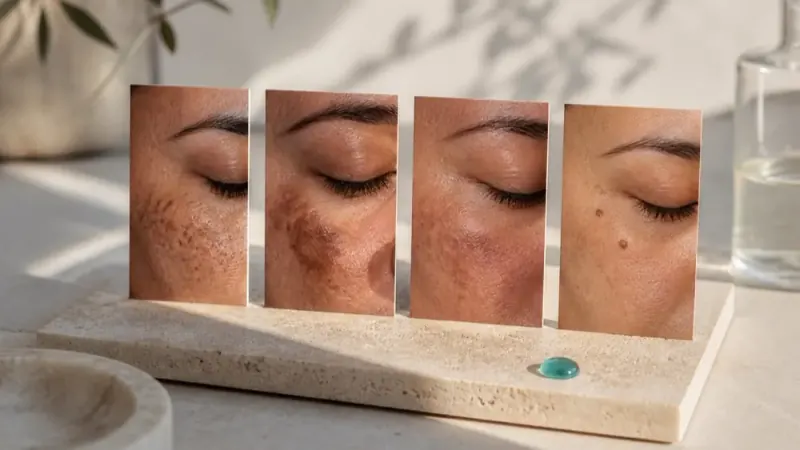
Skinic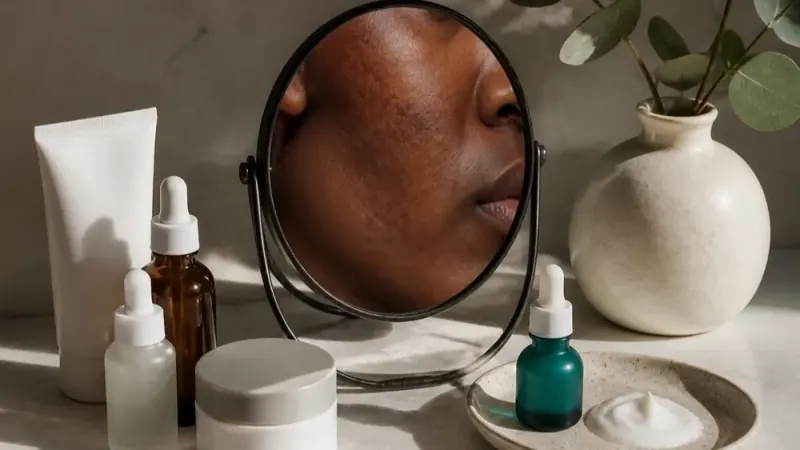
If you have brown or deep skin and you have spent time researching hyperpigmentation treatments, you have likely encountered advice that simply does not work for you, or worse, advice that has made things worse. That is not a coincidence. The majority of mainstream hyperpigmentation guidance, from aggressive laser protocols to high-strength chemical peels, was developed and calibrated with lighter skin types in mind. For melanin-rich skin, those same treatments carry a documented risk of triggering the very condition they claim to treat.
This analysis exists to close that gap. You will find a clear-eyed examination of why standard treatments fall short for brown and deep skin tones, how your skin's biology changes its response to common interventions, and what the evidence actually supports as safer, more effective alternatives. From the risk profile of laser treatments to the emerging science behind tranexamic acid and azelaic acid, each section builds toward a practical, evidence-based framework designed specifically for the skin you are in. If you are not yet sure which type of dark spot you are actually dealing with, our guide to melasma, sun spots, and post-inflammatory hyperpigmentation is a useful starting point before reading on. If you live somewhere with intense year-round sun exposure and a predominantly melanin-rich population, this is the guidance that has often been missing.
Why So Much Hyperpigmentation Advice Does Not Apply to You
If you have tried multiple hyperpigmentation treatments and come away with skin that looks worse rather than better, the problem is very likely not your skin. It is the advice.
The clinical research underpinning mainstream hyperpigmentation protocols was conducted predominantly on lighter skin types, specifically Fitzpatrick types I through III. A December 2024 analysis in the Journal of Drugs in Dermatology confirmed significant underrepresentation of darker skin tones in melasma clinical trials, the condition that most directly informs hyperpigmentation treatment guidelines. This is not a minor methodological footnote. It means the evidence base for widely recommended treatments was built almost entirely on populations whose skin biology differs materially from yours.
Consumer-facing guidance has not caught up. Major platforms routinely publish hyperpigmentation advice without distinguishing between Fitzpatrick types I-III and IV-VI, producing recommendations that are structurally mismatched for melanin-rich skin. The Fitzpatrick scale itself was originally designed for UVA dosing in psoriasis phototherapy, not as a treatment-response classifier, yet it continues to anchor clinical guidance in ways that disadvantage darker skin tones. If you are not certain which type you are — and most people place themselves wrongly — Fitzpatrick skin types I–VI, and how to find yours covers what the scale actually asks.
The practical consequence is familiar to many readers with melanin-rich skin: a laser session or a chemical peel that promised to fade pigmentation instead triggered new pigmentation, leaving the skin darker and more uneven than before. That outcome is not rare or unpredictable. It is a documented biological risk, and it is higher in brown and deep skin tones precisely because of how melanin-rich skin responds to inflammation.
This piece addresses that gap directly. The sections that follow examine two questions. First, why certain widely used treatments carry elevated risk in darker skin, and the specific mechanisms behind that risk. Second, which evidence-based alternatives, including azelaic acid, tranexamic acid, and niacinamide, have a stronger and better-documented safety record for melanin-rich skin.
What Makes Melanin-Rich Skin Respond Differently to Treatment
The difference in how melanin-rich skin responds to treatment is not cosmetic variation. It is rooted in measurable biological differences at the cellular level.
Melanocytes in darker skin tones are more metabolically active than those in lighter skin types, producing greater quantities of eumelanin per cell. Critically, this melanin is distributed uniformly across the epidermis rather than concentrated in clusters. Research on melanocyte distribution confirms that this organisation pattern differs significantly across Fitzpatrick skin types, with uniform distribution in darker skin providing superior photoprotection through maximum light absorption across the skin surface.
That same mechanism is what makes melanin-rich skin more reactive to treatment. Because melanocyte activity is already operating at a higher baseline, any inflammatory signal, including irritation from an active ingredient or thermal damage from a laser, is more likely to trigger a significant melanin production response.
Structural differences compound this. Darker skin tends to have denser dermal collagen and greater lipid content in the stratum corneum. These properties can affect how quickly topical actives penetrate and how the skin recovers from injury. The more clinically significant structural difference, however, is a heightened susceptibility to post-inflammatory hyperpigmentation (PIH): when darker skin perceives injury or irritation, the melanin response is larger, faster, and more persistent than in lighter skin types.
PIH is not a side effect to be weighed against treatment benefits. In melanin-rich skin, it can produce discolouration that is darker than the original concern and takes months to resolve.
A 2025 review in the Journal of Investigative Dermatology confirms that structural and functional differences in darker skin require customised treatment protocols, noting the documented underrepresentation of darker skin phototypes in clinical trials. That clinical consensus has not yet translated into the consumer-facing advice most readers encounter.
The Real Risk Profile of Laser Treatments for Darker Skin
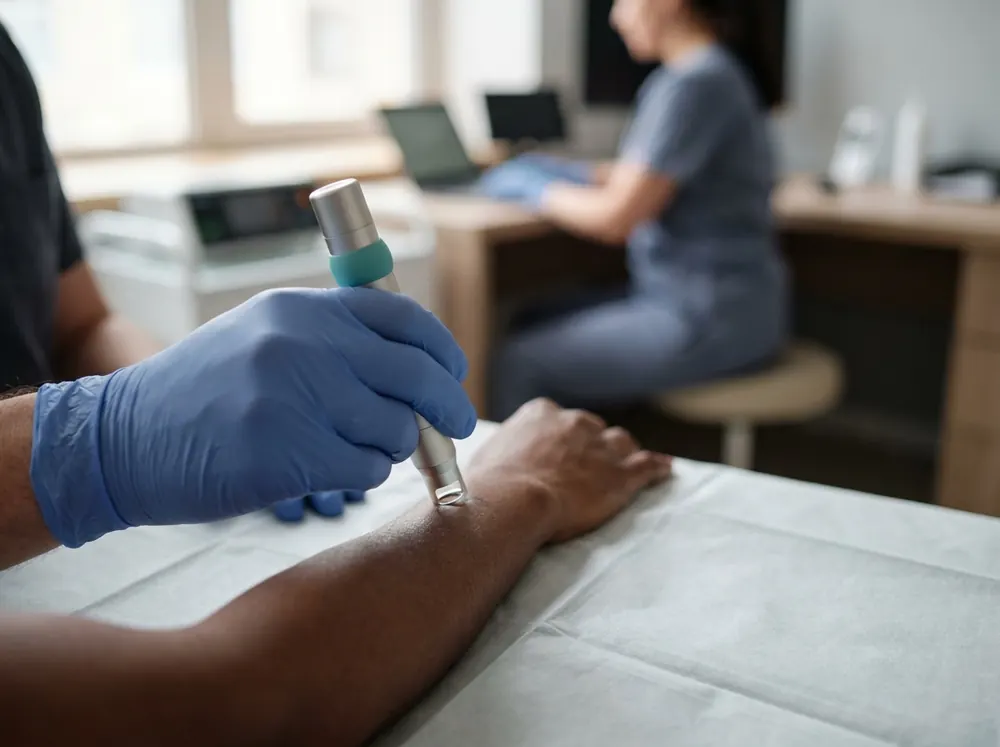
Those structural differences translate directly into a measurable clinical risk when laser energy enters the picture.
Laser devices work by emitting energy that is absorbed by target chromophores, primarily melanin, in the skin. In melanin-rich skin, that absorption is broader and less selective. Energy that should concentrate on the target disperses into surrounding tissue, raising the risk of unintended thermal damage. The American Board of Cosmetic Surgery identifies PIH as "a very real risk" for people of colour undergoing laser treatments, with risk increasing significantly when the provider lacks specialist expertise in darker skin types.
Device selection matters: longer-wavelength systems have generally been studied with more favourable safety profiles for deeper skin tones, though calibrated settings and specialist provider experience in Fitzpatrick types IV–VI are equally critical variables. Even so, clinical evidence confirms that post-operative management, including adjunct topical protocols, is necessary to minimise PIH following ablative procedures.
The consequences of a poorly performed laser treatment are not neutral. PIH triggered by laser injury in melanin-rich skin can be darker and more persistent than the original pigmentation the procedure was intended to treat, leaving the patient in a worse position than before.
In many markets, clinics offer laser treatments without publicly differentiating their protocols by skin type. This makes provider vetting a non-negotiable step before booking any procedure; specifically asking whether a clinic uses Fitzpatrick typing in its intake process and whether it applies adjusted parameters for types IV through VI.
Consumer-facing guidance has partially acknowledged the safety issue, but typically frames the solution around device choice and professional consultation alone. At-home, ingredient-based alternatives are rarely addressed, a gap the following sections address directly.
When Chemical Peels Make Hyperpigmentation Worse
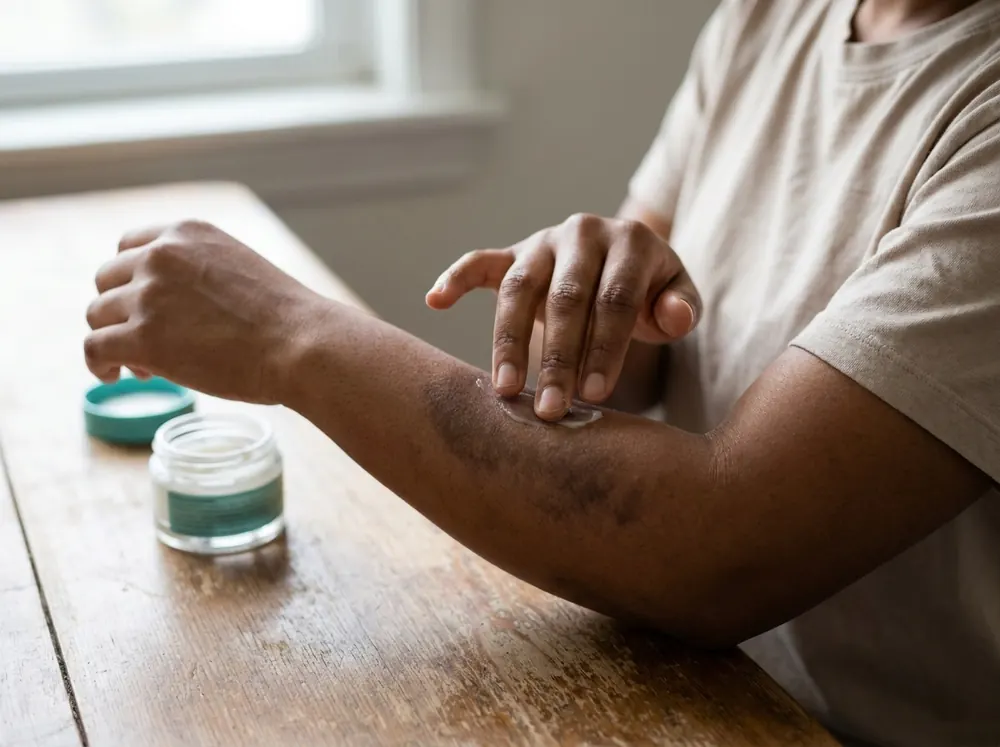
The same PIH risk that makes laser treatments hazardous for melanin-rich skin applies equally to chemical peels, and for the same underlying reason: inflammation triggers excess melanin production, and darker skin triggers it more readily.
High-strength peels, specifically trichloroacetic acid above 20%, high-concentration glycolic acid, and Jessner's solution, work by inducing controlled epidermal injury. In Fitzpatrick types I–III, that injury resolves into even resurfacing. In types IV–VI, the inflammatory response is proportionally amplified, converting what is designed as a controlled procedure into an uncontrolled pigmentation event. Clinical literature confirms that the extent of PIH correlates directly with the degree of inflammation and the depth of melanin deposition, both of which are greater in melanin-rich skin.
Not all peels carry the same risk. Superficial options, including mandelic acid, low-percentage lactic acid, and dilute glycolic formulations, exfoliate without generating the inflammatory depth that stimulates melanocyte hyperstimulation. Published guidance is explicit: very superficial and superficial peels are well tolerated in darker skin; medium-strength peels require caution; deep peels should be avoided entirely because the risk of dyschromia and scarring is high.
The complication problem is compounded by protocol errors. Standard peel timing and concentration ranges are calibrated for Fitzpatrick types I–III. Applying the same protocol to type IV–VI skin without adjustment significantly elevates risk, yet in commercial aesthetics settings this adjustment is inconsistently applied.
Clinical guidelines recommend Fitzpatrick typing and patch testing as non-negotiable prerequisites before any peel procedure in darker skin tones. In practice, both steps are frequently skipped. Before agreeing to any peel, asking directly whether the practitioner performs Fitzpatrick assessment and patch testing is a reasonable and important screening question.
Evidence-Based Alternatives With a Stronger Safety Record for Melanin-Rich Skin
The problem documented in the previous sections is not a shortage of solutions. It is a shortage of accessible guidance pointing darker skin readers towards solutions that already exist and are supported by meaningful clinical evidence.
Three topical ingredients have accumulated the strongest evidence base for hyperpigmentation treatment in melanin-rich skin: azelaic acid, tranexamic acid, and niacinamide. Each has a favourable safety profile in Fitzpatrick types IV through VI, and each has been evaluated in peer-reviewed clinical literature specifically for melasma and post-inflammatory hyperpigmentation. A 2025 study published in the Journal of Cosmetic Dermatology assessed a multi-active serum containing niacinamide and tranexamic acid against 4% hydroquinone in melasma management, with results supporting the combination's clinical utility. For a broader comparison of how these and other ingredients stack up on the evidence, our dark spot ingredient evidence-tier guide covers the full landscape.
Unlike inflammatory modalities, none of these three actives triggers the melanin overproduction cascade, the full mechanism is covered above. Azelaic acid inhibits the tyrosinase enzyme; tranexamic acid interrupts the keratinocyte-melanocyte signalling pathway; niacinamide blocks melanosome transfer to skin cells. All three target pigmentation upstream of the inflammatory trigger that makes PIH so persistent in melanin-rich skin.
Because the mechanisms are distinct, selecting the wrong ingredient for a specific pigmentation type is one of the most common reasons brightening routines fail. Each active warrants its own explanation, covered in the sections that follow.
Azelaic Acid: A Tyrosinase Inhibitor With a Dual Safety Advantage
Azelaic acid is the first of these three actives to examine in detail, and its mechanism explains why it sits at the top of the evidence base for melanin-rich skin specifically.
It works by inhibiting tyrosinase, the enzyme that drives melanin synthesis. There is supporting evidence suggesting this inhibition may preferentially affect overactive melanocytes, though the precise selectivity mechanism has not been fully characterised in the available literature. This makes it mechanistically appropriate for darker skin tones, where blanket suppression of melanocyte activity carries the risk of uneven depigmentation.
The clinical evidence supports its use at concentrations of 15-20%. A meta-analysis of six randomised controlled trials covering 673 melasma patients found azelaic acid produced a statistically significant reduction in Melasma Area Severity Index scores, with no meaningful difference in adverse events compared to hydroquinone. Importantly, none of the controlled trial data showed PIH rebound, the complication that makes laser treatments high-risk for the same patient population.
Beyond tyrosinase inhibition, azelaic acid carries two additional properties that matter for melanin-rich skin. Its mild anti-inflammatory action addresses the low-grade inflammation that perpetuates pigmentation rather than simply suppressing melanin output. Its keratolytic effect accelerates surface cell turnover, helping to clear existing discolouration. These dual properties mean it works on both the cause and the residue of hyperpigmentation simultaneously.
Accessibility is also a practical advantage. Lower-concentration formulations are available over the counter in many markets, while 15–20% prescription-strength preparations are obtainable through licensed dermatology clinics. Side effects reported across trials are limited to transient stinging and light peeling during initial use, with no post-treatment pigmentation darkening documented. That risk profile stands in direct contrast to the aggressive modalities discussed earlier in this piece.
Tranexamic Acid: Emerging Evidence and Melanin Pathway Interruption
Where azelaic acid interrupts melanin production at the enzyme level, tranexamic acid operates at an earlier point in the signalling chain entirely. It works by blocking the interaction between keratinocytes and melanocytes that drives both UV-induced and inflammation-induced pigmentation. When UV radiation or inflammation stimulates keratinocytes, they release signals that activate melanocytes to produce more pigment; tranexamic acid disrupts that communication before the melanin synthesis cascade begins. This complementary mechanism means it can be used alongside tyrosinase inhibitors rather than as a simple substitute.
Clinical evidence supporting its use in darker skin tones has grown substantially. A 2023 study published in Cutis assessed 5% tranexamic acid solution specifically in South Asian patients with melasma, confirming efficacy in skin of colour with the strongest results recorded on the forehead and malar region. Separately, a 2025 randomised controlled trial compared oral and topical formulations directly, adding to a body of research that consistently demonstrates meaningful improvement in melanin index scores without triggering adverse pigmentation events.
Both formulations have a role, but they are not interchangeable. Oral tranexamic acid has produced particularly strong outcomes for melasma in clinical trials; however, it requires medical supervision due to systemic considerations including thromboembolic risk, and it is not appropriate for all patients. Topical tranexamic acid is the more accessible entry point, with a minimal irritation profile that makes it suitable for daily use and compatible with other actives, including niacinamide and azelaic acid, in a layered routine.
This mechanism has specific relevance for many melanin-rich populations. Melasma and PIH are consistently the two most prevalent hyperpigmentation presentations in South Asian, Middle Eastern, and East African skin, and both are precisely the conditions where tranexamic acid's signalling-level interruption is most clinically supported.
Niacinamide: Barrier Support and Melanin Transfer Inhibition
Where tranexamic acid interrupts the signalling between cells that drives pigmentation, niacinamide operates one step later in the same process: it inhibits the transfer of melanosomes, the melanin-containing vesicles, from melanocytes to surrounding keratinocytes. The practical effect is that less pigment reaches the skin's surface, without suppressing melanin production at source. This distinction matters because the mechanism carries no inflammatory consequence, making it structurally appropriate for melanin-rich skin.
Peer-reviewed research confirms that niacinamide reduces cutaneous pigmentation through suppression of melanosome transfer, with clinical improvements requiring consistent use over multiple weeks. Tolerability across skin types, including Fitzpatrick types IV through VI, is consistently strong.
The barrier-reinforcing effect adds a separate layer of relevance for darker skin tones specifically. Niacinamide supports skin barrier integrity, and because barrier disruption is an inflammatory event, this reinforcing effect is directly relevant to PIH risk in melanin-rich skin. This makes it a stabilising ingredient, not merely a brightening one.
5% niacinamide is widely available globally at accessible price points, making it a practical routine anchor.
Niacinamide does not carry the photosensitising profile associated with some exfoliating actives, making it a practical option in high-UV environments, though all active routines should be paired with daily SPF. Kojic acid, which also appears in brightening products, has its own trial record and sensitisation history, covered in our kojic acid article.
Building a Safer Hyperpigmentation Routine for Brown and Deep Skin
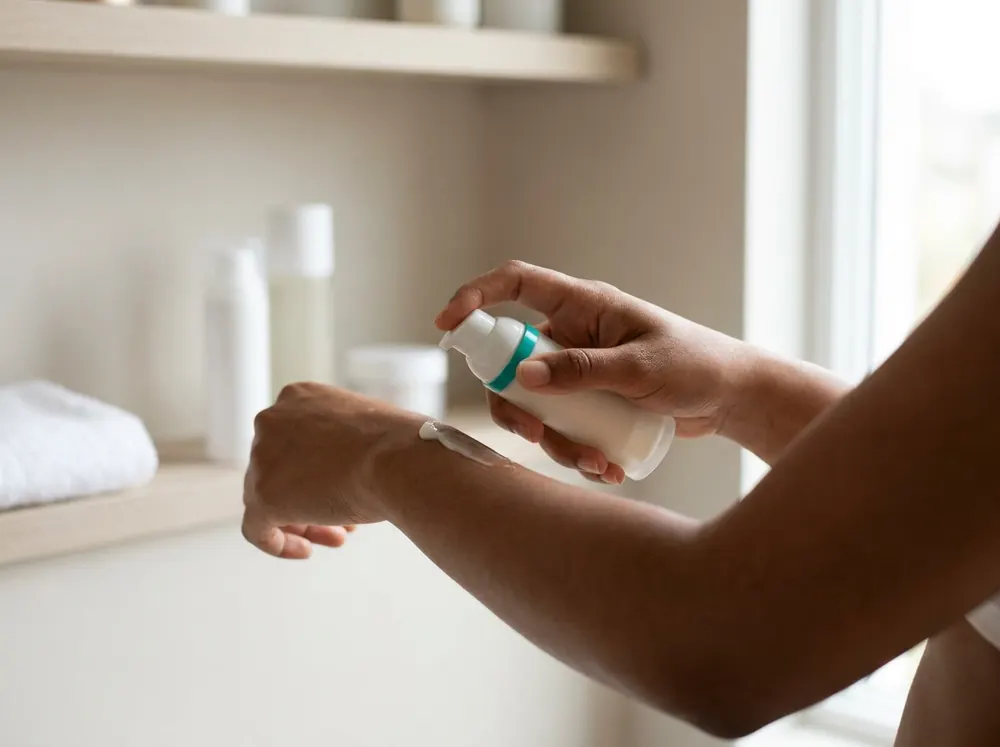
Knowing which ingredients to use is only part of the challenge. How you introduce and use them determines whether they work or trigger the very inflammation you are trying to resolve.
The foundational principle here is straightforward: for melanin-rich skin, consistent and gentle application of evidence-based actives outperforms aggressive single-session treatments. Slow and steady is not a compromise; it is the correct clinical strategy.
The core routine framework is built on three components:
- Morning: Niacinamide serum, followed by broad-spectrum SPF 50. In a high-UV environment, daily SPF is not optional.
- Evening: Azelaic acid or tranexamic acid applied to clean skin.
This structure keeps photosensitising steps to the evening and places the non-negotiable UV barrier at the end of every morning routine.
Introduce one active at a time. Allow four to six weeks before adding anything new. Layering multiple new ingredients simultaneously makes it impossible to identify which ingredient is producing improvement and which is causing irritation, a problem that carries higher stakes in melanin-rich skin where an adverse reaction means potential PIH.
Patch testing is not optional. Apply any new active to a small area, such as the inner forearm or behind the ear, for five to seven days before full-face use. The cost of skipping this step is a reaction that leaves pigmentation worse than the starting point.
Expect results on a clinical timeline, not a marketing one. Meaningful improvements in melanin index scores in clinical studies are measured at eight to twelve weeks. Routines abandoned at four weeks have not been given adequate time to work.
Objective tracking matters here because pigmentation changes are subtle and perception is unreliable. The Skinic app supports consistent selfie-based skin analysis over time, giving users a measurable record of whether their routine is producing actual change rather than relying on memory. For anyone building a routine around these actives, that kind of longitudinal data replaces guesswork with evidence.
When Professional Dermatological Care Is Necessary
At-home routines are appropriate for the majority of hyperpigmentation presentations in melanin-rich skin: mild to moderate PIH, uneven skin tone, and superficial melasma all respond to the consistent topical approach described above. Professional escalation becomes necessary under specific conditions.
Escalate to a dermatologist when:
- Pigmentation is dermal rather than epidermal (deeper discolouration that has not shifted after consistent topical treatment)
- The affected area is large or continues to spread
- There has been no meaningful improvement after 3 to 4 months of consistent use of evidence-based actives
- Hyperpigmentation appears linked to a systemic condition, including hormonal disruption or thyroid dysfunction
If topical tranexamic acid has produced limited results for melasma, oral tranexamic acid is a legitimate next step to discuss with a dermatologist. It has strong clinical evidence for melasma in darker skin tones, but requires medical supervision and is not appropriate for all patients. It is the correct escalation before any laser procedure, not after.
Vetting a Clinic for Melanin-Rich Skin
Provider selection is not a formality. Before committing to any professional procedure, ask directly:
- Does the clinic use formal Fitzpatrick typing as part of the intake assessment?
- What specific laser or peel protocols does the provider use for Fitzpatrick types IV to VI?
- How many patients with darker skin tones has the provider treated with this procedure?
These questions are diagnostic. A qualified provider will answer them specifically and without hesitation.
Red flags to exit on:
- No mention of Fitzpatrick typing during consultation
- The same laser protocol recommended regardless of skin tone
- PIH risk in darker skin described as minimal or unlikely
Fitzpatrick typing is established clinical standard in dermatology. A clinic that does not apply it routinely is not equipped to treat melanin-rich skin safely.
Why This Matters More in Some Climates and Communities Than Others
All of the clinical guidance covered so far applies with particular force in high-UV, high-diversity regions, for reasons that go beyond generic skin-type advice.
In many parts of the world, brown and deep skin tones are the statistical norm rather than the exception, particularly across South Asia, the Middle East, Africa, and their diaspora communities elsewhere. Yet the skincare market, and the advice channels that feed it, remains shaped by Western dermatology conventions developed for Fitzpatrick types I to III. The mismatch is structural, and it is most visible in exactly the places where melanin-rich skin is the majority, not the exception.
Climate compounds this directly. Anyone living in a consistently high-UV climate, tropical, desert, or near-equatorial regions with little seasonal relief, is working against a driver of hyperpigmentation that never really switches off. For anyone managing hyperpigmentation in these conditions, broad-spectrum SPF 50 is a daily non-negotiable, not a summer precaution. If the reason you skip it is the white cast, that is a formulation problem with a fix — sunscreen without the white cast covers which filters cause it, and why a tinted formula blocks a pigmentation driver that untinted ones leave open.
Heat and humidity create a secondary consideration in many of these same regions. Heavy occlusives and rich formulations that perform well in temperate or arid climates can cause congestion and breakouts in hot, humid conditions. Breakouts in melanin-rich skin trigger PIH. Congestion is also harder to read here, because comedonal bumps show lower contrast in deeper skin tones, which is why identifying the bumps on your face before treating them matters more, not less. This is a practical reason, beyond clinical safety, to favour lightweight, well-tolerated actives such as niacinamide and tranexamic acid over occlusive or high-friction formulations.
In many of these markets, the aesthetics industry is dense and commercially aggressive, with laser and peel clinics widely accessible. Accessibility is not the same as appropriate calibration. The availability of a treatment says nothing about whether the protocol has been adjusted for the population's predominant skin type.
At-home routines built on these three actives typically represent a substantially lower cost than professional laser courses, with a lower adverse-event risk profile.
The Clearer Path Forward for Melanin-Rich Skin
The evidence reviewed here leads to a clear conclusion: standard hyperpigmentation treatments carry documented, elevated risks for brown and deep skin tones not because of individual bad luck, but because the protocols underpinning them were developed without melanin-rich skin biology as a reference point. That is a design problem, not a personal one.
As the dedicated ingredient sections above detail, azelaic acid, tranexamic acid, and niacinamide each address distinct points in the pigmentation pathway without triggering the inflammatory cascade that makes aggressive lasers and high-strength peels so problematic for deeper skin tones.
As the routine section details, consistency anchored by daily SPF outperforms aggressive single-session procedures for the majority of concerns.
Clinically meaningful improvements require consistent use over multiple weeks, a timeline well-established in the dermatological literature on topical hyperpigmentation treatment. Tracking changes with objective tools, including consistent photographic analysis over time, gives a more reliable read on whether a routine is working than subjective daily perception.
If previous treatments have disappointed or worsened your pigmentation, that outcome reflects a systemic gap in how skincare guidance has been produced and distributed. The evidence for a safer, more appropriate approach exists. It simply has not been placed where it needs to be.
Conclusion
Hyperpigmentation in brown and deep skin tones is not a cosmetic inconvenience; it is a clinical condition that demands skin-appropriate science. Standard treatments fail not because your skin is difficult, but because the guidance was never built with you in mind.
The core strategy, targeted low-inflammatory actives, daily SPF, and patience over weeks, is detailed fully above.
If your previous routine has disappointed you, the problem was the protocol, not your skin.
Start by auditing what you are currently using against the evidence outlined here. Where gaps exist, address them systematically. Your skin has the capacity to respond. It simply needs the right approach.
Frequently asked questions
5 questions · tap one to open the answer
Why do lasers and peels sometimes make dark marks worse on brown skin?
What are the best ingredients for hyperpigmentation in melanin-rich skin?
Are chemical peels safe for dark skin tones?
How long does it take to see results from a hyperpigmentation routine?
When should I see a dermatologist instead of treating hyperpigmentation at home?
Medically reviewed by
Dr. M.M Hanaei
Aesthetic Physician, Dermatology Fellowship
- MD — Shahid Beheshti University of Medical Sciences (SBMU)
- MCC Licensure (Medical Council of Canada)
- Dermatology Fellowship, Switzerland
- Certified in advanced aesthetic procedures
Last reviewed 9 September 2026