Skinic
There is a specific kind of frustration attached to milia, and it comes from how reasonable your approach has been.
You saw small white bumps under your eye. They looked like whiteheads. You treated them like whiteheads — salicylic acid, then a benzoyl peroxide spot treatment, then a stronger exfoliant, then, eventually, your fingernails. Six months later they are exactly where they were, the same size, the same colour, entirely unmoved. The only thing that has changed is the skin around them, which is now irritated.
Nothing you did was unreasonable. It was simply aimed at the wrong structure.
A milium is not a blocked pore. It is a sealed cyst with no opening to the surface of your skin, which means there is no channel for a topical product to travel down and nothing for an exfoliating acid to unblock. Understanding that one structural fact answers almost every question people have about milia, including why they resist treatment, why squeezing produces nothing, and why the thing that actually clears them is a small procedure rather than a product.
Six Months of Spot Treatment, and They Have Not Moved
Before the mechanism, the recognition — because "it did not respond to acne treatment" is itself one of the more reliable clues.
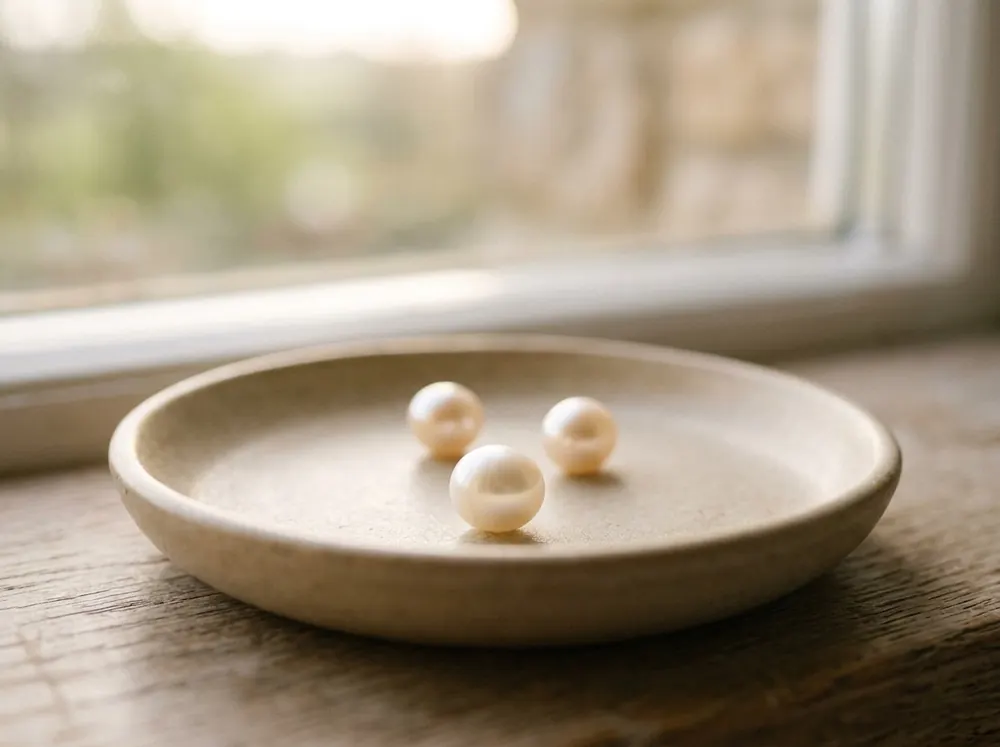
Milia present as small, white to yellowish, dome-shaped papules of one to two millimetres, most commonly on the face. They sit just under the surface with a distinctly firm, pearly quality — more like a grain of sugar under cling film than a spot. They cluster around the eyelids and on the cheeks, they are painless, they are not red or inflamed, and they do not come to a head.
Crucially, they do not change. A whitehead has a life cycle of days to a couple of weeks. A milium can sit in the same place, at the same size, for months or years. If you can point at a white bump and say with confidence that it has looked identical since spring, you are almost certainly not looking at acne.
If you are working through several different bumps at once, every bump on your face, identified sets out the full differential side by side.
A Milium Is a Sealed Pocket, Not a Blocked Pore
Here is the mechanism, and it is worth a paragraph of anatomy because everything else follows from it.
Milia are small, epithelium-lined keratinous cysts in the dermis, thought to result from plugging of pilosebaceous or eccrine sweat ducts. DermNet describes a milium as a small cyst containing keratin — the structural protein of skin — arising as an epidermoid cyst from vellus hair follicles. Under the microscope it is a keratin-filled cyst lined with stratified epithelium.
The operative word in all of that is cyst. Not a pore. Not a duct. A closed sac, walled off by its own layer of epithelium, sitting under intact skin. The bump it is most often confused with has no contents at all — sebaceous hyperplasia is the gland itself, enlarged, which is why it is yellowish and dimpled where a milium is white and domed.
Compare that to a closed comedone, which is the thing people most often mistake milia for. A closed comedone is a genuine follicle, with a genuine duct, that has been plugged with keratin and sebum. The passage exists; it is obstructed. That distinction is the entire difference between a structure an oil-soluble acid can work on and one it cannot.
Primary and Secondary Milia: Two Different Origins
Milia come in two broad forms, and knowing which you have often points at a cause you can do something about.
Primary Milia Appear on Their Own
Primary milia develop spontaneously on otherwise normal skin, most commonly on the face, and they are extremely common at both ends of life. They are not caused by anything you did, they are not a hygiene problem, and they are not a sign of a poor routine.
Secondary Milia Follow Something That Happened to the Skin
Secondary milia arise on skin that has been altered — and the list of triggers is specific and useful. They occur following burns, subepidermal blistering diseases, dermabrasion, radiotherapy, or topical therapy with glucocorticoids or 5-fluorouracil. DermNet adds traumatic milia arising at the site of injury as skin heals, and drug-associated milia following topical medications including corticosteroids and hydroquinone.
Cosmetic procedures belong on that list too. Milia are a common minor side effect of fractional CO2 laser resurfacing, with spontaneous resolution expected — and if bothersome, removable by extraction or pinpoint electrodessication.
So the useful question is not "what am I doing wrong" but "what happened to this patch of skin". A burn, a blistering rash, a resurfacing treatment, a period of steroid cream use, or a course of a topical medication in the months before the bumps appeared is diagnostic information worth bringing to a clinician.
Why Every Topical You Have Tried Failed
With the structure established, the failures explain themselves.
Salicylic acid failed because there is nothing to travel down. Salicylic acid is useful in acne precisely because it is oil-soluble and can penetrate into a follicle. A milium has no follicular opening for it to enter. The acid exfoliates the surface above the cyst and never reaches the cyst.
Benzoyl peroxide failed because there is nothing bacterial to act on. It reduces bacterial load and inflammation in acne. A milium is neither infected nor inflamed — it is a quiet sac of keratin.
Retinoids underperform because they act on turnover, not on an established cyst. A retinoid may reduce how readily new milia form by normalising how the skin sheds, and it is sometimes used for extensive cases, but it does not empty a cyst that already exists.
Scrubs failed because the problem is not on the surface. Physical exfoliation abrades skin above a lesion sitting underneath it, which trades no benefit for a compromised barrier.
Squeezing failed because the contents have nowhere to go. This is the one worth dwelling on. There is no exit. You can press hard enough to bruise the skin and the milium will still be there, now sitting under inflamed tissue.
That last point has a cost beyond the wasted effort. Post-inflammatory hyperpigmentation follows exogenous factors such as mechanical trauma, its course is chronic once established, and lesions persist for months to years. Squeezing a milium under your eye is a reliable way to swap a 1 mm white bump that most people would never notice for a brown mark that outlasts the next year of skincare — and that risk is higher in deeper skin tones, where post-inflammatory pigment is both more frequent and more severe. If that is your skin, hyperpigmentation in brown and deep skin tones is worth reading before you touch anything.

What Actually Clears Them — and Why It Involves Someone Else
The honest answer is the one most skincare content works hard to avoid, because it does not end in a product recommendation.
An established milium has to be opened. The standard approach is that the lesion is de-roofed using a sterile needle or blade and the contents squeezed or pricked out. Other options include diathermy, curettage, cryotherapy, topical retinoids and chemical peels, with laser ablation reserved for extensive cases.
De-roofing is a minor procedure, but it is still a procedure: a sterile instrument, a trained hand, and a controlled entry. It is not something to attempt on your own face with a sewing needle, and the fact that most milia sit on the eyelids and immediately under the eyes should settle the argument on its own. The risks of doing it yourself are infection, scarring, and a pigmented mark — all for a lesion that was causing you no harm.
There is also a genuinely good option that involves doing nothing. Many primary milia clear up by themselves within a few months. For a small number in a place nobody else is looking at from ten centimetres, waiting is a legitimate and free treatment.
Where the count is high, where they have persisted for years, or where they appeared after a burn, a blistering rash or a procedure, that is worth a clinician's time rather than another product.
The Ones You Can Prevent
Prevention is limited, because primary milia largely happen regardless. But two levers are real.
Match the weight of the product to the area. Heavily occlusive eye creams are associated with milia formation, and the eye area is where most milia turn up. This is not an argument against moisturising — it is an argument for matching the formula to the skin. A lighter product around the eyes and a richer one where the barrier actually needs it is better placement than the same rich cream everywhere. We have worked through how to read those formulas in best moisturiser for dry skin.
Protect against sun damage, and do not injure the area. Secondary milia follow trauma, blistering and resurfacing. You cannot prevent every one of those, but you can avoid adding to the list by picking, scrubbing, and over-treating the skin around your eyes.
What is not worth doing: switching cleansers repeatedly, escalating exfoliation, or buying a product marketed as "for milia". There is no topical that reliably clears an established cyst, and the category exists because the frustration is real, not because the products work.
Getting an Honest Read on Whether They Are Changing
Milia change slowly or not at all, which makes them unusually hard to assess by memory — and that is precisely why people conclude a product is working when nothing has moved, or that nothing is working when a crop is in fact resolving.
A fixed reference solves it. Photograph in consistent conditions — same place, same distance, same soft daylight, no filters — and compare across months rather than weeks. Whether that lives in a dated album on your phone or in something built for it like Skinic, the value is having a baseline rather than an impression. For a lesion that either sits still for years or quietly disappears over a few months, that distinction is the whole question.

Conclusion
Milia resist acne treatment for one reason: they are not acne. A milium is a small keratin-filled cyst lined with its own epithelium, sealed under intact skin, with no duct connecting it to the surface. Salicylic acid has nothing to travel down, benzoyl peroxide has nothing to act on, and squeezing has nowhere to send the contents.
Work out which kind you have. Primary milia appear spontaneously and often resolve within a few months on their own. Secondary milia follow something specific — a burn, a blistering rash, a resurfacing treatment, a course of steroid or hydroquinone cream — and that history is the most useful thing you can bring to an appointment.
Then do considerably less than you have been doing. Stop the escalating exfoliation, move the heavy cream away from your eyes, and either wait or have them de-roofed properly by someone with sterile equipment.
The one thing genuinely worth avoiding is the fingernails. A milium causes no harm and is invisible at conversational distance. A pigmented mark under your eye, earned by squeezing at one, can last a year.
Frequently asked questions
5 questions · tap one to open the answer
What causes milia on the face?
Can you get rid of milia at home?
Do milia go away on their own?
Is a milium the same as a whitehead?
Can eye cream cause milia?
Medically reviewed by
Dr. M.M Hanaei
Aesthetic Physician, Dermatology Fellowship
- MD — Shahid Beheshti University of Medical Sciences (SBMU)
- MCC Licensure (Medical Council of Canada)
- Dermatology Fellowship, Switzerland
- Certified in advanced aesthetic procedures
Last reviewed 12 September 2026