Skinic
You have had rough, bumpy skin on the backs of your upper arms since you were about twelve. You have scrubbed it with a body brush, a salt scrub, an exfoliating mitt and a loofah. You have been told it is dirt, that it is acne, and that it would clear up if you drank more water.
It is still there, and the scrubbing may be part of why.
At least three different things produce bumps on the arms, thighs, back and chest, and they are routinely mistaken for one another. Keratosis pilaris is by far the most common and is not an infection or a hygiene problem at all. Folliculitis is inflammation of the follicle itself, and comes in three varieties that need different approaches. Body acne is genuine acne — comedones and all — simply below the neck.
Telling them apart takes about a minute, and it matters, because the instinct they all provoke — exfoliate harder — is wrong for all three, and actively counterproductive for two.
If it is your face rather than your body you are trying to work out, every bump on your face, identified runs the same process one surface up.
Ten Years of Scrubbing and It Is Still There
Start with how common this is, because it reframes the problem.
Keratosis pilaris affects 50–70% of teenagers and 40% of adults. That is not a skin condition in the usual sense; that is most people. If you have fine rough bumps on the outer upper arms, you are in the majority, and the reason nobody talks about it is that it is largely invisible under sleeves rather than that it is rare.
It also explains why the scrubbing failed. A problem affecting half the population, present since childhood, unchanged by a decade of exfoliation, is not a cleanliness problem. It is structural.
Four Questions That Narrow It Down
Look at the area in daylight, ideally from the side so the texture throws shadows, and answer these.
Where is it? Keratosis pilaris sits on the extensor surfaces of the upper arms and thighs — the outer, away-from-the-body surfaces — and can also involve buttocks, trunk and cheeks. Malassezia folliculitis concentrates on the upper trunk: chest, upper back, shoulders. Body acne follows the oiliest zones, mainly the back and chest.
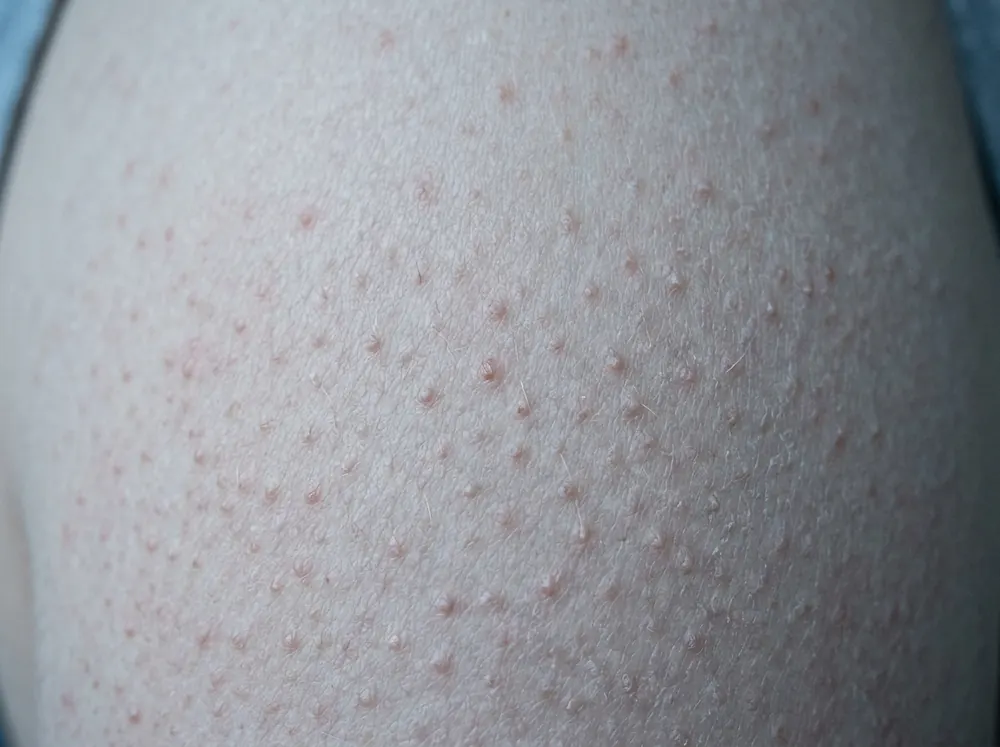
Is it uniform? This is the strongest single signal. Keratosis pilaris produces bumps that are all the same size, evenly spaced, one per follicle, across a whole area. Acne produces lesions at different stages and sizes at once. Folliculitis tends toward uniformity too, which is why it is confused with both.
Does it itch? Keratosis pilaris is usually not itchy, though it can be. Malassezia folliculitis is an itchy, acne-like condition. Irritant folliculitis after shaving is frequently very itchy. Acne is tender rather than itchy.
Does it change with the season? Keratosis pilaris worsens in winter when the air holds less moisture. Body acne and folliculitis usually do the opposite, worsening with heat and sweat.
| Keratosis pilaris | Folliculitis | Body acne | |
|---|---|---|---|
| Where | Outer upper arms, thighs, buttocks | Upper trunk, or legs after shaving | Back, chest, shoulders |
| Size | All identical, evenly spaced | Mostly uniform | Mixed sizes and stages |
| Comedones | No | No | Yes — the defining lesion |
| Itch | Usually not | Often, sometimes intensely | No, tender instead |
| Pus | No | Often, small pustules | In inflamed lesions |
| Season | Worse in winter | Worse with heat and sweat | Worse with heat and sweat |
| Since when | Usually childhood | Recent onset | Adolescence or later |
Keratosis Pilaris: A Plug Around a Hair
The mechanism is specific, and once you know it the failed treatments explain themselves.
Keratosis pilaris involves keratin accumulation in the hair follicles, from abnormal keratinisation of the upper portion lining of the follicle. Keratin that should shed normally instead stays in place, forming a hard plug at the opening of a fine vellus hair follicle. Each bump is one follicle with a plug in it, and often a small coiled hair trapped underneath — which is why the bumps are so regular. They map onto follicles, and follicles are evenly distributed.
Three things follow from that.
It is not on the surface. The plug sits in the follicular opening, not on top of the skin, so surface abrasion cannot reach it and mostly irritates the skin around it.
It runs in families and travels with dry skin. Keratosis pilaris is associated with atopic eczema and with ichthyosis, and genetic factors appear significant, possibly involving filaggrin protein mutations. Filaggrin is central to how the outer skin layer forms and holds water — the same protein implicated in atopic dermatitis. If you have KP, eczema and hay fever, those are related, not coincidental.
It is not curable, but it does fade. DermNet is direct: there is no cure, and it often clears up during adult life. Management improves appearance; it does not remove the tendency.
There is also a red variant — keratosis pilaris rubra — where the surrounding skin is inflamed and pink, most visible on the cheeks and outer upper arms. It is the same process with more visible erythema. Where non-itchy red spots turn up on the legs, one test comes before identifying them — because the single group that needs a doctor looks unremarkable until you press a glass against it.
Folliculitis: The Follicle Is Inflamed, Not Blocked
Folliculitis is the inflammatory cousin, and it comes in three forms that matter here.
Bacterial
Commonly due to Staphylococcus aureus, presenting as tender red spots often with pustules, and able to affect any hair-bearing area. Tenderness is the tell: keratosis pilaris does not hurt.
Malassezia
Caused by a yeast, and described as an itchy acne-like condition usually affecting the upper trunk of a young adult. This is the most consequential misdiagnosis on this page. It looks like back or chest acne, it appears in the same people at the same age, and it does not respond to acne treatment — because the organism is a yeast rather than a bacterium. Two features separate it from acne: it itches, and the lesions are all the same size with no comedones anywhere. Where the trunk is the whole complaint, back and chest acne — and when it is not acne at all works through both tells and the numbers behind them.
Irritant, After Shaving or Waxing
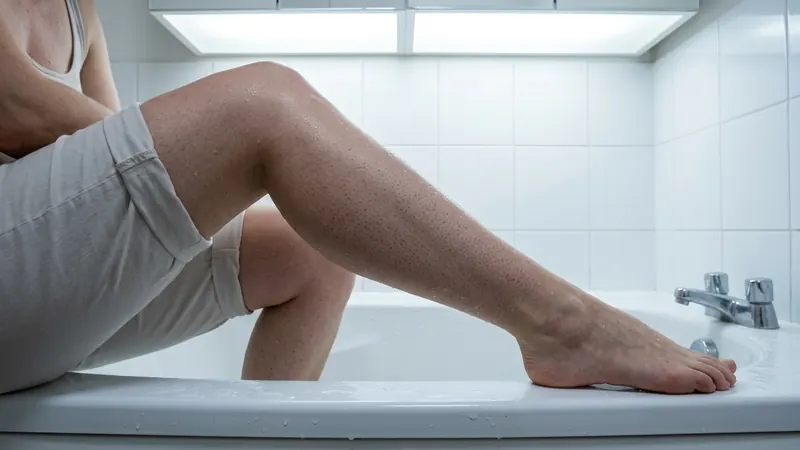
Arises from hair regrowth after shaving, waxing or plucking, with no growth of bacteria or other organisms on swabs, and it is frequently very itchy — particularly on women's lower legs. If bumps appear a day or two after hair removal and settle as the hair grows, this is the likely answer, and no antimicrobial is going to help. Where the legs are the whole complaint, strawberry skin is not dirt in your pores works through it alongside the two other things that produce the same dotted look.
Body Acne: Real Comedones, Below the Neck
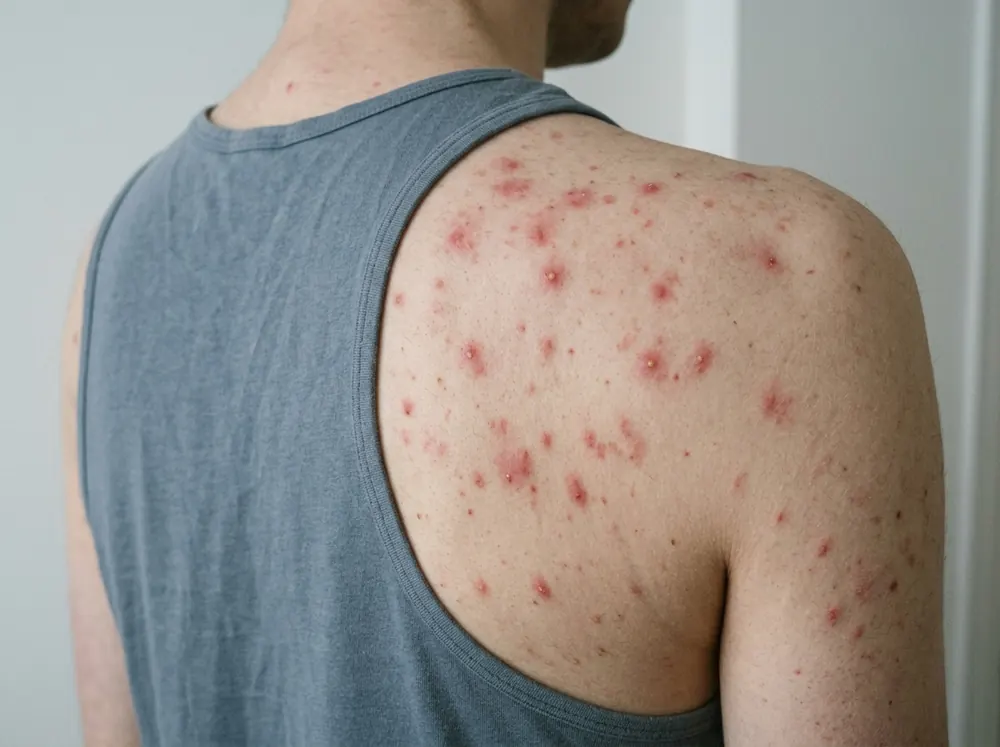
Body acne is the one condition here that genuinely is acne, and the defining feature is the same as on the face: comedones. Blackheads and closed comedones mixed among the inflamed lesions. If you cannot find a comedone anywhere on your back or chest, acne is the less likely answer — the same question that separates rosacea from acne on the face, applied to the body. It might not be acne works through that logic in detail.
The other tell is variety. Acne produces lesions at different stages simultaneously — a new papule here, a resolving mark there, a comedone beside them. Uniformity points away from it.
Why Body Skin Is Not Face Skin
Most body skincare advice is facial advice with the word "body" in front of it, which is why so much of it underperforms.
Sebaceous gland density varies enormously by site. The scalp and forehead carry roughly 400 to 900 glands per square centimetre, far more than the limbs. The back and chest sit between those extremes, which is why they get acne while forearms rarely do, and why the arms — with low gland density — get a keratinisation problem rather than an oil problem.
Three practical consequences:
- Low-oil areas get plugging problems, not greasy ones. Treating upper arms with products designed for oily facial skin targets a mechanism that is not operating there.
- Body skin is thicker and slower. Changes that take six weeks on the face can take twelve on the arms, which is one reason people abandon treatments that were working.
- Clothing and friction do things faces never experience. Straps, waistbands, damp fabric after exercise and sustained occlusion all contribute to frictional acne, where barrier impairment is a key driver.
Why "Exfoliate Harder" Is the Wrong Instinct
Every one of these conditions provokes the same response, and it is wrong in a different way each time.
For keratosis pilaris, the plug is inside a follicle. Physical scrubbing abrades the surface above it, inflames the surrounding skin, and leaves the plug. Worse, in people whose KP travels with atopic skin — which is many of them — that irritation is on skin already prone to reacting.
For folliculitis, scrubbing an inflamed, sometimes infected follicle spreads the problem across the area and damages the barrier that would otherwise contain it.
For body acne, the mechanism is the one already familiar from the face: pressure ruptures the follicle wall and pushes contents sideways into surrounding tissue, converting a small lesion into an inflamed one.
And in all three cases there is a cost that outlasts the bump. Inflammation leaves pigment, more frequently and more severely in deeper skin tones — which is why the Fitzpatrick type that predicts your pigment response is worth knowing before you attack your own arms with a brush.
What Actually Helps — and How Good the Evidence Is
Here is where most keratosis pilaris articles get vague. The honest version is more useful.
Chemical keratolytics are the treatments with real support. A 2025 review of alpha hydroxy acids, beta hydroxy acids and urea found lactic acid and urea demonstrating particularly consistent benefits and acceptable tolerability, while salicylic acid offers theoretical advantages from follicular penetration but has more limited direct evidence behind it.
Two specific findings are worth knowing:
- In a split-side comparison over twelve weeks, lactic acid produced greater mean lesion reduction than salicylic acid — 66% against 52%.
- For speed, 20% urea showed significant improvements in skin texture and smoothness as early as one week.
There is also a finding that contradicts the standard advice. A study measuring barrier function in keratosis pilaris found no statistically significant change in transepidermal water loss after twelve weeks of either lactic or salicylic acid, while hydration improved — suggesting both work by reducing the cohesion between skin cells rather than by repairing a damaged barrier. The authors concluded that a keratolytic should be the standard treatment, naming 10% lactic acid in preference to salicylic acid on efficacy grounds.
In other words: "just moisturise" is weaker advice than it sounds. Moisturising helps, and emollients remain a reasonable first step. But the thing that changes the bumps is a keratolytic, because the problem is cell cohesion in a follicular opening rather than a leaky barrier. Reading a moisturiser label properly is still worth doing — look for the acid or urea on the ingredient list, not just for the word "smoothing" on the front.
And the caveat, which matters as much as the findings. The same review is explicit that the evidence base is constrained by small sample sizes, open-label designs with limited blinding, short follow-up, and heterogeneous outcome measures that make meta-analysis infeasible. These are small studies. The direction is consistent; the precision is not. Anyone quoting a percentage at you as though it were settled is overselling it, this article included — which is why the numbers above come with their source attached.
Tracking Something That Changes This Slowly
Body skin changes on a timescale that defeats memory entirely.
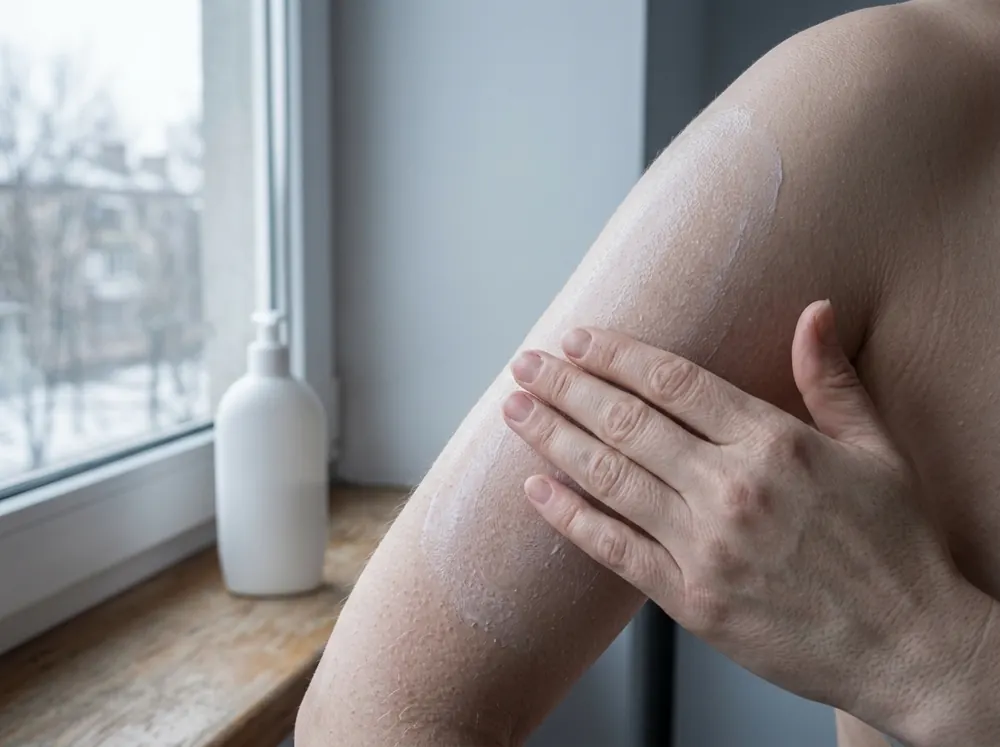
Twelve weeks is the interval the trials use, and it is roughly twice what people give a body lotion before deciding it does nothing. Compounding that, the area is behind you — the backs of your arms and your upper back are places you genuinely cannot see well, and the mirror check happens at a different angle and in different light every time.
The fix is a fixed reference. Same spot, same distance, same light, no filters, and for arms and backs, ask someone or use a timer rather than twisting. Photograph the same patch at week zero and week twelve. Whether that lives in a dated album on your phone or in something built for it like Skinic, the point is having something to compare against when a treatment has been quietly working for two months.
Conclusion
Bumps below the neck are usually one of three things, and the differences are easy to read once you know what to look for.
Uniform, evenly spaced, one per follicle, on the outer upper arms and thighs, present since childhood and worse in winter: keratosis pilaris, a keratin plug at the follicular opening, affecting most of the population and associated with the same genetics as eczema. Itchy, uniform, on the upper trunk with no comedones: think folliculitis, possibly the fungal kind. Mixed sizes with blackheads among them, on the back and chest: acne.
For keratosis pilaris specifically, put the scrub down. The plug is inside the follicle and abrasion never reaches it. What the evidence supports is a chemical keratolytic — lactic acid or urea ahead of salicylic acid on current data — applied consistently and judged at twelve weeks rather than at two.
And hold the evidence loosely. These are small, mostly open-label studies with short follow-up. The direction is consistent enough to act on; the precision is not good enough for anyone to promise you a number.
Frequently asked questions
5 questions · tap one to open the answer
What is the fastest way to get rid of keratosis pilaris?
Is keratosis pilaris caused by poor hygiene?
How do I know if my back acne is actually fungal?
Why do I get bumps on my legs after shaving?
Does moisturising help keratosis pilaris?
Medically reviewed by
Dr. M.M Hanaei
Aesthetic Physician, Dermatology Fellowship
- MD — Shahid Beheshti University of Medical Sciences (SBMU)
- MCC Licensure (Medical Council of Canada)
- Dermatology Fellowship, Switzerland
- Certified in advanced aesthetic procedures
Last reviewed 15 September 2026