Skinic
Search "microneedling before and after" and you get thousands of image pairs. Almost none of them are evidence, and there is a study that puts a number on why.
Researchers pulled the top posts from nineteen facial-aesthetic-surgery hashtags on Instagram and had three plastic surgeons score each before-and-after pair against a five-item rubric for photographic discrepancy. Of 291 posts analysed, photography conditions favoured the postoperative image in 282. That is 97%. The average bias score was 1.71 out of 5.
The same paper found that accounts with more followers had significantly higher bias scores, and that only 27.5% of the top posts came from plastic surgeons at all.
So before any timeline is worth discussing, the pictures have to be dealt with. This article does three things: explains why the photographs you are comparing are not measurements, gives the honest course of a microneedling treatment week by week — including the stretch where skin looks worse — and ends with how to photograph your own so that in three months you have something real to compare.
Why the Photos You Are Looking At Are Not Evidence
There are three separate problems, and they compound.
The Light Does More Than the Treatment
This is the one that surprises people. A randomised, blinded study photographed 51 people under identical conditions — same camera, same lens, same strobe at 5600 K, same distance, same aperture — and changed exactly one thing: the height of the light, giving angles of 0°, 30° and 60°. Twenty-seven blinded raters then scored the resulting images.
Between 0° and 60°, on the same face on the same day, ratings moved measurably. Nasolabial fold severity increased by 0.159 points (p = 0.020). Rated facial attractiveness fell by 0.16 points (p = 0.024) and rated unattractiveness rose by the same amount (p = 0.020). Estimated body mass index went up by 0.23 (p = 0.002).
Nothing about the person changed. The lamp moved seventy-five centimetres.
The authors also found what they called a blind range: between 0° and 30°, assessments barely shifted. Past that threshold, they did. Which means a "before" shot under overhead clinic lighting and an "after" shot under a light placed level with the face are not the same measurement, and the difference is in the direction that flatters the second one.

Expression, Angle, Makeup and Distance
The rubric in the Instagram study scored five separate photographic discrepancies, and lighting is only one of them. A relaxed jaw versus a slightly lifted chin. A neutral face versus a faint smile that lifts the midface. Foundation and a matte powder. A few centimetres closer, which changes lens compression across the nose and cheeks.
Each is small. All five, pushed in the same direction, produce a visible change with no biology underneath it.
You Are Only Shown the Ones That Worked
The third problem is selection, and it is the least fixable. A clinic with a hundred patients publishes the three best outcomes. The photographs are not fraudulent — those three people really did get that result — but the denominator is missing, and the denominator is the whole question. This holds in journals as well as on social media; published image pairs are chosen for how much they demonstrate.
None of this means microneedling does nothing. It means image pairs cannot tell you whether it does, and a different kind of evidence is needed.
What Microneedling Actually Does
The mechanism is not mysterious. Fine needles puncture the epidermis and dermis in a dense pattern, and the body responds to those micro-wounds with its ordinary repair cascade. The procedure's older name — percutaneous collagen induction — describes the intent exactly: injure the skin in a controlled way so that it rebuilds.
A 2025 narrative review of 70 studies traces the sequence. Growth factors are released from platelets and neutrophils at the moment of injury. Around five days later a fibronectin matrix forms, which is the scaffold new collagen is laid down along. Type III collagen — the fast, disorganised kind laid down early in any wound — is then gradually converted to type I, the type that gives skin its firmness.
That conversion is the part worth holding onto, because it sets the timescale. It happens over weeks to months, not days.
The histology backs it up, with a wrinkle. In one study the review cites, one month after treatment there was a statistically significant decrease in total elastin alongside significant increases in collagen types I, III and VII. Elastin only rose above baseline at the three-month mark. Another, using six treatments at two-week intervals, found increased epidermal thickness and increased tropoelastin and collagen I, III and VII, significant at both one and three months.
Which is to say: the tissue is still rearranging itself at one month. What you see in the mirror at week four is not the result.
The Real Timeline
The most useful clinical anchor here is a study of 48 people aged 35 to 75 who each had four microneedling sessions thirty days apart, assessed at days 30, 60, 90 and 150. It is open-label with no control group, which limits what it proves — but it tracked the same people at fixed intervals, which is exactly what image pairs do not do.
Days 1 to 3: It Looks Like Sunburn
Erythema is immediate and universal. In that 48-person study, redness was rated mild in 70% of subjects and moderate in 30%. A systematic review of adverse effects covering 51 articles and 1,029 patients puts roller-device erythema at anywhere from a day to three to seven days, and swelling at twenty-four hours up to two or three days.
Pain is real but short. Mean score across the four sessions was 5.2 out of 10 during treatment. By the evening of day four, 85% of subjects reported no pain; by day six, 81% reported no discomfort.
This is also the window where skin can look deceptively good. Oedema is fluid in the dermis, and fluid fills fine lines. A photograph taken forty-eight hours after a session can show smoother texture than a photograph taken three weeks later, and none of that is collagen. There does not appear to be a study that specifically measured wrinkle scores during the swelling window, so treat this as mechanical reasoning rather than a reported finding — but it is a good reason to distrust any "after" photograph taken within the first week.
Week 1: Dryness and Flaking
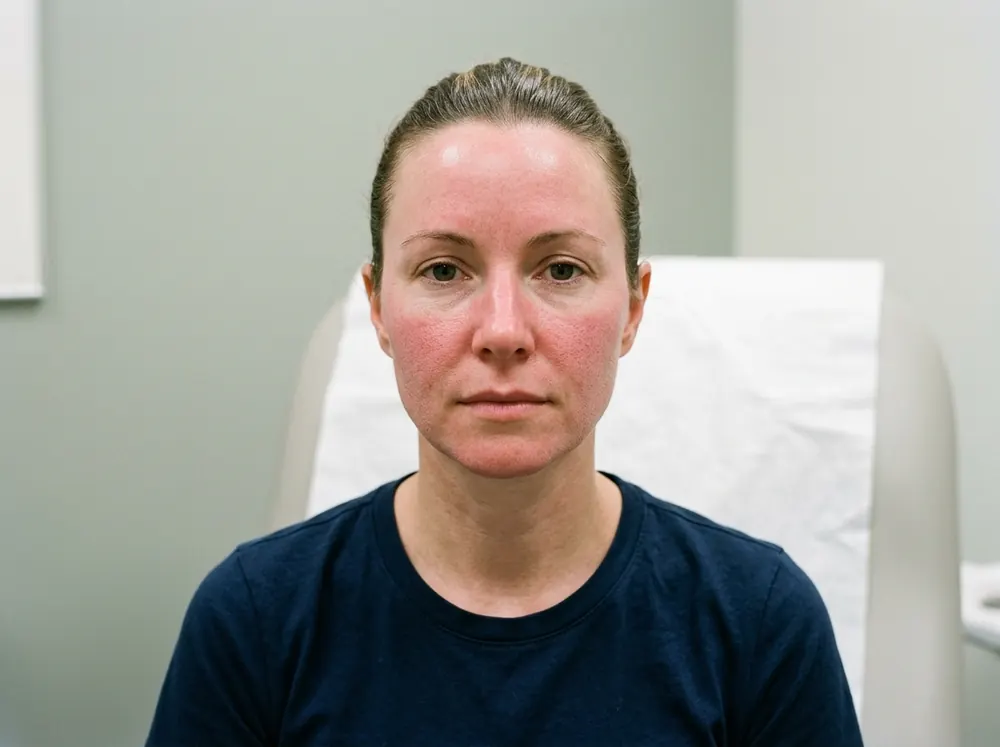
DermNet describes the post-procedure course as dryness, scaling, redness and swelling lasting several days or longer. The flaking phase is the one people are least prepared for, because it arrives after the redness has settled and feels like a setback.
Weeks 2 to 4: The First Honest Signal
DermNet places the earliest visible rejuvenation at around two weeks. This is the start of the signal, not its peak — and it is also where the elastin data says the tissue is still mid-reorganisation.
Months 2 to 5: Where the Numbers Actually Move
In the 48-person study, the measured improvements at day 150 were: global wrinkle score improved by 1.23 points (99% confidence interval 1.11 to 1.34), skin texture by 1.54, and skin laxity by 1.09, all on physician-assessed grading scales.
Day 150 is five months after the first session and roughly two months after the fourth. DermNet's range is wider still — rejuvenation appearing anywhere from two weeks to six or eight months, and for burn scars six months to a year.
The Course, Not the Session
Almost no protocol in the literature is a single treatment. The scar review below found ranges of one to twelve sessions at one- to eight-week intervals for standard microneedling. DermNet recommends a minimum of six weeks between treatments and three to four treatments for moderate acne scarring.
A single-session before-and-after is not a meaningful object. The honest unit is a course measured over four to six months.
What It Does Better, and What It Does Not Touch
A systematic review of 58 studies covering 1,845 patients is the best available summary for scarring, and it is specific about which scars respond.
| Scar type | Shape | Response |
|---|---|---|
| Rolling | Broad, M-shaped, sloping edges | Greatest clinical improvement |
| Boxcar | U-shaped, defined edges | Greatest clinical improvement |
| Icepick | Narrow, deep, V-shaped | Often recalcitrant |
The mechanism explains the pattern. Inducing collagen underneath a shallow depression can lift its floor. An icepick scar is a narrow tract running deep into the dermis, and filling it from below is a different problem.
Two further findings from the same review. Microneedling was tolerated better than laser resurfacing — CO₂, Er:glass and diode — with less downtime, and patients preferred it to intralesional triamcinolone and to a 1450 nm diode laser. But combination treatment consistently beat microneedling alone: with laser, with platelet-rich plasma, with subcision, with a glycolic acid peel. On its own it is the gentler option, not the strongest one.
The honesty clause matters here. The authors could not perform a meta-analysis because the studies were too heterogeneous to pool, and they state plainly that the field suffers from a lack of standardised protocol, with further work needed on the optimal number of passes, sessions and intervals.
One frequently quoted figure deserves a caution. The same literature includes a 120-patient series in which, after an average of 2.5 treatments, all scars improved by 50%, with 80% of patients improving between 50% and 75% and 65% improving by more than 75%. Those last two figures sum to 145%, which means the categories overlap or are being reported differently than they read. It is quoted widely without anyone noticing. Treat it as an impression, not a measurement.
Pigmentation, and Who Should Ask More Questions
Microneedling is often recommended over lasers in darker skin because the micro-channels cause little epidermal damage. The data are more mixed than that summary suggests: post-inflammatory hyperpigmentation was reported in 19 of the 58 studies, over 30% of them, resolving spontaneously or with topical treatment over months. The authors note most patients in the review were Fitzpatrick phototype IV or above, which may bias adverse-event reporting toward pigmentary change — but also means the signal comes from exactly the population that needs to know.
Any controlled injury carries this risk, and it scales with phototype. If you do not know yours, the Fitzpatrick scale is the starting point, and hyperpigmentation in brown and deep skin tones covers what the risk actually looks like and how long it takes to settle. It is the single most important question to raise before a first session, and the answer should not be "microneedling is safe for all skin types" delivered as a slogan.
Depth, Devices, and Why Home Rollers Are a Different Product
This section explains a difference. It is not instruction, and there are no settings here to copy.
The clinical range runs to 3 mm, though DermNet notes 0.5 mm is typical to limit bleeding and speed recovery. Home devices run at about 0.2 mm. The narrative review puts home rollers at under 0.15 mm, against 0.5 to 1.5 mm for a medical dermaroller.
That is not a lower dose of the same thing. The mechanism described earlier — dermal injury, fibronectin scaffold, collagen remodelling — depends on reaching the dermis. A device that does not is doing something else, whatever it is sold as doing.
Device type changes the risk profile too, and not in the direction most people assume. Across modalities, the narrative review found tram-track marks and post-inflammatory hyperpigmentation were most significant with the roller, as was bleeding, while edema was most significant with the roller and pain most significant with the pen. A roller drags needles through skin at an angle as it turns; a pen punctures vertically.
The adverse-effect review records the rarer events: tram-track scarring in two patients, delayed-type granulomatous hypersensitivity in three, one case of scarring from an allergy to the nickel in the needles, herpes simplex reactivation, milia, acne flares. Only two infections appear in 1,029 patients — and one of them was a home-use roller, in a patient who spread varicella from her chest to her face by treating both.
That case is the argument in one sentence. Sterile technique in a clinic is not fussiness; it is the thing standing between a dense field of open channels and whatever is on the device.
The broader framing is worth carrying over from what "medical grade" skincare actually means: the phrase on the box is a marketing category, and what matters is what the device physically does and who is holding it. The same test applies to the other device on the bathroom shelf: what an LED mask can and cannot do turns on a single measurement most manufacturers decline to print.
Photographing Your Own Course So It Means Something
If image pairs are unreliable because their conditions vary, the fix is to stop the conditions varying. You cannot run a trial on yourself, but you can remove the five variables the Instagram rubric scored.
- One light, always the same. Same window, same time of day, same weather if you can manage it. The light-angle study found the shift only became significant past 30°, so the goal is simply not to move the source between shots. Overcast daylight is the most repeatable thing most people have.
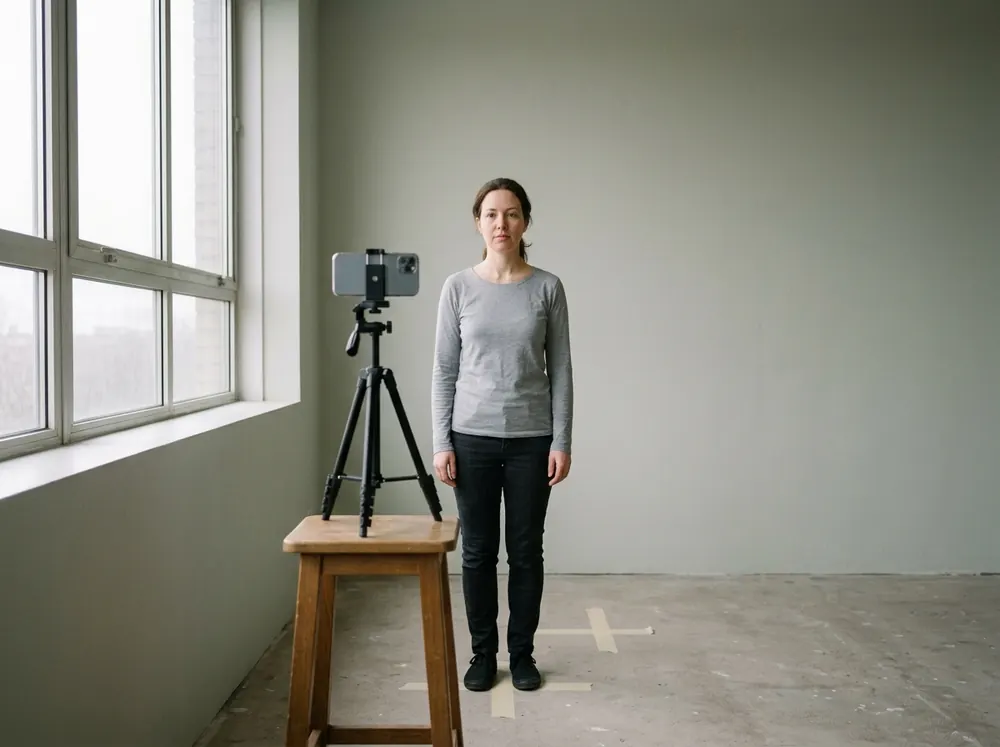
- Fix the camera position. Phone on a small tripod or propped at the same spot, same height, same distance. A strip of tape on the floor for your feet costs nothing and removes lens compression as a variable.
- Neutral expression, every time. Jaw relaxed, eyes open, no smile. A faint smile lifts the midface and erases a nasolabial fold on its own.
- Bare skin. No makeup, no highlighter, no face oil. Same interval after cleansing, since skin looks different damp.
- Three angles, not one. Straight on and both three-quarters. A single frontal shot hides exactly the contour changes you are trying to track.
Then timing, which is the part specific to microneedling. Do not photograph inside the first week. Redness and swelling are at their peak and will flatter the image for reasons unrelated to collagen. Shoot at baseline before the first session, then at a fixed interval — day 30, 60, 90, 150 is the schedule the 48-person study used, and there is no reason not to borrow it.
Five months of dated photographs taken under identical conditions is a better dataset than any clinic gallery, because it has the one thing those do not: every result, not the selected ones.
Conclusion
Microneedling has real evidence behind it. A 58-study review found consistent improvement in rolling and boxcar scars, better tolerability than laser resurfacing, and no serious adverse events across 1,845 patients. A 48-person study tracked measurable improvement in wrinkle, texture and laxity scores out to five months. That is more than most things sold for skin have.
It also has limits stated by the people who reviewed it: no meta-analysis was possible, no standardised protocol exists, icepick scars mostly do not respond, and combination treatment beats it alone every time it has been compared.
What it does not have is a way to be demonstrated in two photographs. The timeline is four to six months across multiple sessions, the visible course runs backwards for the first week or two, and rating a face can be moved by moving a lamp.
So when a before-and-after makes the decision for you, the question to ask is not whether the result is real. It is what the light was doing, where the camera was, what week the second photo was taken, and how many other patients' photographs were not posted.
If you want an answer you can trust, the only reliable one is the one you collect yourself, on the same spot on the floor, in the same window light, for five months.
Frequently asked questions
5 questions · tap one to open the answer
Are microneedling before and after photos reliable?
How long does it take to see results from microneedling?
Does skin look worse after microneedling before it looks better?
What kind of acne scars does microneedling work on?
Are at-home microneedling rollers the same as professional treatment?
Medically reviewed by
Dr. M.M Hanaei
Aesthetic Physician, Dermatology Fellowship
- MD — Shahid Beheshti University of Medical Sciences (SBMU)
- MCC Licensure (Medical Council of Canada)
- Dermatology Fellowship, Switzerland
- Certified in advanced aesthetic procedures
Last reviewed 20 September 2026