Skinic
You bought two moisturisers. A gel for the T-zone, because that area gets shiny by lunchtime, and something richer for your cheeks, which feel tight and look dull. You have been applying them in separate zones like a weather map for about a year.
Your skin is still shiny by lunchtime, and your cheeks still feel tight.
Here is the thing nobody selling you those two products mentions: an oilier forehead and nose with drier cheeks is not a skin type. It is the standard anatomical layout of a human face. Everyone has it. The oil glands are simply not distributed evenly, and no routine is going to change where they are.
Which raises the real question — if the T-zone difference is normal, what is actually going on with the skin that made you go looking for an answer? For a large share of people who identify as combination, the answer is that the skin is dehydrated rather than genuinely two different types, and the two-product strategy treats the symptom on both halves while missing it.
This piece covers where the "combination" label came from, what the sebum measurements actually show, the difference between dry and dehydrated, and why the popular explanation for oily skin — that stripping it makes it produce more — turns out to be much shakier than everyone assumes.
"Combination" Is a Category From 1910
Start with where the word comes from, because it is not a clinical finding.
The familiar four-way split — dry, oily, combination, sensitive — was introduced by Helena Rubinstein in 1910. It is a cosmetics classification, more than a century old, built to sort customers into product lines. Researchers are direct about its shortcomings: it does not incorporate pigmentation status, photoaging or age-related structural changes, which limits its applicability in clinical decision-making.
Dermatology has since built more serious instruments. The Baumann Skin Type Indicator assesses four dichotomous parameters — dry or oily, sensitive or resistant, pigmented or non-pigmented, tight or wrinkled — producing sixteen distinct skin types. Notice that "combination" is not one of them. Oiliness is one axis among several, not a category you belong to.
This matters practically. If you have been trying to place yourself in one of four boxes designed to sell face creams in 1910, some of the confusion is the boxes.
Everyone's T-Zone Is Oilier — Here Are the Numbers
The uneven distribution is not subtle, and it has been measured.
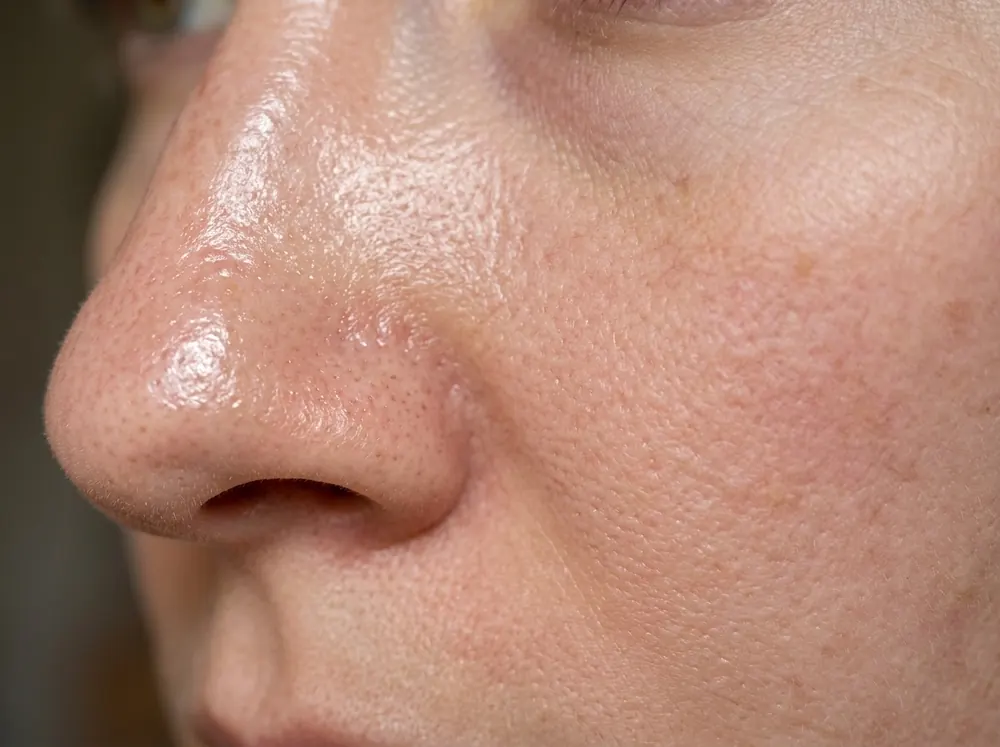
Sebaceous gland density varies enormously across the body. The scalp and forehead carry approximately 400 to 900 glands per square centimetre, far more than the limbs. That density is anatomy — you were born with it, it does not respond to cleanser choice, and it is why the forehead behaves differently from the jaw.
The output follows. In a study of 30 healthy women, forehead sebum measured 96.17 μg/cm² against 38.12 μg/cm² on the cheek — roughly two and a half times as much, with a p-value of 4 × 10⁻⁶. These were not participants selected for having combination skin. They were ordinary healthy volunteers, and the pattern held across the group.
So when you look in the mirror at midday and see a shiny forehead above matte cheeks, you are observing gland density. The person next to you has the same gradient. Some people simply produce more sebum overall, which makes the gradient more visible — but the shape of it is universal.
The useful reframe: you do not have two skin types. You have one skin, with more oil glands in the middle of your face, like everyone else.
But the Hydration Is the Same Across Your Face
Here is the finding from that same study that should change how you think about this, and it is the one nobody quotes.
The researchers measured hydration as well as sebum. Forehead hydration came in at 53.26 arbitrary units and cheek hydration at 51.64 — a difference that was not statistically significant, at p = 0.302.
Read those two results together. Across the same faces, sebum differed dramatically between zones and hydration did not.
That is a direct argument against zoning your moisturiser. A moisturiser's job is water content and barrier support. If hydration is roughly even across your face while oil output is not, then applying a rich cream to your cheeks and a gel to your T-zone is treating a difference that exists in oil while addressing a variable that does not differ. It is the wrong axis.
What is genuinely zone-specific is oil — and oil is managed by cleansing, texture preference and, where relevant, actives. Not by having two moisturisers.
Dehydrated Is Not Dry
This is the distinction that resolves most "combination" confusion, and the two words get used interchangeably in a way that makes the problem unsolvable.
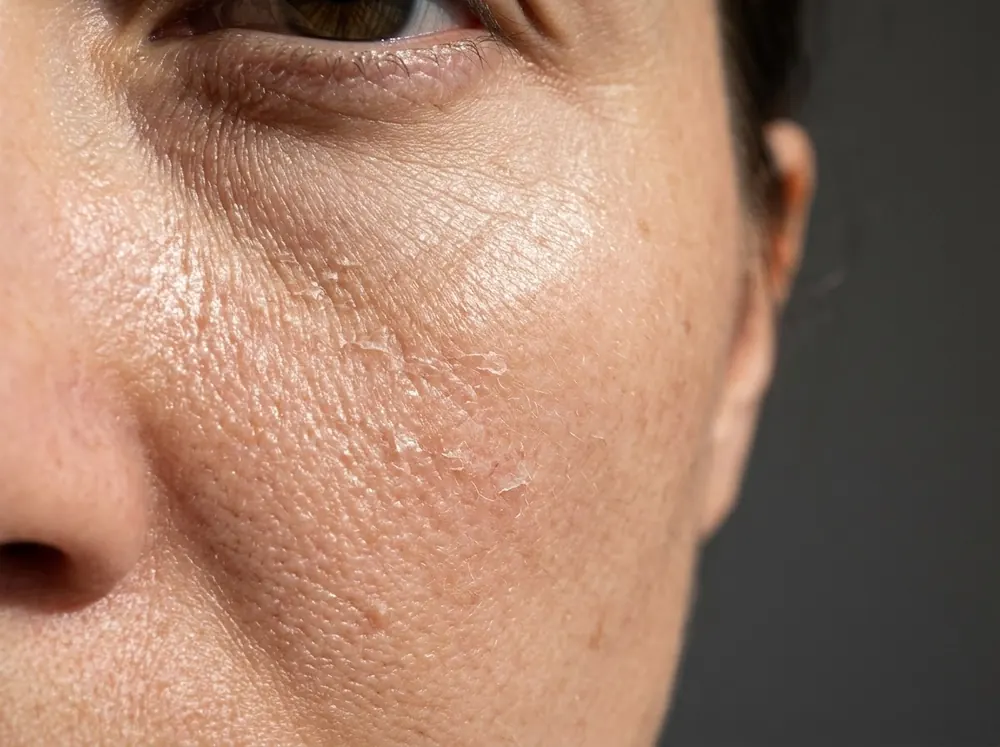
Dry is a lipid problem. The skin is not producing enough oil to hold its barrier together. Dry skin is characterised by roughness or flaking, loss of flexibility, sometimes fissures, and it tends to be a constitutional trait — a description of what your glands do.
Dehydrated is a water problem. The stratum corneum is short of water. That is a state, not a type: it fluctuates with weather, indoor heating, air conditioning, flights, illness, alcohol, and — crucially — with anything that has damaged the barrier's ability to hold water in.
The critical consequence: oily skin can be badly dehydrated at the same time. There is nothing contradictory about it. Plenty of sebum on the surface, not enough water in the layer underneath. And dehydrated skin feels tight, looks dull and crepey, and shows fine lines that disappear when it is hydrated properly — which is exactly the set of complaints that sends people to buy a rich cream for their cheeks.
How to tell them apart on yourself:
| Dry | Dehydrated | |
|---|---|---|
| The problem | Not enough oil | Not enough water |
| Nature | Usually constitutional | A fluctuating state |
| Feels | Rough, flaky, sometimes itchy | Tight, especially after cleansing |
| Looks | Dull, visible flaking | Dull, crepey, fine lines that fill out when hydrated |
| Can it be oily too? | No, by definition | Yes — very commonly |
| Changes with weather, travel, heating | Somewhat | Markedly |
If your cheeks feel tight rather than flaky, if the tightness is worst in the twenty minutes after you wash, and if your skin looks noticeably better on a humid holiday — that is dehydration, and it is a different problem from the one a rich cream is designed for. Reading a moisturiser label properly sets out which ingredient classes address which of the two.
The Feedback Loop Everyone Describes, and What the Evidence Shows
There is a story you have heard many times, probably in an article much like this one: strip your skin with a harsh cleanser and it panics, overproduces oil to compensate, and you end up oilier than when you started. It is tidy, it is intuitive, and it is repeated everywhere.
It is also much less well supported than its popularity suggests.
The best objective look at this comes from scalp research, where the same claim circulates about shampoo. The authors note that people recommending infrequent washing cite the belief that washing causes stimulation of excessive compensatory sebum production — and that there is a dearth of objective data supporting the concern. When they measured it, increased washing frequency produced significantly lower amounts of overall surface lipid and sebum fatty acid, and they concluded that concerns about overcleaning were unfounded both objectively and subjectively.
That is scalp, not face, and the two are not identical — facial data on this specific question is thin. But it is the most direct objective evidence available, and it points the opposite way to the popular claim.
So why does over-cleansing so reliably make skin worse? Because the real mechanism is barrier damage, not rebound oil production. Stripping the stratum corneum of its lipids leaves the barrier less able to hold water, which produces tightness, dullness, flaking and reactivity — dehydration, in other words. And dehydrated skin with normal sebum output reads as worse rather than better: the surface looks dull and rough while the shine is still there, which is precisely the "oily but somehow also tight and flaky" picture that gets labelled combination.
The practical advice barely changes — do not use harsh cleansers. But the reason matters, because it tells you what to fix. You are not trying to suppress a panicking gland. You are trying to repair a barrier. Choosing a cleanser that does not strip is where that starts.
What to Do Instead of Zoning
- Stop treating it as two skins. One gentle cleanser, one moisturiser suited to the drier reading on your face, applied everywhere. If the T-zone feels heavy under it, the answer is a lighter texture overall, not a second product.
- Address water before oil. If tightness after cleansing is your main complaint, the problem is hydration and barrier, and that is what the routine should be built around for the next few weeks.
- Let actives be the zoned part, not the moisturiser. If your T-zone is congested, a targeted treatment there is reasonable. Hydration is not the variable that differs between your zones; congestion may be.
- Give it a fortnight of doing less. Dehydration responds quickly — much faster than most skin changes — which makes this unusually satisfying to test.
- Then reassess. A meaningful number of people find that once the dehydration resolves, what is left is simply a normal face with a normal T-zone.
Working Out What You Actually Have
The honest difficulty with everything above is that it asks you to make a judgement about your own face, and nobody is a good judge of their own face.
Shine is the clearest example. Whether your T-zone looks oily depends on the light, the time of day, what you last ate, the season and whether you have been thinking about it. People check at the moment they feel shiniest and conclude that is the baseline. And tightness — the actual signal that separates dehydrated from dry — is something you feel for twenty minutes after cleansing and have forgotten by the time you are deciding what to buy.
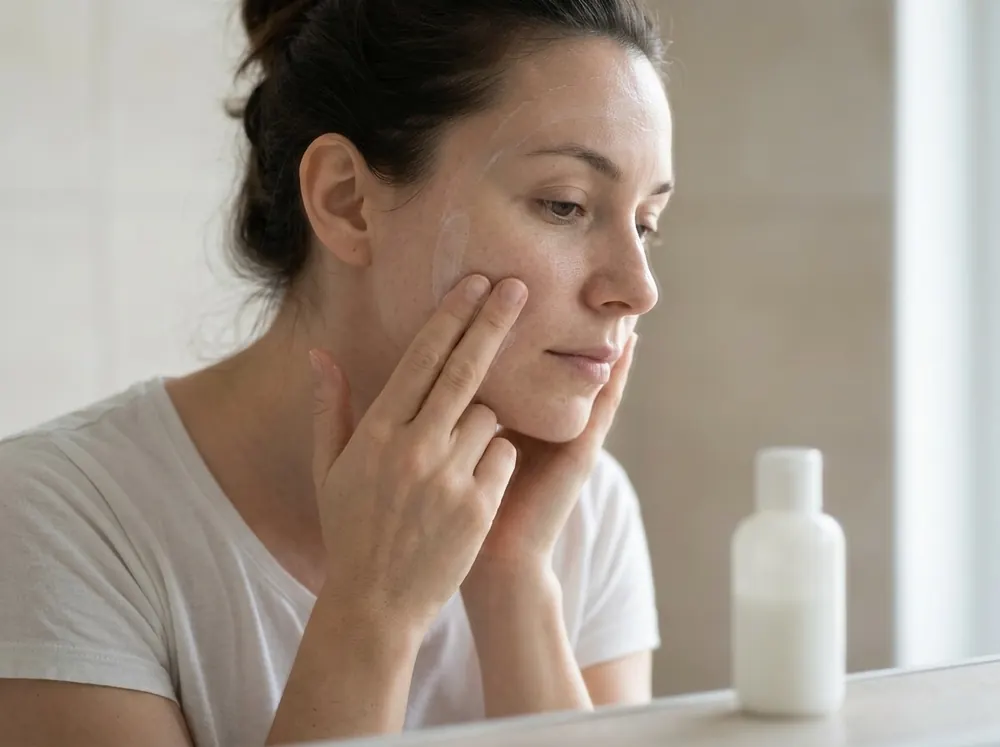
Two things make it more reliable. Check at a fixed time, ideally mid-afternoon, in daylight, before you have touched your face — not at the moment you notice shine. And keep a record rather than an impression: photograph in consistent conditions, same spot, same distance, same light, and note how your skin feels twenty minutes after cleansing. Whether that lives in a dated album on your phone or in something built for it like Skinic, the point is comparing like with like across a fortnight instead of relying on how you remember last week.
If you are also trying to work out your Fitzpatrick type, note that it is a completely separate axis — Fitzpatrick skin types I–VI describes UV response and says nothing about oiliness or hydration. And if you are rebuilding from scratch, how to build a skincare routine is the place to start.
Conclusion
An oilier T-zone is not a diagnosis. Sebaceous glands cluster in the centre of the face in everyone, at roughly 400 to 900 per square centimetre on the forehead, producing around two and a half times the sebum measured on the cheek. That gradient is anatomy, and no product changes it.
What is worth acting on is the part people mislabel. Hydration does not differ meaningfully between facial zones, so zoning your moisturiser targets the wrong axis. Tight, dull, crepey cheeks alongside a shiny T-zone is usually dehydration — a water problem, a state rather than a type, and one that resolves in a fortnight once the barrier is left alone.
Drop the two-product strategy. Use one gentle cleanser, one moisturiser matched to the drier reading on your face, and give it two weeks. Keep any zoning for actives, where the difference between your zones is real.
Most people who think they have combination skin have a normal face and a damaged barrier. Only one of those is worth buying anything for.
Frequently asked questions
5 questions · tap one to open the answer
What is combination skin, really?
Why is my T-zone oily but my cheeks dry?
Do I need two different moisturisers for combination skin?
What is the difference between dry and dehydrated skin?
Does washing your face too much make it produce more oil?
Medically reviewed by
Dr. M.M Hanaei
Aesthetic Physician, Dermatology Fellowship
- MD — Shahid Beheshti University of Medical Sciences (SBMU)
- MCC Licensure (Medical Council of Canada)
- Dermatology Fellowship, Switzerland
- Certified in advanced aesthetic procedures
Last reviewed 13 September 2026