Skinic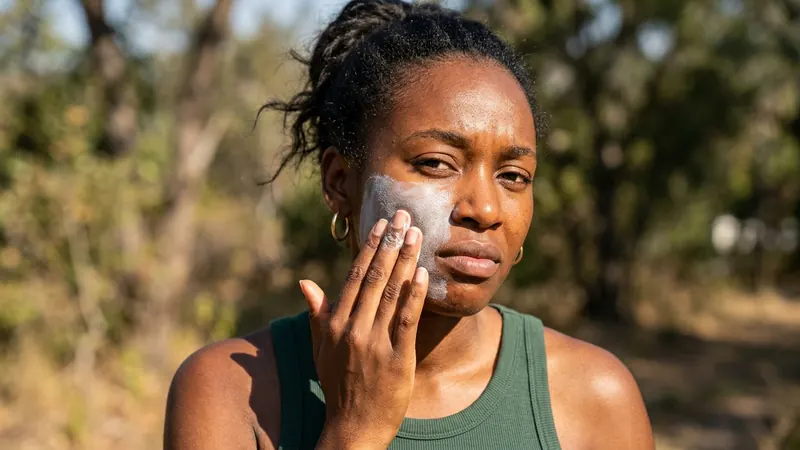
You own sunscreen. It is in the bathroom cabinet. You bought it after reading an article much like this one, you used it for four days, and then you stopped — because it made you look grey, and you were not willing to leave the house like that.
This is treated as an adherence problem, as though the issue is motivation. It is not. It is a formulation problem with a well-understood physical cause, and it lands hardest on exactly the people for whom the pigmentation consequences of skipping sunscreen are most severe.
The white cast comes from specific ingredients behaving in a specific way. Once you understand which ones and why, you can read the back of a bottle and predict how it will look on you before you buy it — which is a far more useful skill than any list of product recommendations, because the list will be out of date in a year and the physics will not.
This piece covers what actually causes a cast, why "mineral versus chemical" is the wrong way to think about it, why sunscreens formulated in Korea, Japan and Europe have felt different for two decades and what changed in the US in June, and the three genuine routes around the problem — including one that is not just cosmetic, because it protects against something UV filters do not touch at all.
You Are Not Skipping It Because You Are Lazy
Worth saying plainly, because most coverage of this skips straight to product picks.
If a sunscreen makes your skin look ashy in daylight, refusing to wear it is a reasonable response to a product that does not work for you. The failure belongs to the formulation and to an industry that spent decades treating type II skin as the default test case.
That framing is not just sympathetic — it is documented. A review of visible light protection across diverse populations reports that more than half of clinicians provided less photoprotection counselling to patients with skin of colour, with dermatologists often overlooking phototype considerations altogether. The same review names inadequate shade matching across diverse skin tones and higher costs as real barriers to the tinted products that would otherwise solve the problem.
So: not a discipline issue. A supply issue, a counselling issue, and a physics issue. The physics is the part you can act on today.
What Actually Causes a White Cast
The cast comes from the mineral filters — titanium dioxide and zinc oxide — and from two properties they cannot help having.
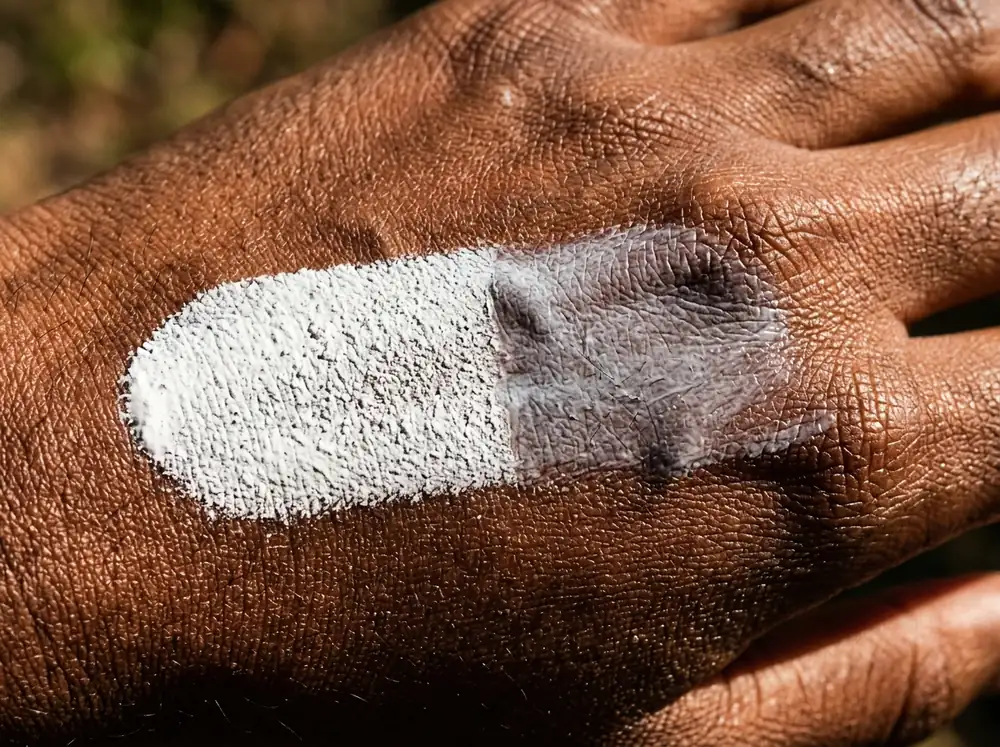
The large particle size and high refractive indices of both TiO₂ and ZnO leave a white, often undesirable residue on the skin. That is the whole mechanism in one sentence.
Refractive index describes how strongly a material bends and scatters light. TiO₂ and ZnO both have high ones, which is precisely what makes them useful against UV — and the same property means they scatter visible light too. Scattered visible light across a surface is what "white" looks like. Zinc paste on a lifeguard's nose is the extreme version of the same effect.
Particle size is the second half. Larger particles scatter longer wavelengths, and the visible spectrum is longer than UV. So a formula built on coarse mineral particles is optically a thin layer of white pigment sitting on your face.
Which points at the fix. Engineering these compounds into nanoparticles leads to less scattering of visible light and improvement in cosmetic appearance. Make the particles small enough and they stop scattering the wavelengths your eye can see, while still handling UV. That is what "micronised", "nano" and "sheer mineral" on a label are describing.
One thing worth addressing since it puts people off: on the safety of nano-scale mineral filters, the same review notes that these particles do not penetrate further than the stratum corneum, the outermost layer of the skin, making systemic absorption unlikely.
"Mineral vs Chemical" Is the Wrong Frame
The two-camp framing has become the default way people shop for sunscreen, and it is the reason so many end up with a cast they did not want.
The real distinction is mechanistic. Inorganic filters work by reflecting and scattering UVA and UVB radiation, while organic filters absorb UV energy and convert it to heat or to harmless wavelengths. Absorption does not scatter visible light. That is the entire reason organic filters are cosmetically invisible — not because they are gentler, newer or better, but because of how they interact with photons.
So if a white cast is your problem, "mineral versus chemical" is not the axis to shop on. Two questions matter: does this formula rely on inorganic filters, and if so, are the particles micronised? A modern organic filter system will not cast. A well-micronised mineral formula usually will not either. A coarse zinc formula will.
Why Korean, Japanese and European Sunscreens Feel Different
There is a reason "korean sunscreen" has become a search term in its own right, and it is not marketing.
The Reason Is Regulatory, Not a Formulation Secret
The US regulates sunscreens as over-the-counter drugs, which places UV filters inside the monograph system — a process that for decades relied on slow notice-and-comment rulemaking. Europe, Japan, Korea and Australia regulate them differently, and approved a generation of newer organic filters that American formulators simply could not use.
Bemotrizinol, sold as Tinosorb S and Parsol Shield, has more than two decades of use across Europe, Australia and Asia. Formulators working in those markets have had access to broad-spectrum, photostable, cosmetically elegant filters for twenty years. That is the difference you feel when a Korean sunscreen disappears into your skin and an American one sits on top of it.
The Sunscreen Innovation Act of 2014 was supposed to fix this. It created an expedited pathway and then yielded no approvals, partly because the FDA required testing not harmonised with international standards. Eight filters submitted under that act remain unapproved.
What Changed in June 2026
This is new enough that most published advice has not caught up.
On 9 June 2026, the FDA added bemotrizinol to the sunscreen monograph as generally recognised as safe and effective at concentrations up to 6% for adults and children from six months — the first new UV filter added since 1999.
Practically, US formulations using it will take time to reach shelves, and seven other filters are still waiting. But the twenty-seven-year gap has ended, and US sunscreens should get cosmetically better from here.
Three Routes Around the White Cast
| Route | How it avoids the cast | Best for | Trade-off |
|---|---|---|---|
| Micronised or nano mineral | Particles too small to scatter visible light | Sensitive or reactive skin that tolerates minerals | Quality varies; high-zinc formulas may still cast |
| Modern organic filters | Absorb UV rather than scattering it | Anyone whose only issue is appearance | In the US, still a limited filter selection |
| Tinted, with iron oxides | Pigments match skin rather than whitening it | Deeper skin tones, and anyone prone to pigmentation | Shade matching is often poor; usually costs more |
The first two solve appearance. The third solves appearance and something else entirely, which is the part worth understanding.
Tinted Is Not Just Cosmetic: The Visible Light Problem
Here is the thing that turns a cosmetic preference into a clinical one.
UV filters protect against UV. They do essentially nothing about visible light — and visible light drives pigmentation, particularly in deeper skin tones.
Blue light in the 400–490 nm range is particularly potent, inducing sustained pigmentation with more pronounced effects in patients with darker complexions. The mechanism is distinct from the UV pathway: opsin 3 detects the light, triggering calcium influx and melanin synthesis. That means a perfect UV sunscreen, applied perfectly, leaves this pathway completely open.
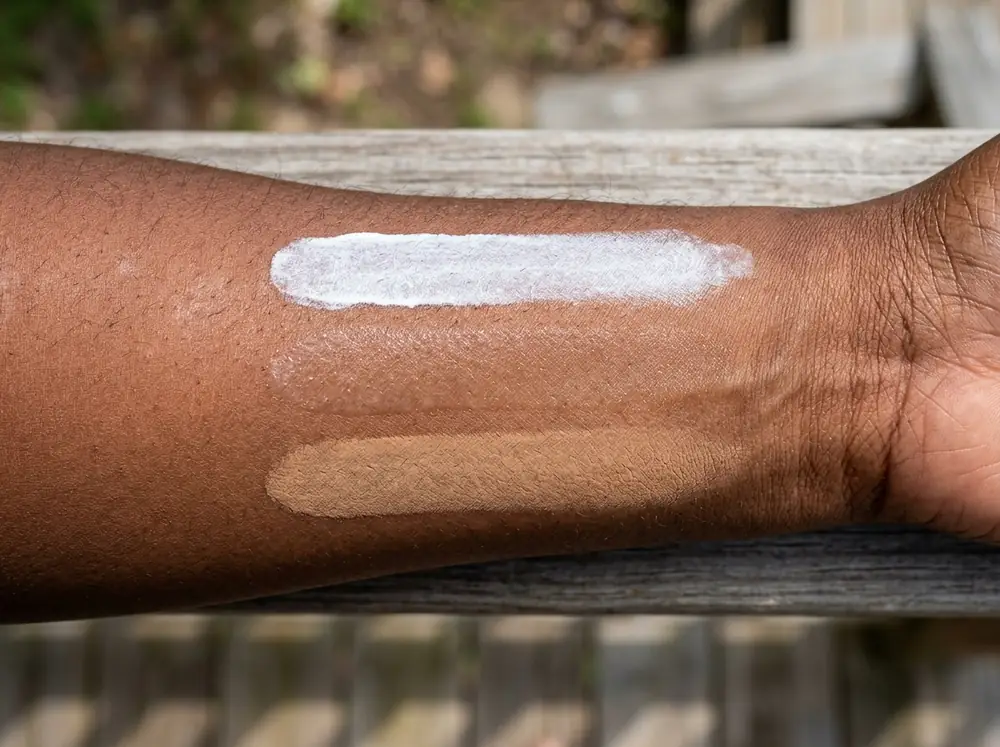
What blocks visible light is pigment. Tinted sunscreens containing iron oxides reduce high-energy visible light transmission by up to 84–97% when properly formulated — typically through a blend of yellow, red and black iron oxides alongside pigmentary titanium dioxide, with the overall pigment blend determining the degree of protection.
So for anyone dealing with melasma, post-inflammatory hyperpigmentation, or dark marks after breakouts, a tinted sunscreen is not the vain option. It is the one addressing a driver that untinted formulas leave untouched. That connects directly to what we have covered in hyperpigmentation in brown and deep skin tones and the types of dark spots.
One honest limitation: the research notes that further work is needed to establish the minimum quantity of iron oxide necessary for protection, so "tinted" on a label is not a guarantee of a meaningful dose. A visible, genuinely skin-matching tint is a better signal than a faint wash of colour.
Why the People Served Worst Need It Most
Put the two halves together and the gap is stark.
Deeper skin tones are more susceptible to visible-light-induced pigmentation, are more prone to post-inflammatory hyperpigmentation after any inflammation, receive less photoprotection counselling, and face inadequate shade matching and higher prices in the product category that would help most.
Your Fitzpatrick type is the variable that routes this decision — and it is worth knowing yours properly rather than guessing, because it also predicts how readily inflammation leaves a mark. Fitzpatrick skin types I–VI sets out how to place yourself, and is explicit that melanin providing some UV protection is a difference of degree, not a pass.
The practical upshot for types IV to VI: prioritise a tinted formula with a genuine shade match, treat the tint as active protection rather than makeup, and accept that finding one may take more effort than it should.
How to Test It on Your Own Face
Bottle descriptions are useless for predicting a cast, because "sheer", "invisible" and "universal" are marketing terms with no defined meaning. Three things actually work.
Read the filter list, not the front. Turn the bottle over. If the actives are only titanium dioxide and zinc oxide at high percentages, expect a cast unless the formula explicitly says micronised. If you see modern organic filters, or iron oxides in the ingredient list, the odds are much better.
Swatch in daylight, not in store. Shop lighting is engineered to flatter. Put a stripe on your jaw — not your hand, which is often a different tone — blend it, step outside, and look in a phone camera. Casts show up in daylight and in photographs far more than in a mirror indoors.
Photograph it. A cast is a subtle shift that is genuinely hard to judge on your own face in real time, and harder still to compare across two products tried a fortnight apart. Same spot, same daylight, same distance, no filters — one photo bare, one with the product on. Whether that lives in a dated album or in something built for it like Skinic, comparing two images side by side settles in five seconds what memory cannot settle at all.
And once you have found one that disappears, two questions remain: how much of it to use — you still tan through sunscreen covers why that matters more than the SPF number — and where it sits in your routine, which AM vs PM skincare covers.

Conclusion
The white cast is optics. Titanium dioxide and zinc oxide have high refractive indices and, at conventional particle sizes, scatter visible light along with UV — which is what a pale film on your face actually is. Shrink the particles, or use organic filters that absorb rather than scatter, and the cast goes away.
Stop shopping by "mineral versus chemical" and start reading the filter list. High percentages of unmodified zinc or titanium will cast. Micronised minerals, modern organic filters and iron oxides will not. And once the finish is right, the amount is what decides the protection — how much sunscreen you actually need covers that, and what "lightweight" actually measures covers why the feel of a formula changes it.
If your skin is type IV to VI, go tinted — not as a cosmetic compromise but because iron oxides block up to 84–97% of the high-energy visible light that drives pigmentation, and no untinted sunscreen touches that pathway at all.
And if sunscreen has felt like something that was not made for you, that was accurate. It largely was not. That is starting to change — the US approved its first new filter in twenty-seven years three months ago — but in the meantime the physics gives you enough to shop with.
Frequently asked questions
5 questions · tap one to open the answer
Why does sunscreen leave a white cast on dark skin?
Do Korean sunscreens really feel different, or is that marketing?
Is mineral or chemical sunscreen better for avoiding a white cast?
Are tinted sunscreens actually better for darker skin?
Are nano sunscreen particles safe?
Medically reviewed by
Dr. M.M Hanaei
Aesthetic Physician, Dermatology Fellowship
- MD — Shahid Beheshti University of Medical Sciences (SBMU)
- MCC Licensure (Medical Council of Canada)
- Dermatology Fellowship, Switzerland
- Certified in advanced aesthetic procedures
Last reviewed 14 September 2026