Skinic
You noticed them in the shower, or when you put on shorts for the first time in months. Small red spots across your shins and thighs. They do not itch, they do not hurt, and you have no idea how long they have been there.
Most of the time, non-itchy red spots on the legs are harmless. Occasionally they are the first visible sign of something that needs attention the same day. The useful thing is that a single test separates those two groups, it takes ten seconds, and you can do it with a drinking glass.
That test comes first in this article, before anything reassuring — deliberately. The reassurance is real and most readers will get to it, but not before the one question that decides whether reading further is the right thing to do at all.
Start With One Test: Does It Blanch?
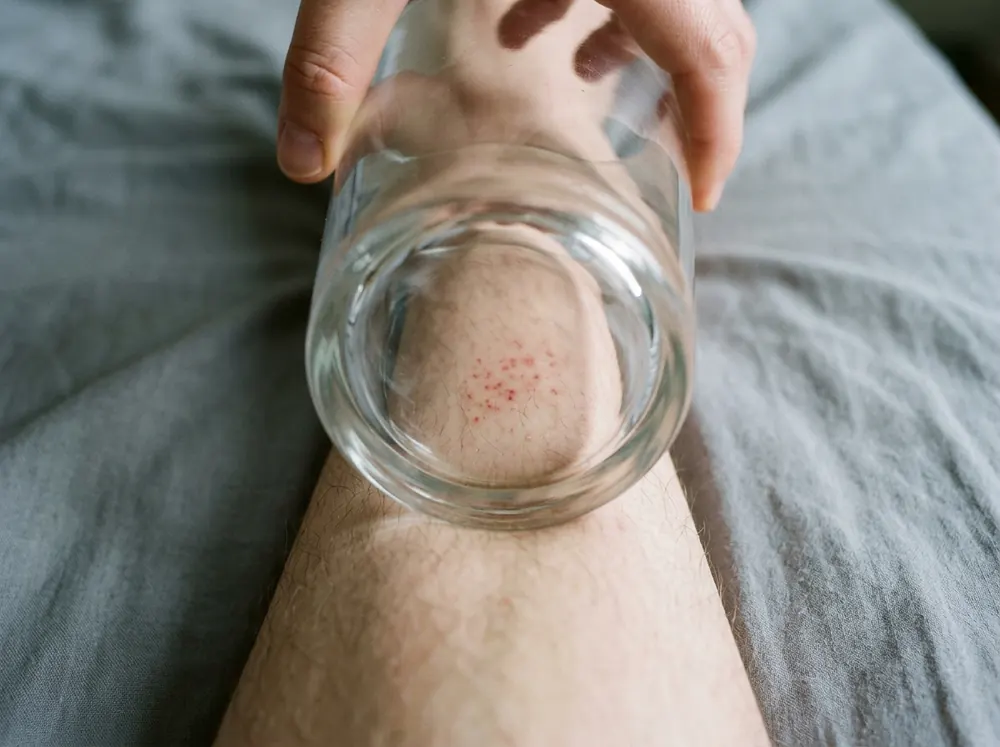
Take a clear drinking glass. Press the base firmly against the skin over a group of the spots, hard enough to squash the skin slightly, and look through the glass at the spots while the pressure is on.
You are watching for one thing: do the spots go pale, or do they stay red?
The technique is called diascopy, and the principle is simple. Erythema — red skin due to an increased blood supply — is red because blood is inside vessels. Pressure squeezes that blood out of the vessels, so the redness fades and the skin blanches. But if blood has leaked out of the vessels into the surrounding tissue, pressure has nothing to push it out of. It stays exactly where it is.
That second situation is called purpura — bleeding into the skin — and the defining feature is that purpura does not blanch with pressure.
So the test sorts your spots into two groups, and the groups mean genuinely different things.
If They Do Not Blanch, Stop Reading and Get Seen
If the spots stay red under firm pressure, that is purpura, and it needs a medical opinion promptly rather than more reading.
Purpura is not itself a diagnosis. It is a sign that blood is escaping small vessels, and the causes fall into broad categories — platelet disorders, coagulation disorders and vascular disorders — some of which are minor and some of which are not. DermNet's guidance is that the underlying cause of purpura should be identified and treated accordingly. That identification is a clinical job involving history, examination and usually blood tests. It cannot be done from a photograph or an article.
This piece is not going to give you a differential for it, and that is on purpose. A list of possible causes, most of them benign, is exactly the thing that lets someone decide they are probably fine and book an appointment next month.
Seek medical attention the same day if non-blanching spots are accompanied by any of: fever, feeling very unwell, a stiff neck, confusion or drowsiness, breathlessness, bleeding from the gums or nose, unusual bruising, or spots that are spreading quickly. Those combinations can indicate an emergency, and the appropriate response is urgent care rather than a routine appointment.
If you feel entirely well and the spots are non-blanching, it is still a GP appointment rather than a wait-and-see — soon, not eventually.
Everything below this point applies only to spots that do blanch.
If They Blanch: Four Common Answers
Blanching means the blood is still inside the vessels, which rules out the urgent category. Now the other features do the sorting.
Cherry Angiomas
The single most common benign answer, and the one people are most often surprised by.
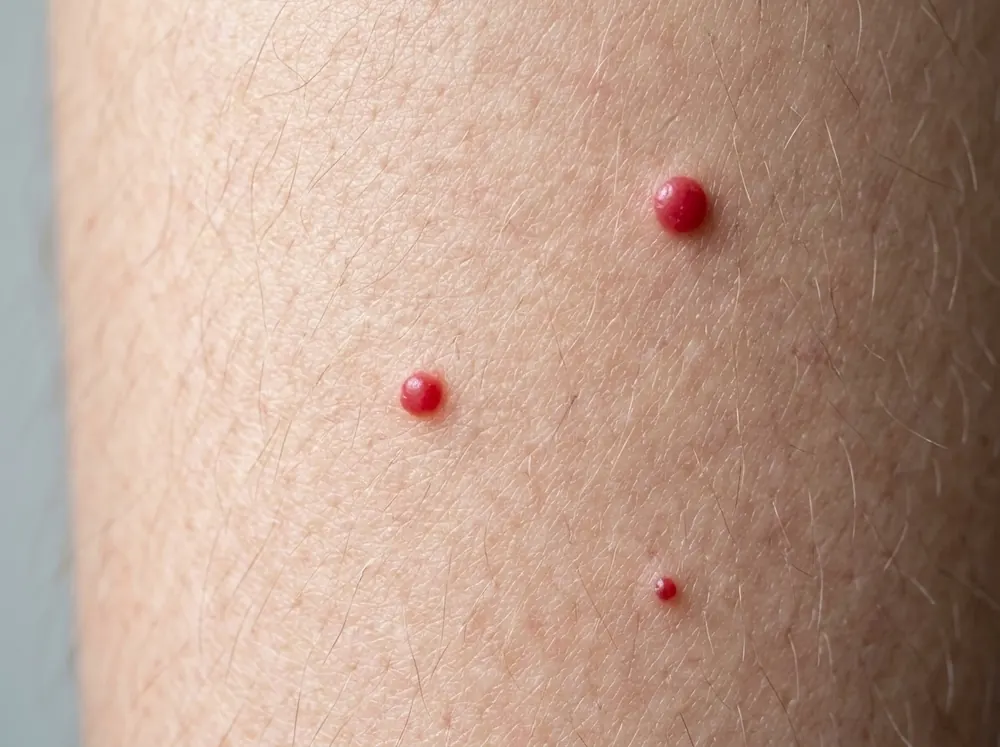
Cherry angiomas — also called Campbell de Morgan spots — are described as asymptomatic firm red, blue or purple papules, 0.1 to 1 cm in diameter, usually scattered over any part of the body surface and rarely found on the hands and feet. They are small, slightly raised, dome-shaped, and a distinctive bright cherry red.
The age pattern is the giveaway. They increase markedly in number from about the age of 40, with an estimated 75% of people over 75 having them — though roughly 5% of adolescents do too. If you are in your forties and noticing more small red dots each year, this is very likely what they are.
They are harmless, so do not have to be treated. Removal by cryotherapy, electrosurgery or vascular laser is available, but for cosmetic reasons or to exclude something else, not because they pose a risk.
One honest note on the glass test here: cherry angiomas are made of proliferated blood vessels rather than simple flushing, so they may only partly fade under pressure. The test's decisive use is identifying the non-blanching group, not sorting the benign ones from each other.
Keratosis Pilaris Rubra
If the spots sit on skin that also feels rough, and they cluster on the outer thighs and the backs of the upper arms, this is likely the red variant of keratosis pilaris — small skin-coloured, red or brown bumps with surrounding redness, on the extensor surfaces.
Keratosis pilaris affects 50–70% of teenagers and 40% of adults and is worse in winter. The distinguishing feature is texture: you can feel it before you see it. Bumps below the neck covers the whole picture.
Folliculitis and Post-Shaving Irritation
If each spot has a hair at its centre, or the spots appeared a day or two after hair removal, the follicle is the unit involved. Irritant folliculitis arises from hair regrowth after shaving, waxing or plucking, with no growth of bacteria or other organisms on swabs.
The complication for this article is that it is frequently very itchy, particularly on women's lower legs — so if you searched specifically for spots that do not itch, this is less likely to be your answer. It remains worth checking, because itch is not universal. Strawberry skin goes through the shaving-related causes properly.
Heat, Friction and Pressure
Transient redness from a hot bath, a heated car seat, sitting cross-legged, or tight clothing is common on legs and resolves on its own within hours. If the pattern maps onto something that was pressing against you, and it fades while you watch, that is the answer and it needs nothing.
Flat or Raised, Scattered or Clustered
Two more observations refine a blanching answer.
Flat or raised. A macule is a small patch of skin altered in colour but not elevated; a papule is an elevated, solid, palpable lesion up to 1 cm. Run a fingertip lightly across the area with your eyes shut. Cherry angiomas and folliculitis are raised. Simple erythema is flat.
Scattered or clustered. Cherry angiomas appear scattered across the body without pattern. Folliculitis follows hair-bearing areas and often the shaving direction. Keratosis pilaris concentrates on the outer thigh and upper arm. Pressure-related redness maps onto whatever was pressing.
| Raised? | Where | Since when | Also on arms? | |
|---|---|---|---|---|
| Cherry angiomas | Yes, dome-shaped | Scattered, rarely hands or feet | Increasing from about 40 | Often |
| Keratosis pilaris rubra | Yes, rough to touch | Outer thighs, upper arms | Usually childhood | Yes, typically |
| Folliculitis | Yes, hair at centre | Wherever you shave | Days after hair removal | Only if shaved |
| Heat or pressure | No, flat | Maps onto contact area | Hours | No |
Why "Not Itchy" Is Useful Information
The search term itself is doing diagnostic work, which is unusual.
Itch points toward the inflammatory and allergic group — eczema, contact dermatitis, urticaria, insect bites, irritant folliculitis. Removing it from the picture narrows things considerably, and it is the reason this article can be as short as it is.
What "not itchy" does not do is reassure. Purpura is typically not itchy either, which is precisely why the glass test comes before anything else here rather than after. Absence of symptoms is not absence of significance.
If your spots are itchy, or if they form patches rather than discrete dots, eczema or psoriasis is the more useful starting point.
What Genuinely Needs Nothing
Worth saying plainly, because the reflex is to treat.
Cherry angiomas are harmless and need no treatment. Heat and pressure redness resolves on its own. Keratosis pilaris is manageable but not curable, and aggressive exfoliation makes it worse rather than better.
For all three, the common failure is escalation: a scrub, then an acid, then a stronger acid, on skin that was not doing anything wrong. Non-itchy red spots on the legs are one of the few skin complaints where doing nothing is frequently the correct answer.
When to Get a Blanching Spot Looked At Anyway
The glass test rules out the urgent category. It does not mean every blanching spot is nothing. Book an appointment if:
- A single spot behaves differently from the rest — growing, changing colour, bleeding, crusting or failing to heal
- The spots appeared suddenly and in large numbers
- They started after beginning a new medication
- They are accompanied by joint pain, swelling or feeling unwell
- You simply cannot settle it, and it is occupying your attention
That last one is legitimate. A five-minute examination that ends in "these are cherry angiomas" is a reasonable use of an appointment.
Photographing It Properly
Legs are easier to photograph than backs and harder than faces — you can see them, but you look at them from above at an angle you can never quite repeat.
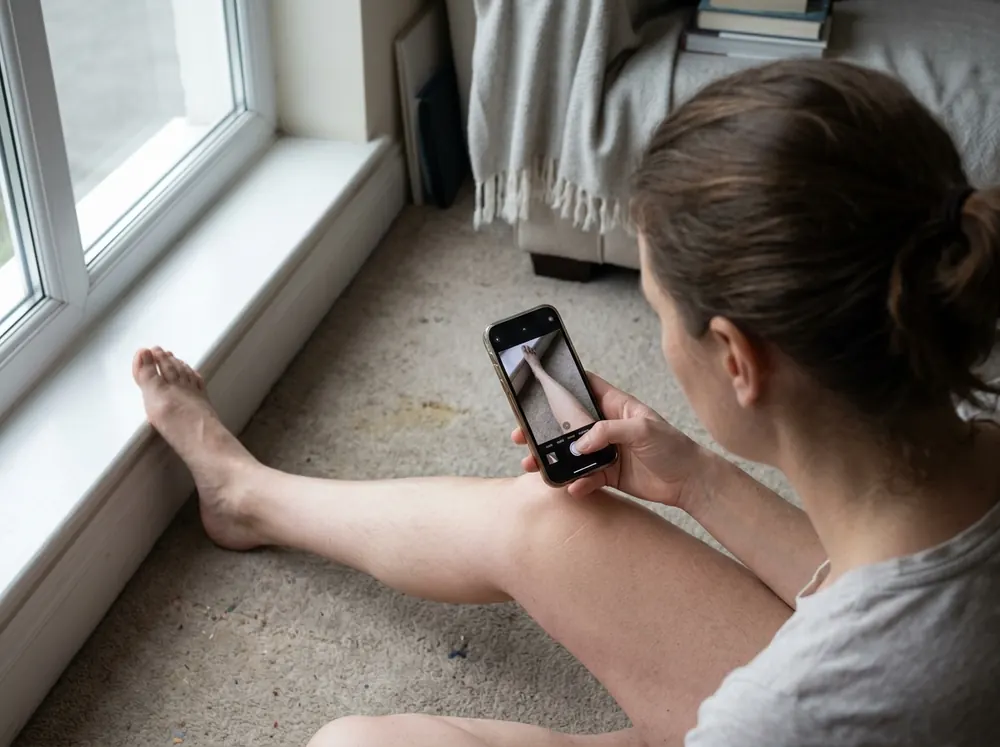
Two things help. Mark the frame: use a fixed landmark such as a knee, an ankle bone or a mole at the edge of the shot, so the same patch is comparable week to week. And use daylight from the side, not overhead bathroom light, which flattens both colour and texture.
Photograph before an appointment, too. Spots that are transient, or that fade under pressure, may look different by the time you are in the room — and a clear photograph from the day you noticed them is useful clinical information. Whether that record lives in a dated album on your phone or in something built for it like Skinic, the point is having the evidence rather than the recollection.
Conclusion
Non-itchy red spots on the legs divide cleanly into two groups, and a drinking glass tells you which one you are in.
If the spots go pale under firm pressure, the blood is inside the vessels and you are almost certainly looking at something benign — most often cherry angiomas, which are harmless, increase with age, and affect around three quarters of people over 75. Or keratosis pilaris rubra, or folliculitis, or simple pressure redness that will be gone by evening.
If they stay red under pressure, that is purpura, and the correct next step is a doctor rather than another article — the same day if you also feel unwell, have a fever, or the spots are spreading.
And do not let "it does not itch" reassure you. It narrows the list usefully, but purpura does not itch either. That is the whole reason the glass comes first.
Frequently asked questions
5 questions · tap one to open the answer
What does it mean if red spots on my legs do not fade when pressed?
What are the small bright red dots on my legs that do not itch?
How do I do the glass test at home?
Can red spots on the legs be harmless?
Does "not itchy" mean it is not serious?
Medically reviewed by
Dr. M.M Hanaei
Aesthetic Physician, Dermatology Fellowship
- MD — Shahid Beheshti University of Medical Sciences (SBMU)
- MCC Licensure (Medical Council of Canada)
- Dermatology Fellowship, Switzerland
- Certified in advanced aesthetic procedures
Last reviewed 19 September 2026