Skinic
You have been treating your back the way you treat your face. A salicylic acid body wash, then a benzoyl peroxide one, then a spray you have to contort to apply. Months in, the bumps across your shoulders and upper back are unchanged, and they itch — which you had assumed was just part of it.
Acne does not itch. That detail is the beginning of a much more useful answer.
Back and chest breakouts are extremely common and genuinely under-addressed: around 50% of people with facial acne have concurrent truncal involvement, and it is routinely left out of consultations booked about the face. But a substantial share of what gets treated as back acne is not acne at all. It is Malassezia folliculitis — a yeast overgrowth in the follicles that looks close enough to acne to be mistaken for it, and that does not respond to anything in an acne routine.
This piece covers the two questions that separate them, why the skin on your back behaves differently from the skin on your face in ways that change what works, and what to change first — which for most people is not a product.
Two Tells That Separate Fungal From Bacterial
You can get most of the way to an answer with two observations.
Does It Itch?
Acne is tender. Individual inflamed lesions hurt when pressed, and the surrounding skin feels normal. Malassezia folliculitis itches — in one cohort, 65% reported pruritus, against acne, which is typically not itchy at all.
If your back has bumps that make you want to scratch, that is information. Most people have been discounting it because "acne that itches" sounds plausible and nobody told them otherwise.
Are the Lesions All the Same Size?
This is the stronger signal of the two.
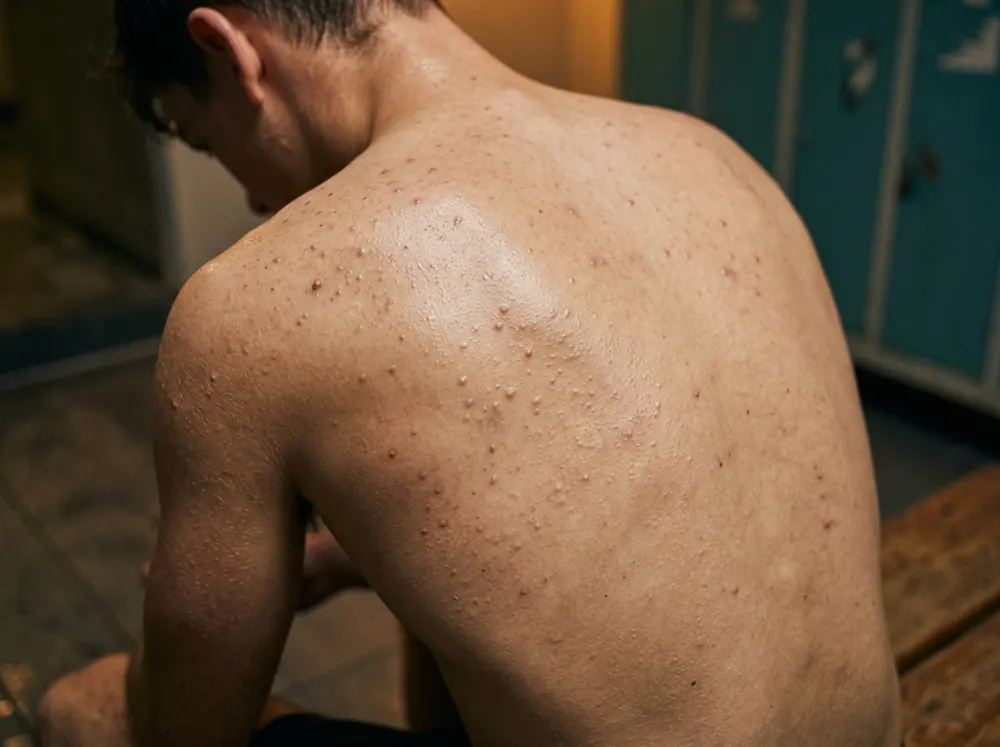
Malassezia folliculitis produces monomorphic follicular papules and pustules — monomorphic meaning all one form. Look across the affected area and the bumps are strikingly uniform: same size, same shape, same stage, evenly distributed.
Acne does the opposite. It produces lesions at several stages at once: a new papule, a resolving one, a healing mark, and — critically — comedones. The hallmark feature distinguishing Malassezia folliculitis from acne vulgaris is the absence of comedones, nodules or cysts. No blackheads, no closed comedones, anywhere.
That is the same question that separates rosacea from acne on the face, applied to the back — and we have worked through that logic in it might not be acne.
| Malassezia folliculitis | Truncal acne | |
|---|---|---|
| Itch | Common — 65% in one cohort | No, tender instead |
| Lesion sizes | All the same — monomorphic | Mixed stages and sizes |
| Comedones | Absent — the hallmark | Present |
| Nodules or cysts | Absent | Possible |
| Worse with | Heat, sweat, occlusion, antibiotics | Heat, sweat, friction, hormones |
| Responds to acne treatment | No — may worsen | Yes, slowly |
How Often This Gets Missed
The scale of the misdiagnosis is the part worth knowing.
In one study of patients with confirmed Malassezia folliculitis, 75% had been previously treated for acne vulgaris unsuccessfully. Three quarters had already been through an acne routine that was never going to work, because the organism involved is a yeast rather than a bacterium.
The distribution overlaps almost perfectly with where people expect acne: it affects seborrhoeic areas including the upper trunk, chest, back, shoulders and face, with one study finding the face most often affected at 57%, followed by the back at 53%.
And the environmental profile explains why it clusters in particular lives. In the same cohort, 83% worked in a warm environment and 71% reported sweating as an aggravating factor. If you train regularly, work somewhere hot, or live somewhere humid — which we have covered in acne in hot, humid climates — you are in the group where this is most likely to be what you have.
Diagnosis is not something you can do from a mirror. A potassium hydroxide preparation examined under a microscope is the accessible test, with dermoscopy and a Wood's lamp as supporting evidence. What this article can do is tell you whether it is worth asking.
Why Antibacterial Treatment Can Make It Worse
This is the part that turns a wasted six months into an actively counterproductive one.
Acne treatment is aimed at Cutibacterium acnes, a bacterium. Malassezia is a yeast — a completely different organism, unaffected by antibacterial agents. That alone explains the lack of response.
But there is a second effect. The review warns that inappropriate or prolonged use of systemic antibiotics may worsen the condition by promoting yeast overgrowth. Suppressing the bacterial population on the skin removes competition, and the yeast expands into the space.
So the pattern people describe — "it got a bit better on antibiotics and then came back worse" — has a mechanism behind it. If a course of oral antibiotics for back acne produced a temporary improvement followed by a worse relapse, that history is worth taking to a clinician rather than filing under bad luck.
Why the Back and Chest Are Not Just a Bigger Face
Even when it genuinely is acne, treating your back like a large face underperforms, and there are measured reasons why.
The skin is thicker. Truncal skin has a stratum corneum of roughly 13 ± 4 cell layers against facial skin's 9 ± 2 — and that thicker barrier may limit how well topical treatments get through. Your face-strength product is being asked to cross about 40% more layers.
There is less oil, not more. This surprises people. Facial areas carry 400–900 sebaceous glands per cm², while most body sites are below 100, with correspondingly lower sebum output. Back acne is not a story about the back being greasier than the face.
The environment is different. Truncal skin sits slightly more acidic — pH 5.0–5.2 against 5.4–5.6 on the face — has fewer sweat glands, and carries a less diverse C. acnes population dominated by a single subtype.
And it spends the day under fabric. Prolonged occlusion by clothing creates a warm, humid microenvironment that may exacerbate local inflammation — a variable your face never experiences.
That last one is the one you can act on today.
Acne Mechanica: Straps, Packs and Damp Fabric
Mechanical and occlusive pressure produces a recognisable pattern. Repetitive contact and friction contribute to frictional acne, where barrier impairment is a key driver of lesion development, and on the trunk the culprits are predictable.
Backpack and bag straps. Two vertical bands over the shoulders and upper back, worn for hours, often over a damp shirt.
Sports bras and gym kit. Tight, synthetic, and worn through exactly the activity that produces the sweat.
Weight benches and car seats. Sustained contact with the upper back across repeated sessions.
Long hair and hair products. Conditioner and styling product rinse down the back in the shower and sit there. This is the body version of the transfer route covered in why you keep breaking out on your forehead.
The tell is geometry. If your bumps trace a strap line, a waistband, or the contact area of a bench, that pattern is not coincidence, and no product will out-compete a mechanical cause left in place.

What to Change First
In order of how much difference each makes, and none of the first three costs anything.
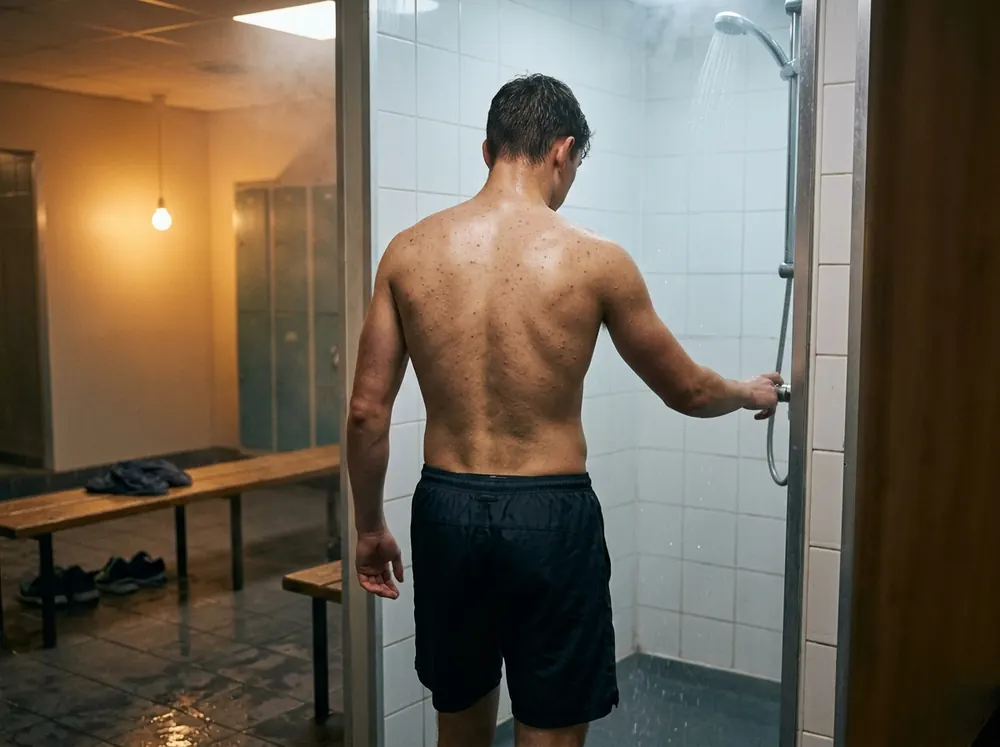
1. Shower promptly after sweating. Not perfectly, not immediately — but the gap between "straight after training" and "two hours later in damp kit" is the largest single variable for both conditions. Heat, sweat and occlusion are aggravating factors for Malassezia folliculitis and for frictional acne alike.
2. Get out of damp fabric. Occlusion under warm, humid conditions is the mechanism. Changing out of a wet top does more than any wash you apply underneath it.
3. Rinse your back last. Conditioner and hair product run down the back. Rinsing hair before washing the body means the residue comes off rather than sitting there.
4. Loosen what is in sustained contact. Where a strap line maps the breakout, adjusting or padding it addresses the cause instead of the symptom.
5. Only then change products — and choose based on which condition you actually have. If the two tells point toward a fungal cause, an acne product is the wrong category, and confirming it needs a clinician rather than a trial-and-error purchase.
One thing worth saying about vigour: the instinct to scrub a back is strong, because you cannot see it and it feels like the area is neglected. Scrubbing damages the barrier, and barrier impairment is a driver rather than a cure here. If you are already dealing with the mixed picture of body bumps more broadly, bumps below the neck sets out the full differential.
When to Get It Looked At
Book an appointment if:
- The bumps itch and are all the same size, with no blackheads anywhere
- Acne treatment has produced no change over eight to twelve weeks
- Antibiotics helped briefly and then it came back worse
- There are nodules or cysts, or anything painful and deep
- It is leaving marks or scars
That last one matters more than people expect. Inflammation on the trunk leaves post-inflammatory pigmentation just as it does on the face, more frequently and more severely in darker skin tones, with a chronic course lasting months to years. Treating the wrong condition for a year is not a neutral delay — it is a year of inflammation depositing pigment you will then want treated separately. We have covered that in hyperpigmentation in brown and deep skin tones.
Tracking Skin You Cannot See
There is a practical problem specific to this article: your back is the one area you genuinely cannot assess. You catch it at an angle in a bathroom mirror, in poor light, twisted round — which is neither consistent nor flattering.
That makes a record more valuable here than anywhere else. Have someone photograph the same area, or use a timer and a fixed position, in the same light and at the same distance, at the start and again eight weeks later. Whether that lives in a dated album on your phone or in something built for it like Skinic, it converts "I think it might be slightly better" into an answer — and on an area you cannot see, that is the difference between giving a treatment a fair run and abandoning it at week five.
Conclusion
Around half of people with facial acne have it on their trunk too, and it is routinely left unmentioned and untreated. But before you escalate the product, check two things: does it itch, and are the bumps all the same size?
Itchy and uniform, with no comedones anywhere, points toward Malassezia folliculitis rather than acne — a yeast, not a bacterium, which is why 75% of people with it in one study had already failed an acne routine, and why antibiotics can make it worse rather than better.
If it genuinely is acne, treat the back as its own surface rather than as a large face. The skin is thicker, produces less oil, sits at a different pH, and spends the day under fabric. The interventions that move the needle most are free: shower promptly after sweating, get out of damp kit, rinse your hair before your body, and take the pressure off whatever strap is tracing your breakout.
Then photograph it, because it is the one part of your skin you will never assess accurately by eye.
Frequently asked questions
5 questions · tap one to open the answer
How do I know if my back acne is fungal?
Why is my back acne not responding to treatment?
Can antibiotics make back acne worse?
Does sweating cause back and chest acne?
Is back skin different from face skin?
Medically reviewed by
Dr. M.M Hanaei
Aesthetic Physician, Dermatology Fellowship
- MD — Shahid Beheshti University of Medical Sciences (SBMU)
- MCC Licensure (Medical Council of Canada)
- Dermatology Fellowship, Switzerland
- Certified in advanced aesthetic procedures
Last reviewed 17 September 2026