Skinic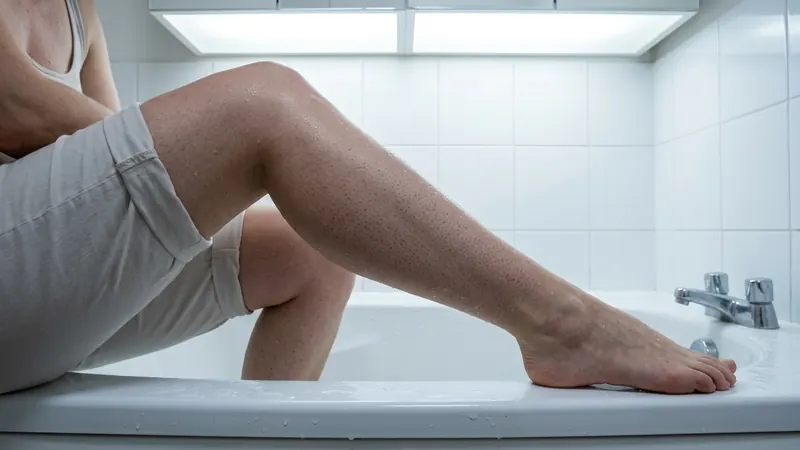
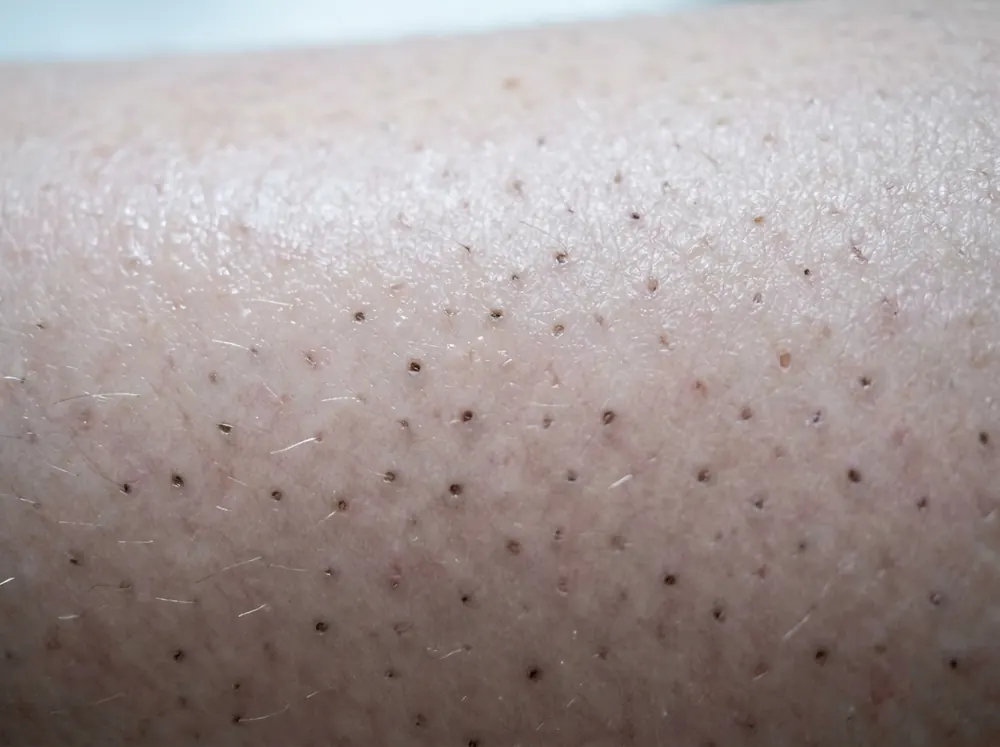
You get out of the shower, look down at your legs, and there they are again. A field of small dark dots across your shins and thighs, one in each pore, like the seeds on a strawberry. You have scrubbed them. You have used a stiffer brush, then a sugar scrub, then one of the exfoliating gloves. They are still there, and the skin around them is now red.
Here is the first useful thing to know: the dots are not dirt, and scrubbing was never going to move them.
The second is that "strawberry skin" is not a diagnosis. It is a description of how something looks, and at least three genuinely different things produce it. One is a plugged follicle that darkens on contact with air. One is a keratin plug you have probably had since childhood. One is the aftermath of shaving. They look similar from standing height and need quite different responses, which is why the generic advice — exfoliate, moisturise, repeat — works for some people and does nothing at all for others.
This piece works out which one you have, explains what the dark colour actually is, and covers what changes it, in rough order of how much difference each thing makes.
There Is No Condition Called Strawberry Skin
Search the term in a dermatology reference and you will not find it. There is no ICD code, no clinical definition, no diagnostic criteria. It is a colloquial description that spread through social media because it captures the appearance well.
That matters for a practical reason. When you search for how to treat strawberry skin, you get advice aimed at an average of three different conditions — which is why so much of it half-works. The useful question is not "how do I get rid of strawberry skin" but "which of these three am I looking at", because the answer changes what you should do next.
The Dots Are Not Dirt
This is the correction that makes everything else make sense.
Where the dark dots are open comedones — plugged follicles with the surface open to the air — the colour has a specific cause. Open follicles expose the keratin inside to air, which oxidises, with melanin granules accumulating, and it is that oxidation and pigment that reads as dark. Exactly the same mechanism as a blackhead on the nose.
Two consequences follow, and both are unwelcome if you have spent years scrubbing.
Washing cannot lighten them. There is no dirt to remove. The colour is a chemical change in material that is already inside the follicle, and no amount of surface cleaning reaches it or alters it.
The plug refills. A follicle that produces a visible plug will produce another one. Emptying it is temporary by design, which is the same reason pore strips on the nose never deliver a permanent result — we have gone through that mechanism in sebaceous filaments are not blackheads.
Where the dots are something else — a keratin plug or a trapped hair — the colour comes from the hair itself showing through, or from post-inflammatory pigment left behind after irritation. Still not dirt.
Three Things It Might Be, and How to Tell
Look at your legs in daylight rather than bathroom light, ideally a day or two after shaving rather than immediately, and work through these.
| Open comedones | Keratosis pilaris | Post-shaving folliculitis | |
|---|---|---|---|
| What you see | Dark dots set into visible pore openings | Small rough raised bumps, skin-coloured to red | Red bumps, some with a hair visible or trapped |
| Texture | Fairly smooth to the touch | Distinctly rough, like fine sandpaper | Raised, sometimes tender |
| Itch | No | Usually not | Frequently, sometimes intensely |
| Timing | Constant | Constant, worse in winter | Appears a day or two after shaving |
| Where | Shins, thighs | Outer thighs and upper arms too | Wherever you shave |
| Since when | Varies | Usually since childhood | Started when you started shaving |
Open Comedones in Leg Follicles
The classic strawberry appearance: dark dots sitting in visibly open follicles, on otherwise fairly smooth skin. The skin does not feel especially rough, and the dots are constant rather than cyclical. This is the version where the oxidation explanation applies directly.
Keratosis Pilaris
If the skin feels rough — properly rough, like fine sandpaper — and you also have it on the backs of your upper arms, this is the more likely answer. Keratosis pilaris involves keratin accumulation in the hair follicles from abnormal keratinisation of the follicle lining, affects 50–70% of teenagers and 40% of adults, and typically sits on the extensor surfaces of arms and thighs. It has been there since childhood and it gets worse in winter. Bumps below the neck covers it in full.
Post-Shaving Folliculitis and Ingrown Hairs
If the bumps appear a day or two after shaving, itch, and settle as the hair grows out, this is irritant folliculitis — which arises from hair regrowth after shaving, waxing or plucking, with no growth of bacteria or other organisms on swabs, and is frequently very itchy, particularly on women's lower legs.
Ingrown hairs are the related problem. When a hair is cut close, the cut end is left sharp, and it can either pierce the skin surface directly or retract beneath the surface and pierce the follicle wall from inside. Either way the body treats the hair as a foreign object and inflames around it. The same mechanism on the face is pseudofolliculitis barbae, where it affects 45 to 80% of men of African ancestry and leaves marks that outlast the bump.
Why Shaving Does More Than You Think
Shaving is the single biggest variable for most people with this complaint, and the reason is that a razor does not only cut hair.
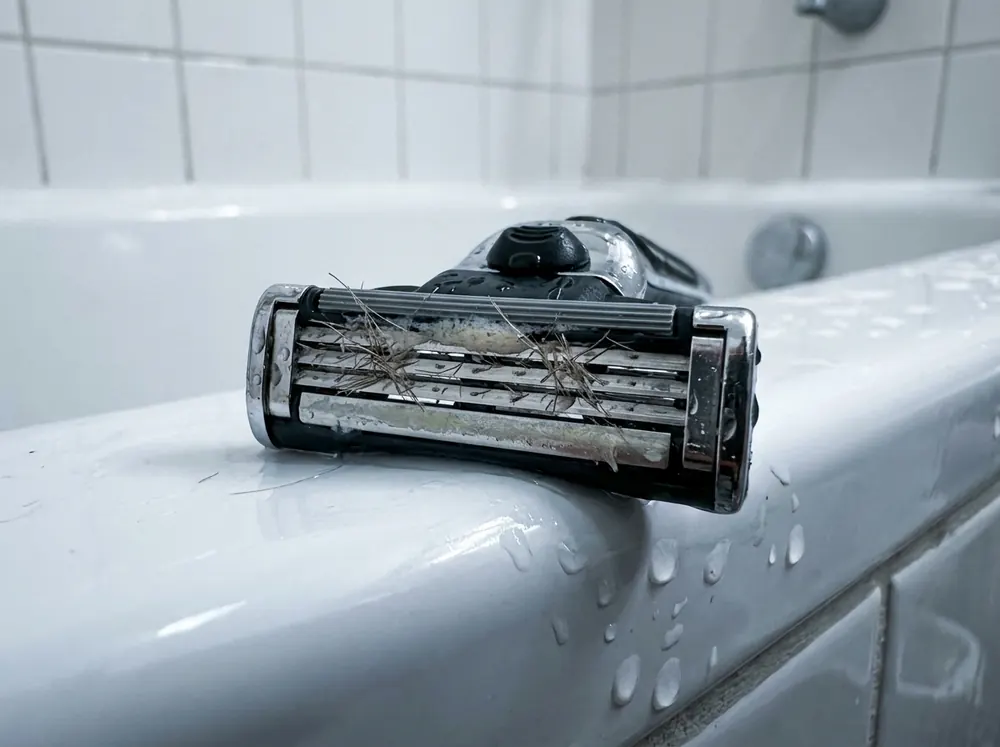
Measured directly, corneocytes account for approximately 20% of the material removed through shaving in the male facial area, rising to 36% in female axillary regions. Corneocytes are the cells of your outermost skin layer. Every pass of a blade takes a meaningful amount of your stratum corneum along with the hair — closer to a third of what comes off, in body shaving.
The consequence is a chain rather than a single event. Shaving produces barrier dysfunction and decreased hydration, and barrier damage triggers pro-inflammatory cytokine release and mast cell degranulation, which drive keratinocyte hyperproliferation and stimulate free nerve endings — producing the itch and redness. This is not a rare reaction: shaving-related irritation is the most common male cosmetic consumer complaint, reported by 88% of men, and there is no reason to think leg shaving is gentler.
So if your legs look worse after shaving and better after a week off, that is a barrier response, not a hygiene failure. And the instinct to exfoliate before shaving to "prevent" the bumps is stacking two forms of barrier removal on the same skin on the same day.
Why This Hits Some People Harder
Two factors change how severe this gets, and neither is under your control.
Hair texture. Ingrown hairs are far more likely with tightly curled, coarse hair, because a curved hair emerging from a curved follicle is much more likely to re-enter the skin. Pseudofolliculitis predominantly affects men of African ancestry, at approximately 45–80%, and while that figure describes facial shaving, the mechanism is the same anywhere hair is shaved — the page is explicit that it occurs at any site including the legs.
Pigment response. After the inflammation settles, post-inflammatory hyperpigmentation and scarring may occur. This is where a temporary problem becomes a lasting one: the bump resolves in a week, and the dark mark it leaves can last months. That risk is higher in deeper skin tones, which is also where the dots contrast most visibly against surrounding skin. If dark marks rather than bumps are what you actually see, hyperpigmentation in brown and deep skin tones is the more relevant piece, and your Fitzpatrick type is what predicts that response.
The uncomfortable implication: for some people, the most effective single intervention is shaving less often, or not at all. That is a real trade-off rather than a lifestyle recommendation, and it is worth stating plainly instead of pretending a product solves it.
What Changes It, In Order of How Much Difference It Makes
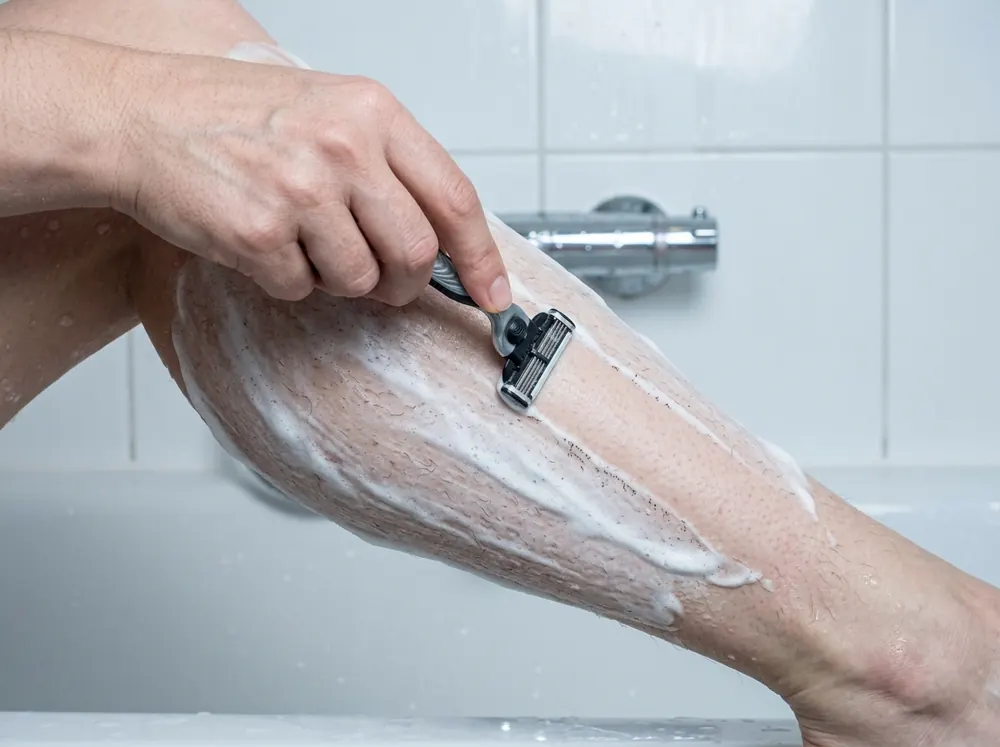
1. Shaving technique, before any product. The recognised guidance for preventing ingrown hairs is to shave in the direction of hair growth rather than against it, avoid stretching the skin, use a sharp blade, and avoid shaving the same area twice. Every one of those reduces how sharply the hair is cut and how much skin the blade takes with it. Shaving against the grain produces a closer shave and a sharper hair end, which is exactly the setup for a hair to re-enter the skin.
2. Blade freshness. A dull blade requires more pressure and more passes, and both increase the corneocyte removal described above. This is unglamorous and it matters more than any serum.
3. Frequency and timing. Longer intervals give the barrier time to recover. Shaving at the end of a shower, on softened hair, reduces the force needed.
4. A chemical exfoliant, used on non-shaving days. Where the dots are comedonal or keratosis pilaris, a keratolytic is the tool that reaches inside the follicle — unlike a scrub, which works only on the surface. Use it on days you are not shaving, since stacking both on the same skin on the same day is how people end up more irritated than when they started.
5. Moisturising, consistently. Not a fix on its own, but shaving measurably reduces hydration and damages the barrier, and a routine that replaces what the blade took is doing real work.
What is not worth doing: stiff brushes, sugar and salt scrubs, exfoliating gloves, and anything marketed as "deep cleaning" the pores on your legs. The dark colour is oxidation inside a follicle, and abrasion on the surface above it achieves irritation and nothing else.
Judging It Honestly
There is a specific trap with legs: you assess them immediately after shaving, in bright overhead bathroom light, at close range, while thinking about them. That is close to the worst possible viewing condition — freshly shaved skin is inflamed by definition, and downward light throws a shadow into every follicular opening.
Two things make the assessment reliable. Look in daylight, at standing distance, two days after shaving rather than two minutes. And compare against a record rather than a memory — same spot, same distance, same light, no filters, photographed at the start and again eight weeks later. Skin on the legs changes slowly and human memory for texture is poor; whether the record lives in a dated album on your phone or in something built for it like Skinic, the comparison is what tells you whether a change in technique actually did anything.
Conclusion
Strawberry skin is not a condition and the dots are not dirt. Where they are open comedones, the colour is keratin oxidising on contact with air — a chemical change inside the follicle that no amount of washing reaches.
Work out which of the three you have. Smooth skin with dark dots in open pores points to comedones. Rough, sandpapery skin that you also have on your upper arms points to keratosis pilaris. Itchy bumps appearing a day or two after shaving point to folliculitis or ingrown hairs.
Then fix the shaving before you buy anything. With the grain, sharp blade, no stretching, one pass — because a razor takes up to a third of its removed material from your stratum corneum, and the barrier damage that follows is what produces the redness and the itch. Add a chemical exfoliant on non-shaving days, moisturise consistently, and judge it in daylight two days later rather than in the bathroom mirror two minutes later.
And put the scrub down. It has had a decade to work.
Frequently asked questions
5 questions · tap one to open the answer
What causes strawberry skin on legs?
Are the dark dots on my legs dirt?
Does exfoliating get rid of strawberry skin?
Why do my legs look worse right after shaving?
How do I stop getting ingrown hairs on my legs?
Medically reviewed by
Dr. M.M Hanaei
Aesthetic Physician, Dermatology Fellowship
- MD — Shahid Beheshti University of Medical Sciences (SBMU)
- MCC Licensure (Medical Council of Canada)
- Dermatology Fellowship, Switzerland
- Certified in advanced aesthetic procedures
Last reviewed 15 September 2026