Skinic
Quick answer
Most wrinkle creams moisturise, which can make lines look softer for a few hours. Only daily sunscreen and prescription retinoids have solid trial evidence for lines. Labels that say "reduces the appearance of" are legally cosmetic claims, not promises that the skin changes.
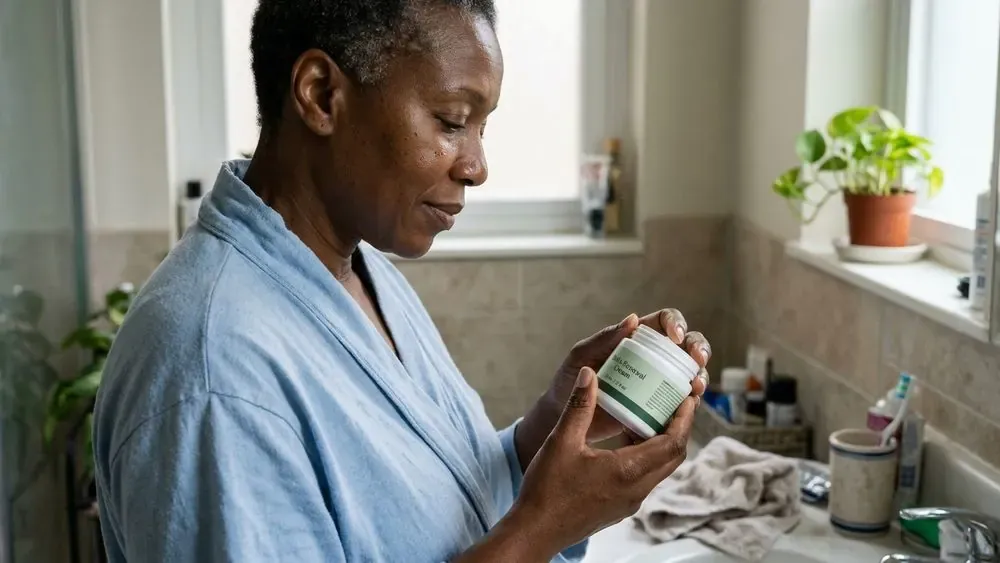
The full evidence is belowYou stand at the sink, holding a jar that says it "reduces the look of wrinkles". It sounds like a promise, but read it again. The words are chosen with care. A cream sold as a cosmetic is not allowed to claim it changes your skin, so the label says it changes how the skin looks.
Most wrinkle creams are moisturisers, and moisturisers can soften lines for a few hours. Only daily sunscreen and prescription retinoids have solid trial evidence for lines. This guide shows how to read the claims. It names no products.
What can a wrinkle cream legally claim?
Why does the label say "reduces the appearance of"?
In the United States, the law sorts products by what they are meant to do. The FDA says a product that only improves how skin looks is a cosmetic. It says a product meant to change the skin's structure or function is a drug, even if it also changes how skin looks. Its example of a drug claim is a product meant "to remove wrinkles or increase the skin's production of collagen".
So a cream sold as a cosmetic keeps to softer words. The FDA says a product that makes lines less visible only by moisturising is a cosmetic. It also notes that cosmetics do not need FDA approval before they go on sale. Drugs do.
What does that mean when you shop?
It means the wording tells you which side of the line a product sits on. "Reduces the look of" is a cosmetic claim. It says nothing about collagen or about lines going away. If a label seems to promise more, ask whether it has drug-level proof behind it.
Why do lines look better for a few hours, then come back?
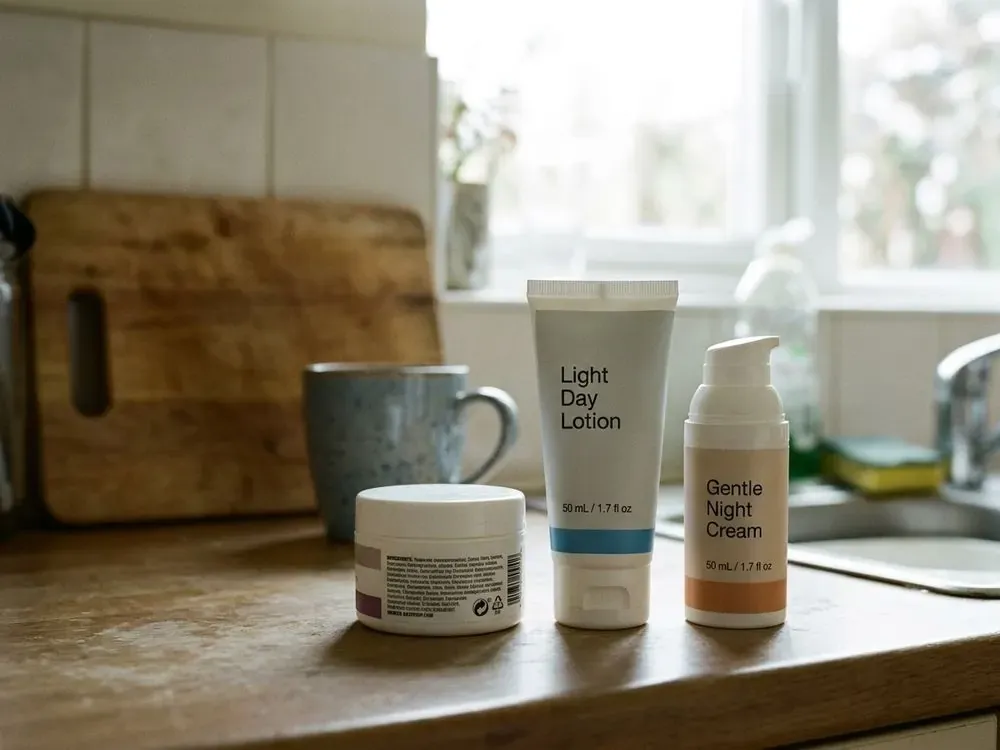
A moisturiser adds water to the skin's outer layer. That layer plumps up a little, and fine lines look softer. The effect fades as the water leaves.
A small trial gives a sense of the timing. It tested lamellar moisturisers on the lower legs of 30 adults with dry skin. After one application, skin hydration was higher for up to 24 hours with two products, and up to 12 hours with the third. The company that sold the products paid for the trial, and one author worked for it. The trial measured hydration, not wrinkles, and it used legs, not faces.
That is the honest limit of what we found. We opened no trial that shows a moisturiser changes wrinkle depth over time. A moisturiser can make lines look better today. It does not tell you the lines are shallower next month.
Which ingredients have real trial data?
What do prescription retinoids show?
Retinoids are relatives of vitamin A. Tretinoin, a prescription retinoid, is the best studied for sun-aged skin. A review of seven randomised trials with 739 people found that most trials showed better wrinkles. The trials ran from three months to two years. The review could not pool them into one number, and side effects such as redness, peeling and dryness were common.
DermNet, a doctor-written skin site, says benefits for sun-aged skin generally need more than six months of use. It says retinol and a close relative are common in cosmetics. It also says some retinoids must not be used in pregnancy. A prescriber decides which medicine suits you. Our guides on what retinol does, week by week and on tretinoin versus retinol give more detail.
What about botanical and other shop-cream ingredients?
Many creams list plant extracts or peptides. A systematic review of botanical extracts (abstract) found 11 trials. All were of poor methodological quality, and side effects were often not reported. Five kinds of extract showed a significant wrinkle reduction, and three others did not. The authors found weak evidence that some extracts may reduce the look of skin ageing, and no evidence that the effect lasts.
Our guide to peptides for skin covers what has trial data there. Our guide to serums, sorted does the same for other active ingredients, and all our aging guides sit in one place.
Why is sunscreen the best "anti-wrinkle" product?
Because it has the clearest randomised trial for slowing skin ageing. In the Nambour trial (abstract), 903 adults under 55 either used broad-spectrum sunscreen every day or used it when they chose. After 4.5 years, the daily group showed no detectable increase in skin ageing. Their ageing was about a quarter lower (24% lower) than the other group.
There are limits. Some data were missing, and the study was too small to spot moderate effects. Our article on whether sunscreen prevents wrinkles goes through the trial in detail. For the full ranking of options, see anti-aging treatments, ranked by evidence.
How do you read a before-and-after claim?
The claim: "Clinically proven to reduce wrinkles by 50%." We looked for the study behind a typical claim of this kind. We found no published trial behind that exact 50% figure, so we cannot report how it was measured. We can show how such claims are usually built.
What does a typical "clinically proven" claim rest on?
A recent UK advertising ruling shows the pattern. A skincare ad said "Clinically proven to lift the skin by 20%". The regulator's ruling, dated 13 May 2026, set out the evidence behind it. A dermatologist graded 30 people on a 10-point scale over 28 days. There was no placebo or control group. The firm also ran two surveys in which users rated themselves, again with no control group.
The regulator upheld the complaint. It found that a grade on a scale is not an objective measure of lift. It also found that 30 people with no control group cannot support the claim. The ruling is about one advertiser, so it does not show that every claim is weak. It does show what to check.
What should you check in any before-and-after claim?
- Was there a control group? Without one, any change could come from time, weather or the cream's base.
- Who judged the result? A person grading a photo or a scale is less objective than a measuring tool.
- How many people, for how long? Thirty people for four weeks cannot tell you about the lines you will have next year.
- Does the photo match the claim? Light, angle and make-up change how lines look in a picture.
What should you look for on the label?
Use the wording as a guide to the kind of claim you are reading.
| If the label says | It is probably | Ask |
|---|---|---|
| "Reduces the look of lines" | A cosmetic claim about appearance | How long does the effect last? |
| "Removes wrinkles" or "boosts collagen" | A claim about the skin's structure, which the FDA treats as a drug claim | Is it a medicine, and who prescribes it? |
| "Clinically proven" | Depends on the study | What was measured, in how many people, with what control? |
Look at the ingredient list too. The FDA page above says cosmetics are not approved before sale. That is why the list and the study behind a claim matter more than the front of the jar.
Conclusion
A wrinkle cream is usually a moisturiser with a clever label. It can make lines look softer for hours. Daily sunscreen and prescription retinoids have the strongest trial evidence for lines, and each has limits. Phrases like "clinically proven" tell you little until you know how many people were tested and how.
If you want to see what a product is doing, keep dated notes or photos in the same light, in an app like Skinic or a notebook. See a clinician about any prescription option, or about a mole or sore that changes.
Frequently asked questions
5 questions · tap one to open the answer
Do wrinkle creams actually work?
What does 'reduces the appearance of wrinkles' mean?
What is the best ingredient for wrinkles?
Does 'clinically proven' mean a cream is proven to work?
Can sunscreen prevent wrinkles?
Medically reviewed by
Dr. M.M Hanaei
Aesthetic Physician, Dermatology Fellowship
- MD — Shahid Beheshti University of Medical Sciences (SBMU)
- MCC Licensure (Medical Council of Canada)
- Dermatology Fellowship, Switzerland
- Certified in advanced aesthetic procedures
Last reviewed 27 October 2026