Skinic
A serum shelf is organised by price, by brand, and by a word that means nothing.
"Serum" is not a category of active, a strength, or a regulatory class. It is a viscosity. In the formulation literature it sits in a list alongside emulsions, creams, lotions, solutions, gels and ointments — all of them vehicles, distinguished by how thick they are and what they are suspended in. There is no technical definition that says a serum contains more active than a cream, and no regulator maintains one.
Which makes the shelf unreadable as organised. So this article reorganises it: by what the active targets, by whether the molecule can physically get in, and by what each category actually has behind it. Two of them have almost nothing.
"Serum" Describes a Texture
Start with the claim that props the whole category up: serums have higher active concentrations than creams.
Go looking for the basis and there is not one. Patent and formulation literature treats a serum as one vehicle option among many, classified by viscosity — lotions around 4,000 to 10,000 mPa·s, fluid creams 10,000 to 20,000, creams 20,000 to 100,000 and above, with serums thinner still. That is a rheology scale. It says nothing about what is dissolved in it.
On the regulatory side, the FDA states plainly that it does not have a list of approved or accepted claims for cosmetics, and that cosmetic labelling does not require FDA approval before a product goes on the market. The only standing requirement is that claims be truthful and not misleading. "Serum" is not a protected term because there is no definition to protect.
What is true is narrower and more useful. A thin, largely aqueous vehicle can carry water-soluble actives at workable concentrations without the emulsifiers and occlusives a cream needs, and it is pleasant to layer. That is a formulation convenience. It is not a potency claim, and the two have been quietly merged.
Before Category: Can It Even Get In?
There is a question that comes before what a serum targets, and almost no product page asks it.
The stratum corneum is a brick-wall structure — cornified cells as bricks, lipid matrix as mortar — and an active has three ways through it: between the cells, through them, or down an appendage. That last route sounds promising and is not: hair follicles and sweat glands account for roughly 0.1% of the skin's surface area.
The constraint that follows is the 500 Dalton rule: compounds with a molecular weight above 500 Da struggle to penetrate normal stratum corneum, while those below it permeate more readily (what reaches each layer of skin maps that rule against real thicknesses). The same review notes that peptides and proteins are large enough that they do not penetrate autonomously. What that leaves of the peptide category is worth following separately, because its best-known ingredient has two published penetration figures that differ by a factor of 136.
Hold that against a serum shelf. Retinol, niacinamide, ascorbic acid, azelaic acid, glycolic acid — all comfortably under the threshold. Collagen, elastin and most proteins are orders of magnitude over it. A product can contain an ingredient, print it on the front, and have no mechanism by which it reaches the layer where it would need to act.
That is the first sort, and it is brutal. Everything below assumes the molecule can get in.
Sorted by What They Target
Five targets, and the evidence quality is not remotely even across them.
| Target | The actives with data | Evidence |
|---|---|---|
| Pigment | Azelaic acid, ascorbic acid, niacinamide, hydroquinone | Strong to moderate |
| Texture and photoageing | Retinoids, alpha hydroxy acids | Strong |
| Inflammation and acne | Azelaic acid, benzoyl peroxide, salicylic acid, niacinamide | Strong |
| Barrier | Ceramides, cholesterol, fatty acids, niacinamide | Moderate, mechanism clear |
| "Regeneration" | Growth factors, exosomes, conditioned media | Thin |
Note what that table does. The same molecule appears in three rows — azelaic acid and niacinamide are each doing several jobs — while an entire marketing category occupies one row on its own with the weakest evidence in the article.
What Each Category Has Trial Data For
Niacinamide — the quiet one
The best value on most serum shelves, and almost never sold that way.
A mechanistic review sets out why it does several things at once: it is a precursor for NAD+, it boosts ceramide synthesis by activating serine palmitoyltransferase expression, it blocks the transfer of melanosomes from melanocytes to keratinocytes — an antimelanogenic route that does not touch melanin synthesis itself — and it inhibits TNF-α, PGE2, IL-1, IL-6 and IL-8 through NF-κB-mediated transcription.
The concentration data is specific and low. 2% applied for four weeks significantly increased stratum corneum ceramides and reduced water loss in dry skin. 4% decreased axillary hyperpigmentation with measurable colorimetric improvement. A 5% emulsion reduced inflammatory biomarkers in 40 panellists after two weeks.
And tolerability: no stinging up to 10%, no irritation up to 5%, with no irritancy across a 21-day test at 5%. Which makes the 10% and 20% products on sale an odd proposition — above the concentrations the evidence used, and above the thresholds where tolerability was established.
One honest caveat the review supplies itself: the mechanism behind niacinamide's effect on sebum remains unknown, and the melanosome-transfer inhibition needs further exploration.
Retinoids and acids — the texture row
These carry the strongest evidence in cosmetic dermatology and both are covered properly elsewhere on this site. The alpha hydroxy acid data, including the regulatory concentration limits that decide what an over-the-counter product can legally be, is the clearest worked example of why the number on the label is not the number that matters.
Vitamin C — real, and the rules are shakier than quoted
Genuine mechanisms: collagen cofactor, antioxidant, tyrosinase inhibitor. But the pH threshold, the concentration ceiling and the verdict on derivatives all trace to one 2001 pig-skin study, and the patent built on that work claims a range four times wider than the figure everyone repeats.
Azelaic acid — the one that covers two rows
Evidence for acne, pigment and rosacea at once, which almost nothing else manages — with the caveat that the "selective for overactive melanocytes" claim that sells it has no support in the mechanism literature.
Barrier actives — clear mechanism, modest claims
Ceramides, cholesterol and fatty acids are what the barrier is actually made of, and what "barrier repair" can legally mean is nothing. The mechanism is sound; whether a topical reconstitutes the skin's own lipid organisation is a separate question the labels do not distinguish.
The Ones With Almost Nothing Behind Them
The fastest-growing premium category, and the thinnest evidence on the shelf.
Growth factors, stem cells and exosomes are sold as regenerative. A 2024 review of regenerative topical skincare opens by dispatching the premise: "No skincare product actually contains stem cells." What is in the bottle is the supernatant from cultured cells — conditioned media, growth factors, peptides and extracellular vesicles, all non-living.
The state of the field, in the author's own figures:
- 217 clinical trials on extracellular vesicles are registered, of which 14 address cutaneous concerns and only a few address aesthetic ones.
- "There are currently no FDA approved exosome products."
- "There is no consensus on purity of preparations, optimal source(s), nor dosage or yield."
The published aesthetic trials are small, and two of the three carry a problem nobody mentions. A 56-person platelet-exosome study over six weeks found significant improvement. But the 28-person split-face study combined the vesicles with microneedling, and the scar study — 32.5% improvement against 19.5% — combined them with CO2 laser. When an unproven topical is applied alongside a procedure with its own established effect, the topical's contribution is not isolated. That is the same problem as reading a treatment result off a before-and-after photograph: the variable you care about is not the only one that moved.
The author's conclusion is the sentence to carry out of this section: "we are far from rigorous scientific studies that will reassure the practitioner as well as the FDA that preparations with EVs are safe and effective for short or long term usage."
That is not "these do nothing." It is "nobody knows yet, and the price does not reflect that."
Concentration and Vehicle Beat Category
The throughline across every brief that fed this one.
Concentration is not potency. Azelaic acid's 15% gel delivers roughly seven times more active into viable skin than its 20% cream. A 2.5% benzoyl peroxide wash rinsed off immediately does essentially nothing, while 5% left on works in thirty seconds. Niacinamide's evidence sits at 2–5% while the shelf sells 10% and 20%.
Vehicle decides delivery. The dermal-absorption review is explicit that absorption depends on the logic of the formulation design, the selection of actives, and the methods used to enhance bioavailability — three things, only one of which is the ingredient list.
pH decides whether some actives work at all. Low-pH ascorbic acid, the AHA limits, the stability trade on vitamin C derivatives.
None of those appear on a product's front label. All of them determine whether it works. Next to whether the formulation could ever deliver the active at all, the order you apply things in is a second-order question.
How to Read a Serum Label
Six questions, answerable from the bottle and the brand's own site.
- What is the active, by name, and at what concentration? If the percentage is absent, that is information. If an ingredient sits below the preservatives in the list, it is present in fractions of a percent.
- Is that concentration the one the studies used? Niacinamide's data is at 2–5%. Vitamin C's is at 10–20%. More is not the same as better and sometimes means worse tolerated.
- Can the molecule get in? Under roughly 500 Da penetrates; proteins and most peptides do not, absent a delivery system the brand should be describing.
- What is the vehicle and the pH? For a pH-dependent active, an unstated pH is an unanswered question.
- Is the evidence for this product, or for the molecule in general? A trial of a different formulation at a different concentration is not evidence about what you are holding.
- If the trial combined it with a procedure, what is the topical's own contribution? Often: unknown.
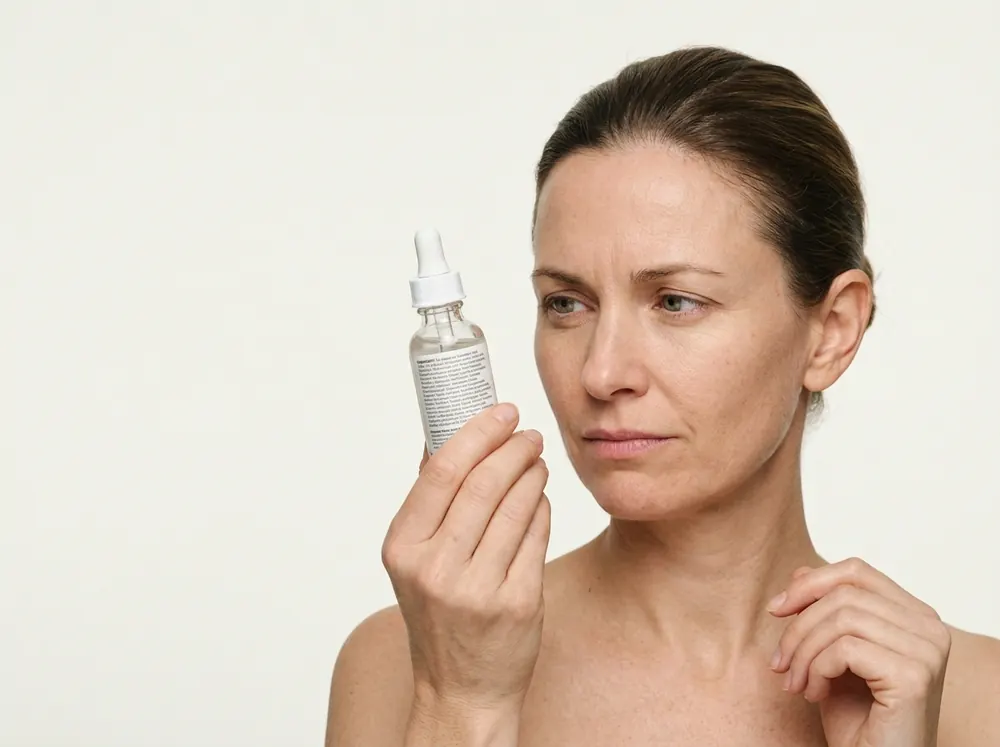
Those six are also the test for whether a recommendation is worth listening to — including one from this site. A product that cannot answer them has not been evaluated, it has been chosen. The same logic applies to any category term that sounds like a standard and isn't.
Conclusion
"Serum" is a viscosity band that acquired a reputation. There is no technical definition behind the word, no regulatory one, and no formulation rule that says a thin product carries more active than a thick one.
Sorted by what they target instead, the shelf separates cleanly. Retinoids and acids have the strongest evidence for texture and photoageing. Niacinamide quietly does four jobs at 2–5%, below the concentrations it is usually sold at. Azelaic acid covers acne, pigment and rosacea with one molecule. Vitamin C works, on rules shakier than they are quoted. Barrier lipids have a clear mechanism and modest claims. And the regenerative category — the most expensive on the shelf — has 14 registered skin trials, no approved products, no consensus on purity or dose, and two of its three published aesthetic studies ran the ingredient alongside a procedure that works on its own.
Underneath all of it sits the question nobody prints: can the molecule cross 500 Daltons of brick wall, in the vehicle it arrived in, at the pH it was formulated to?
Answer that and the shelf becomes short. Most of what is on it is the same handful of molecules at varying concentrations in varying vehicles, sorted by price.
Frequently asked questions
5 questions · tap one to open the answer
Do serums have higher active concentrations than creams?
What concentration of niacinamide should a serum have?
Can collagen or peptides in a serum actually absorb into skin?
Do exosome and growth factor serums work?
How do I tell if a serum is worth buying?
Medically reviewed by
Dr. M.M Hanaei
Aesthetic Physician, Dermatology Fellowship
- MD — Shahid Beheshti University of Medical Sciences (SBMU)
- MCC Licensure (Medical Council of Canada)
- Dermatology Fellowship, Switzerland
- Certified in advanced aesthetic procedures
Last reviewed 4 October 2026