Skinic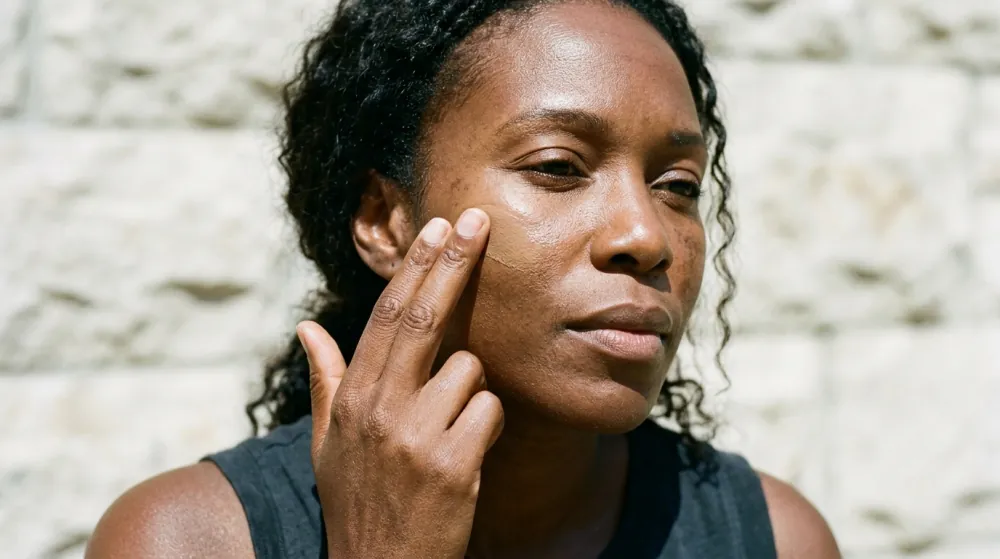
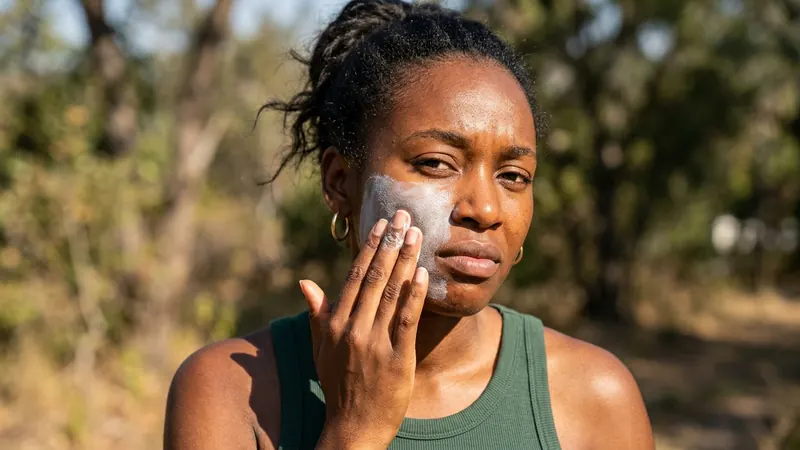
Sunscreen for hyperpigmentation has a blind spot that the SPF number hides. SPF is a sunburn measure, and a review in the Journal of the American Academy of Dermatology states that organic and inorganic UV filters do not protect against visible light; only tinted sunscreens do. Visible light is about half of the sunlight that reaches the ground, and in deeper skin tones it can darken skin for days.
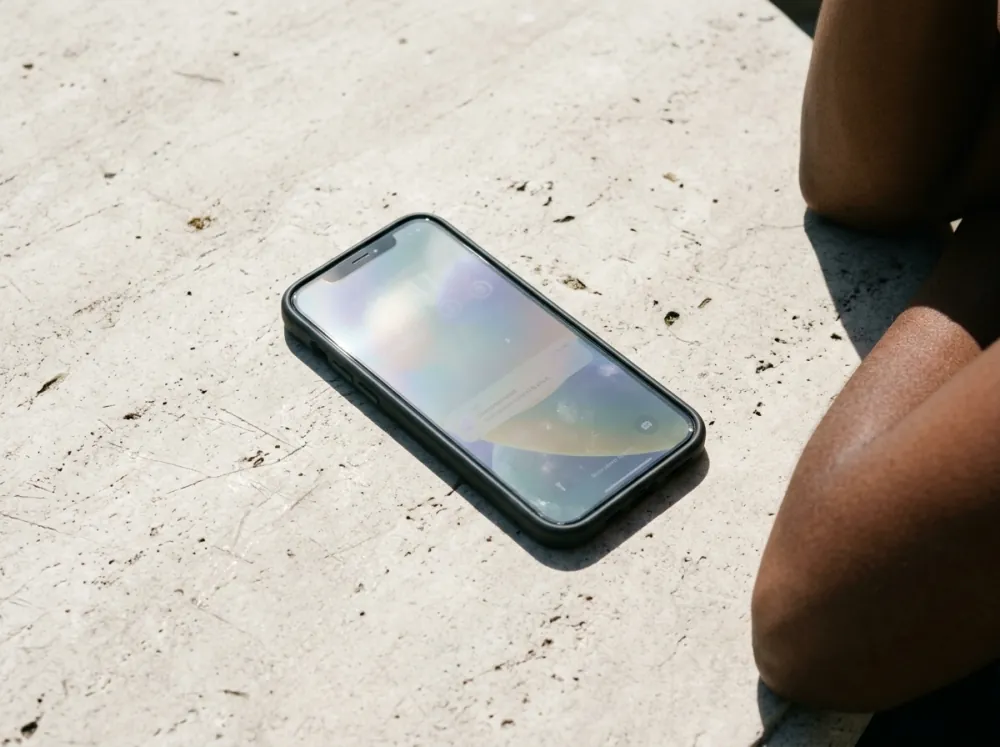
The claim that phone screens cause pigmentation does not survive a dose check. The studies that darkened skin used 40 to 80 joules per square centimetre of blue light, and by our arithmetic the brightest device figure in a 2026 review would need roughly two to four months of continuous exposure to deliver it.
This article on sunscreen for hyperpigmentation covers what SPF does not measure, how much visible light darkens skin, the screen claim, what iron oxides do and how much is known about them, freckles and sun spots, and why the amount applied matters again. It evaluates sunscreen claims. It does not diagnose a mark or recommend a treatment, and a new, changing or persistent dark patch is a question for your own clinician.
What SPF Does Not Measure
SPF is a ratio. A two-part review of visible light describes it as the minimal erythemal dose on protected skin divided by the dose on unprotected skin, tested with sunscreen applied at 2 mg/cm². Erythema is redness, so SPF tracks sunburn, which the review says is driven by UVB and, to a lesser extent, short-wavelength UVA. The same review adds that SPF alone does not indicate protection against UVA or visible light.
The US "broad-spectrum" label extends the test into UVA, but the test range stops at 400 nm. A broad-spectrum product must have a critical wavelength of at least 370 nm, which means at least 90% of its total absorbance sits at or above that wavelength when measured from 290 to 400 nm. Visible light starts at 400 nm, so a product can pass that test and still let visible light through.
The filters do not cover the gap either. The review states that organic and inorganic UV filters used in sunscreens do not protect against visible light. It adds that nanosized zinc oxide and titanium dioxide lack visible-light properties while non-nanosized versions have them, at the price of a white cast.
A 2019 study measured the gap directly. Researchers took 33 sunscreens sold in Brazil, 17 with pigments and 16 without, and calculated a visible-light protection factor for each from its absorption curve. Across the 33, the visible-light factor showed no significant correlation with the labelled SPF (r = 0.28, P = 0.17). A higher SPF did not predict more visible-light protection. The measure is a laboratory proposal, not a regulatory standard, and the two-part review notes that no established guidelines exist for visible-light photoprotection. The authors report no conflicts of interest.
Visible Light and Pigment
Visible light spans 400 to 700 nm. One review puts it at about 50% of the radiation reaching the earth's surface, against about 5% for UV, and a 2026 review puts it at about 45% of sunlight. The figures differ slightly, and neither changes the conclusion.
How Much Light Darkens Skin
The 2026 review of visible-light protection reports that blue light is the most potent inducer of pigmentation at fluences of 40 to 80 J/cm², with red light needing about 150 J/cm². It adds that, depending on location and weather, a blue-light dose in that range may be reached within 15 to 30 minutes of sunlight. Visible-light pigmentation is described as persisting 10 to 22 days and increasing with repeated exposure.
A randomised trial gives a measured example. In 33 women with phototypes III and IV, researchers delivered 60 J/cm² of 450 nm blue light to a forearm site on each of four consecutive days. In the placebo group the individual typology angle, where a lower value means darker skin, fell from 36.11 to 19.32 immediately after the fourth day. It partly recovered and stayed significantly below baseline through the recovery phase. The authors state that 60 J/cm² can be obtained in about an hour at midday on a clear summer day in central Europe.
That differs from the 15 to 30 minutes in the review, and the two sources are not reconciled here. The trial used a single blue wavelength and the review draws on several studies, but both say that sunlight delivers pigmenting doses within an hour. The trial was funded by a company that sells the two ingredients it tested, and four of its authors are employees of that company. That bears on the ingredient results, which are not used here, rather than on the finding that blue light darkened skin.
Who It Affects Most
The darkening is strongest in deeper skin. The review describes visible light as a recognised contributor to pigmentation, particularly in phototypes IV to VI. Blue light is detected by opsin 3 on melanocytes, which triggers a calcium signal and melanin synthesis, and in phototypes III to VI a further step forms stable pigment complexes that help explain why the darkening lasts. The review adds that melasma and post-inflammatory hyperpigmentation are exacerbated by visible light, and that long-wavelength UVA1 amplifies the effect.
Lighter skin is not unaffected. In the trial, some volunteers darkened and others mainly reddened under the same dose, and the grouped difference by phototype was not significant. The review states that all phototypes are susceptible to visible-light photoageing. Our articles on hyperpigmentation in brown and deep skin tones and the types of dark spots on the face cover how pigment behaves in deeper skin and how the main kinds of dark spot differ.
The Figure Audited: "Phone Screens Cause Pigmentation"
The claim has circulated alongside screen-time worries, and our article on sunscreen by skin type already says screens are not a meaningful source. This section shows the working.
What the Dose Arithmetic Gives
The 2026 review gives a solar visible-light irradiance of about 53 mW/cm². It reports that the highest recorded device figure is a tablet at full brightness held 25 cm from the eyes, which produces 0.0073 mW/cm². Dividing the first number by the second gives a gap of about 7,000-fold.
The review's own summary sentence says electronic devices as a group emit 99 to 1,000 times less than sunlight. Its two figures do not match that range when divided. The summary may compare a different quantity, radiance rather than irradiance, but the underlying papers were not opened here, so the discrepancy is reported rather than resolved. Both versions leave a gap of two orders of magnitude or more.
Now the time. At 53 mW/cm², 40 to 80 J/cm² takes about 13 to 25 minutes, which agrees with the 15 to 30 minutes the review gives for sunlight. At 0.0073 mW/cm² the same dose takes about 1,500 to 3,000 hours, or roughly two to four months of unbroken exposure. The two-part review reaches the same position: the cumulative blue-light dose from smartphones, tablets and computer screens does not reach the dose demonstrated to induce hyperpigmentation.
The calculation has assumptions. It treats the effect as depending on total dose, which has not been tested at device irradiances. It assumes the quoted device figure applies to the wavelengths that pigment. And it uses the highest recorded value, so typical use is lower.
What Has and Has Not Been Tested
A 2022 analysis compared the effective irradiance for pigmentation and oxidative stress from the sun, indoor lighting and electronic devices (abstract). Blue light made up about 25% of the sun's rays and about 30% of the radiation emitted by devices, so screens are not unusually blue, only far dimmer. The analysis found the sun to be the main source of effective irradiance for immediate and persistent pigmentation, and device exposure significantly lower. The authors add that it should be considered as a cumulative dose, especially in people with hypersensitivity.
That caution is a position, not a measurement. In our PubMed searches we found no study that exposed skin to a phone or monitor and measured pigment, and the searches were not exhaustive. The accurate statement is that the dose evidence does not support the claim and that direct testing is missing.
Verdict: the claim is not supported as stated. By the numbers in the sources a phone is a very small light source next to the sun, and clear glass allows up to 90% of visible light through, so a sunny window carries a far larger dose than the screen in front of it.
Iron Oxides, and Why Tint Matters
What Blocks Visible Light
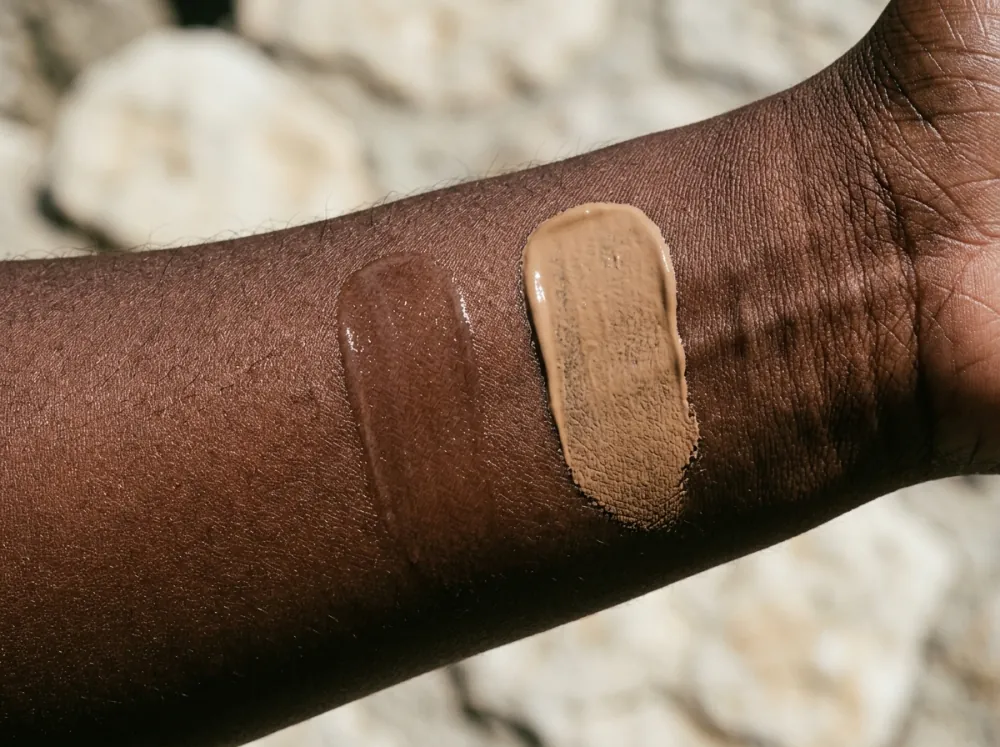
Visible light is blocked by pigment. Tinted sunscreens are a blend of iron oxides and pigmentary titanium dioxide, and the iron oxides come in yellow, red and black forms that can be combined to match different shades. The same review states that tinted sunscreens reduce visible-light transmission by 93 to 98%. The 2026 review gives up to 84 to 97% in its text and 80 to 97% in its abstract. The ranges differ by source and by how products were measured, so they are best read as a band, not a constant.
The 2026 review adds that, to protect against visible light, a sunscreen generally has to be perceptible on the skin, because protection comes from absorbing or reflecting the photons. That is why invisible nanosized filters do not help, and why a visible tint carries information.
What Product Measurements Show
In the Brazilian study, the 17 pigmented products had visible-light protection factors between 3.22 and 6.29, and the 16 non-pigmented products between 1.08 and 1.99. A pigmentation protection factor, which also counts long-wavelength UVA, was above 7 for the iron-oxide products and below 5 for the others. The authors link visible-light protection to the opacity of the product, since more opaque, pigmented formulas reflect more light.
These are product-level laboratory measures on one country's market. They show that iron oxides separate the products. They do not show how much pigmentation any one product prevents on a face.
How Much Iron Oxide Is Enough?
The sources do not say. The 2026 review describes two studies that disagree: one reported similar visible-light protection across formulations with different iron oxide concentrations, and the other found better attenuation at higher concentrations in the 6 to 25% range. Both varied the titanium dioxide too, so the iron oxide effect cannot be isolated. The review concludes that the minimum quantity needed has not been established, so "tinted" on a label is not a guarantee of a particular level.
What the Melasma Trial Found
The trial that most often anchors sunscreen for hyperpigmentation randomised 68 people with melasma to a sunscreen with UV protection plus iron oxide as a visible-light pigment, or to a UV-only sunscreen, both SPF 50 or higher, for 8 weeks (abstract). Sixty-one finished. At 8 weeks the iron-oxide group improved 15% more on the melasma severity score, 28% more on colorimetry and 4% more on a histological melanin measure.
Everyone in the trial was also using 4% hydroquinone, so it shows what a visible-light sunscreen adds to that treatment and cannot show what a tinted sunscreen does alone. The abstract does not state funding. The 2026 review also reports a 12-week randomised, double-blind trial in which an iron-oxide foundation worn with sunscreen improved melasma and dyschromia more than sunscreen alone. It was not opened directly, so its figures are not used here. Which treatment suits a particular patch of melasma is a decision for a clinician.
Freckles and Sun Spots
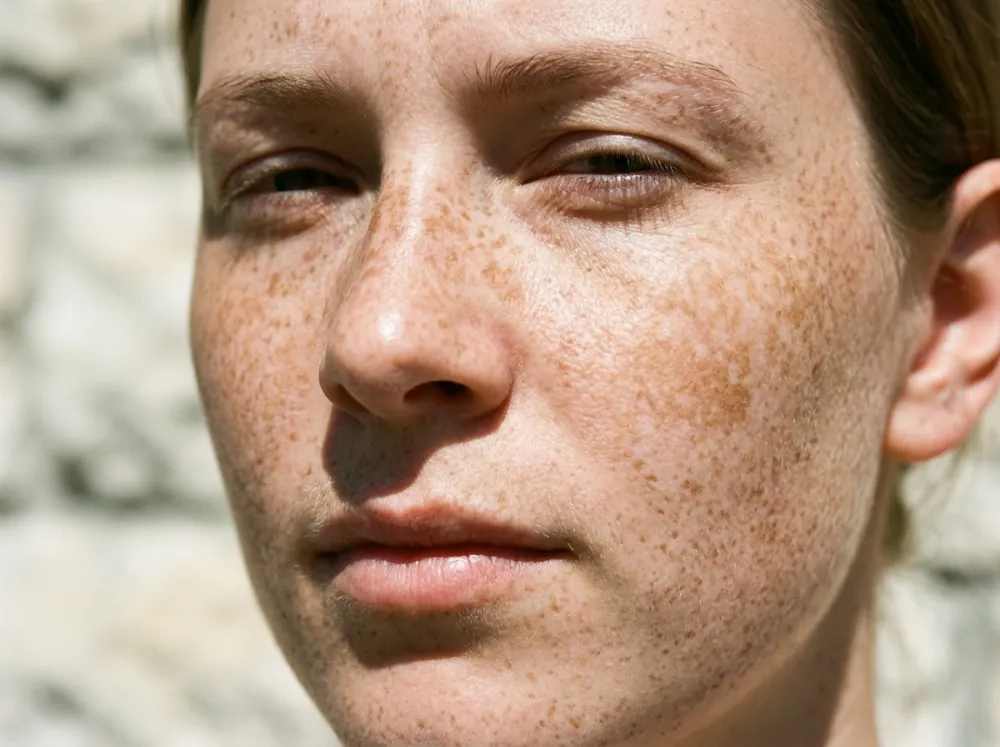
People who search for sunscreen dark spots and for sunscreen for freckles are asking different questions, because the two kinds of mark behave differently. DermNet defines an ephelis as a freckle, a small light brown or tan mark, with hundreds sometimes present on exposed skin. Ephelides are an inherited trait linked to a variant of the MC1R gene, they increase in number after UV exposure, and they are prominent in summer and fade in winter. A biopsy shows more pigment without more melanocytes, unlike lentigines.
Because the trait is inherited, DermNet states freckles cannot be prevented, but the summer darkening can be reduced by careful sun protection. It lists broad-spectrum SPF 50+ sunscreen and cosmetic camouflage among options for people who want to protect or disguise them. It also notes that fair skin is prone to the larger sun-damage freckles called lentigines, along with other signs of skin ageing and skin cancer.
No source opened for this article tested visible light or iron oxides on freckles. The visible-light evidence centres on phototypes IV to VI and on melasma, so a claim that a tinted sunscreen changes freckling in fair skin has not been shown here. Telling a freckle from another pigmented mark is a clinical judgement, usually made by looking, and occasionally by biopsy. A mark that is new, changing, bleeding or different from its neighbours is worth showing to a clinician.
Application Amount, Again
Every number above, SPF included, comes from a tested film. SPF testing uses 2 mg/cm², which the two-part review equates to about 30 mL, or 1 oz, for the whole body, and it reports that consumers usually apply 0.5 to 1.0 mg/cm². Our article on sunscreen by skin type works through what that gap does to a label, and our articles on lightweight sunscreens and sunscreen sticks look at how formulation and format relate to the amount applied.
For visible light the question has a particular form. No source opened here measured how visible-light protection changes with a thinner layer. What follows is reasoning, not a measured finding. The Brazilian study relates visible-light protection to the opacity of the product, and a thinner film is a less opaque film, so a sheer application should transmit more light. The tint on the label cannot say how much of it ends up on a face.
Judging a Tinted Sunscreen for Face Use
No standard exists for visible-light protection, so a tinted sunscreen for face use can be judged only against what the sources describe.
- Iron oxides in the ingredient list. The sources describe tinted protection as a blend of iron oxides and pigmentary titanium dioxide, so the pigment is what the claim rests on.
- A tint that can be seen. Protection depends on the product being perceptible on the skin, and the review warns that the iron oxide content needed is not established.
- A shade range. Shades are made by blending yellow, red and black iron oxides, so a match is possible. Whether a given product offers one for a given skin tone is a question for the shelf.
- Antioxidant claims. In an analysis cited by the two-part review, 10 of 12 sunscreens with antioxidant ingredients had no antioxidant activity and the other two had low activity.
- A UV claim as well. The 2026 review says iron-oxide foundations should be used in conjunction with broad-spectrum UV sunscreens, so the tint adds to the SPF and broad-spectrum label and does not replace them.
- "Blue light protection" wording. With no established guideline, such a phrase cannot be checked against a number.
Conclusion
Sunscreen for hyperpigmentation has to be judged on more than SPF, which measures sunburn, and the US broad-spectrum test ends at 400 nm, where visible light begins. In deeper skin, blue light at doses reachable in under an hour of sun darkens skin for days to weeks, and a review reports that it exacerbates melasma and post-inflammatory hyperpigmentation. UV filters do not block it. Iron oxides do, and product measurements show they separate tinted from untinted products, though the amount needed is unknown.
The phone-screen claim is not supported by the dose numbers, and no study has tested it directly. The melasma trial most often cited for a visible-light sunscreen was small, short, run alongside hydroquinone, and available here only as an abstract. Freckles are inherited and sun protection reduces their summer darkening; the visible-light evidence does not cover them.
Keeping a record can help when a mark is the question. Photographing it in the same place, distance and light, whether in a dated album or in an app like Skinic, shows whether it is fading, holding or darkening, and gives a clinician something to look at. It cannot say what the mark is. For that, and for any decision about treatment, ask your own clinician.
Frequently asked questions
5 questions · tap one to open the answer
Does sunscreen help with hyperpigmentation?
Do phone screens cause dark spots?
Does a higher SPF protect against visible light?
What do iron oxides do in sunscreen?
Can sunscreen stop freckles?
Medically reviewed by
Dr. M.M Hanaei
Aesthetic Physician, Dermatology Fellowship
- MD — Shahid Beheshti University of Medical Sciences (SBMU)
- MCC Licensure (Medical Council of Canada)
- Dermatology Fellowship, Switzerland
- Certified in advanced aesthetic procedures
Last reviewed 9 October 2026