Skinic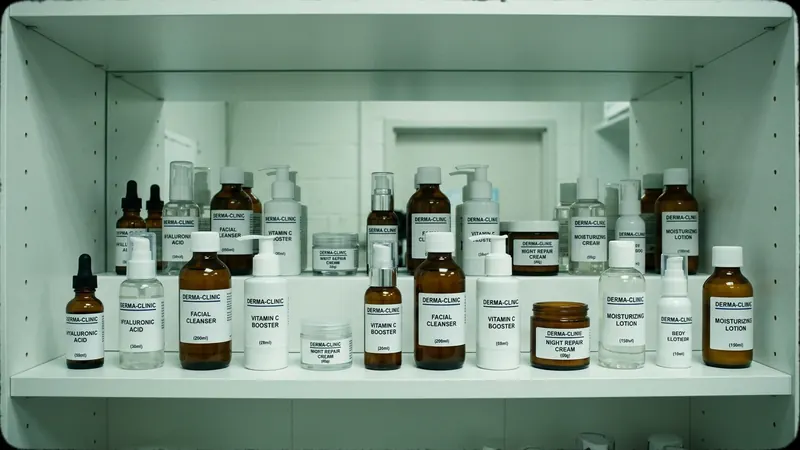
The serum costs four times what the pharmacy version does. It came from a clinic, in heavier packaging, and the label says medical grade. The implication is obvious: this one has been held to a higher standard.
Here is the thing worth knowing before you spend the money. There is no medical grade category. Not in US regulation, not in EU regulation, not anywhere. It is a marketing phrase with no legal definition, no threshold to meet, and no authority behind it. Any company can print it on any bottle.
That does not mean the product is bad, and this article is not going to tell you clinic-dispensed skincare is a scam. Some of it is genuinely better formulated than what you will find in a supermarket. But the reason is never the phrase on the box, and once you know what regulators actually do recognise, you can tell the difference yourself.
This piece covers the two categories that legally exist, what changed in US cosmetic law in 2022, the distinctions that are real, and four questions worth asking about any product making the claim.
There Is No "Medical Grade" Category
Start with the flat statement, because it is unusually clear-cut for a skincare question.
The FDA recognises cosmetics and drugs. It states directly that it does not recognise any such category as cosmeceuticals — the closest thing the industry has to a formal name for this middle tier. "Medical grade" has even less standing than "cosmeceutical", because at least "cosmeceutical" has been formally declined; "medical grade" has never been a candidate.
The same applies to the claims printed beside it. The FDA is explicit that the law does not require cosmetic labeling to have FDA approval before products go on the market, and FDA does not have a list of approved or accepted claims. Terms like hypoallergenic, natural and organic are not legally defined for cosmetics either.
The only standard that applies is that labelling must be truthful and not misleading — enforced after the fact rather than checked in advance, with the Federal Trade Commission handling advertising separately.
So: a phrase nobody defines, on a label nobody pre-approves, in a category that does not exist.
What Regulators Actually Recognise
There are two categories, and which one a product falls into is decided by something more interesting than its ingredients.
A cosmetic is a product intended to be rubbed, poured, sprinkled or sprayed on the human body for cleansing, beautifying, promoting attractiveness or altering the appearance.
A drug is intended for use in the diagnosis, cure, mitigation, treatment or prevention of disease, or intended to affect the structure or any function of the body.
The deciding factor is intended use, not composition. The FDA establishes intended use through claims made on labels and in advertising, through consumer perception, and through whether an ingredient has recognised therapeutic applications. Certain claims trigger drug classification automatically regardless of how they are marketed.
This produces the strange situation at the heart of the category. A product containing an ingredient with real biological activity, sold with claims restricted to appearance, is a cosmetic. The same formula sold with a claim about treating a condition becomes a drug — and drug status brings requirements the cosmetic route does not. The words on the box change the legal category more reliably than the contents do.
Products can also be both at once. An anti-dandruff shampoo is a cosmetic for cleansing hair and a drug for treating dandruff; sunscreens and fluoride toothpastes are in the same position, and must comply with the rules for both.
What Changed in 2022 — and What Did Not
Worth knowing, because it is recent and most coverage of this topic predates it.
The Modernization of Cosmetics Regulation Act of 2022 is described by the FDA as the most significant expansion of its authority to regulate cosmetics since 1938. It introduced four real obligations: facility registration renewed every two years, product listing including ingredients with annual updates, records supporting adequate safety substantiation, and reporting of serious adverse events within 15 business days.
That is a genuine tightening, and it is the reason claims that cosmetics are "completely unregulated" are now out of date.
But here is what did not change, and it is the part that matters for this article. The FDA does not require premarket approval of cosmetic products or ingredients, and neither the law nor FDA regulations require specific tests to demonstrate the safety of individual products or ingredients. Safety substantiation is the manufacturer's responsibility, held in their own records.
So a "medical grade" cosmetic has been through exactly the same premarket process as a drugstore moisturiser: none.
The Distinctions That Are Real
None of this means all skincare is equivalent. It means the meaningful differences are elsewhere, and they are things you can actually check.
Prescription-Only Actives
This is the real line, and there is a clean example.
Hydroquinone was for years available over the counter for pigmentation. It is not any more. Following the CARES Act, OTC skin lightening products containing hydroquinone are not generally recognised as safe and effective, are deemed new drugs, and had to be removed from the market as of 23 September 2020. The FDA states there are now no FDA-approved or otherwise legally marketed OTC skin lightening products, and that Tri-Luma is the only FDA-approved drug containing hydroquinone, for short-term treatment of dark spots in moderate-to-severe facial melasma.
The reason is not bureaucratic. Reported adverse effects include rashes, facial swelling, and ochronosis — a skin discolouration that the FDA warns may be permanent. That is the paradox worth understanding: a treatment for pigmentation that can cause a worse and irreversible pigmentation problem.
That is what an actual regulatory distinction looks like. A prescription requirement, a named approved product, a documented harm, and a date. Compare it with "medical grade", which has none of those things. If you are working on pigmentation, how to remove dark spots on your face covers what the options genuinely are.
Concentration, and Whether It Survives the Jar
A real difference between two products with the same ingredient list can be concentration, formulation and stability — whether the active is present at a level shown to do something, and whether it is still intact by the time you use it.
This is where clinic-dispensed products sometimes do earn their price. It is also completely invisible from the label, because cosmetic ingredient lists give order rather than amount below 1%, and stability is not disclosed at all.
Evidence for the Finished Product, Not the Ingredient
The most common sleight of hand in the category: a study demonstrating that an ingredient does something, cited in support of a product containing that ingredient at an undisclosed concentration in a different vehicle.
An ingredient having published evidence is not the same as this formulation having published evidence. When a brand cites research, the question is whether the study tested the finished product or just the raw material.
Why Clinic Distribution Is Not Evidence
The strongest implied argument for "medical grade" is the setting: a doctor sells it, so it must be better.
Being sold in a clinic is a distribution decision, not a regulatory status. Selective distribution supports price maintenance, and margin on retail products is a meaningful revenue line for aesthetic practices. None of that makes the product bad — but it explains the shelf without needing the product to be superior.
The useful version of the clinic relationship is different and more valuable: a clinician who examines your skin and recommends something specific for what they found. That is professional judgement, and it is worth paying for. The product being physically present in the room is incidental.
A reasonable test: if you asked whether an equivalent formulation is available elsewhere for less, would you get a straight answer? Somebody exercising judgement can answer that. Somebody selling a category cannot.
The Sibling Phrases Are No Better
"Medical grade" travels with a family of near-synonyms, and none of them fares any better under scrutiny.
"Pharmaceutical grade" borrows the language of drug manufacturing, where the term does have meaning for raw chemical purity. Applied to a finished cosmetic it carries none of that across — the purity of an input says nothing about the concentration, stability or efficacy of the product built from it.
"Professional" and "physician dispensed" describe who sells it. That is a distribution channel, exactly as discussed above.
"Clinically proven" is the one worth pausing on, because it sounds like the strongest claim and is the vaguest. It does not specify what was tested, on how many people, against what comparison, or measuring what outcome. A satisfaction survey of thirty users is clinical testing by that standard.
None of these are legally defined. The FDA is explicit that terms such as hypoallergenic, natural and organic are not legally defined for cosmetics, and the same absence applies across the category. The only operative requirement is that labelling be truthful and not misleading.
There is one more split worth knowing. Labelling and advertising are enforced by different bodies: the FDA handles labelling, while the Federal Trade Commission handles advertising claims separately. So the words on the box and the words in the campaign are governed by two different agencies, neither of which reviewed either before you saw them.
Four Questions to Ask About Any Product Making the Claim
- Is this a cosmetic or a drug? If it is a drug, it went through approval and the label will reflect that with an active ingredient and a drug facts panel. If it is a cosmetic, it did not, and "medical grade" does not change that.
- Which active, and at what concentration? If neither is disclosed, the price is not buying you information.
- Was the finished product tested, or just the ingredient? Ask which. The answer is often revealing.
- What would I be buying if the phrase were not on the box? Strip the claim and judge the formula. If nothing is left, that was the product.
A fifth, less comfortable one: what problem am I solving? A well-formulated serum aimed at the wrong condition is still aimed at the wrong condition, at any price — which is why working out what you are actually looking at and knowing your own skin type come before the shopping.

Conclusion
"Medical grade" is a phrase with no definition, on a label with no premarket approval, describing a category no regulator recognises. It is not a lie exactly — it cannot be, because there is nothing for it to be false about.
What is real: the cosmetic-versus-drug line, which turns on intended use rather than ingredients. The 2022 expansion of FDA cosmetic authority, which added registration, listing, safety records and adverse event reporting — but not premarket approval. And genuine prescription boundaries, like the one that removed over-the-counter hydroquinone from the US market in 2020 over a risk of permanent discolouration.
So when a product carries the phrase, ignore it and ask the four questions instead: cosmetic or drug, which active and how much, was the finished product tested or just the ingredient, and what would I be buying if the claim were not there.
Some clinic-dispensed skincare is worth the money. None of it is worth the money because of the words on the box.
Frequently asked questions
5 questions · tap one to open the answer
Is "medical grade" skincare actually regulated differently?
Is clinic-sold skincare better than drugstore skincare?
What is the difference between a cosmetic and a drug?
Are cosmetics regulated at all in the US?
Why can't I buy hydroquinone over the counter any more?
Medically reviewed by
Dr. M.M Hanaei
Aesthetic Physician, Dermatology Fellowship
- MD — Shahid Beheshti University of Medical Sciences (SBMU)
- MCC Licensure (Medical Council of Canada)
- Dermatology Fellowship, Switzerland
- Certified in advanced aesthetic procedures
Last reviewed 18 September 2026