Skinic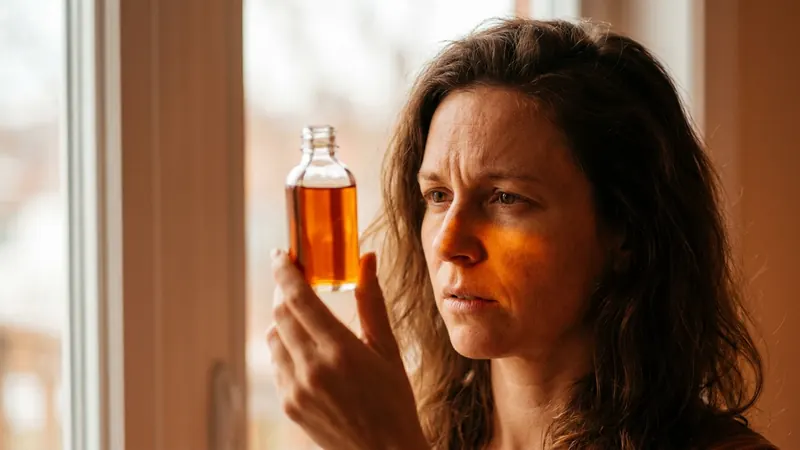
Vitamin C is the most recommended active in skincare after sunscreen and a retinoid, and it is the only one of the three that can be dead in the bottle before you open it.
That is not a marketing criticism. It is a property of the molecule. L-ascorbic acid is hydrophilic, readily oxidised and highly unstable, which is why the category has spent twenty-five years building formulation workarounds around a single awkward fact.
What is more interesting is where the rules came from. The three numbers that define this entire category — the pH, the concentration ceiling, and the verdict on derivatives — all trace back to one paper, published in 2001, conducted on pig skin. And the patent built on that work claims something noticeably different from what gets repeated.
The Molecule Everyone Recommends Is Unstable
Start with what vitamin C does, because it is worth protecting if you can.
It is a cofactor for prolyl and lysyl hydroxylase, the enzymes that cross-link and stabilise collagen fibres, and it directly activates the transcription factors involved in collagen synthesis while increasing expression of the tissue inhibitor of MMP-1, which slows collagen breakdown. It is a potent antioxidant. And it interacts with copper ions at tyrosinase active sites, inhibiting the enzyme that converts tyrosine into melanin — which is the pigmentation mechanism.
Three real jobs: collagen, oxidative stress, pigment.
The problem is delivery. Ascorbic acid is water-loving and unstable, which limits cutaneous penetration before any formulation question arises. In aqueous systems it is highly vulnerable to oxidation, and that threatens the shelf life of the finished product rather than just its elegance.
What the Colour Change Means
Here is the one piece of consumer-grade evidence in all of skincare that you can read with your own eyes.
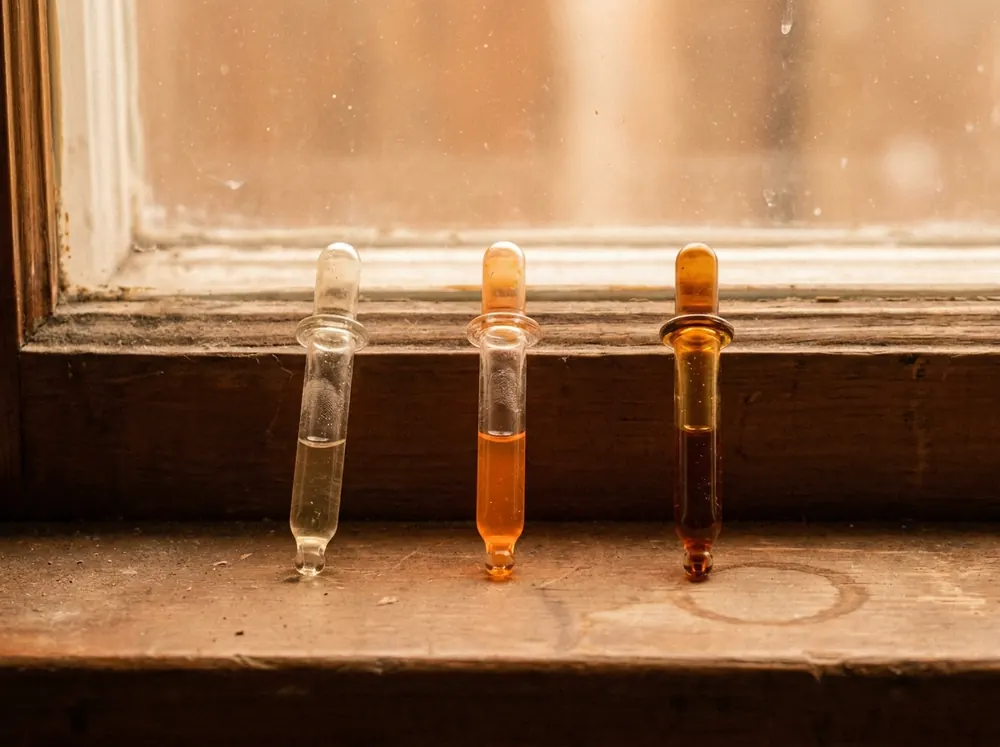
Oxidation of vitamin C solutions is visible as darkening. The same review notes that this is confirmed by the darkening of vitamin C aqueous solutions and emulsions under normal storage conditions. A serum that arrived pale straw and is now orange, amber or brown has oxidised.
That is not a cosmetic flaw you can look past. The oxidised product is not the active molecule — derivatives and degradation products are not L-ascorbic acid, and L-ascorbic acid is the only biologically active form. When the colour goes, the thing you paid for has gone with it.
Three practical consequences follow, and none of them appear on packaging:
- Water is the enemy. Stabilisation strategies centre on monitoring oxygen levels, working in an acidic medium, and reducing water content in the formulation.
- Air and light accelerate it. Which is why packaging is a functional component, not presentation.
- You are the assay. No other active gives you a free readout of whether it is still working.
Three Rules, One Paper
Now the part this article exists for.
Almost every page about vitamin C repeats the same three rules: it has to be L-ascorbic acid, formulated below pH 3.5, at a concentration between about 10% and 20%, because above 20% absorption does not improve. Derivatives, the story goes, do not work.
Read the citations and they converge. The JCAD review attributes the pH rule, the concentration ceiling, and the derivative finding to the same reference — Pinnell SR et al., Dermatologic Surgery, 2001. The specific claims sourced there are that reducing pH below 3.5 improves stability and permeability, that concentration above 20% does not increase biological significance and might cause irritation, and that daily application of several ascorbic acid derivatives did not increase L-ascorbic acid levels in the skin.
One paper, three foundational rules, twenty-five years of category orthodoxy.
Two things about that paper matter and are almost never mentioned.
It Was Conducted on Pig Skin
Porcine skin is used because it is a reasonable model for human percutaneous absorption. It is not human skin. A number generated in that model and then quoted as a fixed human threshold has travelled further than its evidence.
And It Is Not Publicly Readable
It sits behind a paywall at Wiley, returns a payment-required response at the journal's own site, and PubMed is CAPTCHA-walled. Three routes, no access. So the figures above are reported as the reviews attribute them, rather than verified at source — and on a site built on opening what it cites, that limitation belongs in the text rather than a footnote.
The Patent Says Something Different
There is a primary document that can be opened, and it is more informative than the paper.
Sheldon Pinnell — the first author of that 2001 study — was also the founder of a skincare company. He is named as co-inventor on US patent 7,179,841, "Stabilized ascorbic acid compositions and methods therefor", filed in 2005 and granted in 2007. The assignee is listed as L'Oréal USA, originally SkinCeuticals.
That is not an accusation. Academic research becoming a product is ordinary and often good. But when the numbers defining a whole product category come from one researcher's study, and that researcher patented and sold the formulation those numbers describe, the reader is entitled to know before treating the figures as physics.
And the patent's own claims are revealing:
| Parameter | What gets repeated | What the patent claims |
|---|---|---|
| L-ascorbic acid | 10–20%, with 20% the ceiling | 5% to 40% by weight |
| pH | Below 3.5 | "no more than about 3.5", optimal "about 2.5 to 3.0" |
| Ferulic acid and relatives | A stabiliser | 0.2% to 5.0% |
| Vitamin E | Optional partner | 0.3% to 2.0% |
A patent claims broad ranges deliberately — wide claims are how legal coverage works, and the 40% upper bound is not a recommendation. But it does show that the person who produced the 20% figure did not treat it as a hard ceiling when drafting the document that protected his own formulation.
The pH number deserves the same reading. Below 3.5 is a patent claim boundary as well as a biological one, and a recent systematic review of 44 studies covering 3,451 participants records efficacy maintained in stabilised and anhydrous systems at physiologic pH, around 6. If that holds, the acidity rule is a property of one formulation approach rather than a law about the molecule.
Why Every Serum Suddenly Looks the Same
One more fact with a direct consumer consequence: the patent expired in March 2025. Which is a large part of why the market is now full of L-ascorbic acid, vitamin E and ferulic acid serums that look remarkably like each other.
What the Clinical Evidence Actually Shows
Modest, real, and thinner than the category's confidence implies.
The systematic review covered 44 articles — 20 randomised controlled trials, 5 prospective comparative cohort studies, 18 case series and one case report, totalling 3,451 participants. That is a reasonable evidence base by skincare standards, and the authors are candid about its limits: many studies are open label, single centre, and industry sponsored, often short, in small homogeneous cohorts, with limited phototype reporting.
How Small the Trials Actually Are
A double-blind, placebo-controlled study of 10 subjects using 10% vitamin C over 12 weeks found a statistically significant reduction in photoaged scores and improvement in wrinkling. A study of 20 subjects on 5% over six months found significant improvement in furrows on histology and clinical appearance. For pigmentation, 25% vitamin C with a penetration enhancer significantly decreased melasma pigmentation at 16 weeks — though the same review notes that clinical effects on pigment may not match hydroquinone.
The photoprotection figures come from animal work: 10% topical vitamin C reduced UVB-induced erythema by 52% and apoptotic sunburn cell formation by 40 to 60%.
DermNet puts it more bluntly than most clinical references do. On topical antioxidant formulations generally it states that many of the available formulations contain very low concentrations of antioxidants that are not well absorbed by the skin, that many currently available topical vitamin C preparations do not penetrate the skin sufficiently to make any difference, and — on the advertising claims made for them — that almost all of these claims have no rigorous scientific testing to back them.
That is a mainstream dermatology resource saying the quiet part at full volume.
Set that against how the category is sold. Ten-subject trials and animal models are the foundation under a product tier that routinely costs more than a hundred pounds. The evidence supports "this does something useful." It does not support the certainty of the marketing, and it is worth reading alongside what "medical grade" actually means in regulation, which is nothing.
Derivatives: What They Trade Away
Derivatives exist because L-ascorbic acid is difficult. Magnesium ascorbyl phosphate, sodium ascorbyl phosphate, ascorbyl glucoside, 3-O-ethyl ascorbic acid, tetrahexyldecyl ascorbate — all are more stable, most are less irritating, and several work at a friendlier pH.
The trade is conversion. A derivative has to be cleaved in the skin to release active ascorbate, and that step is where the evidence gets thin. The finding everyone cites — from that same 2001 paper — is that daily application of several derivatives did not increase L-ascorbic acid levels in the skin.
The recent review is more careful, and its caution is worth repeating precisely. It emphasises that clinical outcomes hinge primarily on formulation chemistry rather than on the presence of ascorbate alone, and it reports clinical efficacy for several derivative systems — ascorbyl glucoside-arginine complexes at up to 28%, bis-glyceryl ascorbate with maximal effect at 1% — without quantifying whether those derivatives raise skin ascorbate at all.
So the honest position: derivatives have clinical results behind them, and whether they work by the mechanism attributed to vitamin C is a separate question that the literature has not closed. If you cannot tolerate a pH 3 serum, a derivative is a reasonable choice — just not on the assumption that it is the same thing in a gentler wrapper.
Six Things to Check Before Buying
Every item here is answerable from the product itself.
- What form is it? L-ascorbic acid, or a named derivative. "Vitamin C" on the front is not an answer; the ingredient list is.
- What concentration? If it is not stated, that is information. The clinically studied range for L-ascorbic acid sits around 10–20%, with the ceiling quoted more confidently than its source can carry.
- What pH, and does the form require one? A low-pH L-ascorbic acid serum is a tolerability trade, not a marketing choice — and if it stings on already-compromised skin, that is barrier damage rather than the product working.
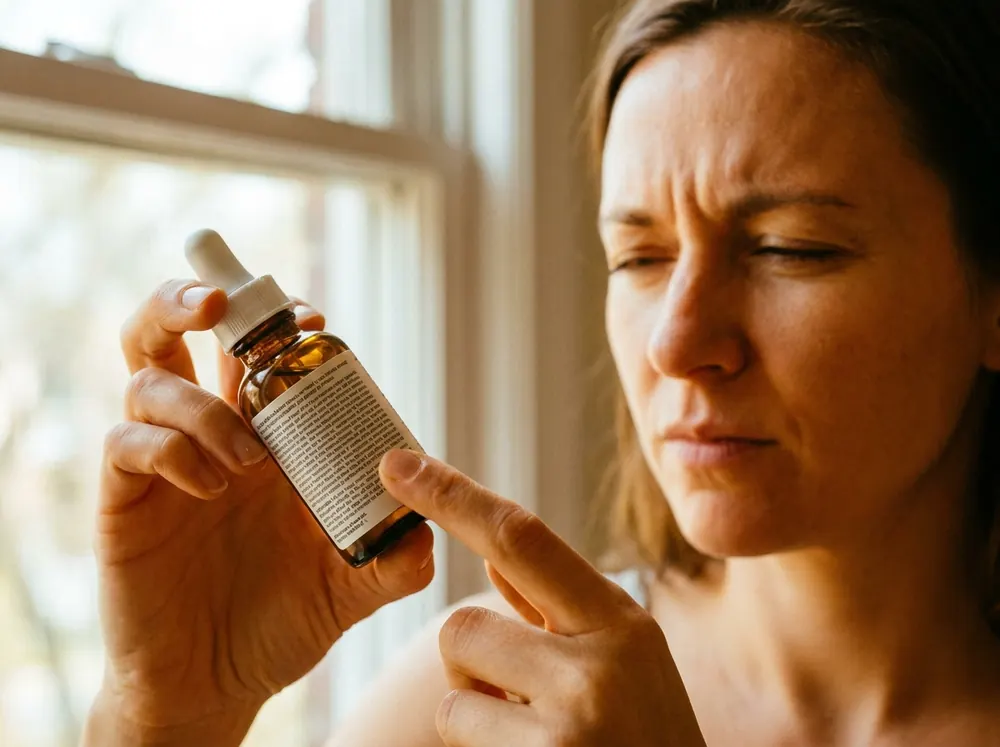
- What is the packaging? Opaque, airtight, small. A clear dropper bottle on a bright shelf is a design decision with a chemical consequence.
- What colour is it now, and what colour was it? The only free assay you will ever get. Photograph it on day one.
- How old is it, and how long has it been open? Stability data in the patent is measured in weeks at elevated temperature, not years on a shelf.
And one habit rather than a checkbox: use it in the morning, because the photoprotection evidence is about UV exposure, and pair it with sunscreen rather than instead of it. The morning and evening routines have different jobs, and this one belongs to the morning.
A note on stacking, since vitamin C is usually bought as an addition to something. A low-pH serum layered onto an exfoliating acid or benzoyl peroxide is a lot of acid on one face. The irritation is additive even when the chemistry is compatible. If you are still deciding what the serum is for, the shelf sorted by target rather than by name is the wider view.
Conclusion
Vitamin C does three things worth wanting: it supports collagen synthesis as an enzyme cofactor, it neutralises oxidative stress, and it inhibits tyrosinase. The clinical evidence for all three is real and modest, built largely on small, open-label, frequently industry-sponsored studies — which the people who reviewed them say plainly.
The rules everyone repeats are shakier than they sound. The pH threshold, the 20% ceiling and the verdict on derivatives all trace to a single 2001 pig-skin study that is not readable at any of three publishers. The patent built on that work by the same researcher — who founded the company that sold the formulation — claims 5% to 40%, not a ceiling at 20%. And a 2025 review of 44 studies records efficacy at physiologic pH, which the acidity rule says should not happen.
None of that means vitamin C does not work. It means the numbers are being quoted with a confidence that their sources do not support, by an industry that has good commercial reasons not to examine them.
What survives all of it is the simplest thing. If it has turned amber, it is finished. That is the one piece of evidence in this entire category you can gather yourself, for free, by looking at the bottle.
Frequently asked questions
5 questions · tap one to open the answer
Does vitamin C serum go bad when it turns brown?
What concentration of vitamin C serum is best?
Does vitamin C serum need to be below pH 3.5?
Are vitamin C derivatives as good as L-ascorbic acid?
How strong is the evidence for vitamin C serums?
Medically reviewed by
Dr. M.M Hanaei
Aesthetic Physician, Dermatology Fellowship
- MD — Shahid Beheshti University of Medical Sciences (SBMU)
- MCC Licensure (Medical Council of Canada)
- Dermatology Fellowship, Switzerland
- Certified in advanced aesthetic procedures
Last reviewed 29 September 2026