Skinic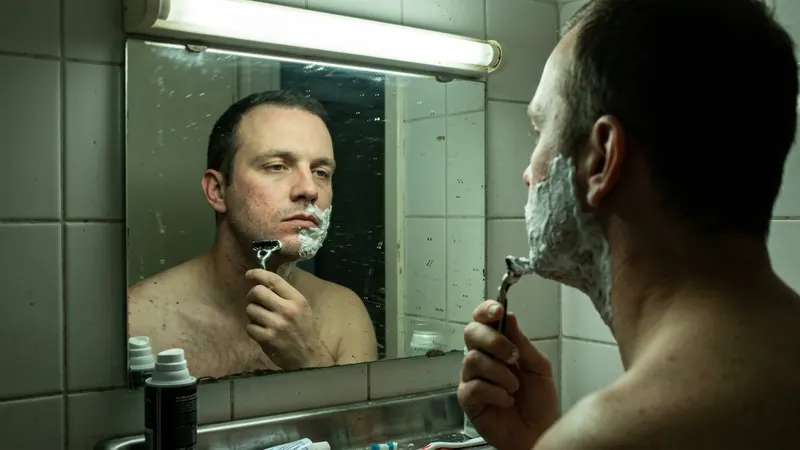
Every page about men's skin opens with the same sentence: men's skin is 25% thicker than women's.
Go looking for where that comes from and it is not there. Not in the comparative physiology literature that can be opened. Not in the facial thickness mapping study. And not in a paper written specifically about male skin that works through every other difference with citations attached.
What is different is real but small, and mostly beside the point. The thing that actually separates a men's routine from anyone else's is that a large area of the face gets scraped with a blade several times a week. Build around that and the routine almost designs itself.
The 25% Figure, Audited
Three places it should be and isn't.
It is not in the facial thickness map. The best available survey of how thick facial skin is used high-frequency ultrasound at 75 MHz across 38 anatomical sites — upper eyelid at a median 573.5 μm, nasal tip at 1,907 μm. It is a genuinely useful dataset and it studied 45 women. No men. The most detailed facial thickness data available cannot speak to a sex difference because it did not measure one.
It is not in the men's-skin paper. A pilot study of a topical antioxidant developed specifically for men opens, as these papers do, by enumerating male–female differences. It covers collagen, sebum, hydration, transepidermal water loss, pH, subcutaneous fat and UV sensitivity, each attributed to a source. For thickness it notes structural differences exist and gives no percentage at all — in a paper whose commercial interest would be served by giving one.
And it is everywhere else. Brand pages, clinic blogs, product copy. The figure circulates without a traceable origin.
To be exact about what this does and does not establish: androgens do thicken skin, and that is not in dispute. What is missing is the number. "Thicker" is supported; "25%" does not trace to anything readable.
What Is Actually Different
Strip out the untraceable and a short, specific list remains — and one item on it points the opposite way from the marketing.
Sebum is higher and stays higher. Greater testosterone means sebum production rates remain relatively stable with age in men, where in women they decline. This is the difference most worth acting on.
Barrier measures run slightly in men's favour. Lower overall transepidermal water loss, generally greater stratum corneum hydration, and consistently lower skin surface pH. The men's-skin paper cites these to Luebberding and colleagues — and gives no magnitudes for any of them, which is itself worth noticing in a paper selling a men's product.
And the one nobody mentions: men burn more easily. Male skin has a 16% lower minimal erythema dose than female skin — the UV dose required to produce visible redness. Lower threshold, less exposure needed to burn.
That inverts the whole "tougher skin" framing. The category sells ruggedness; the measured difference is that it reddens sooner. Which makes sunscreen the least optional item in the routine, and how much you actually need is the question that matters more than which bottle.
The Shave Is the Routine
Here is the reframe the category never makes.
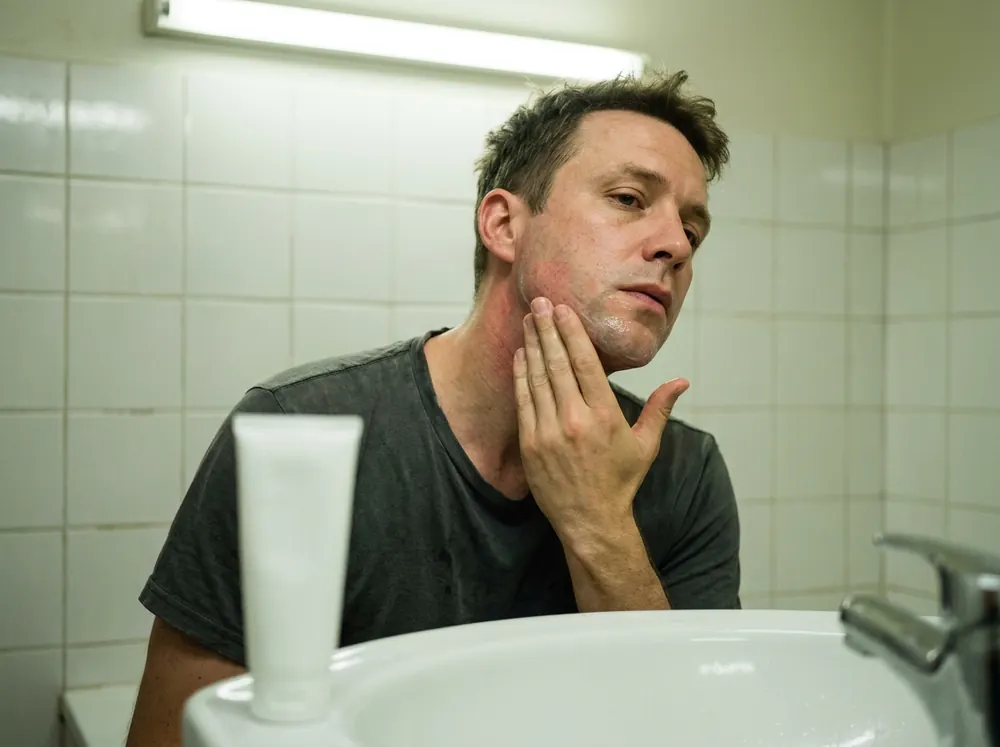
Shaving is a controlled abrasion of the stratum corneum across the lower third of the face, repeated two to seven times a week, usually with soap and warm water, often in a hurry. Nothing else in a normal routine does that.
Which means the highest-value changes are not products at all. They are the blade, the direction, the closeness and what happens in the ten minutes afterwards. A gentler cleanser matters; a different razor technique matters more.
And the damage mechanism is the one the barrier article describes in detail — protein denaturation and lipid extraction, made worse by alkaline soap. A shave followed by a foaming soap bar is two barrier insults in sequence.
Pseudofolliculitis Barbae
This is the payload section, and it is badly covered everywhere.
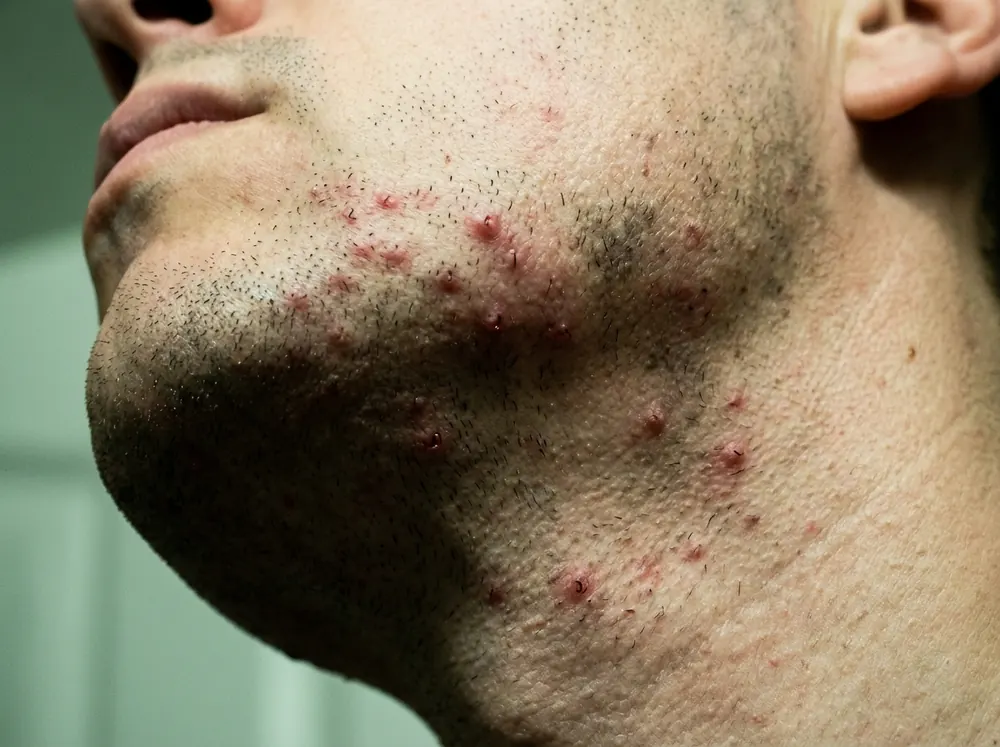
Pseudofolliculitis barbae — razor bumps — is an inflammatory reaction of the hair follicle caused by shaving. It is not infection and it is not acne, though it gets treated as both.
The Mechanism
Tightly curled hair, cut to a sharp point, re-enters the skin by one of two routes. Transfollicular penetration is the hair piercing the skin surface from outside. Intrafollicular penetration is the hair retracting beneath the surface and piercing the follicular epithelium from within. Either triggers a foreign body inflammatory reaction.
That is the same follicular mechanism the site covers below the neck in strawberry skin — one surface up, with a blade involved.
Who Gets It
The prevalence is not marginal. PFB predominantly affects men of African ancestry, at approximately 45 to 80%, because tightly curled coarse hair is the precondition. There is also a genetic contributor: a single nucleotide substitution in the hair follicle companion layer keratin K6hf is an additional risk factor.
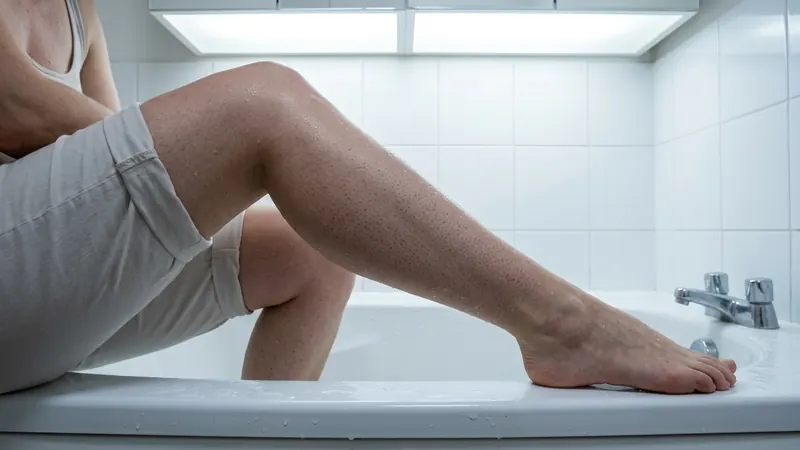
Women are affected too, especially in the groin, and it occurs anywhere hair is shaved or plucked — axilla, pubic area, legs.
What Makes It Worse
Every one of these is a habit, not a product:
- Shaving too close. Closeness is the primary aggravator, and it is what most shaving products are sold on.
- Blade razors over electric. Risk is higher with blades.
- Shaving against the direction of growth.
- Stretching the skin to get underneath the hair.
- Dull blades.
Why It Matters More Than It Looks
Two complications turn a cosmetic nuisance into something durable: post-inflammatory hyperpigmentation and keloid scarring. In the population most affected, PIH is also the most persistent — which is the overlap with hyperpigmentation in brown and deep skin tones.
The most effective intervention is the one nobody sells: stop shaving, or shave less closely and less often. Beyond that, electric shavers, technique changes, laser epilation, and glycolic acid to exfoliate the surface and reduce new inflamed spots — the same molecule and the same surface-level mechanism the acids article sets out.
The Skin Under a Beard Nobody Cleanses
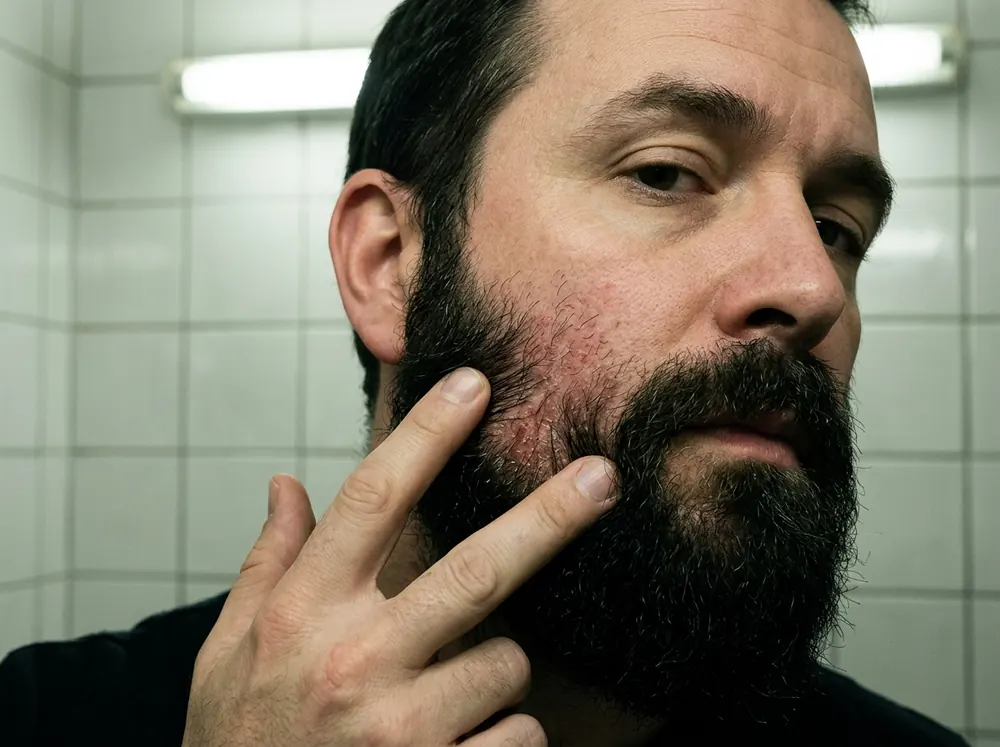
Growing a beard solves pseudofolliculitis barbae and introduces a different problem.
Seborrhoeic dermatitis affects 3 to 12% of the population, is more common in males, and DermNet lists the beard explicitly among its typical sites alongside the scalp, nasolabial folds, glabella, eyebrows and ears. It presents as salmon-pink, thin, scaly, ill-defined plaques, often with minimal itch — which is why it gets mistaken for dry skin and treated with moisturiser that does nothing.
The mechanism explains why facial hair is implicated. Proliferation of Malassezia yeast is considered central, and these fungi produce lipases and phospholipases that break down fatty acids in sebum. Men have more sebum, a beard traps it against the skin, and the yeast has what it needs.
It also flares in winter and improves in summer with sun exposure, which means the seasonal pattern people attribute to "dry weather" may be something else entirely.
The practical point: if the skin under your beard is flaking and pink, a heavier moisturiser is the wrong tool. Medicated antifungal shampoos — ketoconazole, ciclopirox, selenium sulfide — are what the condition responds to, used on the beard as they would be on the scalp.
Four Products, and Why That Is Enough
Everything above collapses into a short list.
- A non-alkaline cleanser. Used once daily at minimum, and not a soap bar. The shave has already stripped protein and lipid; the cleanser's job is not to do it again.
- A moisturiser with an occlusive fraction. Applied after shaving, while skin is still damp. This is the step that addresses the actual damage.
- Sunscreen. Non-negotiable given the 16% lower erythema threshold, and the step with the only randomised trial evidence behind a long-term outcome.
- One active, if you have a specific problem. Glycolic acid for razor bumps. A retinoid for texture or photoageing. Not both, and not at the start.
That is it. Building a routine from scratch without overcomplicating it applies identically regardless of who is doing it — the structure of a good routine is not sex-specific, because the skin biology barely is.
What "For Men" Changes
Fragrance, packaging, and a menthol tingle that people read as efficacy. There is no male-specific formulation science here. If a product is better, it is better for reasons that would make it better for anyone — concentration, vehicle, pH, tolerability.
One thing the category does get right, incidentally: men's products tend to be lighter in texture, which suits higher sebum output. That is a reasonable match to a real difference. It is also the only one.
Conclusion
The number the category opens with — 25% thicker — is not in the facial thickness mapping study, which measured 45 women and no men, and it is not in a paper written specifically about male skin that enumerates every other difference with citations. Androgens do thicken skin. The percentage is untraceable.
What is documented is narrower: higher and more stable sebum, slightly better barrier measures, lower surface pH, and a 16% lower minimal erythema dose — meaning male skin burns at a lower UV dose than the "tougher skin" story implies.
The genuine difference is the blade. Pseudofolliculitis barbae affects 45 to 80% of men of African ancestry, is driven by close shaving on curled hair, and leaves post-inflammatory hyperpigmentation and sometimes keloids. The most effective treatment is shaving less closely, which no product can sell you. Under a beard, the problem changes to seborrhoeic dermatitis, where moisturiser is the wrong tool and an antifungal is the right one.
Cleanser, moisturiser, sunscreen, and one active if you need it. The routine is short because the biology is nearly the same as everyone else's. What is different is what you do with a razor, and that is a technique problem wearing a product problem's clothes.
Frequently asked questions
5 questions · tap one to open the answer
Is men's skin really 25% thicker than women's?
What is actually different about male skin?
How do I stop razor bumps?
Why is the skin under my beard flaky and red?
Do men need special skincare products?
Medically reviewed by
Dr. M.M Hanaei
Aesthetic Physician, Dermatology Fellowship
- MD — Shahid Beheshti University of Medical Sciences (SBMU)
- MCC Licensure (Medical Council of Canada)
- Dermatology Fellowship, Switzerland
- Certified in advanced aesthetic procedures
Last reviewed 6 October 2026