Skinic

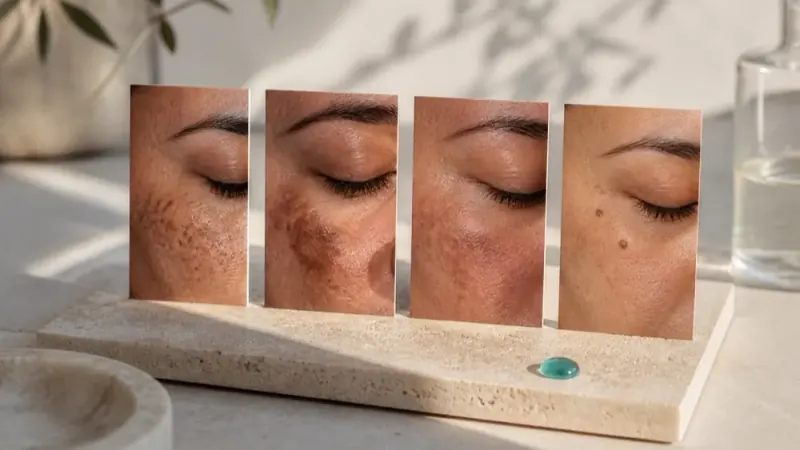
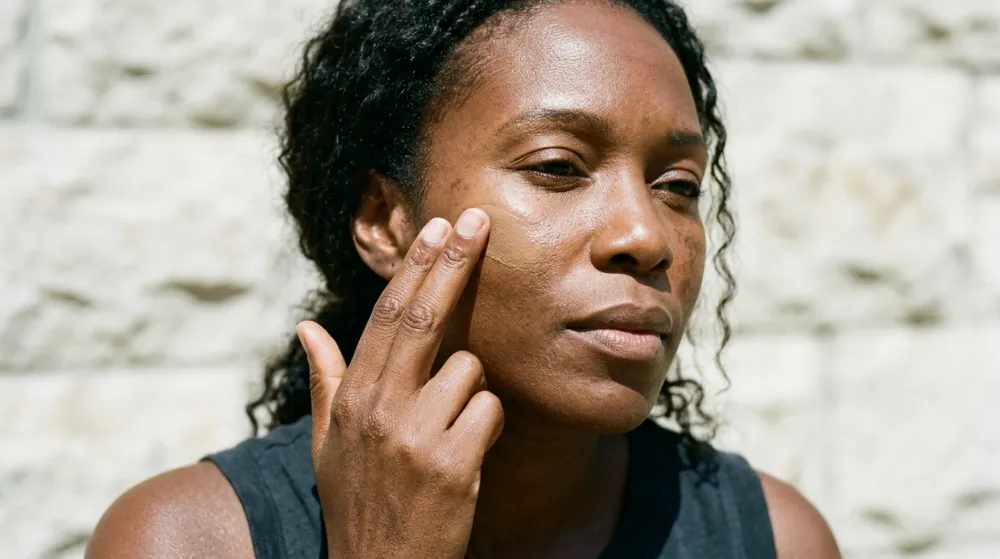
Melasma on the face is a chronic, symmetrical brown pigmentation that comes back each summer because several drivers act together: sunlight, visible light, heat, sex hormones and inherited susceptibility. Sun is the main environmental one, and it is not the only one. That is why a fading cream that "stops working" in July is not necessarily failing.
The claim this article tests is that melasma is caused only by sun. It covers how melasma looks and differs from sun spots, what light, heat and hormones each add, what the evidence and the US label say about tranexamic acid, and why relapse is the rule. It describes and evaluates. It does not diagnose a patch or direct treatment, and prescription options are a clinician's decision.
Symmetric, Patchy, Recurring
DermNet describes melasma as a common acquired disorder with bilateral, blotchy, brownish facial pigmentation, once called chloasma and "the mask of pregnancy". It is more common in women, usually begins between 20 and 40, and is most common in people who tan easily or have naturally brown skin. The same page puts about 60% of people as reporting affected family members.
Where It Sits
DermNet lists a centrofacial pattern (forehead, cheeks, nose and upper lip, 50% to 80% of cases), a malar pattern (cheeks and nose), a mandibular pattern (jawline and chin), and an extrafacial pattern on the forearms, upper arms and shoulders. A clinical review reports a female predominance of 6 to 1 in an Indian study and 39 to 1 in Brazil, and that men were 10% of cases in a Puerto Rican study with the same features as women.
How Deep It Is
DermNet divides melasma by depth. Epidermal melasma has well-defined, dark brown borders, looks more obvious under a Wood lamp, and usually responds well to treatment. Dermal melasma has ill-defined, light brown to blue-grey borders, does not accentuate under the lamp, and usually responds poorly. Mixed melasma is the most common and shows partial improvement. The type is judged by a clinician with a lamp or dermatoscope, not by eye.
Why "Recurring" Belongs in the Name
A 2022 pathogenesis review draws the line plainly: pigmentation from tanning and from post-inflammatory hyperpigmentation fades once the stimulus stops, and in melasma that fading usually does not occur. The review adds that there is no animal model for melasma and that the reasons for its persistence are not fully understood.
How Melasma Differs From Sun Spots and Post-Inflammatory Marks
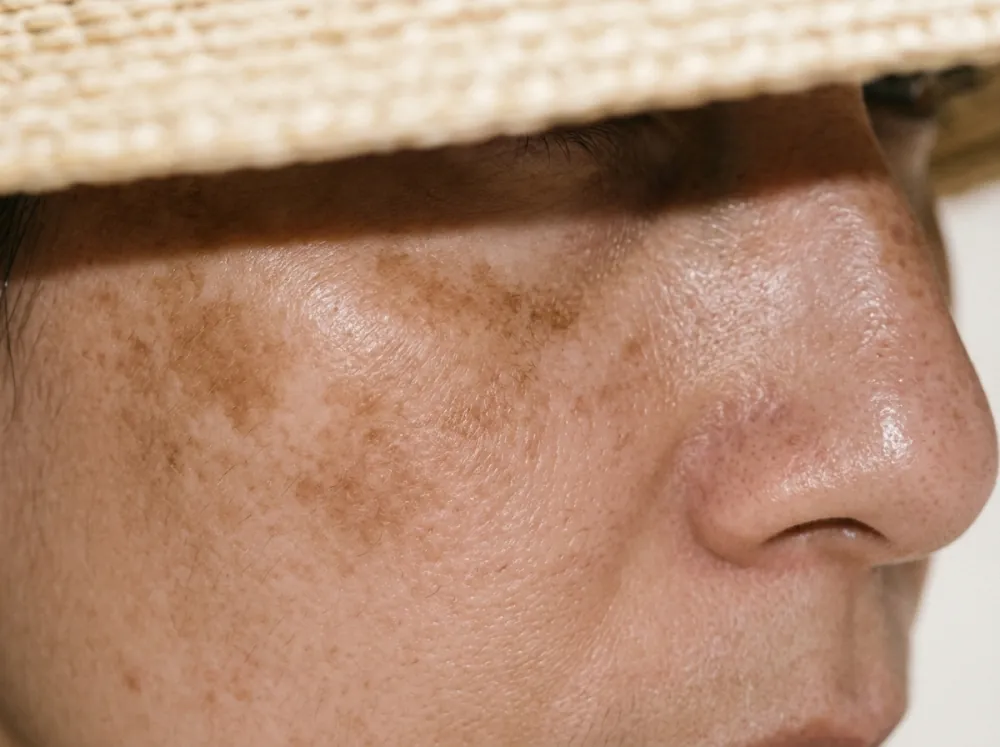
DermNet lists the look-alikes: post-inflammatory hyperpigmentation, solar lentigines and freckles, acquired dermal macular hyperpigmentation, drug-induced pigmentation, and the naevi of Ota and Hori. The practical contrasts follow from the sources above. Solar lentigines are discrete marks, covered in our article on sun spots, age spots and freckles. Post-inflammatory marks follow an injury or rash and fade when it settles. Melasma is bilateral, blotchy and persistent.
That difference matters because the three are managed differently, which our article on the types of dark spots on the face sets out. DermNet describes the diagnosis as clinical, using appearance, a Wood lamp and dermoscopy, with a biopsy only occasionally. DermNet's description is of flat, bilateral patches. A one-sided, raised, bleeding or quickly changing patch falls outside it and is a question for a clinician.
UV, Visible Light and Heat
The pathogenesis review calls sun exposure the most significant environmental factor, because melasma occurs only on photoexposed skin, begins later in darker phototypes, worsens after sun, and is more prevalent in tropical countries. It adds that the roles of the different wavelengths and their combination are not completely understood.
Ultraviolet
The review reports that ultraviolet radiation directly stimulates pigment cells and acts on the surrounding skin cells, mast cells and fibroblasts, and that women with melasma have a lower erythema dose for UVB and UVA than matched controls, a UV-sensitive phenotype. UVB acts mainly on the epidermis and UVA extends to the upper dermis. As reasoning, that fits the dermal component DermNet describes.
Visible Light
In the same review, visible light produces pigmentation only in phototypes III to VI and only at high doses, and only the shorter wavelengths (420 to 470 nm) act through a receptor called opsin 3. That receptor is not overexpressed in melasma skin. Tinted sunscreens with iron oxides, which block the short visible wavelengths, enhance the depigmenting effect of hydroquinone and hinder summer pigmentation. The review adds that no commercial sunscreen gives full protection across UVA and visible light, and that even iron oxide products absorb less from 400 nm.
A narrative review of photoprotection describes a randomised trial of 68 people on 4% hydroquinone in which a sunscreen with iron oxides produced a greater improvement in melasma scores than one without. Its authors have consultancy fees from, or are employed by, a skin-care manufacturer. Our article on sunscreen for hyperpigmentation covers the same trial and its limits.
The pathogenesis review also states that low-dose UV and blue-violet light from ordinary indoor activities far from a window, and light from lamps and electronic devices, are irrelevant for skin pigmentation.
Heat
Infrared radiation is perceived as heat. The review says its effects on skin have been studied mostly in cells, using single exposures to artificial sources, and that no systematic investigation of solar infrared in melasma exists. A survey found an association between severity and occupational heat. Mast cells degranulate with heat, pressure and ultraviolet exposure, which is one proposed route. Heat is a plausible contributor, and it is not an established one.
Hormones
The pathogenesis review reports that 14.5% to 56% of melasma cases occur in pregnant women and 11% to 46% are associated with hormonal contraceptive use. The clinical review gives a different measure: melasma was found in 10.7% of pregnant women in southern Brazil, 16% in Iran, 37% in Morocco and 46% in Pakistan, against 5% in a French group of 60. DermNet says hormonal factors are implicated in about one quarter of affected women. The sources disagree because they count different things, cases against pregnancies against women, in different populations.
Serum hormone levels do not settle the question. The pathogenesis review says studies of oestradiol and related hormones gave contradictory results, and the thyroid link is controversial. The clinical review says male cases suggest that female hormones, though important, may not be essential. Our article on skincare in pregnancy covers the pregnancy case.
The clinical review says melasma linked to pregnancy typically clears within a year of delivery with treatment, 6% remit spontaneously, up to 30% keep some pigmentary change, and it is more persistent in women who used oral contraceptives. DermNet lists stopping hormonal contraception if possible among its general measures. That is a prescriber's decision, not a reader's.

Tranexamic Acid: Oral and Topical, as Reported
Tranexamic acid is a prescription drug first used to reduce bleeding. This section reports what the sources say and gives no dose, no regimen and no advice to use it.
What the Trials Found
A 2024 meta-analysis pooled 28 randomised trials using melasma severity scores at 8 and 12 weeks. Oral tranexamic acid showed a significant improvement compared with adjuvant treatment, with a standardised mean difference of 1.61 at 8 weeks and 2.39 at 12. Topical and intradermal tranexamic acid showed no significant change at either time. The authors note high heterogeneity among the trials, did not examine adverse events, and excluded pregnant and lactating women and people with a history of thrombosis from the pooled studies. A Latin American expert consensus of nine experts agrees that oral tranexamic acid has the most robust evidence of the systemic drugs, notes dose-dependent prothrombotic side effects, says formal contraindications must be observed, and says stopping it may lead to relapse. One of its authors reports advisory and speaker roles with several skin-care and pharmaceutical companies.
What the US Label Says
The US prescribing information for tranexamic acid tablets lists one indication, cyclic heavy menstrual bleeding in females of reproductive potential. Melasma is not on the label, so its use for melasma is outside it. The label contraindicates tranexamic acid with combined hormonal contraception and with active thromboembolic disease, a history of thrombosis or thromboembolism including retinal vein or artery occlusion, or an intrinsic risk of thrombosis. It reports venous and arterial thrombosis and retinal occlusions, and says anyone with visual or ocular symptoms should stop and be referred to an ophthalmologist. It states there are US postmarketing reports of thrombotic events in women who used it with combined hormonal contraceptives.
As reasoning, those two facts meet in the same people. Hormonal contraceptives are associated with 11% to 46% of melasma cases in the pathogenesis review, and combined hormonal contraception is a contraindication on the label. Whether tranexamic acid is suitable is for a prescriber to judge from that person's history. Topical tranexamic acid is listed by DermNet among topical agents, and the meta-analysis found no significant effect for it.
Why It Relapses
The consensus states that no treatment is entirely curative and that relapses are common even after a good response. It lists factors associated with relapse: discontinuing oral tranexamic acid or triple-combination therapy, medium peels and rejuvenation procedures, sun exposure, skipping maintenance treatment, inadequate broad-spectrum protection, hormonal therapy and pregnancy. Microneedling and gentle microdermabrasion are reported with lower relapse rates, though the consensus adds that validation is needed for some procedures. It separates relapse from resistance, where the condition never improved.
The photoprotection review adds that melasma can last 10 to 20 years and that relapse rates are extremely high. It describes a randomised trial of 40 people comparing two sunscreens for preventing relapse, in which the median rise in severity score over six months was lower with the tinted, iron oxide sunscreen (p = .027). DermNet says pigmentation may reappear on exposure to summer sun even after a good result, and that realistic goals depend on understanding chronicity.
As reasoning, summer raises ultraviolet light, visible light and heat together, which are the three drivers above, so a seasonal return fits the evidence. Our articles on azelaic acid and kojic acid cover two of the topical options and what their trials did and did not show.

The Figure Audited: "Melasma Is Caused Only by Sun"
Verdict: false as stated. Sun is the main environmental driver, and it is one of several. Findings:
- Genes. Familial cases are reported by 41% to 61% of patients in Brazil in the pathogenesis review, 60% in DermNet, and over 40% in the clinical review.
- Hormones. Pregnancy and hormonal contraceptives are associated with a substantial share of cases, though the sources give different figures.
- Inflammation. The pathogenesis review lists contact dermatitis and aesthetic procedures as triggers in genetically predisposed people, and the consensus lists medium peels as a relapse factor.
- Other light and heat. Visible light acts in darker phototypes, and heat is plausible but unproven.
- The limit. Sun still sits at the centre: melasma occurs only on photoexposed skin. The disagreement is over "only", not over sun.
Conclusion
Melasma on the face comes back because the drivers do not go away between treatments. Sun is the main one, visible light matters in darker skin, heat is plausible, and hormones and inherited susceptibility set who is affected. Oral tranexamic acid is the systemic option with the most trial evidence, and it carries a label that excludes combined hormonal contraception and anyone with a thrombosis history. Everything else in the evidence points to the same maintenance: protection from light all year, and a clinician who tells relapse from resistance.
If a patch is changing, photographing it in the same light each month, in an app like Skinic or in an album, gives a clinician a record of whether it has spread or deepened. For a patch you want diagnosed or treated, ask your own clinician.
Frequently asked questions
5 questions · tap one to open the answer
What causes melasma on the face?
Does melasma go away on its own?
Is tranexamic acid approved for melasma?
Does visible light cause melasma?
Why does melasma come back every summer?
Medically reviewed by
Dr. M.M Hanaei
Aesthetic Physician, Dermatology Fellowship
- MD — Shahid Beheshti University of Medical Sciences (SBMU)
- MCC Licensure (Medical Council of Canada)
- Dermatology Fellowship, Switzerland
- Certified in advanced aesthetic procedures
Last reviewed 16 October 2026