Skinic
Kojic acid soap is one of the most searched pigment products, and the trials behind kojic acid do not describe a soap. They describe a cream or gel left on skin every day for 12 to 16 weeks. Nothing I could find tests a product rinsed off after a minute.
This article covers how kojic acid works, what the trials used, where it sits next to hydroquinone and azelaic acid, and one claim worth auditing: that kojic acid is safer than hydroquinone. I know most studies below through their abstracts, and I say where I read more and where authors have a commercial tie.
What Kojic Acid Does to Tyrosinase
Kojic acid is a fungal metabolite that blocks tyrosinase, the copper-containing enzyme that catalyses the first two steps of melanin production. A review of tyrosinase inhibitors treats it as the standard against which newer inhibitors are compared, and describes it as the most intensively studied one.
The mechanism, as that review reports it, is different from azelaic acid's. Kojic acid inhibits the first step (monophenolase activity) competitively and the second step (diphenolase) in a mixed way. Its ability to chelate copper at the enzyme's active site may explain the competitive effect, and it also binds slowly to the second step. Our article on azelaic acid describes a different route, where a carboxylate group competes with tyrosine for the binding site.
One caution on all of this. The kinetics in that review come from mushroom tyrosinase, a standard laboratory model, not from human skin. It explains how the molecule works on the enzyme. It does not tell you how much reaches the enzyme in a person.
What the Trials Used
Kojic Acid on Its Own
The most useful trial I found for kojic acid used alone is an Indian study of 80 patients with melasma, randomised to four creams used once nightly for 12 weeks with an SPF 15 sunscreen in the daytime. One group used kojic acid 1% alone, and its melasma severity score fell by about 59%. Adding hydroquinone 2% raised that to about 72%, and adding the steroid betamethasone valerate 0.1% lowered it to about 36%.
The trial was single-blind, reported no conflicts, and had no financial support. It had no hydroquinone-only arm and no plain vehicle arm, so it cannot say how kojic acid compares with hydroquinone or with placebo. All four creams contained kojic acid.
Two Trials That Disagree
A 2025 open-label trial in 72 Indian women compared 5% cysteamine cream with 2% kojic acid cream, each applied nightly for 16 weeks. The kojic acid group's modified melasma severity score fell by 10%, against 12.25% for cysteamine, a difference that was not statistically significant.
That is a long way from 59% at half the concentration in the earlier trial. The two trials used different scoring versions, different designs and different comparators, and I cannot reconcile them. Two authors of the second list Glenmark Pharmaceuticals, and the abstract does not state who funded the work. The honest summary is that reported improvement from kojic acid ranges from about 10% to about 59% across two trials, and the range has not been explained.
The Soap Problem
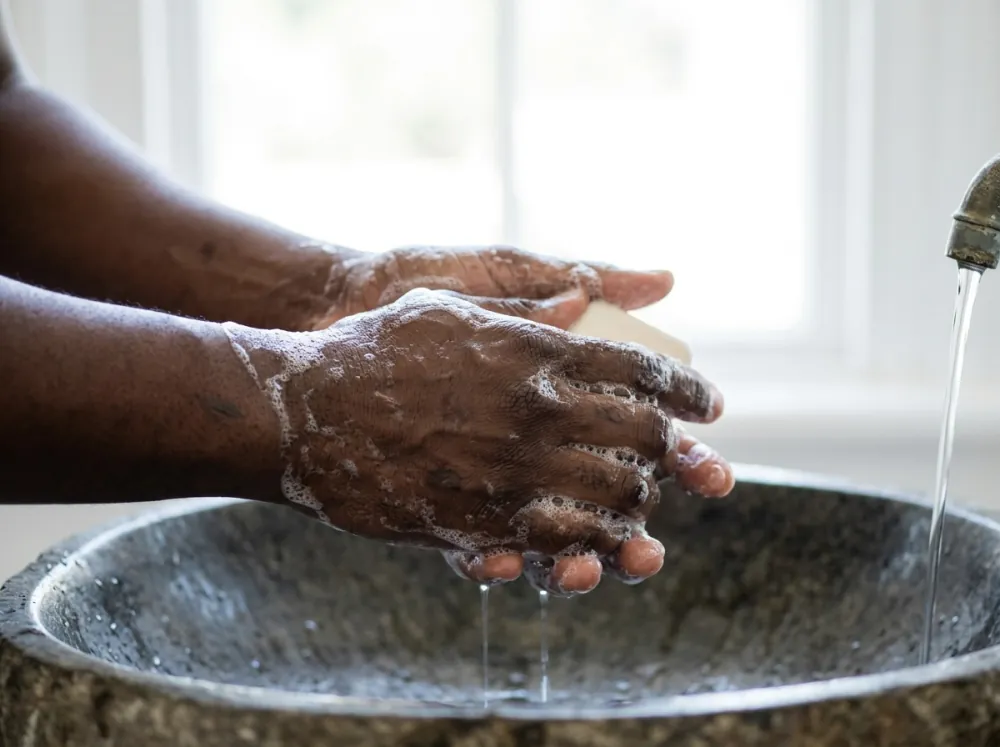
Every trial above used a leave-on cream, applied daily for months. Kojic acid soap is a wash-off product, on the skin for as long as it takes to lather and rinse.
I searched PubMed for trials of kojic acid soap or any wash-off kojic acid product and found none. Kojic acid does appear in soaps, but I found no trial of one. So the evidence for the molecule is real and the evidence for the format is absent.
Contact time is what makes this a real gap, not a pedantic one. Our article on glycolic, salicylic and benzoyl peroxide reports a study in which a 2.5% benzoyl peroxide wash needed about 15 minutes of contact for its bactericidal effect, far longer than a typical wash. That is a different drug with a different mechanism, so it does not transfer to kojic acid. It shows how a rinse-off format can change what the same molecule does, and nobody has run the equivalent test for kojic acid.
My reasoning, labelled as such: a soap that is rinsed within a minute gives an enzyme inhibitor very little time to enter the skin and reach melanocytes. The trials describe months of continuous leave-on exposure, and a soap is not that.
Where It Sits Among the Alternatives
Kojic acid has substantial support in the reviews. A 2023 systematic review of 174 randomised or controlled trials in melasma gave grade A recommendations to hydroquinone, triple combination creams, sunscreens, kojic acid and azelaic acid. It said more large studies are needed for topical vitamin C and topical tranexamic acid. The authors declare no conflicts of interest.
| Active | How it acts | What the comparisons show | Regulatory position |
|---|---|---|---|
| Kojic acid | Tyrosinase inhibitor, competitive and mixed, with copper chelation | No significant difference from hydroquinone in one split-face trial, parity in one company-funded blend trial, a 10% to 59% range across two others | EU opinion: safe as a skin lightener up to 1% |
| Hydroquinone | Tyrosinase inhibitor | Described as first-line in the 2023 review and the 2025 trial I read | Prescription only in the US since 2020, and prohibited in EU cosmetics, per our azelaic acid article |
| Azelaic acid | Competitive tyrosinase inhibition plus an indirect route | No significant difference from 4% hydroquinone in one 329-woman trial, every point estimate favouring hydroquinone | See our azelaic acid article |
| Topical vitamin C | A different step in the pathway | 2023 review says more large studies are needed | Not covered here |
The hydroquinone and azelaic acid rows are carried from our azelaic acid article, which reports the trial figures and the regulatory status, and our dark spots guide places the other actives. The vitamin C row is from the 2023 review. For which type of spot you are treating, the types of dark spots matters more than the active.
The Figure Audited: "Safer Than Hydroquinone"
The Head-to-Head Trials
The kojic acid vs hydroquinone question has been tested directly twice.
In 1996, a split-face study of 39 patients used a glycolic acid and kojic acid product on one side and a glycolic acid and hydroquinone product on the other. The result was close: 51% responded equally, 28% did better on the kojic acid side and 21% on the hydroquinone side. None of that was statistically different. The kojic acid preparation was more irritating.
In 2010, an 80-person double-blind trial compared a formulation of kojic acid, emblica extract and glycolic acid with generic prescription hydroquinone 4%, used twice daily for 12 weeks. It reported efficacy parity, and in the portion of the full text I could open no adverse events were recorded. The study was supported by an educational grant from L'Oréal, one author consults for and has had a research grant from the company, and four of five authors are its employees. The product tested was a blend, not kojic acid alone.
What "Safer" Would Have to Mean
Neither trial was designed to show that kojic acid is safer. They compared lightening over 12 weeks and tolerability while using each product. The one trial that measured irritation found more of it with kojic acid.
Safety in the sense people mean, meaning long-term harm, is a different question. Our azelaic acid article reports that the American Society for Dermatologic Surgery Association has said no cases of cancer from topical hydroquinone have been reported in people, and that the cause of skin darkening, called ochronosis, is unclear. That is a professional body that prescribes the drug, so it is an interested party, and I carry it only as reported there.
On the evidence for kojic acid vs hydroquinone, "safer than hydroquinone" is not established by the comparisons that exist. The evidence shows rough efficacy parity in small trials, one of them company-funded and blended, and more irritation with kojic acid in the one trial that measured it. The two ingredients carry different, unmatched questions about safety, and no trial was built to settle them.
Sensitisation and the Regulatory Position
What EU Regulators Concluded
The European Commission's scientific committee on consumer safety reviewed kojic acid in an opinion adopted in March 2022, with a corrigendum in June 2022. It concluded that, considering concerns about potential endocrine-disrupting properties, kojic acid is safe as a skin lightening agent in cosmetics at up to 1%.
I read the opinion itself, because a second source I found stated the opposite, that kojic acid is not safe even at 1% and only at 0.7%. That page appears to describe the earlier preliminary version, so I did not use it. The final opinion adds a concern about products used with a weakened skin barrier, such as peels, because absorption may be greater. It covers topical cosmetic use only and does not cover kojic acid derivatives.
What the Opinion Records About Sensitising and Thyroid Effects
The opinion records that kojic acid has been reported to interfere with iodine uptake or organification in the thyroid, which is why it was prioritised for review. It also describes a guinea pig sensitisation test in which 2 of 20 animals reacted, and case reports of allergic contact dermatitis, including one reaction to a product containing 0.5% kojic acid.
In a small human study cited in the opinion, six women applied a single dose of a 1% formulation to their cheeks and kojic acid was detectable in plasma at low levels. The authors of that study concluded there was no safety problem. I am reporting the committee's record and not drawing a conclusion of my own.
The Limit in Law
A Commission draft regulation of November 2023 proposed restricting kojic acid to use as a skin lightening agent in face and hand products at a maximum of 1%. A regulatory consultancy reports that this was adopted as Commission Regulation (EU) 2024/996, with compliance dates in February and November 2025. I could not open the Official Journal text, so treat the regulation number and dates as secondary. I also could not determine whether a rinse-off soap counts as a face and hand product under it.
How to Judge a Kojic Acid Claim
The evidence supports a few questions, not a recommendation.
- Is it a leave-on or a wash-off? The trials are leave-on, used for months.
- What concentration, and for how long? The trials used 1% to 2% for 12 to 16 weeks. Under the EU restriction as reported, the face and hand limit is 1%.
- Is the comparison with hydroquinone a blend? The company-funded parity trial tested a combination product, not kojic acid alone.
- Does the claim say "safer"? The trials measured lightening and short-term tolerability, and the one that measured irritation found more with kojic acid.
- Is the pigment new, changing or uneven in outline? That is a question for a clinician, not an active. Darker skin tones also carry a higher risk that irritation causes new pigment, as our guide to hyperpigmentation in deep skin tones explains.
Conclusion
Kojic acid is a real tyrosinase inhibitor with trial support as a leave-on cream or gel, at 1% to 2%, over 12 to 16 weeks. Reported improvement ranges from about 10% to 59% across two trials I could not reconcile. A 2023 systematic review rates it grade A, with the usual caveat that many of these trials are small.
The soap is the missing piece. I found no trial of a wash-off kojic acid product, and a rinse within a minute is nothing like months of nightly leave-on use.
As for safer than hydroquinone, the head-to-head trials show rough parity on lightening, not a difference in long-term safety. Kojic acid carries its own record of sensitisation and a regulatory limit in the EU. If pigment is changing, spreading or new, ask a clinician before choosing an active.
Frequently asked questions
5 questions · tap one to open the answer
Does kojic acid soap work?
Is kojic acid safer than hydroquinone?
How does kojic acid work on dark spots?
What concentration of kojic acid is allowed?
Can kojic acid cause an allergic reaction?
Medically reviewed by
Dr. M.M Hanaei
Aesthetic Physician, Dermatology Fellowship
- MD — Shahid Beheshti University of Medical Sciences (SBMU)
- MCC Licensure (Medical Council of Canada)
- Dermatology Fellowship, Switzerland
- Certified in advanced aesthetic procedures
Last reviewed 8 October 2026