Skinic
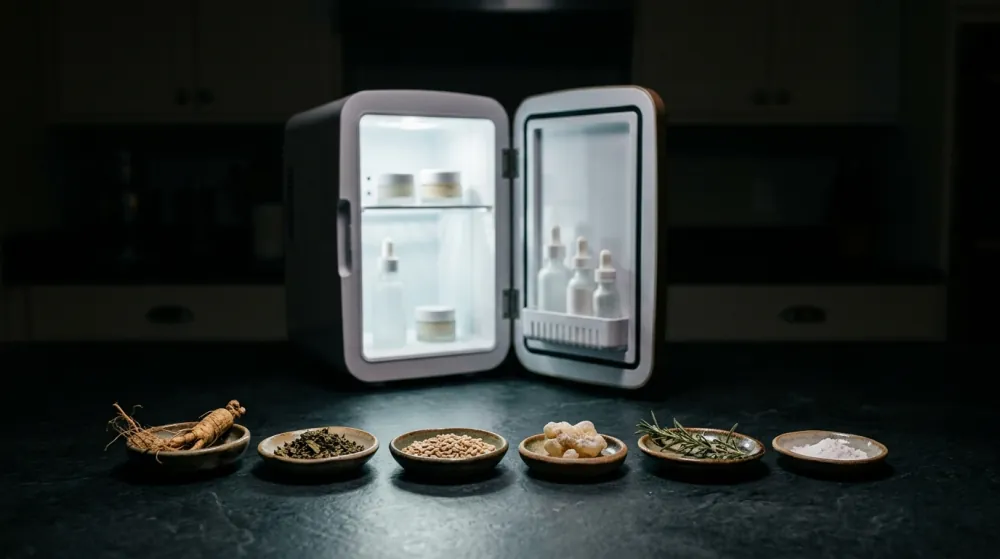
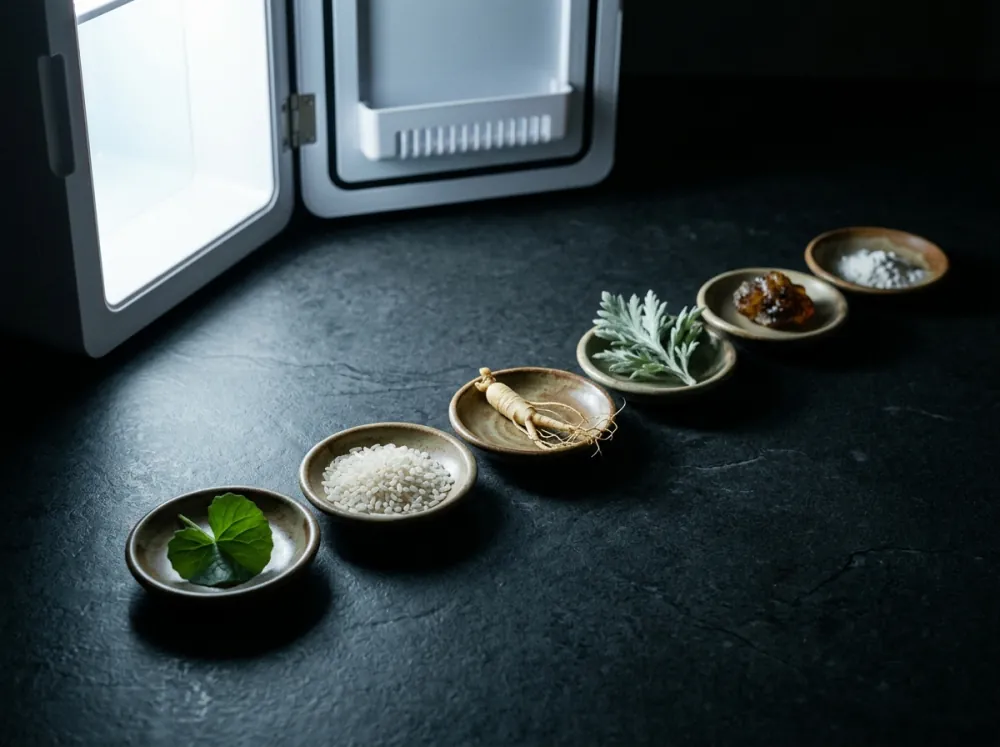
Korean skincare serums built a global category on six ingredients: centella, niacinamide, rice, propolis, ginseng and mugwort. Graded against the sources opened for this article, niacinamide is the only one with controlled human trials reported, and it is a vitamin used worldwide. Centella has small human studies, ginseng and mugwort rest mainly on cell and animal work, and rice could be judged only from an abstract.
The claim this article tests is that Korean skincare is ten years ahead. It covers what changed on Western shelves, a grade for each ingredient, what a serum is, and what separates evidence from marketing. It describes and evaluates. It names no products, and the grades are this article's own shorthand, not a standard.
Why K-Beauty Changed Western Shelves
How the layered Korean routine reached Western shelves is a story of retail and social media, and none of the sources opened measures it. Our audit of the ten-step Korean routine covers what that routine claims. One difference that can be checked is legal.
Korea's Cosmetics Act, in the English translation published by the Korea Legislation Research Institute, defines a "functional cosmetic" as a product aiding skin whitening, wrinkle improvement, gentle tanning or protection from ultraviolet rays, changing or removing hair colour or nourishing hair, or preventing or improving dryness, splits, loss and cornification from weakened skin or hair function. A maker seeking recognition must undergo an examination by the Minister of Food and Drug Safety, or file a report, on safety and effectiveness, and the effectiveness examined is limited to those claims. The Act also bars labelling or advertising a product that is not a functional cosmetic as one. The translation states that it has no legal authority.
That is a rule about which claims need review, not a ranking of ingredients. Nothing in the text compares one product with another.
Six Signature Ingredients, Graded
The grades are shorthand. B means controlled human trials are reported in the sources. C means small human studies, or data from other settings. D means cell and animal work only. A dash means no skin-care efficacy study was opened, and "withheld" means only an abstract was read.
| Ingredient | Grade | What the sources show | Main caveat |
|---|---|---|---|
| Niacinamide | B | Trials reported for sebum, pigmentation and melasma | Review authors work for companies; acne evidence thin |
| Centella | C | Small studies on water loss and hydration | Barrier repair not shown |
| Rice | Withheld | Abstract lists components and reported benefits | Study types not stated |
| Propolis | — | No efficacy study opened | Documented contact allergen |
| Ginseng | D | Cell, animal and lab studies | Active component unclear |
| Mugwort | D | Cell and mouse studies | Several plant species, trials scarce |
Niacinamide: Grade B
A 2024 narrative review reports preparations of 2% to 5% reducing sebum production, a 4% formulation reducing axillary hyperpigmentation, and, in melasma, slower results than hydroquinone with fewer adverse effects. It says niacinamide blocks the transfer of melanosomes to surrounding skin cells and does not act on melanin synthesis. It reports no stinging up to 10% and no irritation up to 5%. Several authors are employed by companies named in its conflict statement, and the trials themselves were not examined here.
The evidence for acne is thinner than that review's wording. A Cochrane review found four nicotinamide studies against clindamycin or erythromycin, none of which measured participants' global assessment, and low-quality evidence of no difference in withdrawals or minor adverse events. The narrative review calls its acne efficacy proven. The two do not agree, and a review of trials is the firmer of the two. Our article on serums sorted by what they target covers the concentration data.
Centella: Grade C
Our article on centella asiatica covers this in full. On intact skin the support is a handful of small trials: a placebo-controlled forearm study with a modest fall in water loss at 5%, and two studies of blends supported by manufacturers. Most of the clinical data come from wounds. The claim that it repairs the barrier is a leap from that, and our article on skin barrier repair covers what barrier repair needs.
Rice: Grade Withheld
A 2022 review of rice products (abstract) searched PubMed and Google for rice, rice bran and fermented rice bran alongside skin-care terms. It lists phenolic compounds, betaine, squalene and tricin as components with reported anti-ageing, anti-inflammatory, whitening, photoprotective and moisturising actions, and says fermented rice bran extract and rice bran broth baths have shown utility in atopic dermatitis treatment. The abstract does not say how many human trials stand behind this, and a search that included Google is not systematic. No grade is given.
Propolis: No Efficacy Study Opened
DermNet describes propolis as a complex mixture of resins, waxes and essential oils that bees make, and says it is advocated as a steroid- and chemical-free natural alternative on the strength of purported antiseptic and anti-inflammatory properties. What the page documents is allergy. European studies report positive patch-test rates of 1.2% to 6.6%, and facial creams and lipsticks are listed as sources of exposure. The main sensitisers are caffeates, and propolis allergy often cross-reacts with balsam of Peru.
Ginseng: Grade D
A 2024 review in the Journal of Ginseng Research covers in vitro and in vivo studies of ginseng extracts, ginsenosides and byproducts. It says it remains unclear which component is the main active, and it describes no human trial. On scars it says benefits would need to be proved after clinical tests. It notes that the root is expensive and individual ginsenosides more so. The review was funded by the National Research Foundation of Korea.
Mugwort: Grade D
Mugwort is the common name for several plants. A 2026 review of Korean Artemisia species cites taxonomic ambiguity and chemical variability, and describes anti-inflammatory effects in macrophages, keratinocyte models and mouse dermatitis models. It states that the findings support biological plausibility but not consumer-level efficacy, that these findings should not be read as established clinical efficacy, and that controlled human trials remain scarce. It also says sensitisation testing is needed. It received no external funding.
Serum Culture
"Serum" describes a texture and not a dose, a point our article on serums sorted makes at length, and the Korean market adds ampoules and essences on top. Our audit of the ten-step routine found no clinical literature on essence as an intervention.
The useful question for any serum is therefore which active, at what percentage. Of the six ingredients, only niacinamide has percentages in the sources opened, 2% to 5% in the sebum studies and 4% in the pigmentation study. For the other five, no source opened gives a typical labelled amount. That matters because, as our article on what medical-grade skincare means explains, an ingredient list shows order and not amount below 1%.
What Travelled and What Was Marketing
What travelled was a vitamin. Niacinamide is used in skin care worldwide, and the 2024 review reports a rise of about 10% in its use in anti-ageing formulations between 2013 and 2018. Nothing in it is specific to Korea.
What was marketed was the word "natural". Propolis is natural, and DermNet documents it as an allergen, with European patch-test positive rates of up to 6.6%. Mugwort on a label can mean any of several species, and the Artemisia review says species identity, extract preparation and concentration all change results. In both cases the plant name tells a reader less than the grade does.
What is still open is most of the list. Ginseng, mugwort and propolis have plausible mechanisms in cells and animals. Whether a serum delivers them to the skin in a form that works, at the amount on the label, is what the sources opened do not show.
The Figure Audited: "Korean Skincare Is Ten Years Ahead"
Verdict: unsupported. No source measures "ahead", and the one checkable difference is regulatory, not evidential. Findings:
- Nothing in the sources opened defines or measures it. No comparison of Korean and non-Korean products or ingredients was found.
- The checkable difference is in claims regulation. Korea's Cosmetics Act sets a category whose safety and effectiveness for specific claims are examined or reported, and bars passing off other products as that category. It is a rule about claims. It does not rank what is in the bottle.
- The six signature ingredients do not show a lead. One has controlled trials, and it is a worldwide vitamin. The ginseng and mugwort reviews, both Korea-focused, say the active component is unclear and that controlled human trials are scarce.
- The limit. "Ahead" could mean texture or formulation, which the sources did not measure, and the Act's text was read in translation.
Criteria for Reading Any Serum Label
These are criteria and not recommendations, and they apply to any serum from any country.
- Name of the active, and the plant species or part where there is one. Mugwort and centella are families of preparations.
- A percentage, or a reason to expect one. The niacinamide studies used 2% to 5%.
- The type of evidence behind the claim. A trial against a vehicle sits above a cell assay, which is the difference between grades B and D above.
- An allergen check. Propolis and fragrance are the ones the sources name. DermNet says propolis allergy cross-reacts with balsam of Peru, and a clinician can arrange patch testing.
- A claim that matches its category. In Korea a functional cosmetic label means safety and effectiveness for whitening, wrinkle, ultraviolet or hair claims were examined or reported. A claim outside those categories has had no such review.
Conclusion
Korean serums travelled on six ingredients, and the sources graded one at the level of controlled human trials. That one is a vitamin used worldwide, and even its acne evidence is thinner in the Cochrane review than in the narrative review. Centella has small studies, ginseng and mugwort have cell and animal work, rice was only seen in an abstract, and propolis is better documented as an allergen than as a treatment. The "ten years ahead" claim has nothing measured behind it.
If a serum changes how your skin looks, photographing the same area in the same light each week, in an app like Skinic or in an album, shows more than the label does. For a reaction that does not settle, ask your own clinician.
Frequently asked questions
5 questions · tap one to open the answer
What are the main ingredients in Korean skincare serums?
Is Korean skincare ten years ahead of Western skincare?
Does centella asiatica repair the skin barrier?
Is niacinamide proven for acne and pigmentation?
Can natural ingredients like propolis cause allergic reactions?
Medically reviewed by
Dr. M.M Hanaei
Aesthetic Physician, Dermatology Fellowship
- MD — Shahid Beheshti University of Medical Sciences (SBMU)
- MCC Licensure (Medical Council of Canada)
- Dermatology Fellowship, Switzerland
- Certified in advanced aesthetic procedures
Last reviewed 16 October 2026