Skinic
Most of the evidence for centella asiatica comes from wound healing and cell studies, and the leap from there to "repairs the skin barrier" or "calms sensitive skin" is where the evidence thins. On intact skin there are small trials, and most of them test centella together with other moisturising ingredients.
The claim this article tests is that centella repairs the skin barrier. It covers where the plant's reputation comes from, the four active compounds, how wound data differ from cosmetic data, what has actually been tested on intact skin, and what the reviews say about product variation and reactions. It evaluates the claims and names no product. It cannot tell you whether it will suit your skin.
From Wound Dressing to Toner
Centella asiatica, also called gotu kola, is a perennial herb used in Ayurvedic, Chinese and Southeast Asian traditional medicine, and a 2025 review of its technology and applications says its reputation rests on cognitive, wound-healing, anti-inflammatory and adaptogenic uses. In dermatology the review says it has been included in topical formulations for wound care, burn management and post-surgical healing, and that the clinical studies are mostly in wounds, particularly diabetic ulcers.
The step from a wound product to a cosmetic toner or cream is a change of skin. A wound is open, inflamed and repairing, and a face is intact. Our article on what toner does applies the same question to another category sold on a name.
The Four Active Compounds
The review describes the plant's marker compounds as triterpenoid saponins in two groups, asiaticosides and madecassosides, and their aglycones. In plain terms there are four names to know.
- Asiaticoside: a triterpene glycoside reported to promote collagen synthesis and wound healing through TGF-beta 1 and fibronectin.
- Madecassoside: a glycoside of madecassic acid, with a structure similar to asiatic acid, also associated with wound repair.
- Asiatic acid and madecassic acid: the aglycones, described as anti-inflammatory and acting through several cell-signalling pathways.
The review adds that a titrated extract is standardised to 40% asiaticoside, 30% madecassoside and 30% asiatic and madecassic acids, and that most commercial products lack standardisation, with variable phytochemical content, questionable bioavailability and limited clinical evidence for specific uses. In the EU and North America, it says, centella is predominantly regulated as a supplement or traditional herbal remedy, which does not require manufacturers to show efficacy in trials, and that stricter standardisation to markers such as asiaticoside and madecassoside is required in countries such as South Korea and Thailand.
Wound Data vs Cosmetic Data
What the Wound Studies Show
The review reports clinical studies in which formulations enriched with madecassoside or whole-plant extracts accelerated wound closure, especially in diabetic ulcers, and attributes this to collagen type I synthesis, fibroblast proliferation and growth-factor upregulation. It does not give the trials individually, and most studies it describes are preclinical.
A split-face randomised trial on facial skin after laser resurfacing is nearer to the face. In that trial (abstract), 30 people with acne scars were treated with an Er:YAG laser, and one half of the face got a 0.05% standardised extract gel and the other half placebo, four times daily for a week and twice daily for three months. Erythema was significantly lower on the extract side, and physicians rated wound appearance, redness and crusting better at days 2, 4 and 7. Skin biophysics did not differ between the sides.
Concentrations
The concentrations differ by setting. The review says wound-healing protocols commonly use creams with 1% extract twice daily, acne gels range from 0.5 to 1%, and it does not give a range for cosmetics. The laser trial used 0.05%. The intact-skin trial below used 2.5 and 5%. As reasoning, a product that does not state its extract percentage cannot be checked against any of these trials.
A compromised-skin trial outside wounds is also worth knowing about. A randomised double-blind trial in 60 older adults with incontinence-associated dermatitis compared a Centella and aloe vera preparation with zinc oxide in petroleum jelly over seven days alongside the same nursing care, and found lower dermatitis risk and severity, lower skin pH and higher skin moisture in the herbal group. That is a barrier-damaged setting, a week long, with a different comparator from a placebo.
What Has Been Tested on Intact Skin
The Placebo-Controlled Study
The most direct study applied an emulsion and a hydrogel with 2.5 or 5% Centella extract, or a placebo, to the forearms of 25 healthy volunteers twice daily for four weeks. After the first week, transepidermal water loss fell by 8% with the 5% emulsion, 6% with the 5% hydrogel, 5% and 4% with the 2.5% versions, and 1% with placebo, compared with the untreated control area. The 5% preparations performed best on hydration and TEWL, and the formulations reduced redness in a methyl nicotinate irritation model. The authors report no conflicts and funded it themselves, and it is small, in healthy people, on forearms.
Studies With Other Ingredients
The other intact-skin studies tested Centella with other moisturisers, so the effect cannot be given to the plant.
- A 24-hour single-application study of a fluid with hyaluronic acid 1%, glycerin 5% and a Centella stem-cell extract used a control site on 20 women: skin hydration at 24 hours was 21% higher, and TEWL was lower (P = 0.049). The medical director of the company that sells the product is an author, and the trial had an unrestricted grant from it. The paper is here.
- A sensitive-skin study gave a cream with Centella leaf extract, ceramide NP and panthenol to 88 Chinese women with self-reported sensitive skin for four weeks, with no control group and no blinding. The sensitivity score fell by 66% at two weeks and 76% at four, and TEWL fell at weeks 1 and 2. It was supported by the product's manufacturer.
The Figure Audited: "Repairs the Skin Barrier"
Verdict: not established for centella on its own. A modest TEWL reduction at 5% in one small placebo-controlled study is the supported reading. Findings:
- The plan's test is intact-skin TEWL data, and there is a little. One 25-person study found 8% lower TEWL with a 5% emulsion at one week, against 1% for placebo.
- The other TEWL results are from blends. Hyaluronic acid and glycerin, or ceramide and panthenol, are barrier and humectant ingredients in their own right, and neither study isolated the plant.
- A placebo-controlled test of a low concentration found no biophysical difference. The 0.05% gel in the laser trial helped redness but skin biophysics did not differ.
- The strongest claim has no matching data. "Calms sensitive skin" from a small percentage of extract rests on a single-arm, unblinded, manufacturer-supported study of a multi-ingredient cream.
- Trial concentrations range widely. The intact-skin placebo trial used 2.5 to 5%, and the wound and laser trials 0.05 to 1%, so a product's percentage matters, and no source opened gives typical labelled percentages.
Limits: most trials are small, short and in Asian or healthy volunteers; the review itself calls for more rigorous trials. Our article on skin barrier repair covers what the barrier needs and what has been shown to restore it.
Reactions and Standardisation
The 2025 review states that allergic reactions and dermatologic sensitivity have been occasionally reported with topical use, and that skin irritation is among the most commonly reported adverse effects, with no major contraindications formally established. Searches also return case reports of contact allergy to centella extract (titles only; not opened). The 48-hour patch test in the placebo-controlled study found no irritation or sensitisation in 25 healthy volunteers, which is a small sample.
Standardisation is the other issue. A systematic review of centella for wrinkles (abstract) included five double-blind randomised trials with 172 Asian women, found hydration markedly raised and improvements in lip and periocular wrinkles at 8 to 12 weeks, and concluded that lack of standardisation prevents general application. The review is here. Our article on sunscreen for sensitive skin covers ingredient allergy more broadly, and the one on the 10-step Korean routine covers where plant extracts sit in that routine.
Conclusion
Centella's evidence is mostly wound and cell data, built around four triterpenoids. On intact skin the support is a handful of small trials: one placebo-controlled study with a modest TEWL drop at 5%, and two manufacturer-supported studies of blends. The claim that it repairs the barrier or calms sensitive skin is a leap from that, and no source opened gives typical labelled percentages. Centella is one of six signature Korean serum ingredients graded together in Korean skincare serums: the ingredients that travelled.
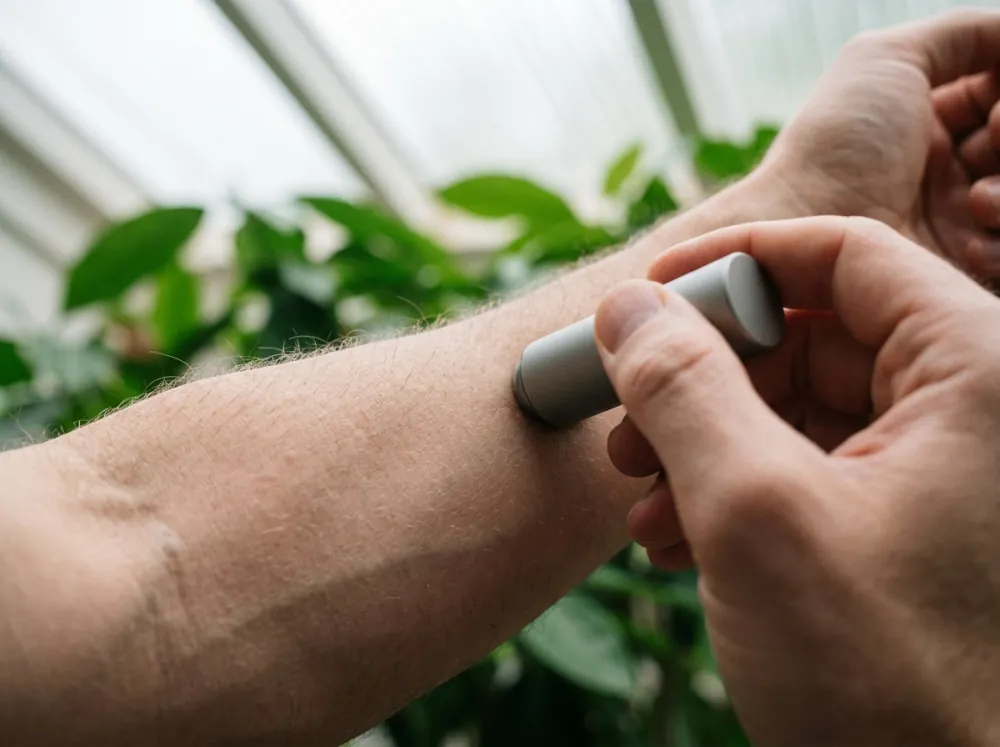
If you want to see whether a product changes your skin, photographing the same area in the same light each week, in an album or in an app like Skinic, shows more than the label does. For irritation that does not settle, ask your own clinician.
Frequently asked questions
5 questions · tap one to open the answer
What is centella asiatica used for in skincare?
Does centella asiatica repair the skin barrier?
Does centella calm sensitive skin?
What are the active compounds in centella asiatica?
Can centella asiatica cause skin reactions?
Medically reviewed by
Dr. M.M Hanaei
Aesthetic Physician, Dermatology Fellowship
- MD — Shahid Beheshti University of Medical Sciences (SBMU)
- MCC Licensure (Medical Council of Canada)
- Dermatology Fellowship, Switzerland
- Certified in advanced aesthetic procedures
Last reviewed 15 October 2026