Skinic

Exfoliation means loosening or removing the outermost cells of the skin, and it comes in three forms: abrasion with scrubs, brushes or devices, acids that dissolve the bonds between cells, and enzymes that mimic the skin's own shedding. The obvious way to compare them is physical against chemical. The variable most people get wrong is frequency, and it is also the one the sources cover least.
The claim this article tests is that scrubs cause micro-tears. It covers what exfoliation removes, what the evidence says about scrubs, acids and enzymes, what the sources say about how often, the signs of overdoing it, and what to check on a label. It evaluates claims and reports directions from regulators. It names no product and prescribes no schedule, and a reaction that is severe, spreading or persistent is a question for your own clinician.
What Exfoliation Removes
All three methods act on the same thing, the outer layer of dead cells. A 2024 review of alpha hydroxy acids describes peeling agents as disrupting the bonds between cells so that dead cells come away and turnover is promoted. DermNet describes salicylic acid as a keratolytic, a medicine for scaly, thickened, flaky skin. Abrasion removes the same layer by friction.
That layer is also the skin's barrier, which is why the question is never only whether exfoliating works. Our article on skin barrier repair covers what the barrier is and how damage is measured, and the one on skin texture covers what exfoliation can and cannot change about how skin looks.
Scrubs: What the Evidence Covers
The brief for this article assumed that particle size separates a gentle scrub from a harsh one. No source read here compared particle size, shape or hardness on skin, so the idea is reasoning and not a finding. What the sources do contain is narrower.
DermNet's precautions for salicylic acid preparations tell users to avoid abrasive soaps and cleansers, and cosmetics or soaps designed to peel or exfoliate, on the treated area unless a doctor directs otherwise. That is a caution about stacking, and it treats abrasion as an irritant like any other.
What Clinician-Applied Abrasion Shows
A split-face study of diamond microdermabrasion (abstract) measured the barrier in 28 patients. Water loss through the skin was significantly higher right after the procedure and at 24 hours, and was back to baseline by day 2. Hydration and redness rose right after and returned to baseline by day 1. The authors concluded that forehead and cheek recover within 2 days, and that weekly treatment leaves enough time to recover.
The limits are plain. This is a clinician-controlled device on the forehead and cheek, in a small group, from an abstract. It shows that abrasion measurably and temporarily changes the barrier, and it does not describe a home scrub.
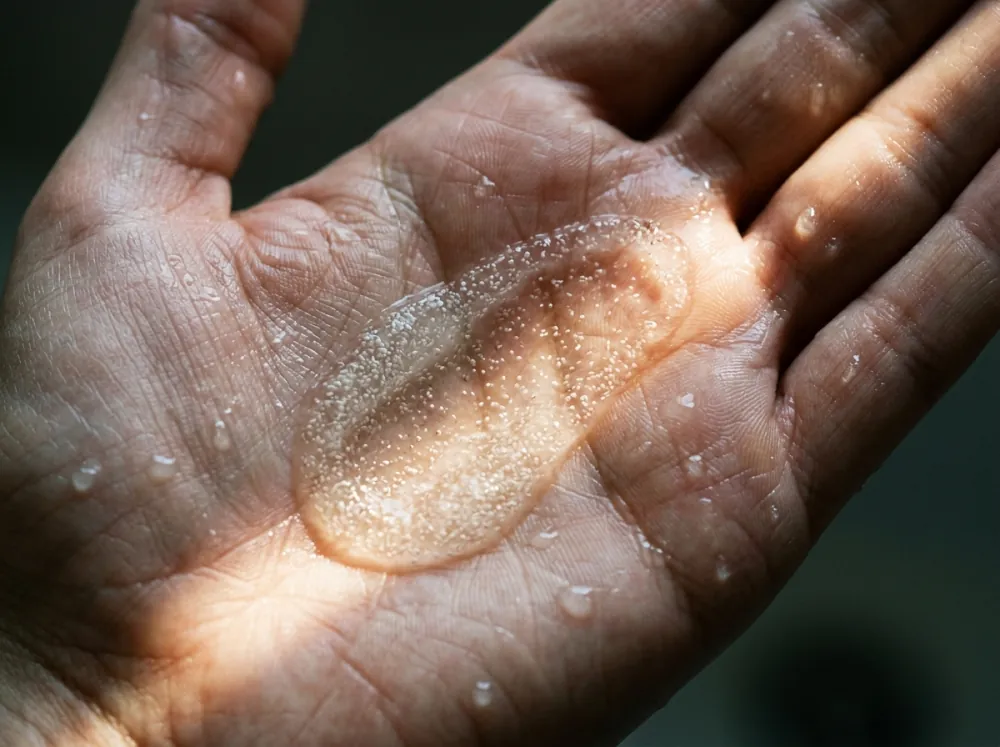
Acids and Enzymes
Hydroxy Acids
The 2024 review says the optimal concentrations of alpha hydroxy acids for efficacy with minimal side effects are not yet precisely defined, and that higher concentrations bring more irritation and sensitivity. It reports the regulatory tiers as 10% or less at pH 3.5 or higher for daily home use, up to 30% for trained professionals, and drug status above that. It also reports the EU's older limits of 4% for glycolic acid at pH 3.8 or higher and 2.5% for lactic acid at pH 5 or higher. Our article on glycolic, salicylic and benzoyl peroxide covers what each acid has evidence for.
The FDA's page on these acids adds a sun-sensitivity finding. After four weeks of application, volunteers' sensitivity to UV-induced reddening rose by 18 percent and their sensitivity to UV-induced cell damage doubled on average, and a week after stopping the differences had gone. FDA's suggested label wording is a Sunburn Alert to use sunscreen and limit sun exposure while using the product and for a week afterwards. Our article on broad spectrum sunscreen explains what a sunscreen label does and does not measure.
Enzymes
A review of proteolytic enzymes as exfoliating agents (abstract) says the enzymes can mimic the skin's own shedding, but found only 11 articles and few clinical trials. Its authors call for more robust studies in living skin before enzymatic exfoliation can be recommended as a treatment. Enzymes are therefore an unevaluated option, not a gentle one.
How Often, by Skin Type
No source read here compared exfoliation frequencies, and none gives a schedule by skin type. Frequency appears only inside directions written for other purposes.
| Product or procedure | Frequency stated | Source |
|---|---|---|
| Over-the-counter acne products (salicylic acid 0.5–2%, benzoyl peroxide) | Start once daily, build to two or three times daily if needed, and drop back to once daily or every other day if bothersome dryness or peeling occurs | FDA acne monograph |
| Superficial peels by a professional | Some people have them every few weeks | DermNet chemical peels |
| Moderate-depth peels | Wait 3 to 6 months between | DermNet chemical peels |
| Alpha hydroxy acid cosmetics | 10% or less at pH 3.5 or higher is the daily home-use tier | 2024 review |
| Scrubs, brushes, enzymes | No frequency found | none |
The monograph directions apply to acne products and are not exfoliation advice as such, though they show the regulator's logic: start low, and step back when the skin dries or peels.
On skin type, DermNet says patients with Fitzpatrick skin types IV to VI have a higher risk of dyspigmentation and scarring from peels, so lighter peels are used. For everyone else the sources are silent, and the following is reasoning. Skin that is already flaking or itching may be dryness, eczema or seborrheic dermatitis, which our article on dry, flaky patches on the face separates. Skin on a retinoid has a second active to account for, and our article on tretinoin versus retinol covers how retinoids differ.
Signs You Have Overdone It
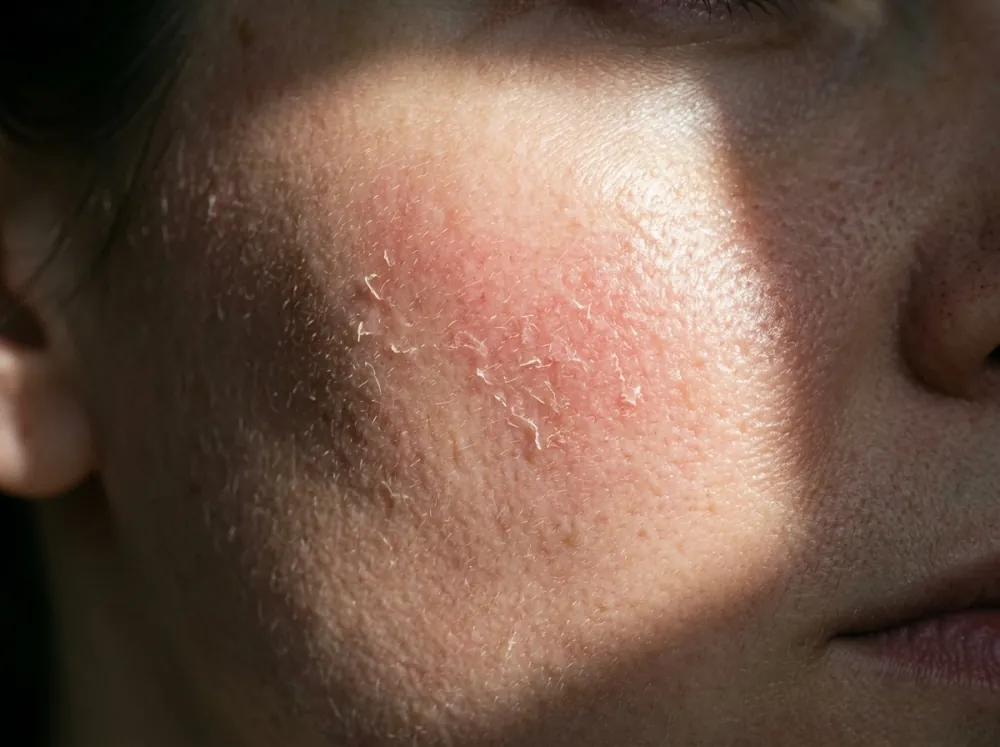
The acne monograph's labelling describes irritation as redness, burning, itching, peeling or possibly swelling, says it may be reduced by using the product less often or at a lower concentration, and says to stop and ask a doctor if irritation becomes severe. DermNet lists moderate or severe skin irritation as a reason to check with a doctor.
The FDA's page on hydroxy acids counts 114 adverse reports between 1992 and February 2004, with burning (45), dermatitis or rash (35), swelling (29), pigmentary changes (15), blisters or welts (14) and peeling (13) the most common. It says the more serious reactions occurred most often with products causing the greatest degree of exfoliation, such as skin peelers. These are reports, not rates, and the data are old.
The Figure Audited: "Scrubs Cause Micro-Tears"
Verdict: unproven as stated. Findings:
- No study of micro-tears from facial scrubs was found. Title-and-abstract searches of PubMed for micro-tears with scrub, for walnut shell scrubs, and for abrasive particle size returned nothing relevant, and a search of Europe PMC's open-access full texts for "micro-tears" or "microtears" alongside scrub or exfoliation returned four papers on unrelated subjects.
- Abrasion does change the barrier. In the microdermabrasion abstract, water loss was higher at 24 hours and back to baseline by day 2. That is a measurable, temporary effect from a device, not a demonstration of tearing.
- The documented harms are about irritation and stacking. DermNet lists abrasives among the things not to combine with salicylic acid, and FDA's reports concern acid peelers, not scrubs.
- Neither type is inherently gentler. Physical against chemical is not the axis the sources use. Intensity, concentration, frequency and the state of the skin are.
- The limit. No home scrub was studied, and an absence of studies is not evidence that nothing happens. The claim is unproven, not disproven.
How to Judge an Exfoliation Claim
A search for the best exfoliator returns product lists, and the sources give criteria instead.
- Find the acid and its percentage. For hydroxy acids, 10% or less at pH 3.5 or higher is the home-use tier in the sources.
- Look for the sun wording. FDA's suggested statement is a Sunburn Alert, and a product with an exfoliating acid and no such wording is a reason to ask why.
- Read "peel" as a different category. FDA says products with therapeutic claims are drugs, and skin peelers may carry high concentrations.
- Check whether the label has an ingredient list. FDA requires one on retail cosmetics but not on products used only by professionals, such as those in salons.
- Treat "enzyme" and "gentle" as unevaluated. No source defines gentle, and the enzyme literature is thin.
- Do not stack by default. The monograph's warning is that irritation and dryness are more likely with another topical acne medication at the same time.
Conclusion
Exfoliation is one action by three routes on the same outer layer. Whether a scrub tears the skin is unproven, whether acids or enzymes are gentler is not shown, and how often is the question the sources answer least. What they do support is a pattern: start low, expect temporary barrier change, take sun protection seriously with acids, and step back at the first dryness or peeling.
Writing down what you used and how the skin looked the next day, in an app like Skinic or in a notebook, shows more about your own frequency than any schedule. For a reaction that blisters, swells or persists, ask your own clinician.
Frequently asked questions
5 questions · tap one to open the answer
How often should you exfoliate your face?
Is physical or chemical exfoliation better?
Do face scrubs cause micro-tears?
Do exfoliating acids make skin more sensitive to the sun?
What are the signs of over-exfoliating?
Medically reviewed by
Dr. M.M Hanaei
Aesthetic Physician, Dermatology Fellowship
- MD — Shahid Beheshti University of Medical Sciences (SBMU)
- MCC Licensure (Medical Council of Canada)
- Dermatology Fellowship, Switzerland
- Certified in advanced aesthetic procedures
Last reviewed 18 October 2026