Skinic
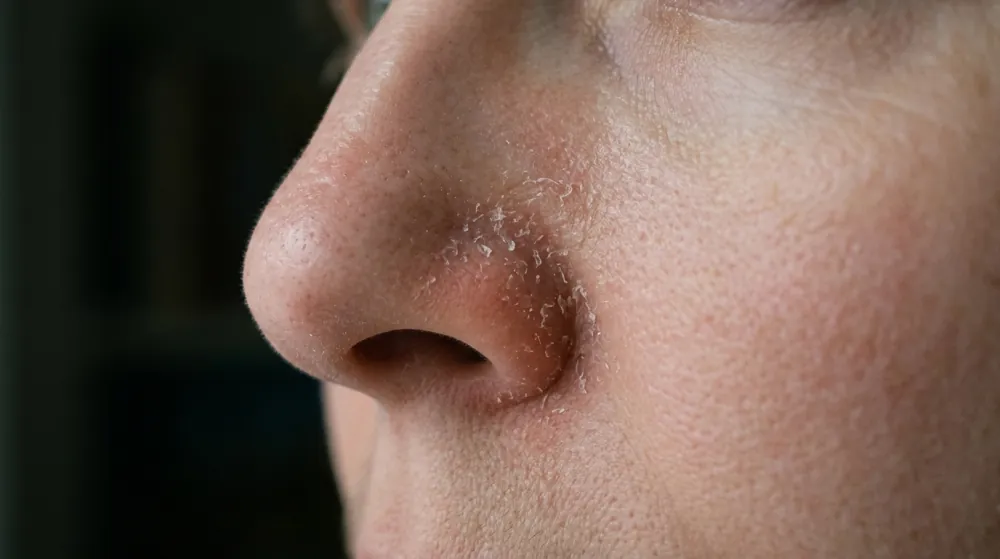
Dry patches on the face have three common causes: plain dry skin, eczema and seborrheic dermatitis. They are told apart less by how dry the patch looks than by where it sits, whether it itches, and what the scale looks like. Flaking itself is a symptom of all three, which is why the first question is not whether to exfoliate but which of the three is present.
The claim this article tests is that flaky skin means you need to exfoliate. It covers the three causes, where each tends to appear, how greasy scale differs from dry scale, why a moisturiser fixes one and not the others, and when to be seen. It describes. It does not diagnose a patch, and a rash that is new, spreading, weeping or not settling is a question for your own clinician.
Three Causes of Flakes
DermNet defines dry skin as skin lacking moisture in the outer layer, with cracks in the surface. It has a dull, rough, scaly look, is less pliable, and becomes inflamed and fissured when severe. The cause is an abnormality in the barrier function of the stratum corneum, with an overall reduction in its lipids and reduced water-holding capacity. Dryness is common in people with atopic dermatitis, and DermNet says dry areas that become itchy may mean a form of dermatitis has developed.
DermNet describes dermatitis as a group of itchy inflammatory conditions, with acute forms showing redness, swelling, small blisters and oozing, and chronic forms showing skin thickening, scaling, fissuring and scratch marks. It lists atopic and seborrheic dermatitis as common endogenous types, and irritant contact dermatitis as the result of exposure to irritants that include soaps, detergents, abrasives and even water.
Seborrheic dermatitis, the third cause, is a common chronic or relapsing form of dermatitis affecting oil-rich areas of the scalp, face and trunk. It affects 3% to 12% of people, usually begins in late adolescence, and is more common in males. Dandruff, DermNet says, is its uninflamed scalp form, with bran-like scaly patches and no underlying redness.
Where Each Appears
Seborrheic Dermatitis
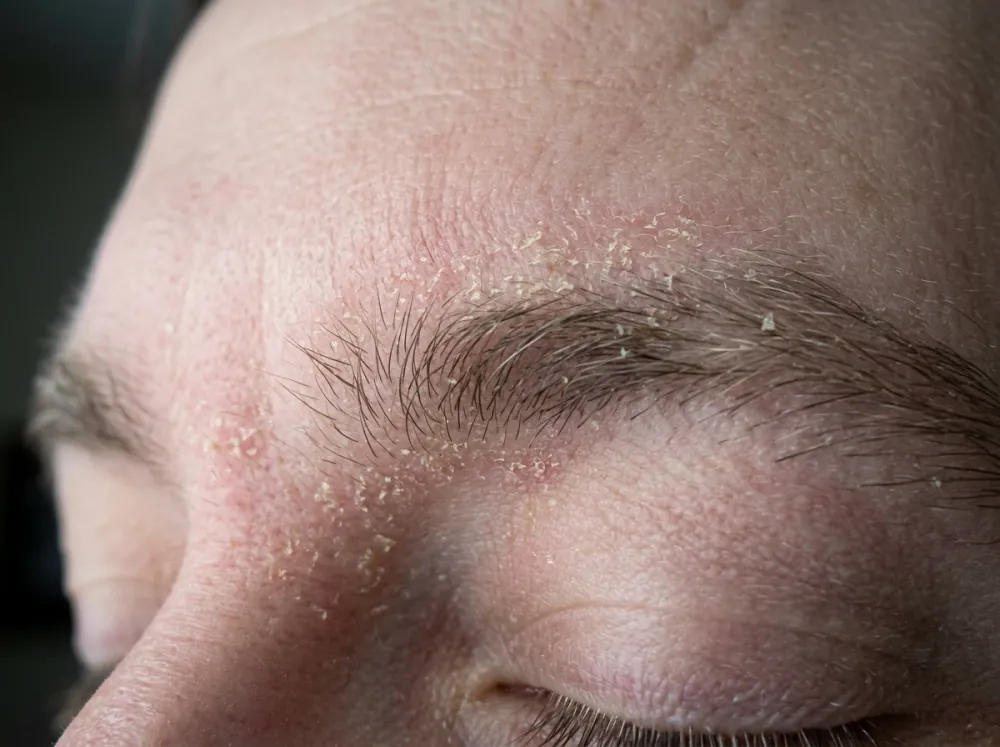
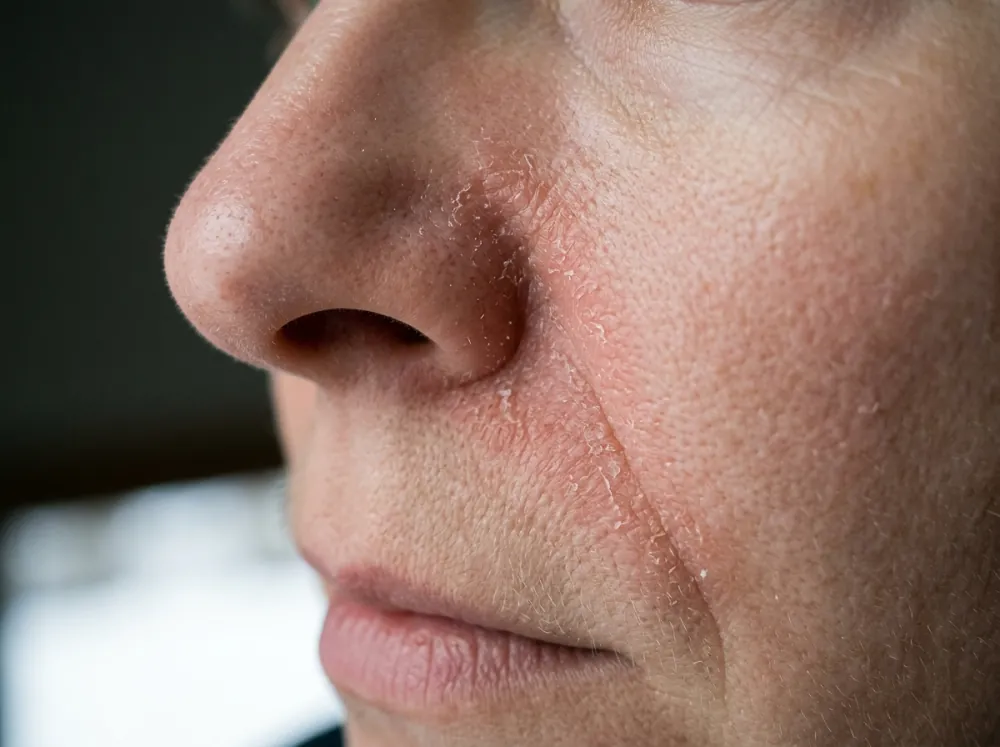
DermNet places adult seborrheic dermatitis where sebum production is high: the scalp, nasolabial folds, glabella (between the eyebrows), eyebrows, beard, ears, and the skin behind the ears. It lists petal- or ring-shaped flaky patches on the hairline and salmon-pink, thin, scaly, ill-defined plaques in the skin folds on both sides of the face, plus scaly red eyelid margins. It adds that in darker skin the condition often presents as scaly hypopigmented patches, sometimes in arcs or petal shapes, and that it is among the five most common diagnoses in Black patients.
Dry Skin and Eczema
Dry skin has no signature site on the face in the sources opened. DermNet says any site can be dry and that the shins are most often involved. It lists the things that dry skin out: low humidity, air conditioning, direct heat, excessive bathing, soaps and solvents, alcohol-containing products, and friction from rough clothing or abrasives. Atopic dermatitis in infants often involves the cheeks, according to DermNet, and our article on eczema on the face covers where eczema shows on the face and why eyelids differ.
Greasy Scale vs Dry Scale
The sources describe scale differently, and they do not entirely agree. A 2025 narrative review describes seborrheic dermatitis as erythematous-to-orange patches with thick, yellowish, greasy scales, and calls itch the most frequent symptom. DermNet describes thin, scaly, ill-defined plaques on the face and says itch is minimal most of the time. The greasy picture is classic on the scalp and in infants, and facial patches can be finer. Neither source lets a reader grade a patch from scale alone.
Itch is a more useful clue for eczema. DermNet defines dermatitis as itchy, and says dry patches that become itchy may be dermatitis. Dryness without inflammation is described as rough, dull and scaly. The sources do not provide a validated home test. As reasoning, a patch that is itchy, red and weeping points toward eczema, a patch in the brows and nose folds with salmon-pink colour and fine yellowish scale points toward seborrheic dermatitis, and a diffuse rough dullness without redness points toward dryness. Several can coexist, since DermNet notes dry skin may become eczematous.
Why Moisturiser Fixes One and Not the Others
Dryness and Eczema
DermNet calls moisturisers and emollients the mainstay of treatment for dry skin, applied liberally and often enough to reduce itch, improve barrier function and reduce water loss. It adds that a topical steroid may be used if dry skin is itchy or has become dermatitis.
Seborrheic Dermatitis
Seborrheic dermatitis is different. A 2022 review says its treatment is aimed at modulating sebum production, reducing colonisation by Malassezia yeast, and controlling inflammation, and that limited clinical evidence supports emollients in it. A Cochrane review of 51 studies found topical ketoconazole 2% lowered the risk of failed clearance by 31% against placebo at four weeks (low-quality evidence), with a remission rate similar to steroids and fewer side effects. A Cochrane review of 36 trials found topical steroids more effective than placebo for clearing seborrheic dermatitis of the face or scalp, with no difference between mild and strong steroids in the short term, and calcineurin inhibitors comparable to steroids. Most studies in both reviews were short, four weeks or less, and 24 of the 51 antifungal trials had some form of conflict of interest.
That is reported evidence, not advice. The point is narrower: a moisturiser addresses the barrier and does not, by itself, address yeast and inflammation. The 2025 review notes that barrier dysfunction is part of seborrheic dermatitis too, and that emollient data come mostly from atopic dermatitis. Our guide to dry skin treatment covers the lipid and water sides of dryness, and the one on skin barrier repair covers what the barrier needs.
When to Get Seen
This article describes. A clinician diagnoses, and DermNet says seborrheic dermatitis is diagnosed on the location, appearance and behaviour of the lesions, with a biopsy if the diagnosis is uncertain. Reasons the sources give for a visit:
- A patch that does not behave as described. DermNet's differential for seborrheic dermatitis includes atopic and contact dermatitis, psoriasis, rosacea, tinea, impetigo, candidiasis, lupus and secondary syphilis. Our articles on eczema versus psoriasis and on rosacea, perioral dermatitis and acne separate two of those.
- Weeping, blistering or signs of infection. DermNet lists secondary bacterial or fungal infection as a complication, and acute dermatitis shows oozing and blisters.
- Eyelid involvement. Scaly red eyelid margins are a feature of seborrheic dermatitis, and eyelid skin reacts to treatment differently, as our eczema article explains.
- Severe or sudden disease. DermNet notes that severe adult seborrheic dermatitis is sometimes associated with immunosuppression and neurological conditions.
- A patch that thins or reddens with treatment. DermNet lists skin thinning, dilated vessels and steroid-induced telangiectasia as complications, and the 2022 review warns that overtreatment can cause xerosis or irritant contact dermatitis.
The Figure Audited: "Flaky Skin Means You Need to Exfoliate"
Verdict: mostly false as a rule. Flaking is a symptom of three conditions, and only one lists scale removal as part of treatment. Findings:
- For dry skin, abrasives are a listed cause. DermNet lists friction from rough clothing or abrasives among the things that dry skin out, and the mainstay of treatment is moisturising.
- For eczema, the scale is the surface of inflammation. DermNet lists abrasives among the irritants that cause irritant contact dermatitis, and describes treatment as targeting inflammation and the barrier.
- For seborrheic dermatitis, keratolytics appear, alongside the main treatments. DermNet lists salicylic acid, lactic acid, urea and propylene glycol "to remove scale when necessary", beside antifungals, mild steroids and calcineurin inhibitors. The 2022 review calls propylene glycol a keratolytic and humectant for scalp use and notes it can irritate, and describes gentle removal of loosened scale in cradle cap after emollients. That is a clinician-guided adjunct, not a scrub.
- The limit. None of the sources tests facial exfoliation in any of the three conditions. The statement is that the sources do not support it as the first move, and that it is listed as a cause of dryness and irritation. A fuller account of scrubs, acids and frequency is in how to exfoliate your face.
Conclusion
Dry patches on the face are dryness, eczema or seborrheic dermatitis, and sometimes more than one. Location, itch and the look of the scale narrow the choice, and the sources disagree on how greasy the scale is. A moisturiser addresses the barrier, which is the whole story in dryness and part of the story in the other two. Exfoliating is not the first answer to flaking, and scale removal appears only as an adjunct in seborrheic dermatitis.
If a patch keeps coming back, noting where it is and photographing it in the same light each week, in an app like Skinic or in an album, shows more than memory does about whether it follows the winter or the products. For a patch that weeps, spreads, thins or will not settle, ask your own clinician.
Frequently asked questions
5 questions · tap one to open the answer
What causes dry flaky patches on the face?
How can seborrheic dermatitis be told from dry skin?
Is face dandruff the same as seborrheic dermatitis?
Should flaky skin on the face be exfoliated?
When should flaky patches on the face be checked?
Medically reviewed by
Dr. M.M Hanaei
Aesthetic Physician, Dermatology Fellowship
- MD — Shahid Beheshti University of Medical Sciences (SBMU)
- MCC Licensure (Medical Council of Canada)
- Dermatology Fellowship, Switzerland
- Certified in advanced aesthetic procedures
Last reviewed 17 October 2026