Skinic
Skin texture is one word for at least five different problems: bumps, dips, dryness, fine lines and visible pores. They feel different under a fingertip, they have different causes, and they respond to different things. Treating all five with the same exfoliant is a familiar way to end up with the same texture and a more irritated face.
The claim this article tests is that exfoliating smooths texture in one use. In a study that measured skin surface roughness with 3D scans of silicone replicas, unevenness fell right after exfoliation and mostly faded within 14 days. This article covers the fingertip test, each of the five problems, and what exfoliation can and cannot change. It describes and routes. It does not tell you which one you have, and treatment belongs with your own clinician.
One Word, Five Problems
"Texture" is a lay word. Dermatology sources describe the pieces separately: follicular and comedonal bumps, atrophic scars, dry skin, wrinkles, and enlarged pores. In a network meta-analysis of topical treatments for facial photoaging, fine wrinkles, coarse wrinkles, pigmentation and roughness were scored as four separate outcomes, which is itself a sign the word covers more than one thing.
The fingertip test below is an organising device. It is not a validated diagnostic tool, and a bump that does not fit any row belongs with a clinician. As reasoning, not a finding, comparing the patch with a neighbouring area of the same person helps, since dryness, bumps and dents are all easier to judge against that person's own baseline.
The Fingertip Test
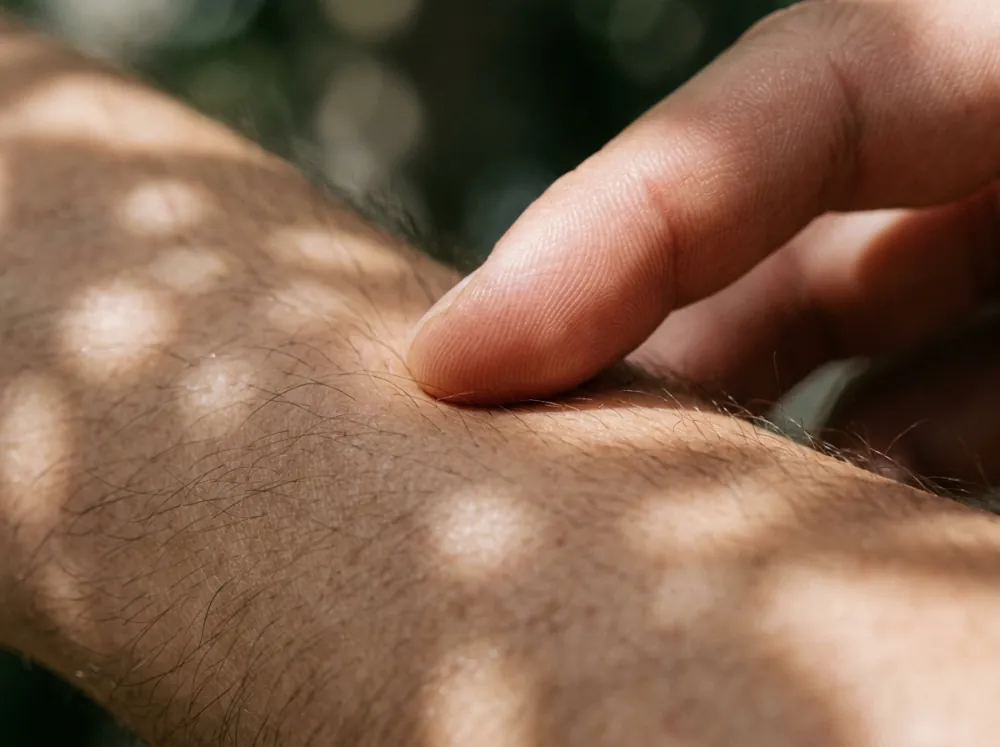
Close your eyes and move a clean fingertip lightly over the area. What you feel decides the row.
| What you feel | What it may be | Where to read more |
|---|---|---|
| Small, firm, skin-coloured bumps with no opening, on the forehead, chin or cheeks | Closed comedones | Closed comedones |
| Sandpaper-rough bumps, one per hair, on the outer upper arms or thighs | Keratosis pilaris | Bumps on the body |
| Shallow or narrow dents where acne used to be | Atrophic acne scars | Microneedling before and after |
| Overall rough, scaly or tight skin, sometimes with cracks | Dry skin | Dry skin treatment |
| Nothing you can feel; small visible openings on the nose and cheeks | Enlarged pores, sometimes with open comedones | Sebaceous filaments vs blackheads |
Bumps
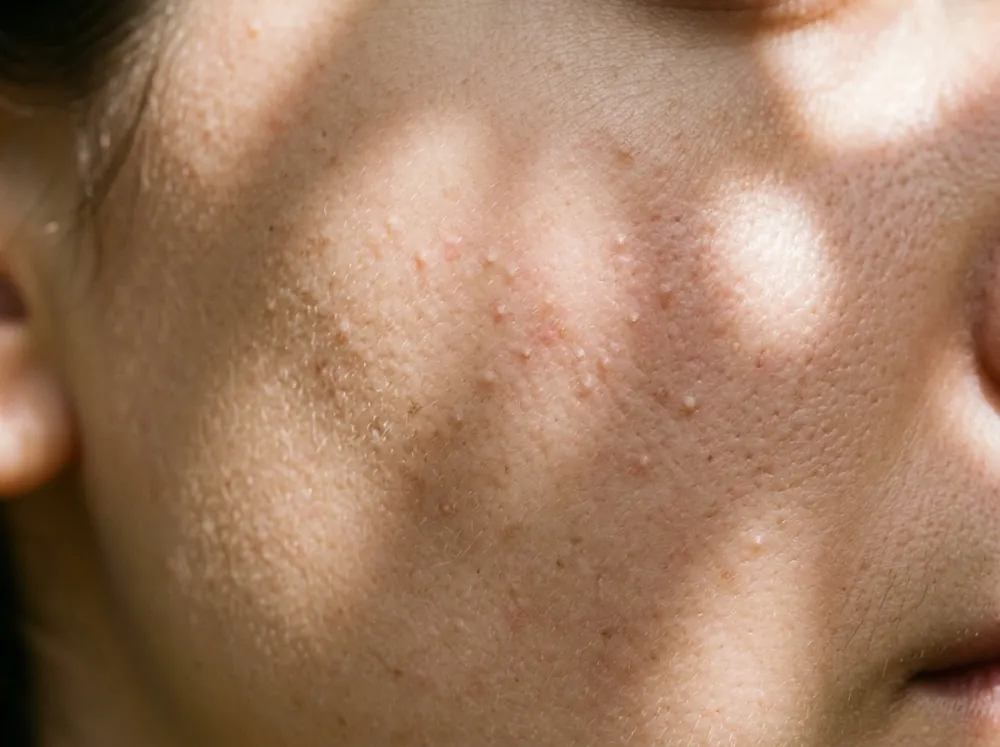
Bumpy skin on the face is the most common version of the complaint, and it has more than one cause. Two of them are covered here because they are the ones a fingertip finds first. Others, including milia, sebaceous hyperplasia, folliculitis and inflamed acne, have their own articles, and a guide to telling facial bumps apart is a separate article.
Closed Comedones
DermNet describes closed comedones (whiteheads) as uninflamed skin-coloured papules that must be punctured to remove their contents. Open comedones (blackheads) are grey, orange, brown or black papules whose keratin contents can be expressed or extracted. The difference is whether the follicle has an opening, which is why an acid that works through an opening behaves differently on the two. Closed comedones are also uninflamed, so they are usually felt before they are seen.
Keratosis Pilaris
DermNet describes keratosis pilaris as a very common dry skin condition caused by keratin accumulating in the hair follicles. It affects 50 to 70% of teenagers and 40% of adults, most often on the extensor surfaces of the upper arms and thighs, and is usually worse in winter. The skin feels rough and dry and the bumps can be skin-coloured, red or brown. It has no cure and often clears up during adult life.
Dips
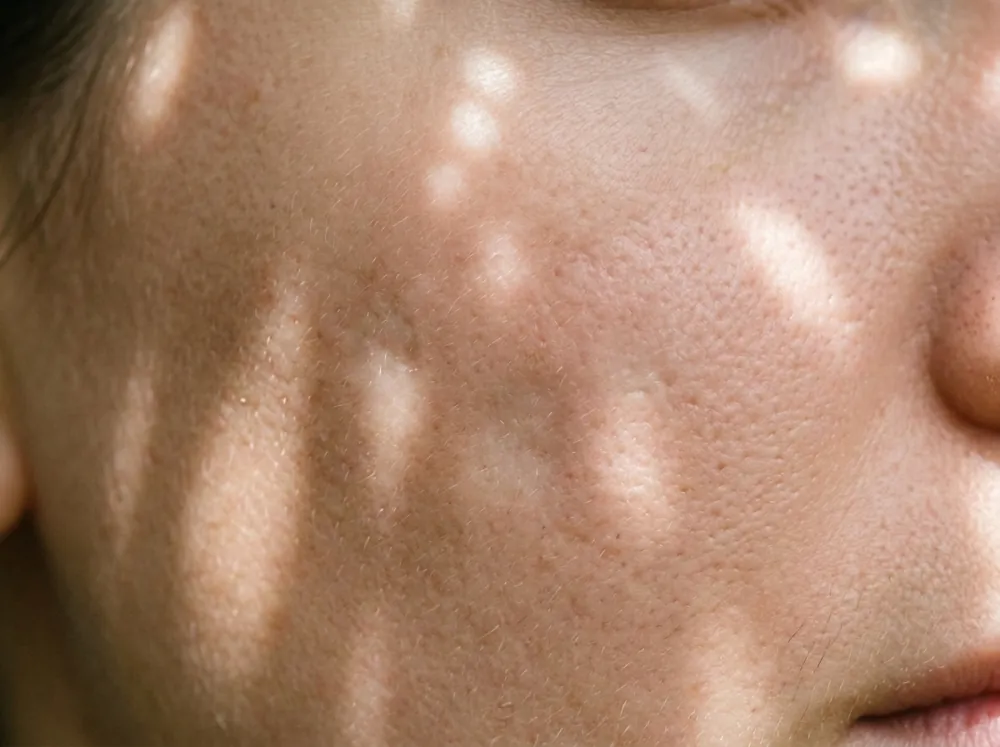
Dents that follow acne are usually atrophic scars, which are depressions. DermNet's page on acne scarring says most acne scars are atrophic and result from net destruction of collagen in the dermis. It names three types: ice-pick scars (narrow, deeper than wide, V-shaped, 60 to 70% of atrophic scars), boxcar scars (wider round or oval depressions with distinct edges) and rolling scars (wide with sloping edges).
These are not rough patches that a scrub can smooth. DermNet says resurfacing procedures aim to blend scars into the surrounding skin and may be best used for more superficial scars, that multiple treatments may be needed, and that active acne should be treated before scar management starts. DermNet adds that picking at active lesions can increase the likelihood of scars, and that postinflammatory colour changes, which are flat and cannot be felt, often improve with time but may take months or longer. A mark you can see but not feel is a pigment problem and not a dent. Our article on microneedling before and after covers which scar types respond to which kind of procedure.
Lines and Roughness
Dryness and Fine Lines
DermNet defines dry skin as skin that feels dry to the touch, from a lack of moisture in the stratum corneum, giving a dull surface with a rough, scaly quality and, when severe, cracks. Nearly everyone over 60 has dry skin. Its causes include low humidity, excessive bathing and contact with soap, and the mainstay of treatment is moisturisers or emollients.
"Dehydration lines" is a lay term that none of the sources opened defines. The network meta-analysis scores fine wrinkles separately from roughness, which is the distinction to keep: a line is a fold or crease, and roughness is the grain of the surface. No source opened measured whether a moisturiser alone changes fine lines. Our article on dry skin treatment covers the dry-skin side.
Visible Pores
DermNet describes enlarged pores as depressions in the facial skin surface containing one or more openings to the ducts carrying sweat and oil. It lists increased sebum production, hair follicle size, comedogenic products, loss of elasticity with age and sun damage as causes, and says open comedones can sometimes be seen within a pore. DermNet adds that pores often appear larger with age, that pore size may fluctuate during the menstrual cycle with the largest size at ovulation, and that certain ethnic groups may have larger pores. Pores are seen, usually not felt, which is why they sit last in the fingertip test.
What Exfoliation Can and Cannot Change
Claim audited: "Exfoliating smooths texture in one use."
Verdict: it changes how the surface feels for days, and no source opened shows it changing structure. Findings:
- Immediate and short-lived. In a 3D-scan study of 23 volunteers aged 31 to 67 (abstract), diamond microdermabrasion reduced surface inequalities immediately, but the effect mostly diminished within 14 days. The authors conclude the method improved the skin surface only immediately after application. That is an instrument, not an at-home acid or scrub, and no study opened measured a single at-home exfoliation.
- Roughness gains in trials took weeks. The photoaging network meta-analysis pooled 23 randomised trials of 3,905 people, with an average treatment period of eight weeks (range four to 36). In its roughness analysis of 11 trials and 2,096 people, glycolic acid ranked among the most effective treatments with an odds ratio of 120, but the confidence interval ran from 7.5 to 1,909, which means better than control with little precision. The authors note possible commercial bias.
- The causes of bumps and dents are not on the surface. Closed comedones must be punctured, keratosis pilaris is keratin filling the follicle, and atrophic scars are lost collagen in the dermis.
- Scars need procedures, repeated. DermNet says multiple resurfacing treatments may be required, and only more superficial scars are suited to them.
Exfoliation is a real tool for dry, flaky or dull surface roughness, and the evidence for repeated use is better than for single use. There is also a limit in the other direction: DermNet lists excessive bathing, contact with soap and frictional irritation from abrasives among the causes of dry skin, so a scrub used too often can add to the roughness it was meant to remove. Our article on glycolic, salicylic and benzoyl peroxide covers how the acids differ, and where an exfoliant makes things worse is a matter of irritation and barrier damage rather than texture.
Conclusion
Skin texture is five problems under one name: bumps (closed comedones or keratosis pilaris), dips (atrophic scars), dryness, fine lines and visible pores. A fingertip can sort most of them, because bumps and dents can be felt and pores cannot. Exfoliating once smooths how the surface feels for days, and in the one objective study opened the effect mostly faded within two weeks. The causes of bumps and dents are below the surface.
If you want to know whether anything is changing, photographing the same patch in the same place and light each week, in an album or in an app like Skinic, shows more than touch does. For scars, spreading bumps or anything that worries you, ask your own clinician.
Frequently asked questions
5 questions · tap one to open the answer
What does skin texture mean?
What causes bumpy skin texture on the face?
Does exfoliating fix uneven skin texture?
How do you tell acne scars from other texture problems?
How long does it take to improve skin texture?
Medically reviewed by
Dr. M.M Hanaei
Aesthetic Physician, Dermatology Fellowship
- MD — Shahid Beheshti University of Medical Sciences (SBMU)
- MCC Licensure (Medical Council of Canada)
- Dermatology Fellowship, Switzerland
- Certified in advanced aesthetic procedures
Last reviewed 14 October 2026