Skinic
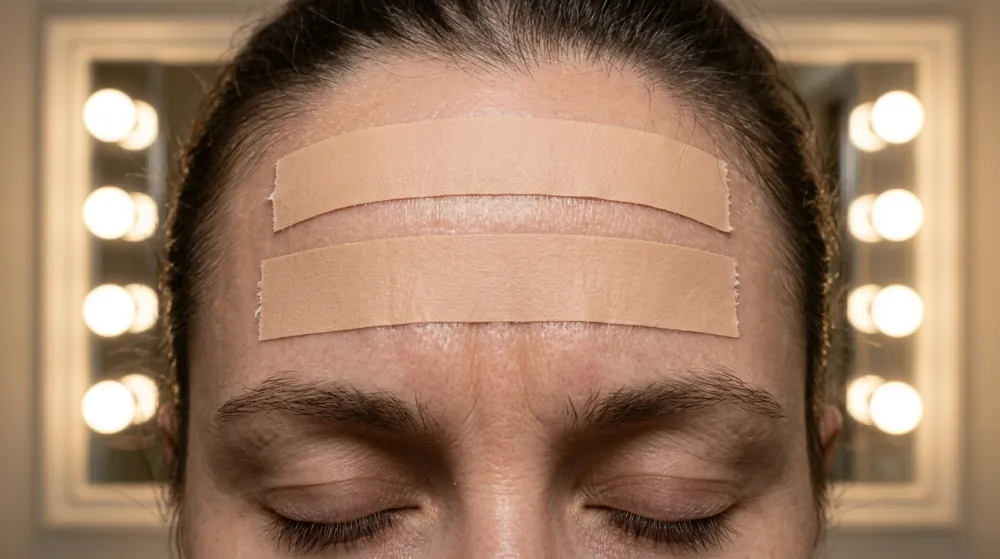
Face tape for wrinkles has no trial behind it that could be found. Searches of PubMed and Europe PMC for taping, kinesiology tape and adhesive tape used against facial lines returned nothing that tests the practice on faces. The idea rests on a plausible-sounding mechanism, that holding skin still overnight keeps it smooth, and on the fact that some lines do come from movement.
The claim this article tests is that taping retrains facial muscles. It covers what overnight immobilisation could and could not do, how static and dynamic lines differ, what adhesives do to skin, and what has evidence for lines. It evaluates the trend. It does not tell you to use tape or how to apply it.
Why It Trended
The case for face tape for wrinkles starts from a simple idea: lines are folds, so holding the skin flat should flatten them. Part of that is true. Wrinkles come in kinds, and some are made by movement. The pitch fails on the kind that matters most for visible lines, which is the kind that no longer needs movement to show.
The sources opened for this article do not address the trend itself. What they offer is the biology of lines and the evidence on the things the tape is claimed to do.
What Overnight Immobilisation Does
What Was Tested
Nothing that could be found. There is no controlled study of face tape and wrinkle depth, none that measures lines before and after a night of taping, and none that follows lines through the next day. A 2009 paper on surgical adhesive tape for facial rejuvenation exists in the literature index, but it had no abstract to read, so its findings are not reported here.
What Can Be Reasoned
As reasoning, not a finding, tape could smooth the skin for a while because it stretches and holds it, and it could limit movement in the taped area while it is on. Neither effect has been measured, and neither would reach the structures that make an etched line permanent. The claim that lines return by lunch is likewise an expectation and not a result.
Sleep itself leaves marks, and that is better studied. A study of 542 French women aged 44 to 70 found sleep lines in 11% (abstract), often more than one, on the forehead, along the nose, on the cheeks and under the eyes. They were associated with age, with more severe skin ageing, and strongly with diminished-function variants of the MC1R gene, and the authors say sleep lines should be told apart from expression wrinkles. Tape does not address how a face lies on a pillow.
Static vs Dynamic Lines
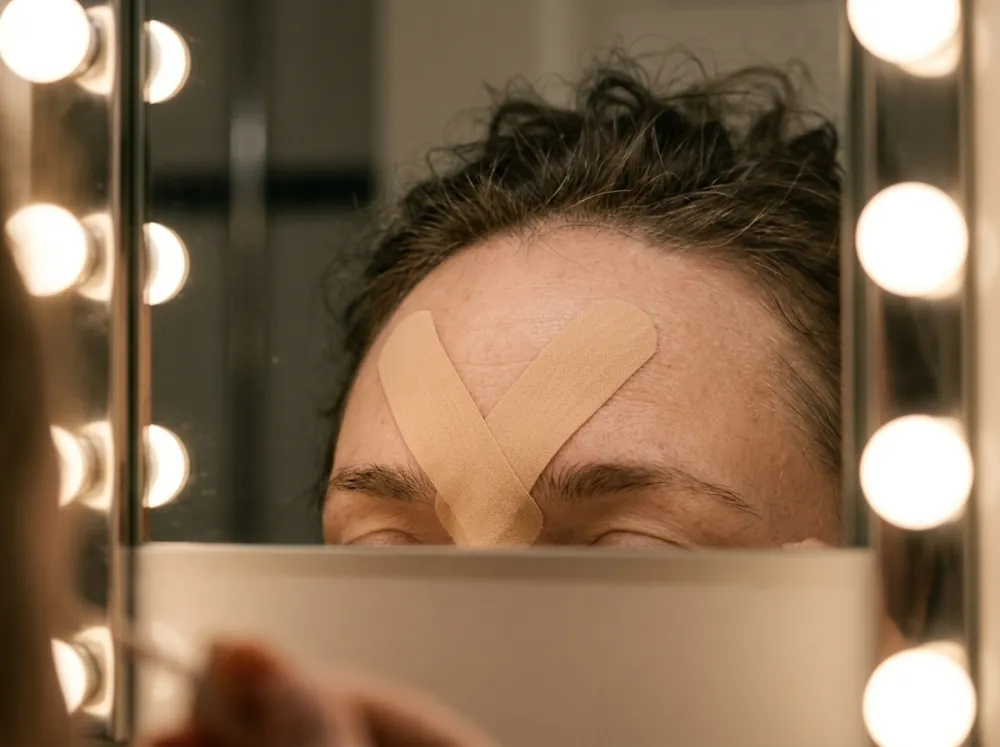
A review of ultraviolet photoaging describes the two kinds. Dynamic wrinkles form from repeated facial expressions, while static wrinkles progress as the skin loses its capacity to recover from creasing. The same review ties the second to ultraviolet damage: UV stimulates enzymes that break down collagen, and repeated exposure lowers the skin's collagen and its ability to repair.
A review of botulinum toxin anatomy makes the clinical distinction. Dynamic lines that appear only with animation respond more to toxin, while etched static lines may need skin-directed treatment or filler-type support, and the visible crease is the endpoint of a process, not necessarily the place to intervene. A useful check it describes is to look at rest, gentle smile, maximum smile and squint. The paper concerns the lateral canthal lines (crow's feet) and is written for injectors, so it describes a way of reading lines and is not a guide for readers.
What follows for tape is limited. A dynamic line is made by a muscle that is working and goes away when it stops. A static line has already stopped depending on the muscle. As reasoning, holding the skin does nothing to collagen, and nothing opened suggests it prevents the repeated creasing that precedes a static line.
The Figure Audited: "Taping Retrains Facial Muscles"
Verdict: unsupported. No source opened tests it, and the mechanism does not fit. Findings:
- No study tests taping and muscle behaviour. No trial of face tape was found at all.
- Tape does not make a muscle work. As reasoning, an adhesive strip can limit movement or remind a wearer to stop frowning, but it provides no resistance or repetition. That is closer to restraint than to training.
- Training itself has weak evidence. In a control-group study of 18 people (abstract), 9 did daily facial exercises for seven weeks and a lay panel compared photographs. Only one of many comparisons was significant, in the upper lip area, and the authors conclude that it cannot be concluded that facial exercises are effective. Exercise at least involves the muscles, and it did not show clear wrinkle results.
- The wrinkles that bother most are static. The toxin anatomy review separates animation-only lines from etched ones, which are not helped by muscle control alone.
- If the goal is to reduce movement, that is what botulinum toxin does, by weakening a muscle, and it is a procedure by a trained injector, which is a different thing from tape.
Limits: the exercise study is small and about exercises, not tape, and the toxin review is aimed at one line type.
Adhesives and Irritation
Skin Stripping and Tension
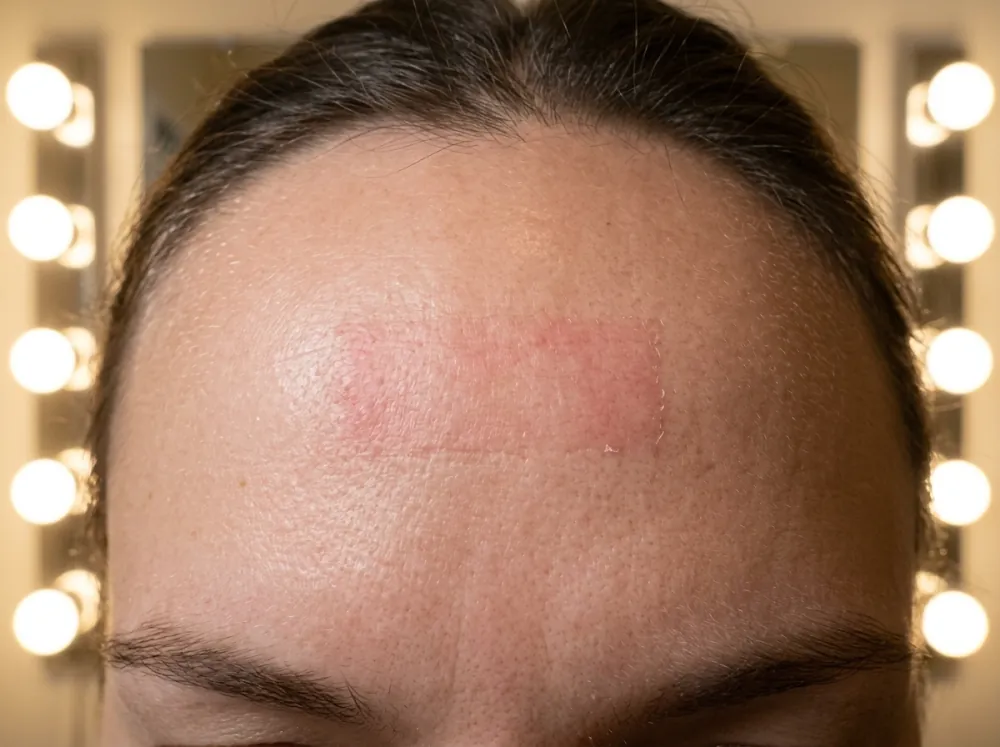
A scoping review of medical adhesive-related skin injury defines it as damage that remains for 30 minutes or more after an adhesive is removed. It lists mechanical kinds, skin stripping (removal of stratum corneum layers with the adhesive), tension injuries and blisters, and skin tears, and dermatitis kinds, irritant and allergic. In hospital populations the prevalence reported ranged from 3.4% to 25% in intensive care, with a daily mean of 13%, and 15.4% in older people in long-term care. Those are medical tapes on patients, often with fragile skin, so the figures do not transfer to cosmetic use. The review lists atopic dermatitis and psoriasis as skin conditions that make skin more vulnerable. The review is here.
Contact Dermatitis
DermNet's page on allergic contact dermatitis lists rosin in adhesive plasters and acrylates among common allergens. A reaction usually appears 24 to 72 hours after contact, is well demarcated at the site, but may extend or become generalised, and allergen carried on the fingers can cause dermatitis on the eyelids. The scoping review describes irritant dermatitis as burning, stinging and well-delimited redness, and allergic dermatitis as intense itching that can appear after 48 hours or days.
Eyelid and face skin is thin, and our article on eczema on the face covers why eyelid dermatitis is often allergic. Our article on the skin barrier covers why repeated stripping is not harmless. No source opened measured reactions to face tape specifically, so the risk is an extrapolation from medical adhesives and from the allergen list, labelled as such.
What Has Evidence for Lines
The evidence for lines is for other things.
- Topical tretinoin. A systematic review of seven randomised trials found it improved wrinkling, mottled pigmentation, sallowness and lentigines from as early as one month and for up to 24 months. Our article on tretinoin and retinol covers the difference.
- Sunscreen. Because ultraviolet breaks down collagen, protection is the evidence-backed prevention. Our article on SPF and wrinkles covers the trial.
- Toxin for dynamic lines. The anatomy review describes it as the most responsive option for lines that appear with animation, as a clinician-delivered treatment.
- Skincare peptides. Our article on peptides for skin covers what the topical studies show.
- Massage and tools. Our article on face massagers separates how skin feels for hours from lasting change.

Conclusion
Face tape for wrinkles has no trial, and the practice depends on a mechanism that fits dynamic lines at best. Static lines are etched, tape does not make a muscle train, the one control-group study of facial exercise could not show that exercise works, and adhesives can strip or inflame skin. Sleep lines are real and are linked to sleeping position, age and genetics.
If you want to know whether any routine changes your lines, photographing the same area at rest and mid-expression in the same light, in an album or in an app like Skinic, gives you a comparison. For irritation that does not settle, or lines you want to discuss treating, ask your own clinician.
Frequently asked questions
5 questions · tap one to open the answer
Does face tape work for wrinkles?
Can face tape retrain facial muscles?
Can face tape irritate your skin?
What is the difference between static and dynamic wrinkles?
What actually reduces wrinkles?
Medically reviewed by
Dr. M.M Hanaei
Aesthetic Physician, Dermatology Fellowship
- MD — Shahid Beheshti University of Medical Sciences (SBMU)
- MCC Licensure (Medical Council of Canada)
- Dermatology Fellowship, Switzerland
- Certified in advanced aesthetic procedures
Last reviewed 15 October 2026