Skinic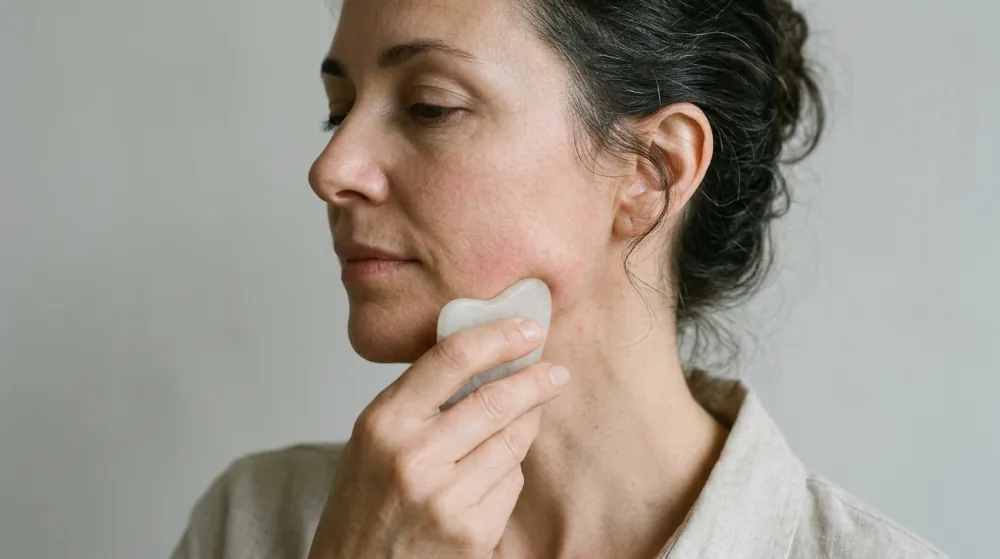
The only randomised trial I found of a face massager ran for eight weeks in 34 women. In both massage groups the measured surface distances across the face shrank by about 2 to 3 millimetres. Neither group was compared with a group that did nothing.
Something does happen when a tool is pressed and glided over the face. Soft tissue moves, blood flow rises for a while, and small changes show up over weeks. The two claims on the box, that a face massager drains lymph and sculpts the face, are harder to find in the evidence. This article separates what moves for minutes from what has been measured over weeks, and audits that pair of claims. It evaluates the claims. It does not teach a technique.
I read the randomised trial, the CT pilot and the Cochrane review in full, and know the rest through abstracts. I say where.
Something Does Happen, and the Question Is for How Long
The clearest physiological result is about blood flow. In a pilot study, 11 healthy volunteers received a single gua sha treatment on the back, and laser Doppler imaging showed a fourfold increase in surface microcirculation for the first 7.5 minutes and a significant increase across the whole 25-minute measurement period. Gua sha, as that paper defines it, intentionally raises transitory petechiae and bruising, which are small bleeding spots under the skin.
That was the back, not the face, in 11 people, and it measured 25 minutes. It tells you the skin flushes. It does not tell you anything lasts.
Tissue also moves. A Tokyo group scanned six volunteers upright and lying down and found that facial soft tissue has vertical mobility, and in a cadaver head, ink injected in three sections spread craniocaudally, along the head's length, rather than following gravity. The authors speculated that this mobility is involved in why massage works. That is their speculation, and the study does not test massage.
What Lymphatic Drainage Is, and What It Is Not
Manual lymphatic drainage is a hands-on therapy used for lymphoedema, which is swelling caused by fluid the lymphatic system is not clearing. The Cochrane review of it describes it as usually one part of complex decongestive therapy, alongside compression, skin care and exercises.
That review covered six small trials, of 24 to 45 participants, in women with arm swelling after breast cancer treatment. In two trials with 83 participants, adding drainage to compression bandaging gave an extra 7.11% reduction in swelling (95% confidence interval 1.75% to 12.47%). In a trial of drainage plus standard physiotherapy against physiotherapy alone, there was no significant difference between groups. In four trials the person measuring the swelling knew which treatment each patient had, which could bias results. The authors concluded drainage is safe and may offer additional benefit to compression bandaging.
My reasoning, labelled as such: a swollen arm whose lymph drainage has been damaged is not a healthy face, so those results cannot be carried over.
The Face After Surgery
The nearest facial trial I found is a Belgian study of 26 people after jaw surgery, in which 13 had six sessions of manual lymphatic drainage and 13 did not. Three-dimensional scans showed swelling falling faster in the drainage group, and patients reported less swelling and pain in the first month. But the differences were not statistically significant, so the study cannot say drainage helped.
What Nobody Measured
I found no study that imaged lymph flow in a healthy face during massage or gua sha. The Tokyo group's 2021 paper makes the point itself: the effectiveness of facial massage is often explained by increases in blood and lymphatic flow, but that is difficult to square with the lifting effect seen on the cheeks.
Transient Versus Structural
"Sculpting" implies something lasting changes in the structure of the face, such as fat pads, muscle or bone. The studies measure different things on very different time scales, and the table keeps them apart.
| What is claimed | What can be measured | Time scale | What I found |
|---|---|---|---|
| Glow, flush | Skin blood flow | Minutes | A fourfold rise for 7.5 minutes on the back, 11 people |
| Less puffiness | Swelling | Hours to days | No measurement in healthy faces. Not significant after jaw surgery |
| Tissue moves | Displacement of soft tissue | During the massage | Vertical mobility shown on CT. Massage itself not tested |
| A more defined face | Surface distance, cheek position | Weeks | Millimetre changes in two small studies below |
| Lasting structure | Fat, muscle, bone | Months or more | Nothing I found |
The bottom row matters because, in my reasoning, a flush and a bit of fluid shift can flatter a photograph without changing anything lasting. Our microneedling article makes the same point about swelling, noting that skin can look deceptively good in the first week for reasons unrelated to collagen.
What the Trials Measured
The Randomised Trial
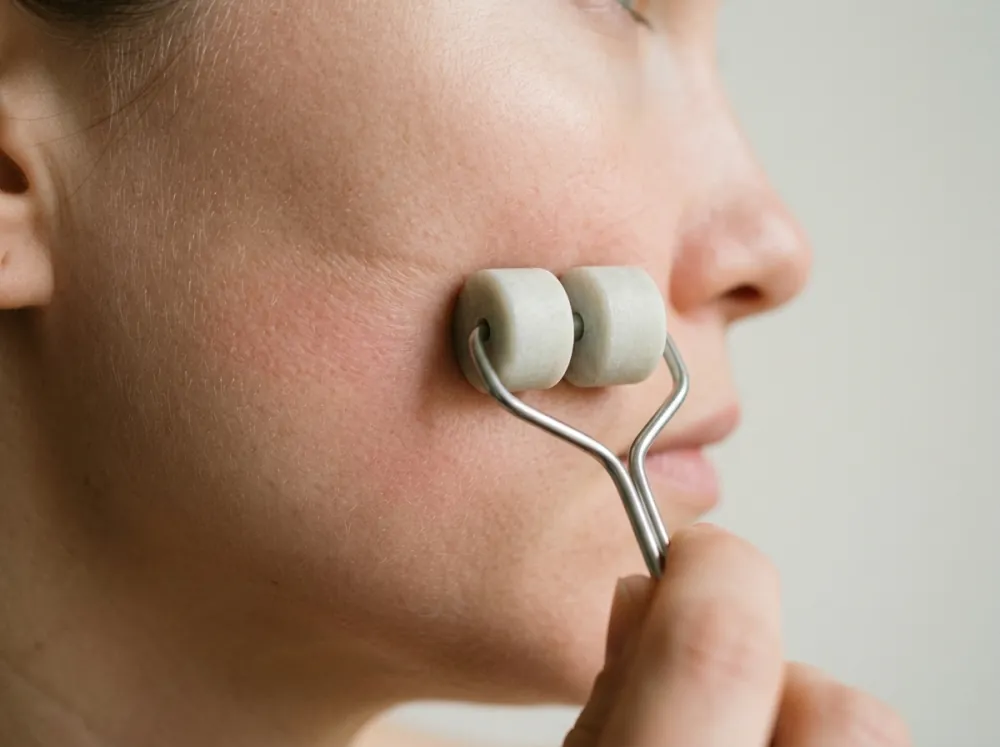
A Korean trial randomly assigned 34 women aged 20 to 50 to a facial roller or a gua sha tool, used for 10 minutes, five times a week, for eight weeks. One dropped out, leaving 33. Facial surface distances measured with a 3D scanner fell by 2.23 to 2.40 mm in the gua sha group and 2.75 to 3.26 mm in the roller group, significant within each group, with no significant difference between groups on contour.
The groups differed on tissue properties. Gua sha lowered muscle tone and dynamic stiffness in the masseter, the jaw muscle, and the roller group's skin elasticity measures rose by 8.6% and 7.5%. The authors report no conflicts, the work was supported by a university research fund, and both groups used the same commercial dual-function tool.
What it did not have is a group that did nothing. Both arms were active, so the study cannot tell massage from any other reason measurements might drift over eight weeks. The authors list no long-term follow-up and no standardised photographs among their limitations.
The Small CT Study
A Tokyo group had five volunteers aged 29 to 37 massage their own faces for about 90 seconds, twice a day for two weeks, then compared CT scans before and after. The top of the cheek became 0.8% thinner and shifted upward and outward by about 3.9 mm, and the height of the SMAS, a layer of fascia within the cheek, rose by 2.6%.
The authors call it a preliminary pilot, with a small sample and a limited age range. It had no control group, and I could not tell from the paper how long after the last massage the scan was taken. It comes from a group with overlapping authors to the 2021 paper above.
Where Friction Causes Problems
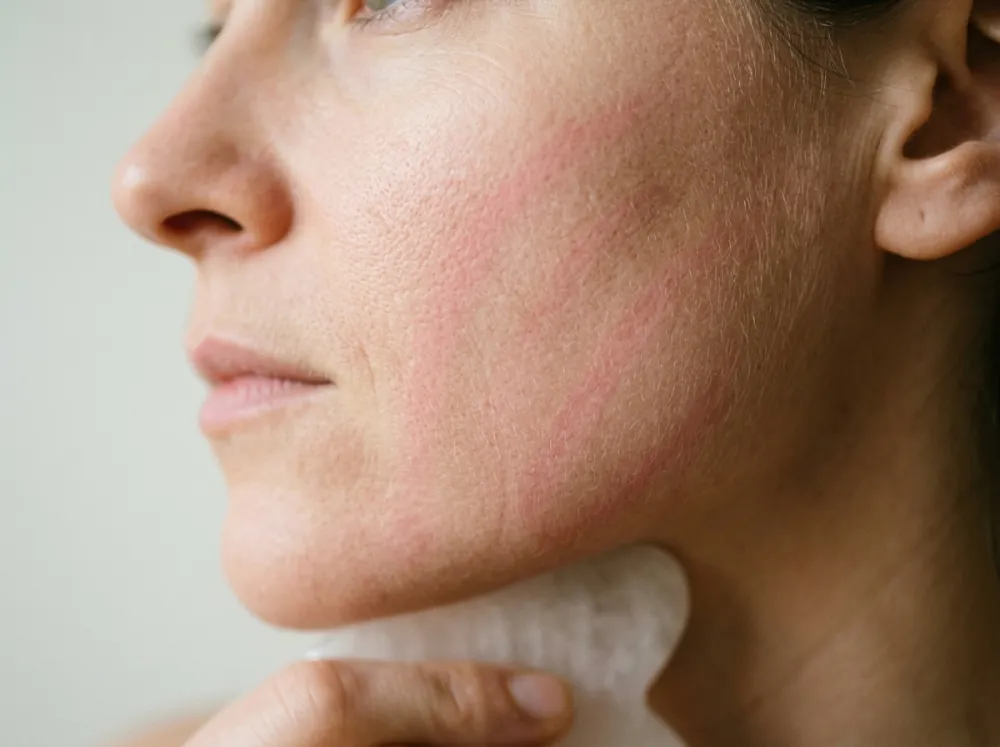
Gua sha is designed to mark skin, as the blood flow study defines it. Whatever a face tool is marketed as, a technique that intentionally raises petechiae and bruises can do that to the face.
The best data on harm from facial massage come with a caveat. An Indian study followed 142 women through 169 salon facial treatments, each combining vigorous massage with creams, steaming and a mask, and in some cases comedone extraction. Erythema and puffiness appeared in 36.1% within 15 minutes to 2 hours and lasted 2 to 6 hours. Mild dermatitis developed in 4.7%. An acne-like eruption appeared 3 to 10 weeks later in 33.1%, mainly deep nodules on the cheeks, the area of focus during the massage, healing with hyperpigmentation.
In most of the women with that eruption, it followed every treatment. But massage was one step among several, so these figures cannot be attributed to massage alone. A few of the lesions were closed comedones, which our guide to closed comedones covers.
The Figure Audited: "It Drains Lymph and Sculpts"
Half One: Drains Lymph
Not shown for healthy faces. The evidence for manual lymphatic drainage comes from lymphoedema, where the benefit over compression alone is a few percentage points in small trials. The one facial trial after surgery found no significant effect. I found no study imaging lymph flow in a healthy face during any facial massage.
Half Two: Sculpts
Measured in millimetres, over weeks, in small studies. The randomised trial found 2 to 3 mm reductions in surface distance with no do-nothing arm, and a five-person pilot found 3.9 mm of cheek movement. Both are small, and neither shows what lasts.
The Verdict
The claim is partly supported and mostly unmeasured. Skin blood flow rises for a short time, soft tissue moves, and two small studies report millimetre-scale changes over weeks. Draining lymph is not shown in healthy faces. Lasting structural change is not shown at all, and neither study includes a long follow-up.
How to Judge a Face Massager Claim
The evidence supports a few questions.
- Is the claim about a flush or about structure? A flush lasts minutes. Structure would take months to show.
- Does the claim say "drains lymph"? In healthy faces, no one has imaged that.
- Compared with what? In the randomised trial, both arms were active, so the result is a comparison of two tools.
- How big is the change? Two to three millimetres on a scanner may be real and still not visible in a mirror.
- What does the technique do to the skin? Gua sha is meant to mark skin, and one salon study of facials that included massage saw dermatitis and delayed breakouts.
For the adjacent device with the same pattern of strong claims and thin trials, see our LED mask evidence review.
Conclusion
A face massager or gua sha tool does move things. Blood flow rises for minutes, soft tissue shifts, and in two small studies facial measurements changed by a few millimetres over weeks.
The claims on the box go further than the studies. Draining lymph has not been shown in healthy faces, where the technique's evidence comes from swollen arms. Sculpting has been measured in millimetres, without a no-treatment group and without long follow-up.
If your goal is a cosmetic one, the evidence supports a modest, unproven expectation, not a promise. If your face is swollen for a reason you do not know, ask a clinician before treating it yourself.
Frequently asked questions
5 questions · tap one to open the answer
Does a face massager drain lymph?
Does gua sha sculpt or lift the face?
How long do the effects of facial massage last?
Can gua sha or a face roller cause problems?
Is a face roller or gua sha better?
Medically reviewed by
Dr. M.M Hanaei
Aesthetic Physician, Dermatology Fellowship
- MD — Shahid Beheshti University of Medical Sciences (SBMU)
- MCC Licensure (Medical Council of Canada)
- Dermatology Fellowship, Switzerland
- Certified in advanced aesthetic procedures
Last reviewed 8 October 2026