Skinic
Non-invasive skin tightening treatments are measured in millimetres, not in the way an advertisement suggests. In a systematic review of microfocused ultrasound, the brow lifts reported ranged from 0.47 to 1.7 mm, and the review itself notes that a measured lift "does not mean that this is visible to the human eye". Radiofrequency has measurable effects on laxity in the reviews opened, and no cream has a trial showing that it tightens skin.
The claim most often attached to these treatments is that a single session lifts like a facelift. No source opened compares any device with surgery, and the FDA's own wording for the focused-ultrasound system opened here is "temporary changes in the physical appearance of the skin". This article follows the evidence for radiofrequency, ultrasound and creams, then asks who sees a result and what to ask before paying. It evaluates claims. It does not tell you to have, avoid or schedule any treatment.
What "Tightening" Means in a Trial
Measured Millimetres
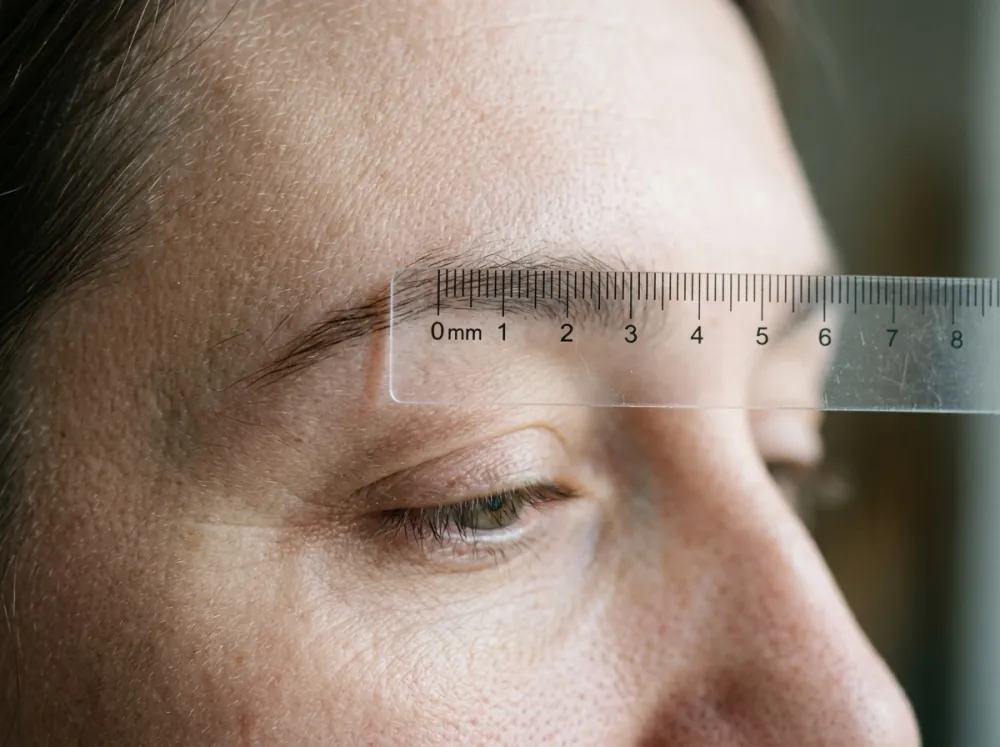
When a trial says a device tightened skin, the figure is usually a small distance on a photograph. The systematic review of microfocused ultrasound pooled 16 studies of a single treatment, all in female patients. Brow lifts were 0.47 to 1.7 mm, and submental lifts, the area under the chin seen from the side, were a reduction of 26 to 45 mm². One of the studies reported that 35% of subjects had a brow lift above 0.5 mm at 3 months, 45% at 6 months and 39% at one year.
Those numbers are real measurements. They are also on two-dimensional photographs, and the review states that a measured lift is not necessarily visible to the eye or aesthetically pleasing.
Global Scales and Who Rates Them
The other common outcome is a global improvement scale, where an investigator or the patient chooses a grade from "no change" to "significant improvement". In the pooled investigator scores (337 patients) at day 90, 92% showed some improvement, but "mild" was the largest category at 47% against 36% "moderate". The patient-rated scores (81 patients) were mostly mild, at 42% at 90 days and 53% at 360 days, with 25% reporting no change at 90 days.
A larger meta-analysis of 42 studies found 89% of patients improved by investigator scores and 84% by patient scores, then added a warning: when a "neutral" answer was offered, satisfaction fell from 91% to 62%, and the authors note that counting neutral answers as positive may overestimate efficacy.
Radiofrequency
What the Reviews Report
Radiofrequency devices heat tissue with electrical energy. A systematic review of monopolar and bipolar devices (abstract) identified 207 articles and kept 23, with nine on monopolar and five on bipolar devices for the face. It concludes that there is clinical evidence for measurable improvement in skin laxity of the face and body, that most complications were minor and transient, and that major complication rates were higher with monopolar devices than with bipolar ones.
The abstract does not give effect sizes in millimetres, so it cannot be compared with the ultrasound figures above. No source opened measured radiofrequency against ultrasound in a comparison that can be cited here.
The Microneedling Variant and the FDA Communication
Radiofrequency microneedling adds needles that deliver the energy beneath the skin surface. On 15 October 2025 the FDA issued a safety communication on these devices. It reports serious complications with uses meant to improve the appearance of the skin, including treating wrinkles and "tightening": burns, scarring, fat loss, disfigurement and nerve damage, some needing surgical repair or medical intervention. The FDA says its evaluation is ongoing, that RF microneedling is a medical procedure and not a cosmetic treatment, and that these devices should not be used at home.
Our article on microneedling before and after covers the non-radiofrequency version, and the article on LED masks applies the same question about device claims to light.
Microfocused Ultrasound
Microfocused ultrasound delivers focused ultrasound energy below the skin surface in small points, which the review describes as thermal injury zones of about 1 mm³ at set depths, typically 1.5, 3 and 4.5 mm. The idea is that heat contracts and denatures collagen, after which new collagen forms. The mechanism is laboratory and histology work cited by the review, and the outcomes above are what the human studies measured.
Side effects were mostly pain and transient redness. Pain averaged about 3.8 on a 10-point scale after anaesthetic or analgesics, transient redness with or without swelling occurred in almost all patients, and uncommon effects such as bruising, numbness, skin burns and white linear marks on the neck occurred in 2% (14 of 573) of patients. The larger meta-analysis put pain at 4.85, moderate, with mostly mild to moderate redness, swelling, bruising and tenderness.
The evidence has two limits worth stating plainly. In the 42-study meta-analysis, 31 studies were before-and-after designs, 9 were observational cohorts and only 2 were controlled clinical trials, and the authors report signs of publication bias for the investigator-rated improvement and satisfaction results. The meta-analysis was funded by Merz North America, and several of its authors report consulting and speaking support from Merz Aesthetics. This is reported, not a judgement of the findings.
The FDA's wording is narrower than the marketing. The system's 2026 clearance letter lists its indications as lifting the eyebrow, lifting lax tissue under the chin and neck, improving lines and wrinkles of the décolleté, and improving the appearance of skin laxity on the abdomen, arms and knees. The intended use is "temporary changes in the physical appearance of the skin". The cheeks, jawline and whole face are not among the listed indications.
What Creams Can and Cannot Do
Cosmetic Claims
A cream cannot be proven to tighten skin by a label. Under the FD&C Act, the FDA states, cosmetic products and ingredients, with the exception of color additives, do not require FDA approval before they go on the market. A product is a drug or a cosmetic by its intended use, and claims to affect the structure or function of the body, for example to reduce cellulite or regenerate cells, make it a drug. The law defines a cosmetic by purposes such as cleansing, beautifying and altering appearance. As reasoning, not a finding, a cream could leave a temporary feel of tightness on the surface; nothing opened shows a cosmetic changing the laxity of the skin below.
No randomised trial of a cosmetic cream on skin laxity was found in the search for this article, which does not prove none exists. Our article on peptides for skin and on medical-grade skincare cover the claims commonly made on those labels.
A Drug With Trials: Tretinoin
The one topical with randomised evidence in photoaged skin is tretinoin. A systematic review of seven randomised trials found that it improved wrinkling, mottled hyperpigmentation, sallowness and lentigines from as early as one month, lasting up to 24 months, though two studies found no change in tactile roughness. The outcomes reported are wrinkles, pigment and sallowness. Skin laxity or tightening is not among them, and the review notes that different formulas and outcome measures limit uniformity. Our article on tretinoin and retinol covers what each can claim.
The Figure Audited: "One Session Lifts Like a Facelift"
No source opened supports it. The ultrasound systematic review studied a single treatment and reported millimetre-scale changes, graded improvement that was mostly mild at 90 days, and no long-term follow-up beyond one year. It states that the longer-term data are not available. Excess skin laxity was an exclusion criterion in several of the included studies, and three studies found less improvement as baseline laxity increased, which led the authors to say surgery would be the better route for severe laxity. The FDA's clearance describes temporary changes in appearance, not a structural lift.
No trial opened compared a non-invasive device with a facelift. A claim of equivalence has nothing in these sources to rest on.
Verdict: modest and measurable for mild to moderate laxity, not facelift-like. Brow lifts of 0.47 to 1.7 mm, mostly mild global grades, and a rate of neutral responses that cuts satisfaction from 91% to 62% when it is allowed to appear.
Who Sees a Visible Result
The ultrasound review gives a consistent picture of who benefited. It concludes that treatment seems effective for mild to moderate laxity, and less so for severe laxity. Improvement declined with increasing baseline laxity in three studies. In one study of 11 patients with a body mass index above 30, only three improved, and another study reported higher self-rated scores for those with a BMI of 25 or less. Participants were more than 90% adult women, so results in men are little tested in these studies.
None of this is a prediction for any individual. It means that the studies enrolled people with mild to moderate laxity, so their results do not necessarily apply to more severe laxity.

Questions Before Paying
These are questions the evidence above makes reasonable, not instructions.
- Which device, and what is it cleared for? The FDA's clearance documents list indications by device. "Tightening" the whole face is not the wording used for the ultrasound system opened here.
- Who performs it? The FDA says RF microneedling is a medical procedure and recommends a licensed provider with training and experience on the specific device.
- What result is expected, in what unit, and how was it measured? The trials measure millimetres on photographs, and global grades that are mostly "mild".
- For how long? Follow-up in the ultrasound studies ran to about a year, and the review notes no longer-term data.
- How is the surrounding evidence funded? The largest ultrasound meta-analysis was funded by an aesthetics company.
- How will change be tracked? The studies relied on dated photographs taken before and after, at fixed time points.
A consultation with a dermatologist or other licensed clinician can address which of these applies to a given face.
Conclusion
Non-invasive skin tightening treatments produce small, measurable changes in mild to moderate laxity. Ultrasound brow lifts are about 0.5 to 1.7 mm, global scores are mostly "mild", and the largest meta-analysis flags publication bias and an industry funder. Radiofrequency has a similar direction of effect without comparable numbers in the sources opened, and the FDA is evaluating serious complications with radiofrequency microneedling. Creams do not have trials for tightening, and the one topical with randomised evidence, tretinoin, was tested for wrinkles and pigment.
If you are weighing a treatment, photographing the area in the same place and light before and after, in an album or in an app like Skinic, gives a comparison that memory does not. For a decision about a procedure, ask your own clinician.
Frequently asked questions
5 questions · tap one to open the answer
Do non-invasive skin tightening treatments work?
Does radiofrequency tighten skin?
Do skin tightening creams work?
How long do skin tightening results last?
Is skin tightening as good as a facelift?
Medically reviewed by
Dr. M.M Hanaei
Aesthetic Physician, Dermatology Fellowship
- MD — Shahid Beheshti University of Medical Sciences (SBMU)
- MCC Licensure (Medical Council of Canada)
- Dermatology Fellowship, Switzerland
- Certified in advanced aesthetic procedures
Last reviewed 13 October 2026