Skinic
Two weeks into a new retinoid, your skin is worse. Every forum, every brand FAQ and every comment section has the same answer ready: it's purging, push through.
It might be. Purging is a real phenomenon with a specific mechanism. But the word has been stretched to cover any reaction to any product, which makes it useless exactly when you need it — and there is trial data on this question that almost nobody quotes, because the most interesting number in it is inconvenient.
Here it is up front. In three randomised controlled trials, 8.7% of people using an inactive vehicle formulation had a meaningful increase in inflammatory lesions over two weeks. No active ingredient. Roughly one in eleven.
That is the baseline your own observation has to beat, and it is why "I broke out after starting it" is weak evidence on its own. This article covers what the trials found, the four tests that actually separate purging from a reaction, and why the fourteen-day rule is a convention rather than a finding.
What the Trials Actually Measured
The best available data comes from a review of three Phase 3 multicentre, double-blind, randomised trials covering 4,550 subjects. Flaring was defined precisely: an increase of 10% or more in inflammatory lesion count after two weeks of treatment, with a 20% threshold also tested.
Participants started with a mean of 29 inflammatory lesions, 49 non-inflammatory lesions and 78 lesions in total.
| Group | Baseline acne | Flared at 2 weeks |
|---|---|---|
| Tretinoin 0.025% alone | Mild | 15.4% |
| Vehicle alone | Mild | 8.7% |
| Clindamycin + tretinoin | Mild | 7.6% |
| Clindamycin + tretinoin | Moderate | 8.5% |
Three things fall out of that table, and all three are worth sitting with.
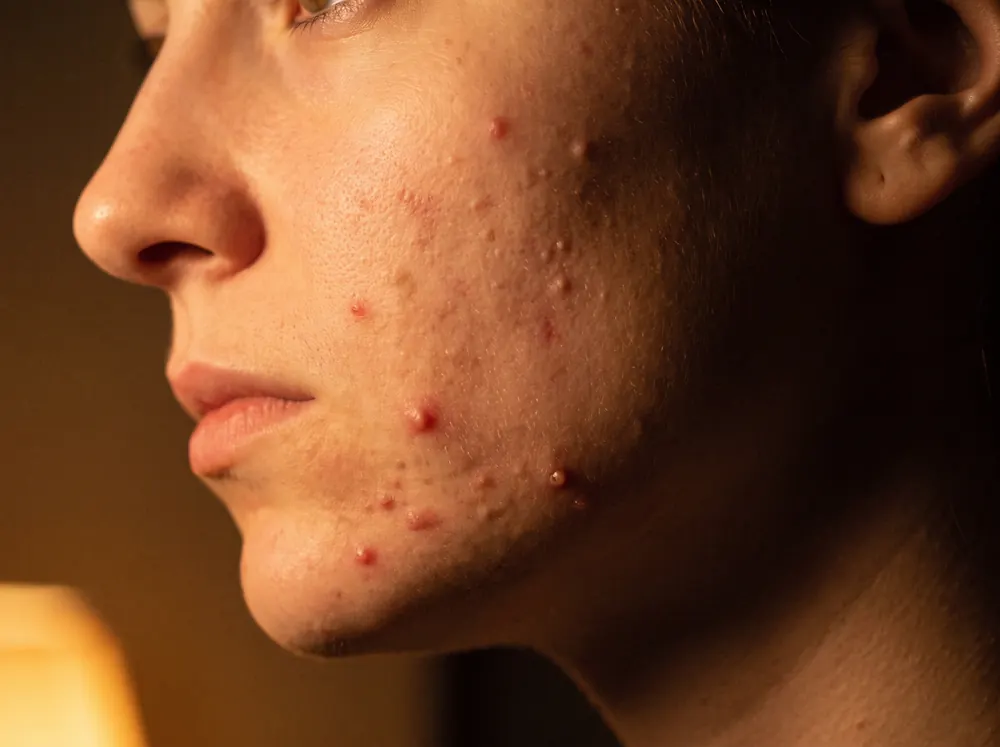
Flaring is real, and small. Tretinoin monotherapy produced flaring in 15.4% against the vehicle's 8.7%. The difference attributable to the drug is under seven percentage points — roughly one person in fifteen. The other side of that: more than 84% of people on tretinoin did not flare at all.
It only appeared in mild acne. The authors are explicit that the effect "was seen only for those with mild acne at baseline and not in those with moderate or severe baseline inflammatory acne." If you started with a lot of lesions, a 10% increase is a larger absolute change and it did not show up.
The combination product did not flare. At 7.6% and 8.5%, the clindamycin and tretinoin gel sat at or below the vehicle rate. Adding an antibiotic removed the effect entirely, which points away from "the retinoid is pushing things out" and toward something else.
The authors offer that something else. Rather than a purge, they suggest the increase "could be the result of the natural drive of underlying acne overcoming the anti-inflammatory activity of the therapy and/or it may represent a delay in the onset of therapeutic activity."
In plainer terms: your acne was going to do what it was going to do, and the treatment had not started working yet.
Where the Belief Came From
It is not invented. The same paper traces it: the original hydroalcoholic formulation of tretinoin at 0.05% was frequently associated with significant cutaneous irritation, and up to 20% of patients developed new papules and pustules during the first few weeks.
That was a real observation about a real product. Formulations changed. The belief did not.
One note on the source, in the spirit of the rest of this site: that paper carries no funding or conflict-of-interest declaration in its text. The trials it reviews are industry-run Phase 3 studies of a commercial combination product, and the finding — that the combination does not flare — is commercially convenient. It is still the largest dataset on the question by a wide margin, which is why it is here.
The Mechanism, and Which Ingredients Can Cause It
The purge hypothesis depends on a specific piece of anatomy. Acne begins as a microcomedone — a small hyperkeratotic plug, mostly made of corneocytes, sitting in the lower part of the follicular infundibulum. It is invisible. It is the precursor from which closed comedones, open comedones, papules and pustules all develop.
The claim is that an ingredient which accelerates follicular turnover brings microcomedones that already existed to the surface faster than they would otherwise have arrived. Weeks of future breakouts, compressed into a fortnight.
That is mechanistically coherent, and it has a strict consequence most people skip: it can only apply to ingredients that accelerate turnover.
Two classes qualify:
- Retinoids — tretinoin, adapalene, tazarotene, retinal, retinol. They bind retinoic acid and retinoid X receptors and normalise follicular keratinisation.
- Hydroxy acids — glycolic, lactic, salicylic. They reduce cohesion between surface corneocytes and promote desquamation.
Nothing else does. A moisturiser cannot purge you. Nor can a cleanser, a vitamin C serum, a niacinamide, a peptide, a sunscreen or an oil. If any of those is followed by new spots, the mechanism is not available and something else is happening.
That single rule resolves most cases before you look at anything else.
Four Tests That Separate Them
Work through these in order. The first one that fails ends the question.
1. Ingredient
Did you start a retinoid or a hydroxy acid? If not, it is not purging. This is not a strong indicator, it is a precondition.
2. Location
Purging surfaces lesions that were already forming, so it appears where you already break out. Acne concentrates on the face, neck, chest, upper back and upper arms, where large hormonally responsive sebaceous glands are abundant.
New spots in a place you have never had them — along the hairline where a product ran, on the sides of the neck, in a band where something sat — are not a purge. They are a map of where the product went.
3. Lesion Type
A purge produces the lesions your acne already produces: comedones, papules, pustules, in a familiar mix.
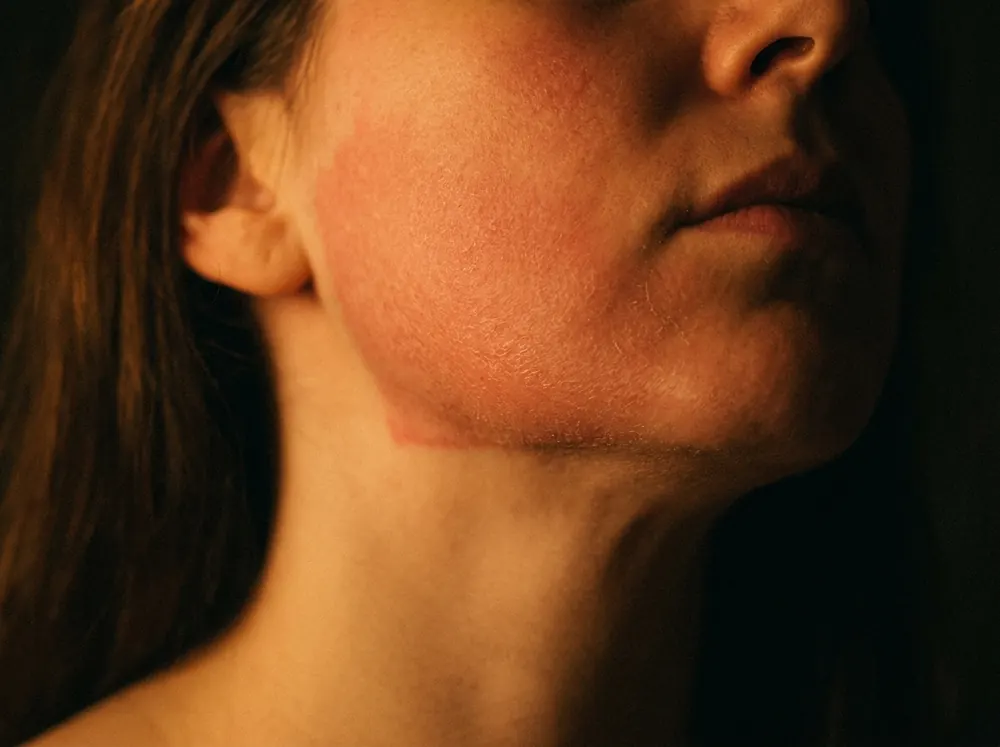
A reaction usually does not look like acne. Diffuse redness, a burning or stinging quality, scaling, tightness, or a well-demarcated patch that follows the shape of application — these are dermatitis, not acne. Closed comedones in particular have their own separate logic, and a sheet of uniform small bumps appearing suddenly is worth examining rather than waiting out.
4. Timeline
Purging should be bounded and then improving. If week six is worse than week three, the hypothesis has failed regardless of what the first three weeks looked like.
The awkward part is that there is no agreed duration to check against, which the next section deals with honestly.
What a Reaction Looks Like Instead
Three things get called purging that are not, and they are distinguishable.
Irritant Contact Dermatitis
By far the commonest. It is inflammation caused by something damaging the skin faster than it can repair itself, and DermNet names retinoids and benzoyl peroxide directly as causes.
The tells: it is confined to where the product went, and the dominant sensations are burning and pain rather than itch. Acute exposure gives localised, well-defined redness, papules and swelling. Repeated mild exposure gives dryness and cracking first, then redness.
This is the thing most often mistaken for purging, because it arrives on the same schedule and the papules can look like spots. The difference is that it stings, and it stops at the edge of where you applied.
Allergic Contact Dermatitis
Different mechanism entirely — a type IV delayed hypersensitivity reaction involving CD4+ T-lymphocytes. Two features separate it:
It requires prior sensitisation, and you may have used an allergen for years before becoming sensitised, which is why "but I've always used this" is not a defence. Once sensitised, the reaction appears 24 to 72 hours after exposure. The same clock applies to allergic reactions on the hands, which eczema on the hands covers.
It also spreads. Though usually well demarcated at the contact site, transfer on the fingers can carry it elsewhere — so an eruption in a place you never applied anything is more consistent with allergy than with purging. Methylisothiazolinone, a preservative in wash-off products, is specifically noted as one that often causes an itchy red face.
The Product Simply Causing Spots
The third possibility is the flattest one: the product is causing acne. Not surfacing it, causing it.
Here the label will not help you. The FDA states plainly that it does not have a list of approved or accepted claims for cosmetics, and that the law does not require cosmetic labelling to have FDA approval before products go on the market. The only standing requirement is that claims be truthful and not misleading. "Non-comedogenic" is not a certification you can check; it is a statement the manufacturer made.
If the eruption started with a product, is confined to where that product goes, and does not improve, the product is a reasonable suspect regardless of what is printed on it. And if the lesions do not look like your usual acne at all, it may not be acne — rosacea and perioral dermatitis are both routinely treated as breakouts, and acne treatment makes both worse.
The 14-Day Rule, and Why It Is a Rule of Thumb
Now the number this article is named after, handled honestly.
"Purging lasts four to six weeks" appears on effectively every page about this subject. It does not appear to trace to a source. The trial data above measured flaring at two weeks and stopped — there are no lesion counts reported at four, six, eight or twelve weeks. It establishes whether an early increase happens. It says nothing at all about how long one lasts.
So the fourteen-day framing in this article's title is a practical convention, not a threshold anyone has measured. It is defensible for a different reason: two weeks is the interval the only relevant data uses, and it is short enough to act on.
What is measured is the other end. StatPearls puts it plainly: at least two to three months of treatment compliance are needed to assess whether a treatment is working.
Those two numbers are the honest frame. Fourteen days is long enough to tell whether something is going wrong. It is nowhere near long enough to tell whether something is working. Most people quit in the gap between them, and the most common way an acne routine fails is by producing redness that gets mistaken for progress.
How to Photograph It So You Actually Know
The reason this question is so hard to answer is that you are comparing today's face to a memory of last week's face, in different light, at a different time of day, in a worse mood.
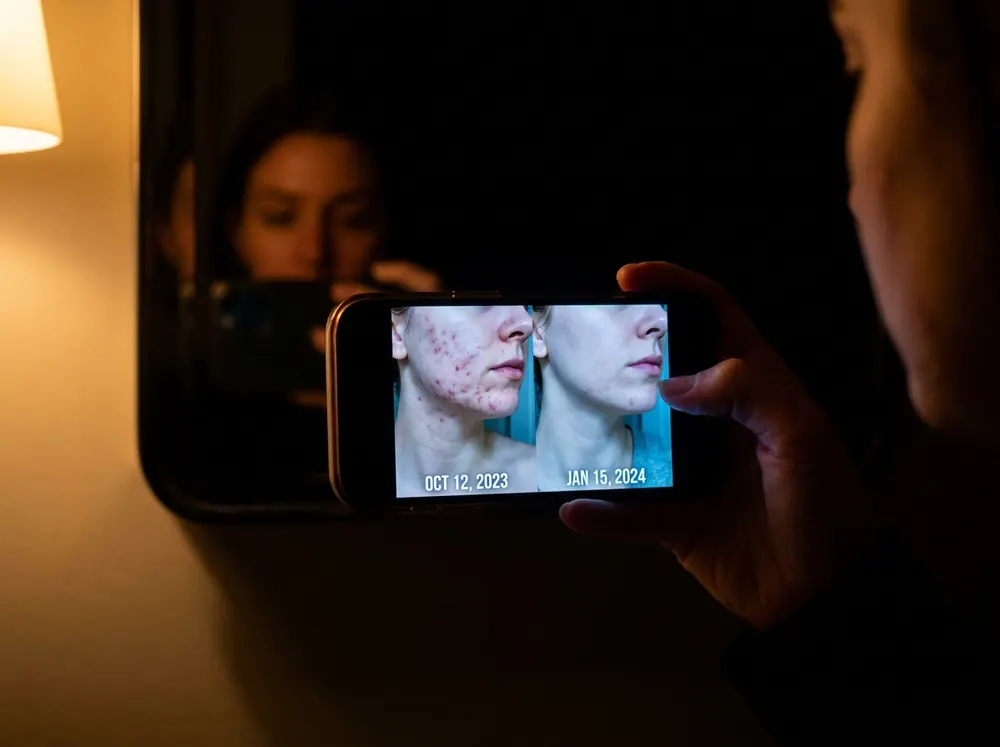
The fix is the same one that applies to any before-and-after: remove the variables. The photographic conditions that make treatment comparisons unreliable apply just as much to your own bathroom.
- Same light, every time. One lamp, same position, same time of evening. Consistency matters far more than quality — a single warm bathroom lamp used every night beats good light used occasionally.
- Same distance and angle. Phone propped in the same spot. Straight on plus both three-quarters, because a single frontal shot hides the jawline where most of this happens.
- Neutral expression, bare skin. No smile, no makeup, same interval after cleansing.
- Count, do not judge. The trials counted inflammatory lesions because counting is more reliable than impression. You can do the same on one area — one cheek, the chin — and a number you wrote down beats a feeling you remember.
- Date everything, and take a baseline before you start, which is the shot everyone forgets and the only one that cannot be recreated.
Then read it against the four tests. Fourteen days of dated photographs of one cheek under one lamp will answer this question better than any amount of searching, because it is the only evidence that is actually about you.
Conclusion
Purging is real. It is also much smaller and much narrower than the word's usage implies.
In 4,550 people, tretinoin monotherapy produced an early flare in 15.4% against 8.7% on an inactive vehicle — a real effect of about seven percentage points, confined to people with mild acne, and absent entirely when the retinoid was combined with an antibiotic. More than four in five people did not flare. And roughly one in eleven flared on nothing at all, which is the number that should make anyone cautious about drawing conclusions from a fortnight of their own skin.
The practical version is short. Only retinoids and hydroxy acids can purge you. It should appear where you already break out, look like the acne you already get, and be improving by week six. If it burns rather than itches and stops at the edge of where you applied, that is irritation. If it arrived 24 to 72 hours after use and is spreading, think allergy. If none of the mechanism is available, the product is simply causing spots, and no label on the bottle can tell you otherwise.
And the duration everyone quotes has no traceable study behind it. What does have evidence is the other number: two to three months before you can say whether a treatment is working. Two weeks tells you whether something is going wrong. Only the long version tells you whether it is going right.
Frequently asked questions
5 questions · tap one to open the answer
How do I know if my skin is purging or breaking out?
How long does skin purging last?
Can moisturiser or vitamin C cause purging?
Does everyone purge on tretinoin?
Does a non-comedogenic label mean a product will not cause breakouts?
Medically reviewed by
Dr. M.M Hanaei
Aesthetic Physician, Dermatology Fellowship
- MD — Shahid Beheshti University of Medical Sciences (SBMU)
- MCC Licensure (Medical Council of Canada)
- Dermatology Fellowship, Switzerland
- Certified in advanced aesthetic procedures
Last reviewed 20 September 2026