Skinic
Tallow for skin has a famous claim attached to it: that it matches the lipids in your skin. The claim is half true, and the half that is true is about the wrong lipid. Human sebum, the oily film on the surface, is made of triglycerides, wax esters and squalene. The skin barrier underneath is made of ceramides, cholesterol and free fatty acids. Tallow resembles the first, and the sources opened report none of the main components of the second.
The claim that tallow is biocompatible with human skin comes from a 2024 scoping review. That review searched two databases, screened 147 studies and kept 19, which it describes as comparative, basic science and animal studies. It states that there are significant research gaps in how tallow can be used on human skin.
This article covers why it trended, the lipid-match claim compared fraction by fraction, what the figure audited actually rests on, what tallow does as an occlusive, the acne and rancidity questions, and when a skin problem needs more than a balm. It evaluates a claim. It does not recommend or advise against a product.
Why It Trended
What Social Media Claims
A 2025 cross-sectional analysis looked at beef tallow skincare posts on YouTube, Instagram and TikTok, including the top 50 posts under a tallow skincare hashtag on the last two platforms. It reports that claims of efficacy for acne, atopic dermatitis and psoriasis were prevalent but largely lacked cited evidence. Acne claims appeared in 29 posts, eczema in 25 and psoriasis in 12. Risks were rarely mentioned, only YouTube videos cited sources at all (16%), and very few posts recommended consulting a healthcare professional.
The paper's own conclusion is that evidence remains insufficient to support the claims and that most existing evidence for tallow is based on studies of its ingredients, not of tallow on skin.
Who Is Making Them
The same analysis measured financial bias, defined as signs of a commercial relationship such as affiliate links, discount codes, sponsorship or ownership. Bias was present on every platform, in 92% of Instagram posts and 74% of YouTube videos. Beauty and skincare brands showed the highest rate (96%), personal channels 55%, non-dermatologist physicians 67% and other speakers 76%. Dermatologists were the least likely to promote tallow (7%) or to show financial bias (7%).
Those numbers describe the sample of posts the authors identified. They do not say tallow does not work. They say that most of the people making the claim have something to sell.
The Lipid-Match Claim, Compared
Sebum Is Not the Barrier
A review of sebum states that sebum is predominantly composed of triglycerides, wax esters and squalene, a fluid hydrophobic surface film, whereas the epidermal lipids of the stratum corneum are characterised by ceramides, free fatty acids and cholesterol, which form a solid-phase barrier matrix. A 2026 review adds that the stratum corneum's lipid classes are maintained in approximate equimolar ratios, with ceramides the dominant component, nearly half of the total lipid by weight.
So there are two different lipid systems on the skin, and a product can resemble one without resembling the other. The social media analysis says that both tallow and human sebum have high proportions of palmitic and oleic acid, allowing tallow to integrate into the skin's lipid matrix. The first half is checkable. The second, that it integrates, is an inference, and the sources opened show no test of it.
Fatty Acid by Fatty Acid
Human sebum is described by one review as dominantly triglycerides and fatty acids, adding up to 57.5% of total lipids, followed by wax esters (26%), squalene (12%) and cholesterol (4.5%). A food-science study measured the fatty acids of refined beef tallow.
| Component | Human sebum | Skin barrier (stratum corneum) | Beef tallow |
|---|---|---|---|
| Triglycerides and free fatty acids | 57.5% of sebum lipids | free fatty acids are one of three main classes | triglyceride-rich fat |
| Wax esters | 26% | not a main class | none reported |
| Squalene | 12% | not a main class | none reported |
| Cholesterol | 4.5% | one of three main classes, near equimolar | not reported in the sources opened |
| Ceramides | not a main class | nearly half by weight | none reported |
| Palmitic acid (C16:0) | converted in sebum to sapienic acid | 27.5% of fatty acids | |
| Stearic acid (C18:0) | 28.4% | ||
| Oleic acid (C18:1) | a major sebum triglyceride fatty acid | 31.6% | |
| Linoleic acid (C18:2) | rapidly degraded in sebaceous cells | an essential fatty acid | 1.7% |
The tallow figures are from a 2025 study of refined beef tallow: saturated fatty acids 62.62%, monounsaturated 33.99%, polyunsaturated 2.14%, with myristic, palmitic, stearic and oleic acids together above 90%.
The overlap is real at the level of individual fatty acids: palmitic and oleic acid are important in both. The sebum review describes a unique sebum fatty acid, sapienic acid (C16:1 with its double bond at the sixth position), made by desaturating palmitic acid in sebaceous glands. The tallow table lists C16:1 at 1.67% without saying which isomer. The overlap stops at the lipid classes. No wax esters, squalene or ceramides appear in the tallow sources, and a source that measures them in tallow was not found.
The role of oleic acid itself is contested. The social media analysis says oleic acid is a recognised penetration enhancer that disrupts stratum corneum lipid packing in vitro and may increase permeability, and that it may trigger sebaceous gland hyperactivity. The sebum review calls oleic acid the sebaceous fatty acid with the strongest antibacterial and anti-inflammatory properties. Both are reported here as they stand.
The Figure Audited: "Tallow Is Biocompatible With Human Skin"
What the Scoping Review Concluded
The claim traces to a 2024 scoping review of tallow and skin. Its answer to the first of five questions, whether the composition of tallow makes it suitable for skin, is that "tallow looks to be biocompatible". The reasoning is compositional: tallow is rich in triglycerides, especially oleic, palmitic, stearic and linoleic acids, and the barrier contains cholesterol, free fatty acids and ceramides. The review also states that there is a lack of direct research on how tallow crosses the barrier or works on the skin, and that the literature on the two separately provided what it called strong evidence of tallow's biocompatible nature.
That is an argument from composition, not a test on skin. The comparison in the review is between tallow and the barrier lipids, and the section above shows the match is to sebum, not to the barrier.
What Its 19 Studies Were
The review screened 147 studies and kept 19, which it describes as comparative studies, basic science studies and animal studies. Its own summary is that more research geared towards tallow as a cosmetic in humans is needed, and that the question on side effects had the most discrepancies between sources.
The benefit studies it describes used modified or derived materials. One made emulsions of mutton tallow modified with hemp seed oil to raise the polyunsaturated fat content and found them hydrating. Another tested fat esters derived from tallow and reported hydration rising by 4.7% to 47.2% over 30 to 180 minutes, while the unmodified fat first decreased hydration by 47.1% at 30 minutes and was up 8.7% at 180 minutes. The unmodified fat also left an oily surface. The side-effect studies are mixed: a skin irritation classification of tallow as a severe irritant in a solvent system, rabbit and guinea pig tests reporting no irritation or sensitisation, and studies of tallow-derived amine surfactants, a different substance, that were very irritating in concentrated form. The review notes that the study reporting no irritation tested no humans.
Verdict: the claim is not shown, and the strongest source for it says so. The review concludes biocompatibility from composition and states that research on human skin is lacking. The animal and derived-material studies point in different directions on irritation. "Biocompatible" here means a reasonable expectation, not a demonstrated result.
What It Does as an Occlusive
The common argument is that an occlusive is an occlusive: a fat on the skin slows water loss, so tallow works like any other. A 2025 within-person randomised trial of 54 healthy adults compared extra virgin olive oil and petrolatum on the forearm. Both increased stratum corneum hydration and reduced redness, but only petrolatum reduced transepidermal water loss, and its effects on desquamation were more pronounced. The authors conclude petrolatum exerted the stronger occlusive effect.
So fats are not interchangeable as occlusives, at least between a liquid plant oil and petrolatum. No source opened measured water loss for tallow, which is a solid fat. What can be said is limited: tallow is a lipid that sits on the surface, plausibly adds some occlusion, and has not been tested against petrolatum or a barrier cream. Our articles on skin barrier repair and moisturisers for dry skin cover what has been tested.
Comedogenicity and Rancidity
Acne
No comedogenicity rating or test for tallow was found. The social media analysis reasons from components: palmitic acid, a major component of sebum, increased the inflammatory signals IL-6 and IL-8 in sebocytes in cited work, oleic acid may trigger sebaceous hyperactivity, and stearic acid can provoke inflammation in excess. Tallow is about 28% palmitic, 28% stearic and 32% oleic acid by the table above.
That is reasoning from cited laboratory work, not a test of tallow on acne-prone skin. The scoping review adds that the oily residue of unmodified tallow may deter oily or acne-prone skin. Claims that tallow helps acne were prevalent in the posts and lacked evidence.
Rancidity
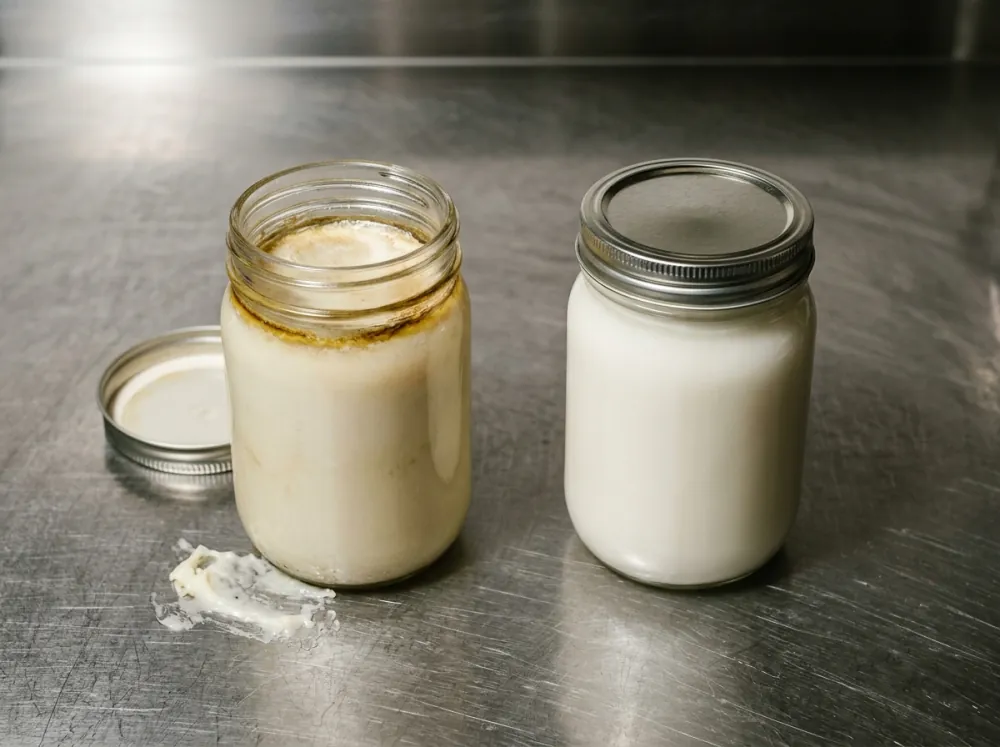
Animal fat oxidises. In a food-science study of refined beef tallow stored for up to 28 days at 4, 25 and 45 °C, in sealed or open containers and in light or dark, higher temperature, air exposure and light all accelerated oxidative deterioration, and storage at 4 °C kept the fat stable. The authors note that room-temperature oxidation of tallow typically produces unpleasant rancid odours.
That was a culinary tallow, not a skincare product, and no source opened shows that oxidised tallow harms skin. The result would apply in principle to any tallow balm left open in a warm room, but it was not tested on one. The sourcing question is also open. The scoping review mentions that a melanoma vaccine's oleic acid source was switched from tallow to olives over a prion concern, which concerned an injected product and not a topical one. A jar sitting open and warm in a bathroom is the condition the food study found worst for the fat.
When Skin Needs More Than a Balm
The question of tallow for skin problems is really a question about diagnoses. The conditions the posts promoted tallow for, acne, eczema and psoriasis, are medical diagnoses with established treatments. Our articles on eczema versus psoriasis and eczema on the face cover how to recognise them and when to be seen. A rash that is persistent, spreading, painful or not settling is a reason for your own clinician, and a new product is a reason to note it in a trigger log and to stop if skin reacts.
Our article on dry skin treatment covers what has evidence for dryness.
Conclusion
Tallow resembles sebum, not the skin barrier. The fatty acid overlap with sebum is real for palmitic and oleic acid, but the barrier is built from ceramides, cholesterol and free fatty acids, and none of the tallow sources report ceramides. The "biocompatible" claim rests on a scoping review that reasons from composition and found no human trial. As an occlusive, tallow is untested, and a plant oil in a trial was weaker than petrolatum.
The popularity of tallow for skin care is tied to financial bias in the posts that promote it. The practical risks that can be named are an oily surface, an untested acne profile and oxidation of fat left open and warm. If you are watching how skin responds to a new product, photographing it in the same place and light, in an album or in an app like Skinic, shows change more reliably than memory. For acne, eczema or psoriasis, ask your own clinician.
Frequently asked questions
5 questions · tap one to open the answer
Is tallow good for your skin?
Is tallow biocompatible with human skin?
Does tallow match the lipids in your skin?
Is tallow comedogenic or bad for acne?
Does tallow go rancid?
Medically reviewed by
Dr. M.M Hanaei
Aesthetic Physician, Dermatology Fellowship
- MD — Shahid Beheshti University of Medical Sciences (SBMU)
- MCC Licensure (Medical Council of Canada)
- Dermatology Fellowship, Switzerland
- Certified in advanced aesthetic procedures
Last reviewed 11 October 2026