Skinic
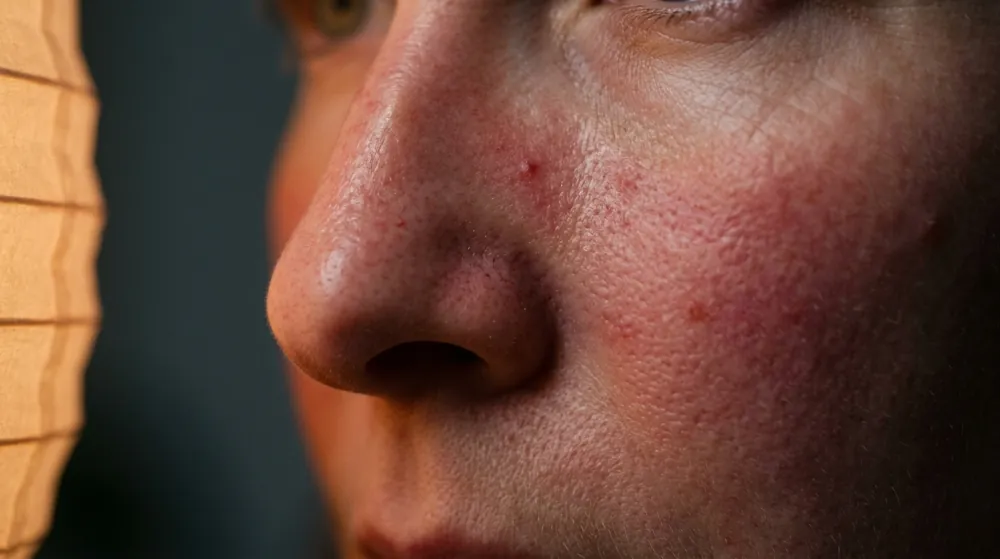
Rosacea treatments act on features, not on the condition as a whole. A cream that clears bumps does little for redness, and a laser that closes visible vessels does nothing for flushing. That is why a single ranked list of rosacea treatments misleads, and why the better question is which option has what level of evidence for which feature.
This article reports the certainty tier that systematic reviews and a consensus panel assign to each option, by feature. It evaluates evidence. It gives no strengths, doses or regimens, and it does not say what to use. Rosacea is diagnosed and treated by a clinician, and eye symptoms, thickening skin or a rash that is spreading are reasons to be seen sooner.
Match the Treatment to the Feature
The reviews now sort rosacea by what is present, the phenotype approach, in place of the older four-subtype system. A 2019 systematic review of 152 randomised trials and 20,944 participants graded the certainty of the evidence for each feature. Its searches ended in March 2018, and only 16 of the 152 trials were at low risk of bias. Several of its authors report ties to companies that make rosacea products, and its funding came from a dermatology society.
The table gives the tier it reports, with later work noted where it exists.
| Feature | Option reported | Certainty reported |
|---|---|---|
| Persistent redness | Topical brimonidine | High, for a temporary reduction |
| Topical oxymetazoline | Moderate, for a temporary reduction | |
| Pulsed dye laser, Nd:YAG laser, intense pulsed light | Low to moderate | |
| Bumps and pustules | Topical azelaic acid, topical ivermectin | High |
| Topical metronidazole, topical minocycline | Moderate | |
| Low-dose modified-release doxycycline | Moderate to high | |
| Low-dose isotretinoin | Moderate to high | |
| Tetracycline, low-dose minocycline | Low | |
| Flushing | Any option | No randomised trials |
| Thickened skin (phyma) | Any option | No randomised trials |
| Eyes | Oral omega-3 fatty acids | Moderate |
| Ciclosporin eye drops | Low |
Our article on mild rosacea covers recognising the early signs, and the one on seeing a dermatologist for rosacea covers how a clinician decides.
For Persistent Redness
Topical Vasoconstrictors
Brimonidine and oxymetazoline narrow the surface vessels for a few hours. The 2019 review reports effects within 30 minutes, a peak at 3 to 6 hours, and a return to baseline after that. For brimonidine, two low-risk trials found a two-grade improvement in self-assessed redness at 3 hours in 114 of 277 people, against 54 of 276 on vehicle, with no rebound redness in four weeks of follow-up. For oxymetazoline, two trials found it in 99 of 446 against 59 of 439, and six people on oxymetazoline had rebound redness against two on vehicle over 29 days.
These are temporary effects, and the tiers describe that. DermNet adds that persistent use of this class may cause rebound flushing when stopped, so it is often used for special occasions.
Lasers and Light
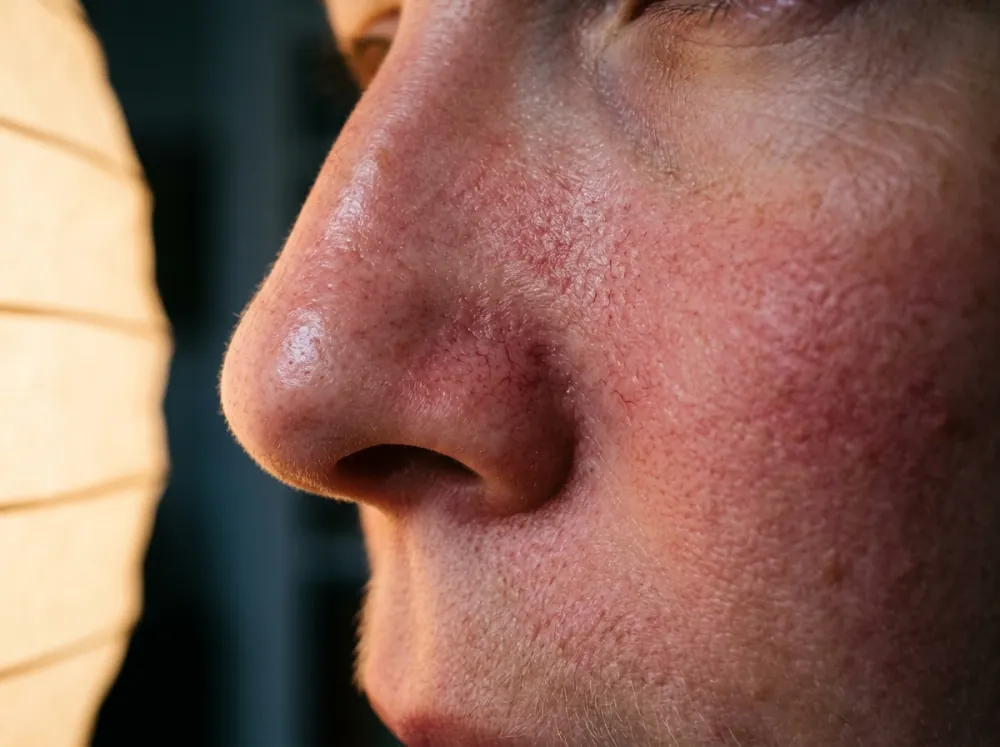
Laser and intense pulsed light are widely used for redness and visible vessels. The 2019 review found only a few small randomised trials of 16 to 49 patients, predominantly low-certainty.
A 2026 network meta-analysis of devices pooled 25 trials with 843 patients. Most had unclear or high risk of bias. Radiofrequency microneedling ranked above pulsed dye laser for satisfaction and redness, but it was flagged as an outlier with possible publication bias, and a pulsed dye laser plus oxymetazoline ranked first for visible vessels. Adverse events were reported unevenly: one trial found superficial atrophic scars in 11.1% after a yellow laser, and another found long-term effects in 10.8% after intense pulsed light. Less than 3% of participants had Fitzpatrick type V skin and none had type VI, and the global consensus panel says these devices need an experienced provider in darker skin because they can cause dyspigmentation. The panel adds that melanin can camouflage redness, so rosacea can be under-recognised in darker skin. The funder was a laser society, and two authors report lecture fees from a laser maker.
Our article on broken capillaries on the face covers the vessel evidence in more depth.
For Bumps and Pustules
Topical Options
The 2019 review found high-certainty evidence that topical azelaic acid and topical ivermectin reduce lesion counts. Participant-assessed improvement with azelaic acid was reached in 648 of 1,132 people against 439 of 1,091 on vehicle, and with ivermectin in 615 of 910 against 169 of 461. Topical metronidazole and topical minocycline were rated moderate. The review adds that vehicle alone reduced lesion counts, by 10 to 11 in the azelaic acid trials and 12 to 23 in the ivermectin trials, so the benefit of the active is the difference over that.
The syntheses disagree on the order. The 2019 review found ivermectin slightly more effective than metronidazole and could not establish whether azelaic acid beats metronidazole. A 2025 network meta-analysis of 19 trials in moderate-to-severe disease ranked one azelaic acid cream first, but with an imprecise estimate (odds ratio 8.54, 95% confidence interval 2.48 to 29.45), and reported that the azelaic acid gel had the most adverse events. It declares no funding and no conflicts. Our article on azelaic acid covers that ingredient in full, and the order is best read as contested.
Oral Options
For moderate and severe bumps, the 2019 review rates low-dose modified-release doxycycline moderate to high, with more people clear or almost clear (91 of 353) than on placebo (53 of 354). Low-dose isotretinoin produced a 90% or greater lesion reduction in 62 of 108 people against 5 of 48 on placebo in one trial, with more adverse events (69% against 44%). The review notes that isotretinoin is teratogenic and should not be prescribed in pregnancy or to people trying to conceive. The consensus panel also says to minimise full-dose antibiotics to avoid resistance. These options are for a clinician to weigh, not a reader.
For Flushing
The 2019 review found no randomised trials for flushing. The global consensus panel's 2019 update removed topical alpha-agonists and oral beta-blockers from its flushing algorithm because evidence is limited, while noting that clinical experience suggests they could be considered in certain situations. The panel was funded by a company that makes rosacea products, which was not involved in voting. DermNet still lists beta-blockers, clonidine, CGRP antagonists and gabapentin among flushing options, and recommends a symptom diary to identify triggers. The honest tier for flushing is that no option has trial evidence, and the choice belongs to a clinician.
What Skincare Can Contribute
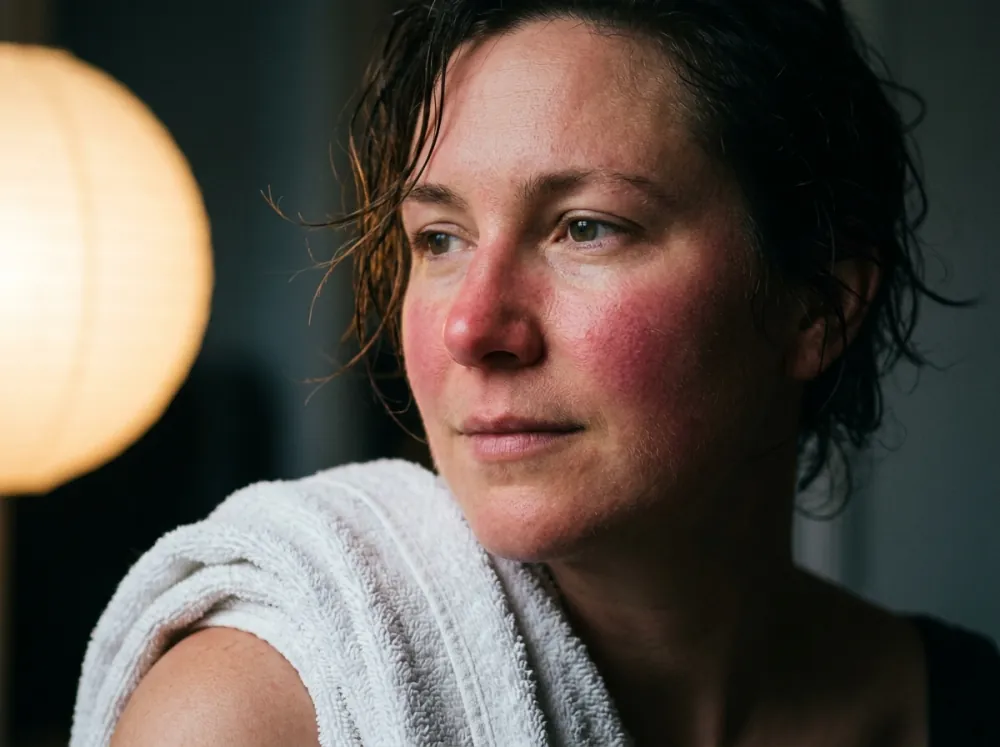
DermNet lists general measures for everyone with rosacea: moisturise frequently, use gentle cleansers, use zinc oxide or titanium dioxide sunscreen of SPF 30 or higher, avoid exfoliants, alcohol-based products and topical steroids, and use green-tinted cosmetics to reduce the look of redness. The consensus panel lists general skincare, trigger avoidance and camouflage among the topics to cover with patients.
None of the reviews read here graded cleansers, moisturisers or sunscreens as interventions, so this is guidance and not a certainty tier. It also means the over-the-counter question is only partly answerable. These reviews do not classify products by prescription status, and the measures above are the over-the-counter part that guidance names. Our article on sunscreen for sensitive skin covers the sunscreen evidence.
What Has Little Evidence
- Clindamycin cream. Two trials of 629 people found it no better than vehicle (low to moderate certainty).
- Clindamycin with tretinoin gel. One trial found no difference in quality of life, physician ratings or lesion counts, and more dryness, scaling and worsening of rosacea.
- Permethrin, dapsone, sodium sulfacetamide with sulfur, pimecrolimus and others. The 2019 review found them at unclear-to-high risk of bias or too thinly reported to grade. A Swiss guideline cited in the review rates some of these level A, a rating the review's authors say they clearly disagree with.
- Unusual treatments. Tranexamic acid, honey, diclofenac gel and botulinum toxin injections were in the same unclear group.
- Thickened skin and flushing. No randomised trials.
Evidence being thin is not evidence of no effect, and a clinician may still use some of these.
The Figure Audited: "Rosacea Is Caused by Demodex Mites"
Verdict: unproven as stated. The link is real, the cause is not established. Findings:
- Association. A meta-analysis of 23 case-control studies (abstract) with 1,513 rosacea patients found they were more likely to carry Demodex (odds ratio 9.04) and had higher mite density than controls. Its authors state that between-study variability was high and that a causal relationship could not be established from case-control studies.
- Multifactorial. DermNet lists genetic susceptibility, innate and adaptive immune dysregulation, neurovascular mechanisms, an impaired barrier and ultraviolet light, and says increased Demodex density "may play a role".
- Treatment works without mite excess. A split-face trial in 27 people with low or zero Demodex counts (mean 0.6 to 0.7 mites per square centimetre) found both topical metronidazole and ivermectin improved persistent redness equally over three months. The authors suggest an anti-inflammatory effect, and the trial was single-blinded and small.
- Response is not cause. That an anti-parasitic cream helps bumps does not show that mites cause them, because the same drug may calm inflammation. This is reasoning.
- The limit. No source tested whether removing mites changes the course of the disease.
Conclusion
Rosacea has no cure, and the evidence runs feature by feature. High-certainty evidence exists for temporary redness reduction with topical vasoconstrictors and for bumps with azelaic acid and ivermectin. Light and laser options have low-to-moderate certainty, flushing has no trial evidence, and which topical for bumps ranks first is contested. Mites are associated with rosacea and are not shown to cause it.
Noting which feature bothers you most, and photographing it in the same light over weeks, in an app like Skinic or in an album, makes a visit more useful. A clinician can match options to the feature and to your skin, and eye symptoms are worth raising sooner.
Frequently asked questions
5 questions · tap one to open the answer
What is the best treatment for rosacea?
Do creams help the redness of rosacea?
Is there evidence for laser treatment of rosacea?
Are there over-the-counter treatments for rosacea?
Do Demodex mites cause rosacea?
Medically reviewed by
Dr. M.M Hanaei
Aesthetic Physician, Dermatology Fellowship
- MD — Shahid Beheshti University of Medical Sciences (SBMU)
- MCC Licensure (Medical Council of Canada)
- Dermatology Fellowship, Switzerland
- Certified in advanced aesthetic procedures
Last reviewed 18 October 2026