Skinic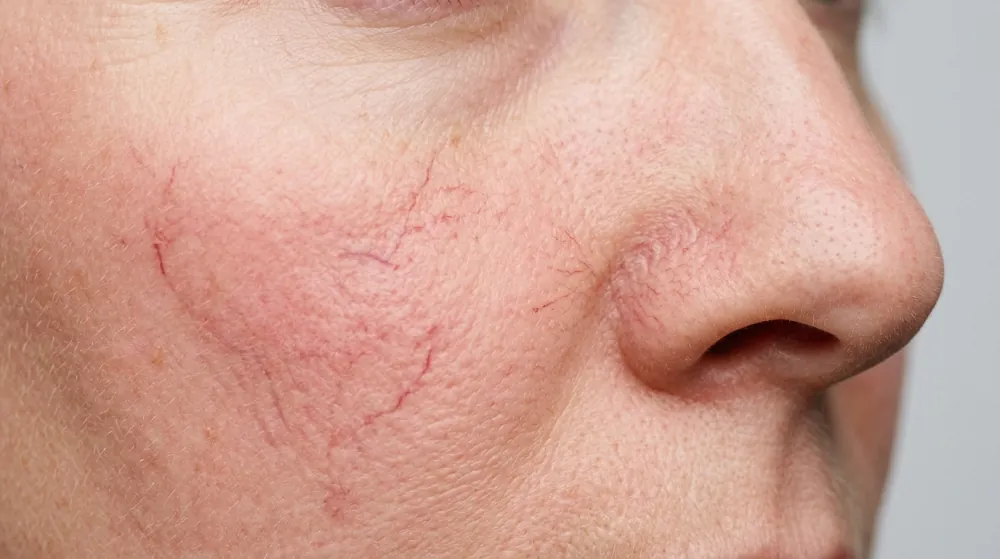
Broken capillaries on the face are not broken in the usual sense. DermNet defines telangiectasia as visible small, linear red blood vessels, and gives "broken capillaries" only as a common name. The vitamin K cream marketed for them has two small trials behind it, and both measured bruising after laser treatment, not the vessels.
This article on broken capillaries on the face covers what they are, the causes that turn up on the list, where they cluster, what creams can and cannot reach, the vitamin K claim, and what vascular laser and intense pulsed light (IPL) studies report. It describes and evaluates. It does not tell you what a particular vessel or patch of skin redness is, and a procedure belongs with your own clinician.
Not Broken, Dilated
What the Term Means
DermNet describes telangiectasia as visible small linear red blood vessels, also called telangiectases, and lists "broken capillaries" as an alternative name. Blue ones are called spider veins by the same page and given a different name, venulectasia, because venules are involved. It separates both from large red arteries, large blue veins and blood vessel tumours such as angiomas.
The word "broken" suggests a rupture. None of the sources opened for this article uses the word dilated for these vessels in so many words. A review of light-based devices describes treatment as reducing the diameter of blood vessels, which fits vessels that are wider than usual and visible through the skin, not vessels that have burst. That reading is the article's own, based on those descriptions.
What They Are Not
DermNet states that telangiectases are generally harmless, and that treatment may be sought because of bleeding or unsightly appearance. Bleeding is mentioned, so they are not always inert. The same page cautions that they need to be distinguished from other vascular conditions, which is a reason for a clinician to look rather than for a reader to self-diagnose.
Skin redness is a related but broader complaint. A flush that comes and goes, persistent redness and visible vessels are different features, and the evidence on what helps differs by feature, as the sections below show.
Rosacea, Sun or Genes
DermNet's classification gives three broad routes, and the list is long enough that a single vessel cannot be traced to one cause by looking.
Inherited. Several inherited conditions are listed, and DermNet adds that telangiectasia may be a normal feature of facial skin in some families.
Acquired. The acquired list begins with rosacea and sun-damaged and aged skin, especially in those who smoke. It also includes pregnancy, liver disease (particularly with alcohol or viral infection), Cushing syndrome, several connective tissue diseases, scarring and radiation damage, and some skin tumours, including basal cell carcinoma and sebaceous hyperplasia.
Medication. Vasodilators, especially calcium channel blockers (mainly at sun-exposed sites), and long-term systemic or topical corticosteroids are listed. For facial steroids, our article on acne treatment that made redness worse covers how steroid-related vessels and redness arise.
Rosacea is the cause most often discussed for the face. A review of rosacea describes it as a chronic inflammatory disease mainly affecting the cheeks, nose, chin and forehead, with flushing, persistent redness, bumps and telangiectasia among its features. It links rosacea flushing to nerve-mediated responses to temperature change, exercise, UV, spicy food and alcohol. Our article on rosacea, perioral dermatitis and acne covers how it is told apart from the other two.
The breadth of the list is the point. New, widespread or sudden vessels, or vessels with other symptoms, are a question for a clinician who can examine and test.
Where They Cluster and Why
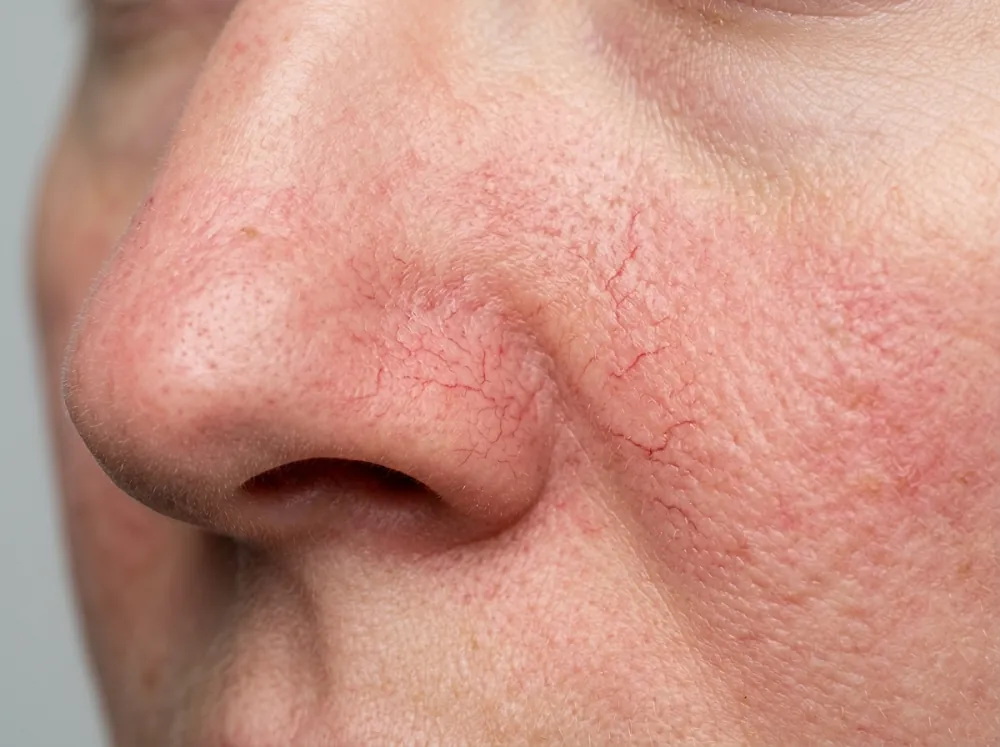
The sources describe the pattern, not a mechanism. In rosacea the usual sites are the cheeks, nose, chin and forehead. DermNet lists sun-exposed sites as where calcium channel blocker vessels appear, and lists poikiloderma of Civatte, a sun-damage pattern, on the sides of the neck.
A reason for the nose and cheeks follows from those descriptions, but it is reasoning here: these areas stand out from the face and take the most sunlight, and UV is both a rosacea trigger in the review and a cause of damaged skin in DermNet's list. Our article on sunscreen by skin type covers how much sunscreen is actually applied, which bears on this.
The light-device review notes that long-pulsed Nd:YAG and pulsed dye laser are both effective in rosacea-associated nasal telangiectasia but should be used carefully to avoid side effects. It also describes a small study in which conspicuous vessels on the nose were hard to clear.
What Topicals Cannot Reach
A systematic review of rosacea interventions graded the evidence by feature. For persistent redness there was high-certainty evidence for topical brimonidine and moderate certainty for topical oxymetazoline. For bumps and pustules there was high-certainty evidence for topical azelaic acid and ivermectin, and our article on azelaic acid covers the rosacea findings. For skin redness with visible vessels, the review found low-to-moderate-certainty evidence for laser and IPL, and no topical in that list.
The oxymetazoline data show what a topical does. In two trials, two-grade improvement in self-assessed redness at 3 hours occurred in 99 of 446 people on oxymetazoline 1% cream against 59 of 439 on vehicle. Rebound redness over the 29-day follow-up was reported in six patients on oxymetazoline and two on vehicle. The trials measured redness at 3 hours, so they show a short-term effect on skin redness and say nothing about vessel structure.
DermNet's list of treatments for facial red veins is electrosurgery, IPL, vascular laser and sclerotherapy. It names no cream. The reasoning is that a permanently visible vessel would need to be closed or shrunk, and no source opened reports a cream that does that. A network meta-analysis of laser trials found one place where a topical mattered: oxymetazoline combined with pulsed dye laser appeared better for telangiectasia than the laser alone (mean difference −0.58, 95% CI −1.03 to −0.14). That is a topical added to a laser session, not a cream working alone.
The Figure Audited: "Vitamin K Cream Fades Broken Capillaries"
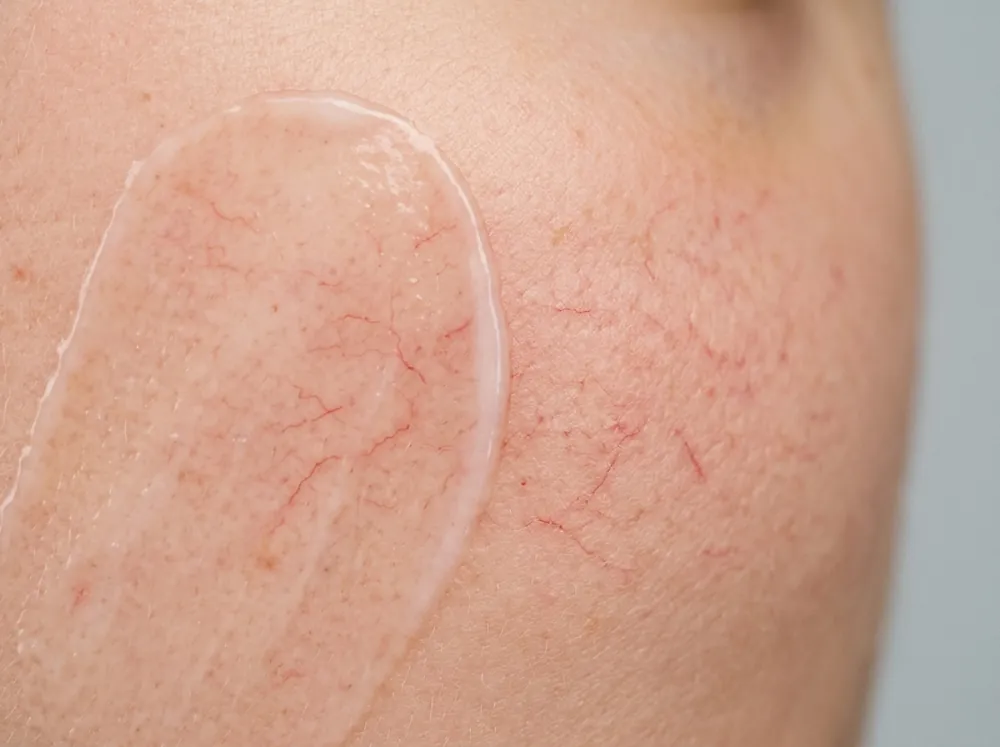
The claim circulates in marketing for creams aimed at spider veins and broken capillaries. No individual product was examined here. What follows traces the research the claim appears to rest on, and that link is an inference.
What the Vitamin K Trials Measured
Two controlled trials involved vitamin K and people with facial telangiectasia. Both used the telangiectasia as the reason for a laser session, and both measured the bruise the laser leaves.
A 2002 trial enrolled 22 patients and compared vitamin K cream with vehicle on opposite halves of the face for two weeks before or after treatment of facial telangiectases with a 585-nm pulsed dye laser (abstract). Bruising was rated by patients and physicians on a visual scale. Vitamin K before the laser made no significant difference, and vitamin K after the laser lowered the bruising scores, especially in the first days.
A 2009 trial randomised 20 people with bilateral facial telangiectasia to a vitamin K oxide gel on one side and vehicle on the other for about nine days after a pulsed dye laser set to cause purpura (abstract). Investigators rated photographs. Differences did not reach statistical significance over the study, though there was a trend to faster clearing of purpura with the gel. No adverse effects were seen. Funding is not stated in either abstract.
What They Did Not Measure
Neither trial measured the vessels. The outcome in both was purpura, which is blood in the skin after the laser injures a vessel wall. The question the trials asked was whether a cream speeds the clearing of that bruise after the treatment, not whether it fades the capillary that was treated.
We found no trial of a topical vitamin K measuring clearance of facial telangiectasia in our PubMed searches, which were not exhaustive. Where the claim began is not stated in any source opened. The reasoning is that trials that pair "vitamin K" with "telangiectasia" in a title or abstract are easy to read as a vitamin K effect on vessels.
Verdict: the claim is not supported as stated. The evidence is two small trials (22 and 20 people), tested for bruising after laser, one significant for the post-treatment timing and the other not significant. They are not evidence that the cream fades a vessel.
What Vascular Lasers Do (Reported)
This section reports what studies describe. It is not a guide to treatment, and settings, pass counts and aftercare are outside the article.
The mechanism, as the light-device review describes it, is that vascular lasers emit a wavelength absorbed by oxyhemoglobin, converted to heat that damages the vessel wall and coagulates it. Pulsed dye laser is the best studied. IPL is a broad-spectrum light source that is filtered to target the vessel. The same review concludes that facial erythema and telangiectasia in general respond poorly to treatment, that PDL and IPL are both effective for erythema, and that there are not many large randomised trials.
The evidence quality is modest. The systematic review of rosacea interventions found only a few small randomised trials of 16 to 49 patients. The network meta-analysis included 25 randomised trials, most of them at unclear or high risk of bias, found radiofrequency microneedling better than pulsed dye laser for satisfaction and erythema, and noted that two of its authors had received lecture fees from a laser manufacturer. Reports in the light-device review include a 140-patient IPL series with excellent results in 67.1%, a 30-patient narrow-band IPL series where 30% had recurrence at 6 months, and a trial in late-stage rosacea where 2-year recurrence was 8.41% with IPL against 48.33% in the comparison group. These are individual reports, not pooled estimates.
Side effects are part of the picture. The review lists purpura and post-inflammatory hyperpigmentation with pulsed dye laser, and blisters, dyspigmentation and scarring with IPL, with permanent hypopigmentation possible. It states that skin colour and ethnicity matter for choosing a device. Vascular laser and IPL are clinician-delivered procedures, and which one suits a given vessel, on a given skin type, is for the clinician to assess. The wider rosacea picture, including how it is diagnosed and what a visit involves, is in seeing a dermatologist for rosacea.
Conclusion
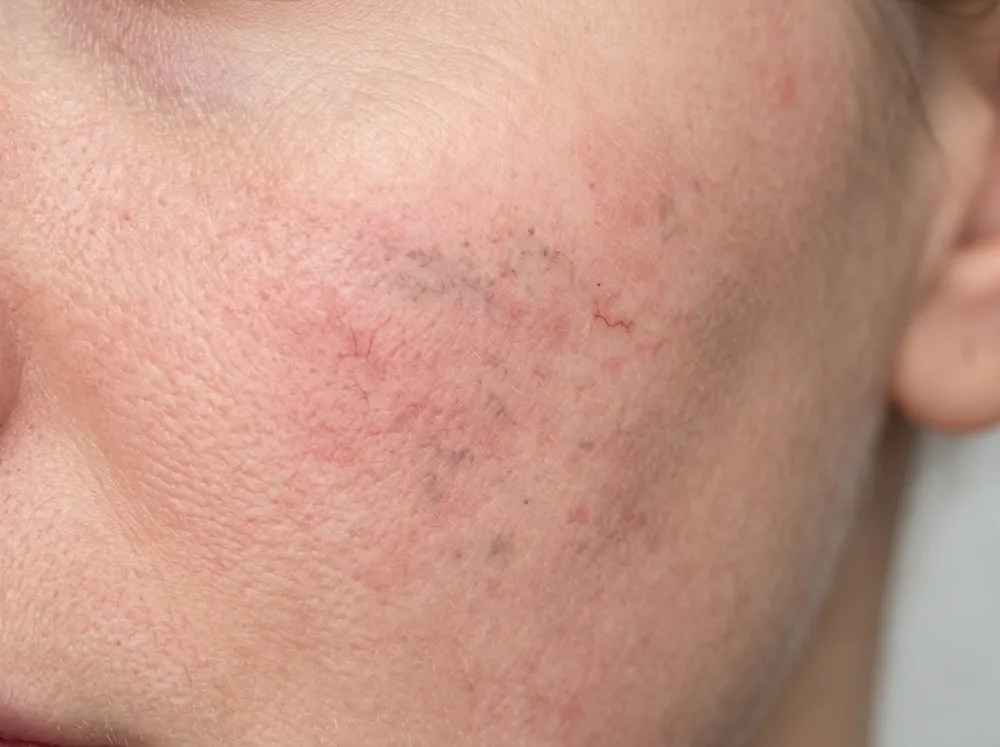
Broken capillaries on the face are visible small vessels, which the sources describe as vessels and not as tears, with a long list of causes that includes rosacea, sun damage, genetics, medication and some illnesses. The pattern follows sun-exposed and central areas, though the sources describe the pattern more than the mechanism.
For skin redness, creams act over hours at best. The vitamin K trials measured bruising after laser, and no source opened reports a cream that closes a vessel. Vascular laser and IPL are the options the evidence addresses, with modest-quality trials, side effects and recurrence reported, and a clinician is the person to decide whether any of it applies.
Photographing the area in the same place, distance and light, whether in a dated album or in an app like Skinic, shows whether the redness or the vessels are changing and gives a clinician something to look at. It cannot say what a vessel is. For that, and for any procedure, ask your own clinician.
Frequently asked questions
5 questions · tap one to open the answer
What are broken capillaries on the face?
Does vitamin K cream get rid of broken capillaries?
What causes broken capillaries on the face?
Can any cream reduce skin redness or visible vessels?
Do lasers and IPL remove broken capillaries?
Medically reviewed by
Dr. M.M Hanaei
Aesthetic Physician, Dermatology Fellowship
- MD — Shahid Beheshti University of Medical Sciences (SBMU)
- MCC Licensure (Medical Council of Canada)
- Dermatology Fellowship, Switzerland
- Certified in advanced aesthetic procedures
Last reviewed 10 October 2026