Skinic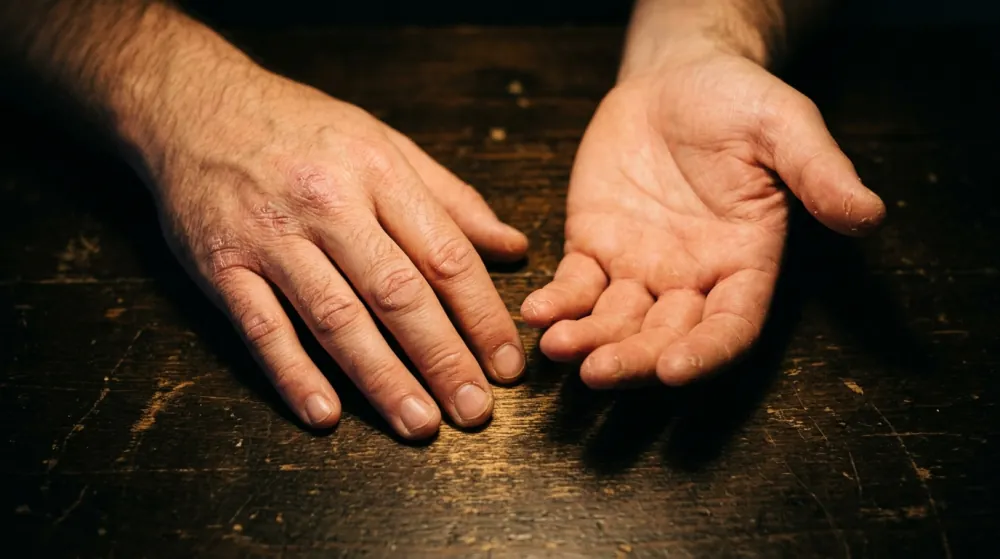
Eczema on hands is usually more than one thing at once. DermNet describes it as often resulting from a combination of constitutional factors, injury from irritants and immune reactions, which is why advice that blames a single cause tends to fail. A meta-analysis of healthcare workers pooled a one-year prevalence of 27.4% for self-reported hand eczema.
This article is about recognising hand eczema, understanding why hands behave differently from faces, and checking one claim: that hand washing causes it. It does not tell you what to put on your hands. Treatment depends on the type, and choosing it is a clinician's job.
Three Causes, Usually Overlapping
A 2024 Lancet review says chronic hand eczema is commonly classified by its suspected main cause into irritant, allergic and atopic. The major risk factors it names are current or past atopic dermatitis and excessive or prolonged exposure to irritants or allergens. It also says that in up to two-thirds of people the condition becomes chronic.
The review reports itch, pain and a burning sensation as typical, and says appearance and severity change over time. The first author declares research grants and consulting fees from several pharmaceutical companies, which is common for a clinical review of a condition with newly approved drugs.
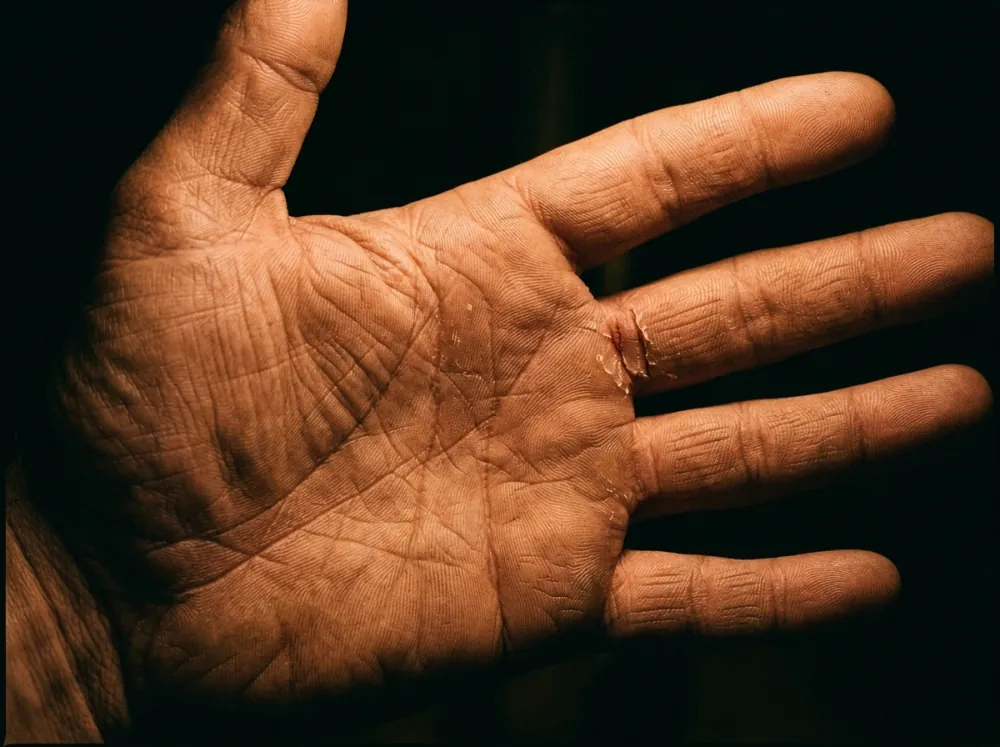
DermNet's description of how it looks is the practical one. Acute hand dermatitis brings red bumps and patches, swelling, blistering, weeping, crusting and fissuring. Chronic hand dermatitis brings dryness, scale and thickened skin. Either can affect the backs of the hands, the palms, or both.
Irritant, Allergic, Atopic: What Separates Them
DermNet notes that the cause of eczema on hands can be complicated to pin down, because it may be multifactorial. These are the patterns it describes, and they are what a clinician looks for rather than a way to diagnose yourself.
| Type | What drives it | Where it tends to appear | Clues |
|---|---|---|---|
| Irritant (irritant contact dermatitis) | Repeated exposure to water, soaps, detergents and other low-grade irritants, or a single injury from a strong one | Finger webs first, then fingers, backs of the hands and wrists. Often spares the palms | Builds up over time with wet work |
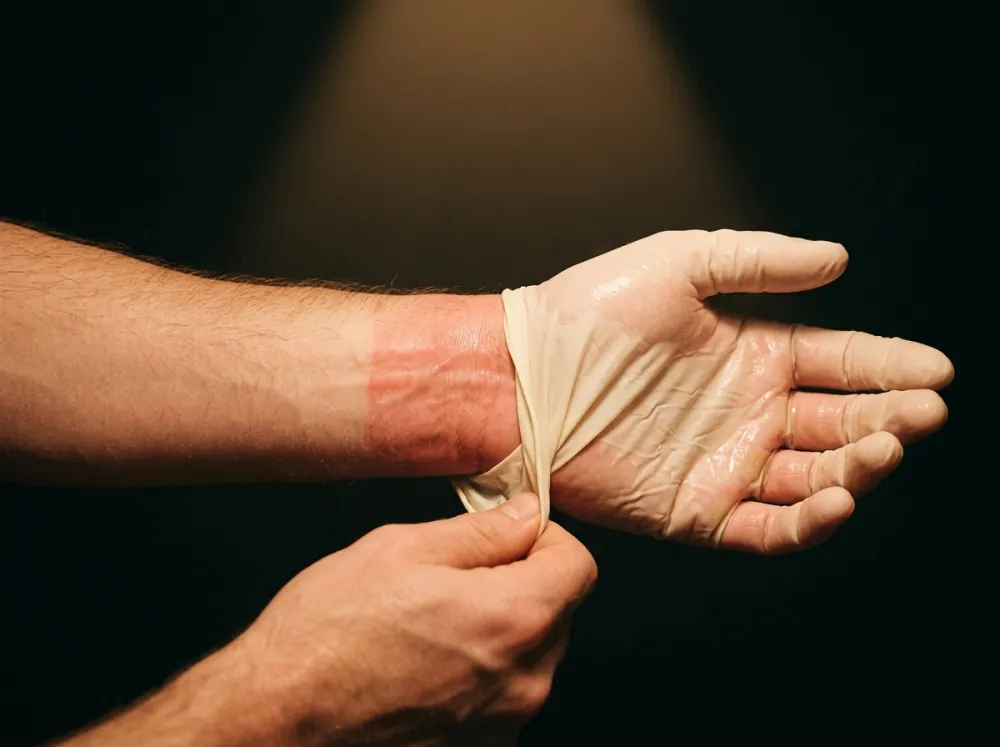
| Allergic | A delayed immune reaction to a specific allergen | Irregular, often asymmetrical | Flares tied to certain tasks or places hours to days earlier. A sharp border, for example at a glove cuff |
| Atopic | A defective skin barrier, with irritants as triggers | Backs of the hands and around the wrists | Signs of atopic dermatitis elsewhere, such as the skin creases |
DermNet lists common hand allergens as nickel, fragrances, rubber accelerators and chromate in gloves, and p-phenylenediamine in permanent hair dye. It says there are about 30 common allergens and innumerable rare ones.
Patterns That Look Different
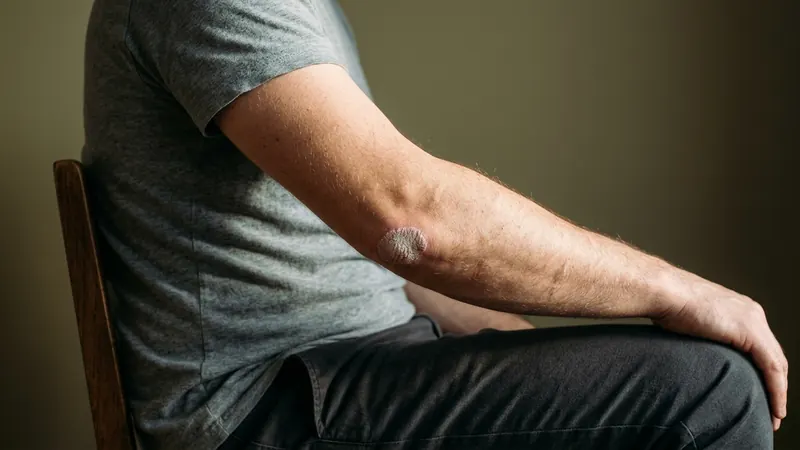
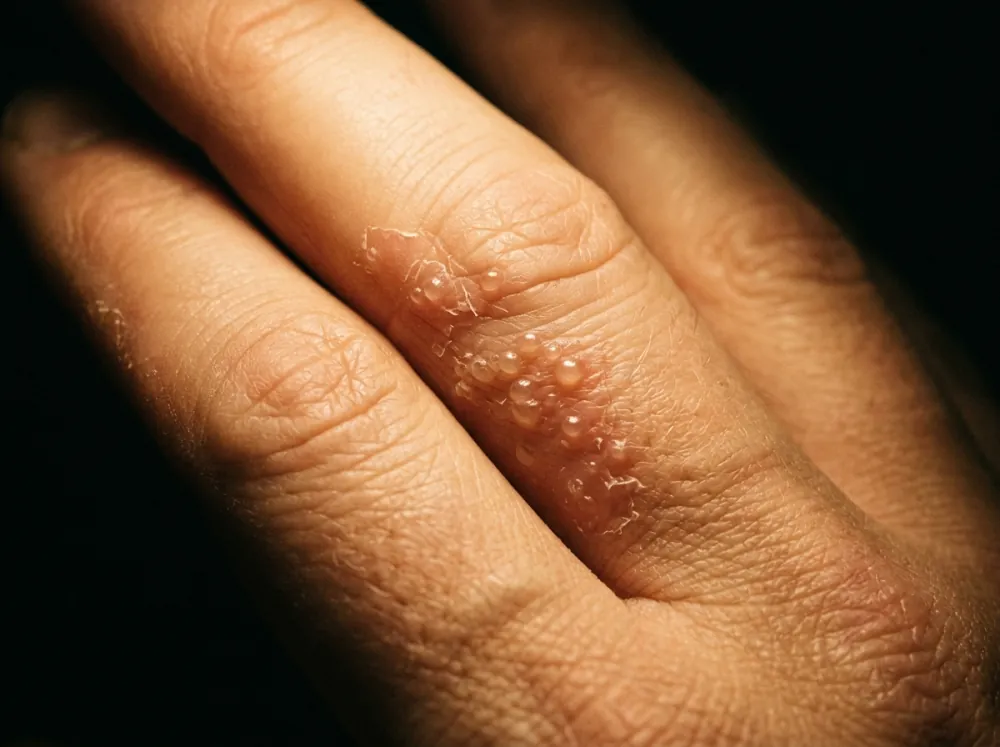
Some forms are named by what they look like. DermNet describes vesicular hand dermatitis, also called pompholyx, as crops of intensely itchy, skin-coloured blisters on the palms and the sides of the fingers, likely made worse by sweating. Hyperkeratotic palmar dermatitis is a chronic, dry, thickened palm that can resemble palmar psoriasis but is less red and less sharply bordered. Fingertip dermatitis can affect one finger or several.
Things That Look Like It
DermNet lists three mimics. Contact urticaria, for example to latex gloves, brings redness, itching and swelling that resolves within an hour. Psoriasis is symmetrical, well-circumscribed, red and scaly. Tinea manuum, a fungal infection, tends to be one-sided or asymmetrical with scale at the edge. Our piece on eczema versus psoriasis covers how those two differ in general.
Why Hands Are Different
Hand skin has a different structure from facial skin. DermNet's account of epidermal structure notes that the palms have a particularly thick epidermis, and its table of skin structures lists hair follicles and their associated structures as absent from the palms and soles. It also says sebaceous glands mostly open into hair follicles. My inference from those two statements is that palms have no oil-gland lubrication of the kind the face has, and that is reasoning, not something DermNet says directly.
The bigger difference is exposure. DermNet lists the irritants that reach hands as water, detergents, solvents, acids, alkalis, cold, heat, friction and drying dusts. They damage the outer stratum corneum, remove lipids and disturb the barrier, and the resulting water loss and inflammation impair it further. Our article on the skin barrier explains that lipid layer and why damage to it compounds.
The 24-to-72-Hour Clock
Timing is one of the few clues that separates the types. DermNet says allergic contact dermatitis is a delayed hypersensitivity reaction that typically appears 24 to 72 hours after exposure and usually resolves over several days once the allergen is removed. Our article on purging versus breaking out explains the same clock for face products and why you can react to something you have used for years.
The other types run on different clocks, according to the same DermNet page. Irritant dermatitis can appear immediately after a single injury or develop slowly after repeated exposure. Contact urticaria appears within minutes and fades within minutes to hours.
- Within minutes: contact urticaria, such as a reaction to latex.
- Immediately after a strong irritant: acute irritant dermatitis.
- Slowly, with repeated low-grade exposure: cumulative irritant contact dermatitis.
- 24 to 72 hours after contact: allergic contact dermatitis.
A cause that you identify from timing is a hypothesis, not a result. Identifying an allergen is a clinical procedure, covered at the end of this article.
The Figure Audited: "Hand Washing Causes It"
What the Meta-Analysis Found
A 2022 systematic review and meta-analysis pooled 45 cohort, case-control and cross-sectional studies on hand hygiene and hand eczema. Washing hands at least 8 to 10 times a day was associated with a relative risk of 1.51 (95% confidence interval 1.35 to 1.68). Washing at least 15 to 20 times a day had a pooled relative risk of 1.66 (1.51 to 1.83). Use of alcohol-based hand sanitiser was not significantly associated with hand eczema.
The authors declare no conflicts of interest. I read only the abstract, so I cannot tell you how heterogeneous the studies were or how they were weighted.
What a Healthcare Study Added
A Swedish cross-sectional study of 9,051 healthcare workers found a one-year prevalence of self-reported hand eczema of 21%. After adjusting for sex, age, wet work at home, lifestyle and atopic dermatitis, there was a dose-dependent association with the number of soap hand washes at work and with time working in disposable gloves. There was no association with alcoholic disinfectant use, and no association with hand washing outside work.
Thirty per cent of the workers washed with soap more than 20 times a day at work, and 54% wore non-sterile gloves for over two hours. The response rate was 43%, and the outcome was self-reported.
Why the Verdict Is "Associated, Not Proven"
Result: the claim survives in a weaker form. Frequent washing with soap and water is associated with hand eczema, in a dose-dependent way, at a moderate relative risk of about 1.5 to 1.7. That is consistent with DermNet's description of water, soaps and detergents as irritants that damage the barrier.
But "causes" asks for more than the evidence shows. Every study in the meta-analysis was observational, and observational designs show association, not cause. Self-reported outcomes and a 43% response rate leave room for bias in the healthcare study. People with early or atopic-prone skin may also differ in how often they wash, a possibility I cannot rule out from these abstracts. And alcohol rub, which is also hand hygiene, showed no significant association in either source.
The accurate version is that frequent hand washing with soap and water is a risk factor that adds to others, chiefly atopic dermatitis and allergen exposure, as the Lancet review states.
What the Evidence Says About Gloves and Frequency
Gloves are a protection and an exposure at the same time. In the Swedish study, more than two hours a day in disposable gloves was associated with hand eczema in a dose-dependent way. DermNet notes that sweating under gloves aggravates dermatitis and that rubber accelerators are a common allergen.
None of this means gloves or washing should be dropped. It means the type of glove, the time worn and the exposure underneath are all variables, and the right balance for one person depends on their job, their skin and their allergens. That is a decision for a clinician, ideally one who knows the work involved.
When It Needs Patch Testing and a Clinician
Some questions cannot be answered at home. DermNet says people with chronic hand dermatitis may need patch tests to detect contact allergens, and that a biopsy or skin scrapings may be needed to exclude other causes. Identifying an allergen is a clinical procedure, and guessing wrong can mean avoiding the wrong thing for years.
See a clinician when:
- It keeps coming back or does not settle. Chronic cases are common, and the cause may need testing.
- There are pustules, crusting or increasing pain. DermNet lists bacterial infection as a complication.
- It is one-sided, or has scale at the edges. That is the pattern DermNet gives for a fungal infection.
- It affects your nails or spreads to the forearms or feet. DermNet lists both.
- It is tied to your work. Occupational cases may need workplace changes, not only skin care.
Conclusion
Hand eczema is usually a mixture of irritant, allergic and atopic causes, and the pattern, the timing and the person's history help a clinician separate them. Hand skin is thick, has no hair follicles on the palm, and meets more water, soap and friction than any other skin, which is why it behaves differently from facial skin.
On the question of eczema on hands and washing, the claim that hand washing causes it survives only as a risk factor: about a 50% to 66% higher risk with frequent soap-and-water washing in a meta-analysis of observational studies, with no significant link to alcohol rub in either source I read. It adds to atopic dermatitis and allergen exposure, not replacing them.
If your hands keep flaring, blister, crack or look infected, ask a clinician about patch testing before you change what you wash with.
Frequently asked questions
5 questions · tap one to open the answer
Does washing your hands cause hand eczema?
What are the types of hand eczema?
How can you tell irritant from allergic hand eczema?
How long after contact does an allergic reaction on the hands appear?
When should hand eczema be checked by a doctor?
Medically reviewed by
Dr. M.M Hanaei
Aesthetic Physician, Dermatology Fellowship
- MD — Shahid Beheshti University of Medical Sciences (SBMU)
- MCC Licensure (Medical Council of Canada)
- Dermatology Fellowship, Switzerland
- Certified in advanced aesthetic procedures
Last reviewed 8 October 2026