Skinic
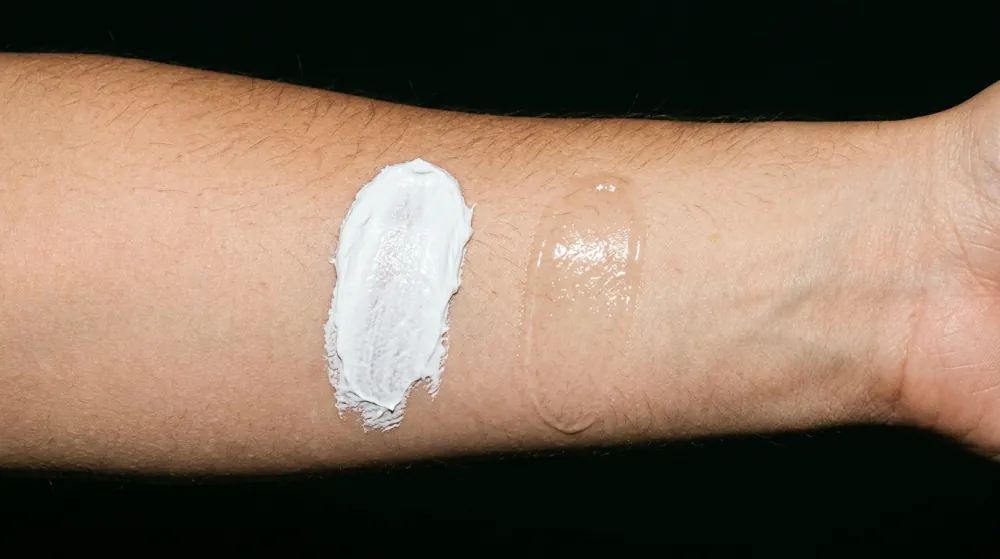
A mineral sunscreen is one whose active ingredients are zinc oxide, titanium dioxide or both. A chemical sunscreen uses carbon-based organic filters instead. The usual way of explaining the difference is that minerals sit on the skin and reflect UV like a mirror, while chemical filters soak in and absorb it. For UV, the optical measurements behind this article say close to the opposite. The differences that are documented lie elsewhere: how broad the UVA coverage is, how stable each filter is in sunlight and water, whether the film looks white, and how each is regulated.
The claim this article tests is that mineral sunscreens reflect UV like a mirror. It covers the reflect-versus-absorb story, what zinc oxide and titanium dioxide do, UVA coverage, stability, cast, and what the label words mean to a regulator. It evaluates claims and names no product. It reports the US regulatory position and does not clear any ingredient for use, and a reaction that is severe, spreading or persistent is a question for your own clinician.
The Reflect vs Absorb Story
A 2024 review of UV filter controversies divides filters into organic (chemical) and inorganic (physical, mineral). It says organic filters absorb UV and release the energy as heat or longer wavelengths, and that physical filters work by reflecting and scattering UVA and UVB. A 2023 trial in swimmers gives the same description as background.
An optical study (abstract) tested that description directly. It used an integrating sphere to measure the transmission and reflectance of titanium dioxide and zinc oxide. Average reflection across the UV range was only 4% to 5%, less than SPF 2, and the remainder of the protection came from absorption of UV photons. The authors concluded that these oxides protect primarily by absorption, not by significant reflection or scattering. Only the abstract was available, so the particle sizes, film thickness and conditions are unknown, and one study is not a consensus.
Where Reflection Does Happen
The same abstract reports that at long UVA and visible wavelengths, above the energy the particles absorb, they are predominantly reflectors, with up to 60% reflection. A 2011 review of nanoparticle sunscreens says UV attenuation involves reflection and scattering of UV and visible light as well as absorption, and that scattering depends on particle size. Read together, the two sources suggest that UV is mostly absorbed and visible light is mostly scattered. That scattered visible light is the white film.
What Zinc and Titanium Actually Do
Both oxides are semiconductors. A semiconductor has an energy gap, and light with at least that much energy lifts an electron across it, which is how the particle absorbs a photon. The 2011 review gives about 3.03 electronvolts for bulk rutile titanium dioxide and about 3.2 for anatase. It describes titanium dioxide as primarily a UVB absorber and zinc oxide as more efficient in UVA, so the two are complementary.
Size Changes the Balance
The older sunscreen particles were micro-sized, roughly 0.1 to 10 micrometres. Nanoparticles are under 100 nanometres. When particles fall below about half the wavelength of visible light, visible light passes through and the film looks transparent, and the review says zinc oxide at 200 nanometres or smaller is virtually transparent.
There is a cost. According to the same review, shrinking the particles raises UVB absorption at the expense of UVA-1 absorption, so the balance between UVA and UVB protection can shift. It reports that studies relating particle size to the required UVA-to-UVB balance are rare and mostly commercial, and suggests that mixing grades of zinc oxide with nanosized titanium dioxide may restore the balance. A film that looks clear and a film that covers UVA-1 are different properties, and the front of a pack reports neither.
UVA Coverage Compared
Each organic filter has an absorption maximum that usually sits within either the UVA or the UVB band, so commercial products combine several to reach broad coverage, according to the 2024 review. A 2023 review of avobenzone says organic filters absorb a narrow band, whereas for inorganic filters the interplay of absorption and scattering gives wide-spectrum protection. Zinc oxide has the broader UVA reach of the two oxides, with the size caveat above.
None of that makes "mineral" a guarantee of UVA coverage. In the US, broad spectrum is a pass/fail test on the finished product with a critical wavelength threshold of 370 nanometres, as FDA's 2011 labelling rule sets out. FDA's question-and-answer page says its 2021 proposed order would require every sunscreen at SPF 15 and above to be broad spectrum, with a new UVA I to UV ratio of 0.7 or higher. Our article on reading a sunscreen label explains what that test does and does not measure. No source read here compared UVA coverage between a mineral formula and a modern organic combination head to head, so neither side can be declared broader.
Stability and Photodegradation
Organic Filters
Stability varies by filter. The avobenzone review says avobenzone absorbs strongly in the UVA, undergoes keto-enol tautomerism, and photodegrades, forming reactive intermediates. It adds that available photostabilisers only partly suppress the radicals produced. The swimmers' trial, by contrast, describes the newer organic filters it used as photostable. "Chemical" is therefore not one stability profile. It depends on the filter and the formula.
Mineral Filters
The 2011 review reports that titanium dioxide and zinc oxide are photoactive. Illuminated particles can form superoxide and hydroxyl radicals, anatase titanium dioxide shows the most activity, and coatings reduce the effect, especially silica-based ones, but cannot completely prevent it. Zinc oxide is less photoreactive but may be unstable during irradiation. The trial lists silicon dioxide, dimethicone and triethoxycaprylylsilane as the coatings on its oxide particles.
The sources disagree here. The 2024 review calls physical filter molecules inert, and so free of photoallergic and phototoxic risk. The 2011 review reports photocatalytic activity that coatings reduce but do not remove, though most of its data come from laboratory systems and not from sunscreen worn on skin. This article reports both and does not resolve them.
Water
The 2024 review says physical filters often resist water less well because they do not bind into the skin. The swimmers' trial points the other way. In 22 swimmers, SPF 30 sunscreens fell after 1.5 hours of swimming from a median of 27 to 12.3 for the inorganic cream, and from 30 to 9.9 for the organic cream, a difference in the fall of P=.02 favouring the inorganic product. The limits are real: one pair of creams from one maker with film-forming polymers, an SPF test that used UVB only, an authors' note that the sample was smaller than planned, and two pools that differed. Both creams lost more than half their SPF.
Cast and Skin Tone
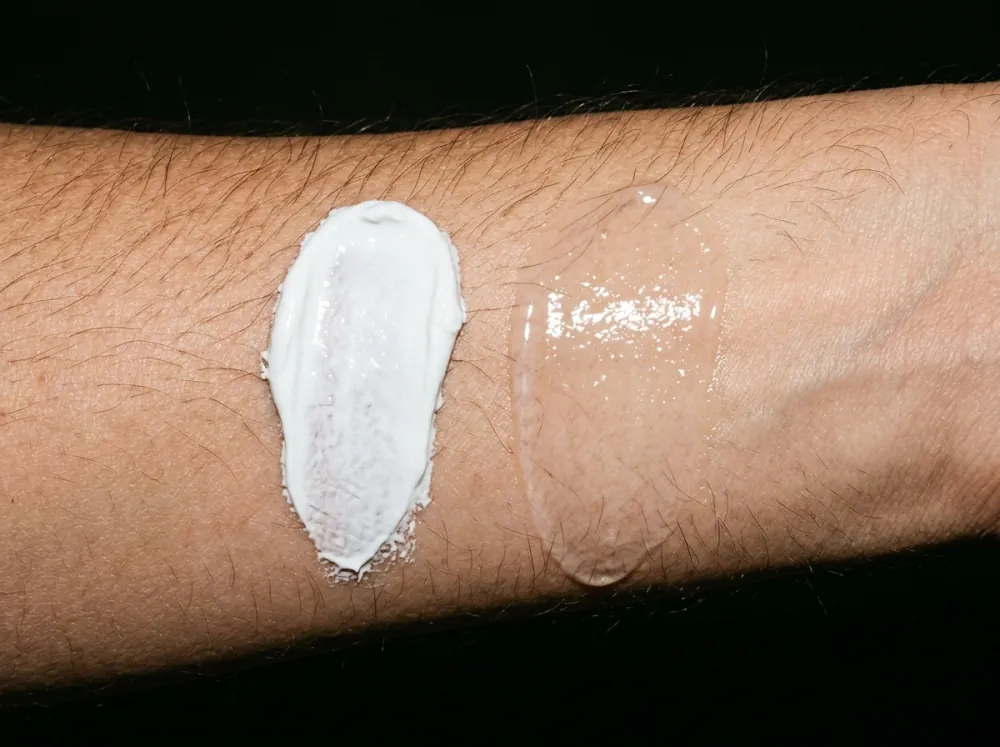
The cast is the scattering described above, so it follows particle size and loading, not the mineral label. Making particles transparent costs UVA-1 coverage in the review's account, and an opaque film costs wearability. Our article on sunscreen without a white cast covers the optics and the routes around it, and the one on sunscreen for hyperpigmentation covers tinted formulas and visible light.

What the Label Words Mean to a Regulator
The 2011 FDA labelling rule defines broad spectrum, SPF and the claims that are allowed, and it calls "sunblock" false or misleading. A search of the rule's text found no definition of "mineral", "physical" or "chemical", and no requirement to state particle size. The sources read do not say otherwise, so these are everyday words, not regulated terms. Whether mineral filters are reef-neutral is covered in reef-safe sunscreen.
The regulated unit is the active ingredient. According to FDA's question-and-answer page, content current to 10 September 2026, a deemed final order under the CARES Act treats sunscreens with 16 active ingredients as GRASE, FDA's category for generally recognized as safe and effective. A 2021 proposed order would keep only zinc oxide and titanium dioxide, at up to 25%, in that category, and would require more data for 12 others, including avobenzone, oxybenzone and octinoxate. FDA says this request is not a finding that those 12 are unsafe. In 2026 FDA finalised the removal of aminobenzoic acid and trolamine salicylate and added bemotrizinol, which our article on the bemotrizinol order covers. This is the US position as reported, and other markets follow their own rules.
The Figure Audited: "Mineral Sunscreens Reflect UV Like a Mirror"
Verdict: mostly false for UV, true for visible light. Findings:
- Measured reflection in the UV is small. The optical study (abstract) found 4% to 5% reflection across the UV, below SPF 2, with absorption supplying the rest.
- Mirror-like behaviour sits at the other end of the spectrum. The same abstract reports up to 60% reflection at long UVA and visible wavelengths, which is the white film.
- Scattering is not zero. The 2011 review says reflection and scattering contribute alongside absorption and depend on particle size. None of the sources quantified the shares in finished products.
- The mirror description is widely repeated. A 2024 review and a 2023 trial both state the reflect-and-scatter mechanism as background, so the statement is easy to find in the literature.
- The limit. The mechanism does not change how a finished sunscreen is rated. SPF and broad spectrum are measured on the product, and no source tested whether the mechanism changes protection in daily use.
How to Judge a Mineral or Chemical Claim
A search for the best mineral sunscreen returns product lists, and the sources give criteria instead. These are questions for a label, not a ranking.

- Read the active ingredients, not the front. Zinc oxide and titanium dioxide only is what "mineral" means in everyday use, and a product listing both kinds of active is a hybrid. That is reasoning, not a sourced finding.
- Look for broad spectrum. It is the finished-product UVA test, and a mineral label does not replace it.
- Treat "invisible" and "nano" as a UVA question. Transparency is a size effect, and the size effect has a UVA-1 cost in the review. The sources do not say what size any product uses.
- Check what coats the particles. Coatings appear in the ingredient list, and they affect photoreactivity in the 2011 review.
- Do not read "sunblock" as a stronger claim. FDA treats it as misleading.
- Weigh sensitivity separately. Whether mineral is gentler is its own question, covered in our article on sunscreen for sensitive skin.
Conclusion
Mineral and chemical sunscreens differ, but not in the way the mirror story says. The oxides mostly absorb UV and scatter visible light, UVA coverage depends on particle size and the full formula, stability and water behaviour vary by filter and vehicle, and the words "mineral" and "chemical" are not regulated terms. The regulated unit is the active ingredient, and the US position is still moving.
For choosing between formulas, writing down the active ingredients, the broad spectrum statement and how the film looks and wears, in an app like Skinic or in a notebook, shows more than the front of the pack. For a reaction that spreads, blisters or persists, ask your own clinician.
Frequently asked questions
5 questions · tap one to open the answer
What is the difference between mineral and chemical sunscreen?
Do mineral sunscreens reflect UV like a mirror?
Does a mineral label guarantee broad spectrum protection?
Are mineral sunscreens more water resistant?
Which mineral sunscreen is best?
Medically reviewed by
Dr. M.M Hanaei
Aesthetic Physician, Dermatology Fellowship
- MD — Shahid Beheshti University of Medical Sciences (SBMU)
- MCC Licensure (Medical Council of Canada)
- Dermatology Fellowship, Switzerland
- Certified in advanced aesthetic procedures
Last reviewed 17 October 2026