Skinic
Red light therapy for the face is in an unusual position. The underlying science is real, published and mechanistically plausible. The consumer product is sold on numbers that mostly come from studies too small and too loosely designed to support them. Both things are true at once, and almost every article about LED masks picks one and ignores the other.
The reason the two can drift so far apart is dose. Photobiomodulation is a dose-dependent effect with a well-documented ceiling — more light past a certain point does less, not more — and the dose depends on numbers most masks do not print on the box.
So this article separates the two questions, goes through what the clinical literature does and does not support, explains why "it has red LEDs" is not a specification, and ends with the small set of questions that actually decide whether a device is worth the money.
Two Different Questions You Are Actually Asking
Does the mechanism work? Does shining red or near-infrared light on skin produce a measurable biological change? This has a research literature going back decades.
Does this device deliver it? Does the specific mask you are looking at emit the right wavelength at the right intensity for long enough to reproduce what those studies did?
These get collapsed into one, and the collapse is where the marketing lives. A brand can cite genuine peer-reviewed research about photobiomodulation without that research having used anything resembling its product.
What the Information Around These Devices Looks Like
It is worth knowing what the information environment around these devices looks like. A cross-sectional study analysed 100 top TikTok posts about LED light therapy masks and scored them on DISCERN, a validated 16-item instrument for consumer health information that runs from 15 to 80.
| Uploader | Share of posts | Mean DISCERN score |
|---|---|---|
| Influencers | 63% | 19.76 |
| Non-physician providers | 14% | 23.61 |
| Other accounts | 15% | 20.43 |
| Physicians | 8% | 25.56 |
Every category scored near the bottom of the scale. The best performers — physicians — reached 25.56 out of 80. And 80.1% of influencer posts were promotional against 6.4% educational, while the physicians' posts ran 62.5% educational.
The authors also record what those posts leave out: contraindications, precautions and clinical evidence are rarely mentioned, alongside reports of eye damage, skin irritation, and cutaneous lupus erythematosus-like reactions with improper use.
What Photobiomodulation Is Supposed to Do
The proposed pathway is specific enough to be testable. Light at particular wavelengths is absorbed by cytochrome c oxidase, an enzyme in the mitochondrial electron transport chain. That absorption is thought to increase production of endogenous energy in the form of ATP, along with downstream effects on reactive oxygen species and nitric oxide signalling, stimulating fibroblasts, keratinocytes and other cell types.
Penetration is wavelength-dependent, and this is the part that makes wavelength claims checkable rather than decorative:
- Blue, 400–470 nm — limited penetration, useful for conditions in the epidermis
- Red, 630–700 nm — reaches the dermis, where fibroblasts are
- Near-infrared, 700–1200 nm — the deepest penetration
Which is why "red light for wrinkles, blue light for acne" is not arbitrary. Collagen is made by dermal fibroblasts, so a rejuvenation claim needs a wavelength that reaches the dermis. Cutibacterium acnes sits in follicles in the epidermis and upper dermis, and it produces porphyrins whose most abundant form peaks in absorption at 415 nm — blue light excites those porphyrins, generating reactive oxygen species that damage the bacteria.
What the Clinical Evidence Supports
Unevenly, and the unevenness is the useful information.
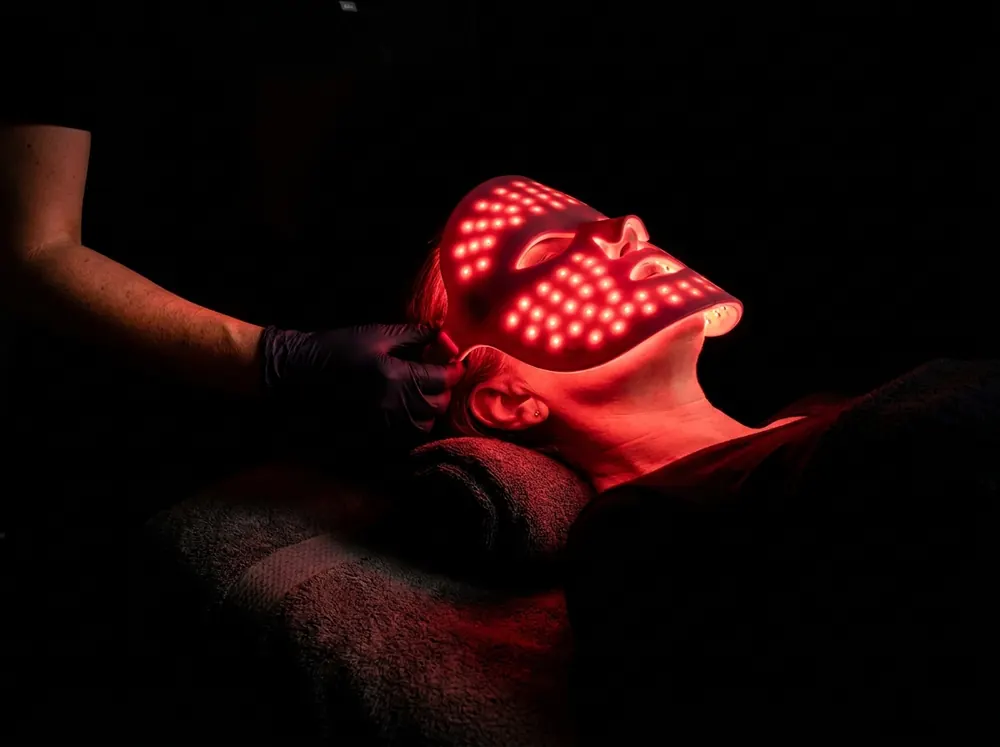
Acne is the strongest case. Blue light at 415 nm has shown a significant, dose-dependent effect, and combining red with blue outperforms either alone — one study reported 78% lesion reduction for a combined protocol against 38% for LED treatment alone. DermNet notes blue–red combination therapy is well tolerated and superior to blue light by itself. For home devices specifically, DermNet cites a trial finding 24.4% improvement in inflammatory lesions and 19.5% in non-inflammatory lesions. Real, modest, and nowhere near what a retinoid or benzoyl peroxide does.
One caveat that gets skipped: blue light works by killing a bacterium. If the thing on your face is not bacterial acne, there is no mechanism for it to help. Rosacea, perioral dermatitis and acne are routinely confused, and only one of the three is what blue light targets.
Rejuvenation is supported but softer. The dermatology review above rates it as an area with multiple supporting studies, including reversal of collagen downregulation. But the same authors state the central problem plainly: published studies often addressed fewer than 20 patients, and are difficult to compare with each other because of diversity in the parameters used. They call for larger, better-controlled work before efficacy can be defined.
Other indications vary. Psoriasis has three double-blind controlled studies, with blue light at 420 nm reducing plaque erythema 33.9% against 26.7% for red at 630 nm. Atopic eczema has one randomised controlled trial. Androgenetic alopecia has an FDA-approved device at 635 nm.
The Trial Everyone Quotes
The most widely circulated consumer-mask numbers come from a study of a specific commercial mask. It is worth looking at properly, because it is a good illustration of how a real result and a weak design coexist.
Twenty healthy volunteers aged 45 to 70 used the mask for 12 minutes, twice a week, for three months. At day 84 the reported outcomes were a 38.3% reduction in crow's feet wrinkles, a 47.7% increase in dermal density and a 70.3% decrease in sebum. Measurements were made with standardised photography and a 20 MHz ultrasound probe — genuinely objective instruments.
Now the rest of it. There was no control group and no randomisation. There was no sham arm and no reported blinding of assessors. The three headline percentages appear without p-values or confidence intervals. The sebum figure comes from only ten of the twenty participants. And in the declarations, one author is the CEO of the company that manufactures the mask, with another listed as a consultant to the same company.
None of that means the numbers are invented. It means a single-arm, unblinded, uncontrolled twenty-person study run with the manufacturer's involvement is the weakest design that can still produce a percentage, and that percentage is now doing a great deal of marketing work.
Compare it with what a properly designed trial of the same question specifies. A randomised, controlled, double-blind protocol for facial photobiomodulation blinds participants with dark goggles, gives the control group a sham mask emitting white light along with recordings of the device's operating sounds, has three blinded plastic surgeons grade the photographs, and measures forehead wrinkles by optical coherence tomography on silicone moulds. That is the standard. Almost nothing in the consumer-facing literature meets it.
Dose Is the Whole Argument
Here is the thing that makes "has red LEDs at 660 nm" an almost meaningless specification.
Photobiomodulation follows a biphasic dose response. Too little light does nothing; the right amount stimulates; too much inhibits. A review by Huang and colleagues documents this across dozens of studies, and the examples are not subtle — in their own traumatic brain injury work, delivering ten times more light by raising irradiance tenfold lost all therapeutic benefit and produced worse performance.
Worse, total dose does not determine the result. The single most clarifying example in that review: a 670 nm laser produced a significant effect at 4 mW/cm² applied for 1,250 seconds — and that effect was lost when the same 5 J/cm² total was delivered at 15 mW/cm² for 333 seconds. Same wavelength. Same total energy. One worked and one did not, because the intensity and the exposure time were different.
An oral mucositis study showed the same thing: benefit at 55 mW/cm², nothing at 155 mW/cm², with identical fluence in both arms.
The Six Numbers That Decide It
So the parameters that actually decide whether a device does anything are:
- Wavelength in nanometres, with tolerance
- Irradiance in mW/cm², measured at the distance the skin actually sits
- Fluence in J/cm², which follows from irradiance times exposure time
- Exposure time per session
- Session frequency and total course length
- Continuous or pulsed, and pulse frequency if pulsed
A review of light parameters in photobiomodulation is blunt about what happens when these go unreported: inconsistency in reporting them is a major source of contradictory research findings and has done much to hinder acceptance of the effect. Of the articles that review excluded, 43 were dropped because fluence was not mentioned and 29 because power or fluence rate was not.
The same review gives working ranges. Reciprocity — the assumption that doubling intensity and halving time gives the same result — appears to hold roughly between 1 and 100 J/cm² at 1 to 100 mW/cm², and stops applying outside it. For superficial targets like skin, doses tend to be around 4 J/cm², with a range of 1 to 10. The photothermal ceiling at 600–700 nm is about 300 mW/cm².
Two Masks, Three Times the Intensity
Two published masks make the spread concrete. The commercial mask above ran at 21.7 mW/cm² and 15.6 J/cm² over 12 minutes. The mask in the Brazilian trial protocol ran at 6.4 mW/cm² and 8.02 J/cm² over 21 minutes. Both are LED face masks emitting red light around 630–660 nm. Their irradiances differ by a factor of more than three, and both sit at or above the top of the 1–10 J/cm² range typically used for skin.
Neither of those is obviously wrong. The point is that they are not the same treatment, and nothing on either box would tell you that.
What to Ask Before Buying a Device
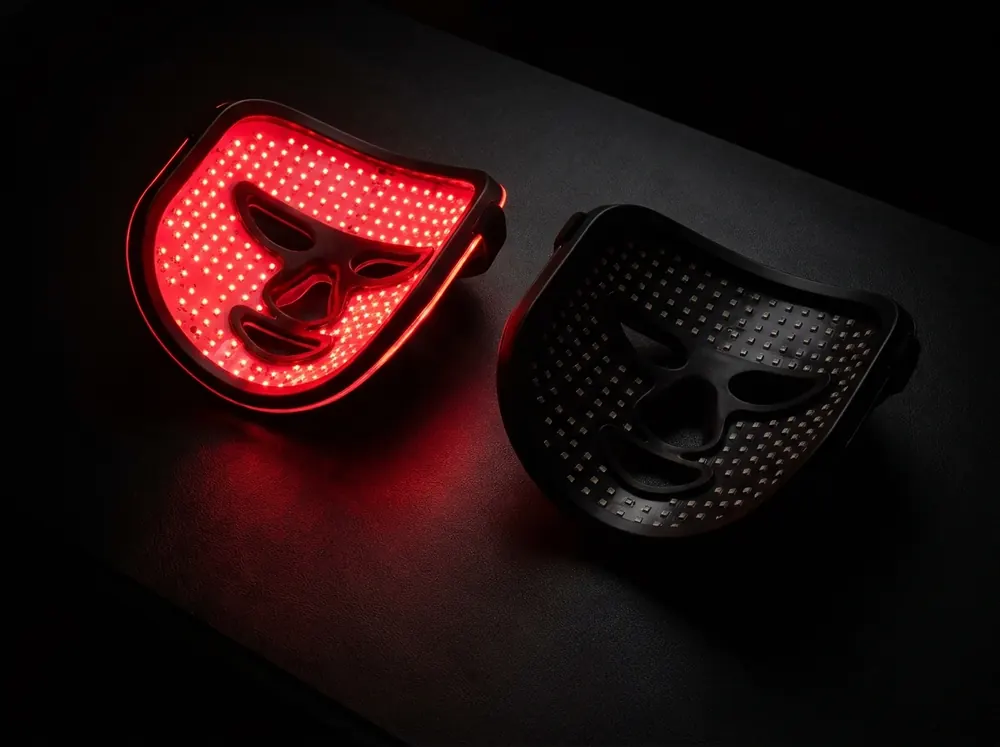
A short, specific list. Every item is answerable, and a brand that cannot answer it has told you something.
- What is the irradiance in mW/cm², and at what distance was it measured? This is the single most important number and the one most often absent. Output measured at the diode is not output at your skin.
- What wavelengths, with what tolerance? "Red light" is not a wavelength. The Brazilian protocol specifies 660 nm ±10 nm. That is what a specification looks like.
- What fluence per session, over what exposure time? These must be consistent with each other and with the irradiance. If quoted numbers do not multiply out, the numbers are decorative.
- Does the cited research use this device, or photobiomodulation in general? Studies of a clinical panel at a fixed distance under supervision do not transfer to a flexible mask sitting on your face.
- Who funded and who authored the cited study? Manufacturer involvement is not disqualifying, but it belongs in your reading of the result. It is disclosed in the paper, not in the advertisement.
- What is the eye protection, and what are the contraindications? Eye damage and lupus-like reactions appear in the literature. A device sold with neither warning nor eyewear is cutting a corner you can see.
The general principle carries over from what "medical grade" skincare actually means: the category name on the box is marketing, and what matters is the measurable specification underneath it.
What It Will Not Do
Setting expectations against the evidence rather than the advertising.
- It will not resurface scars. Nothing in this literature supports LED light remodelling atrophic acne scarring. That is microneedling and resurfacing territory, with its own mixed evidence.
- It will not replace acne treatment. A home-device trial found 24.4% improvement in inflammatory lesions. That is an adjunct, not a substitute.
- It will not work faster than the studies it borrows from. The consumer-mask study ran twice weekly for three months before reporting anything. The properly controlled protocols run four weeks minimum. There is no two-week version of this.
- It will not be permanent. No study here tested durability after stopping. Every protocol is a continuing course.
- It will not compensate for sun exposure. Photoageing is caused by ultraviolet light, and nothing in a red LED addresses the input.
- It is not the only device with strong claims and thin trials. Face massagers and gua sha show the same pattern.
One more, on safety rather than efficacy. Light-based treatment behaves differently across skin types, and pigmentation risk after any light or heat exposure scales with phototype. If you do not know yours, the Fitzpatrick scale is the starting point. LED phototherapy is non-ablative and non-thermal and is generally well tolerated — but "generally well tolerated" is a statement about averages, and the reported adverse effects include dryness, itch, rash and headaches.
Conclusion
The honest verdict is a split one.
The mechanism is real. Cytochrome c oxidase absorbs red and near-infrared light, ATP production increases, fibroblasts respond. Acne has the strongest clinical support, with blue light acting on a specific bacterial target at a specific absorption peak and combination blue–red outperforming either alone. Rejuvenation has multiple supporting studies and measurable collagen effects.
The evidence is thin where the money is. Rejuvenation studies routinely run under twenty patients. Parameters vary so widely between them that reviewers cannot compare them. The most quoted consumer-mask numbers come from an uncontrolled, unblinded, twenty-person study co-authored by the manufacturer's chief executive. And the effect being measured is dose-dependent in a way that makes the absence of published irradiance figures genuinely disqualifying rather than merely unhelpful.
So the useful question is not "does red light therapy work". It is: does this device state its irradiance at skin distance, its wavelength with a tolerance, and its fluence per session — and do those three numbers agree with each other and sit inside the range the research used?
Most masks do not answer that. A few do. The difference between them is not the price, and it is not on the front of the box.
If the answer to the question is that you like how it feels to sit for twelve minutes with something warm and quiet on your face, that is a real answer and worth what it is worth. It is just not the same answer as the one the research supports.
Frequently asked questions
5 questions · tap one to open the answer
Does red light therapy for the face actually work?
What irradiance should an LED face mask have?
Can an LED mask get rid of acne?
Are at-home LED masks as good as in-clinic treatment?
Are LED face masks safe for your eyes?
Medically reviewed by
Dr. M.M Hanaei
Aesthetic Physician, Dermatology Fellowship
- MD — Shahid Beheshti University of Medical Sciences (SBMU)
- MCC Licensure (Medical Council of Canada)
- Dermatology Fellowship, Switzerland
- Certified in advanced aesthetic procedures
Last reviewed 20 September 2026