Skinic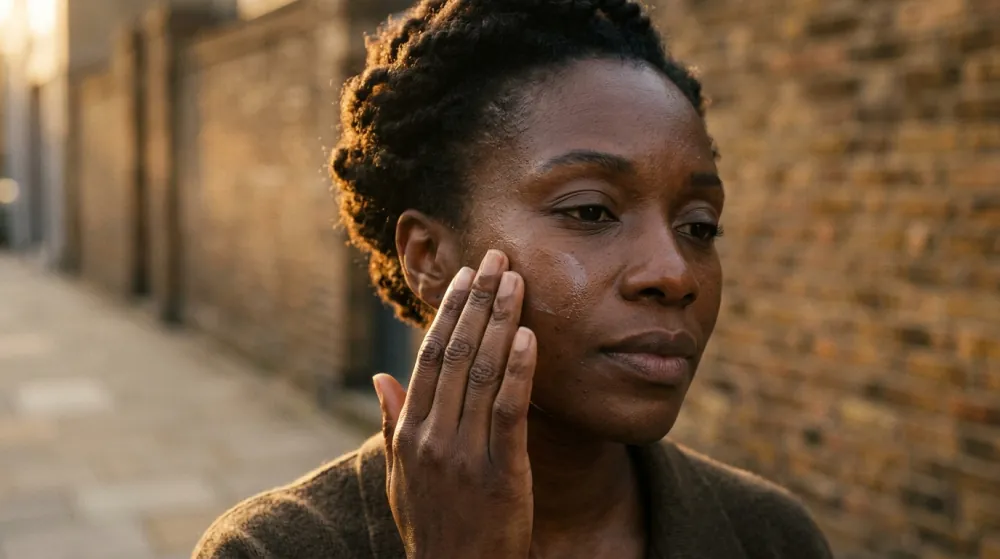
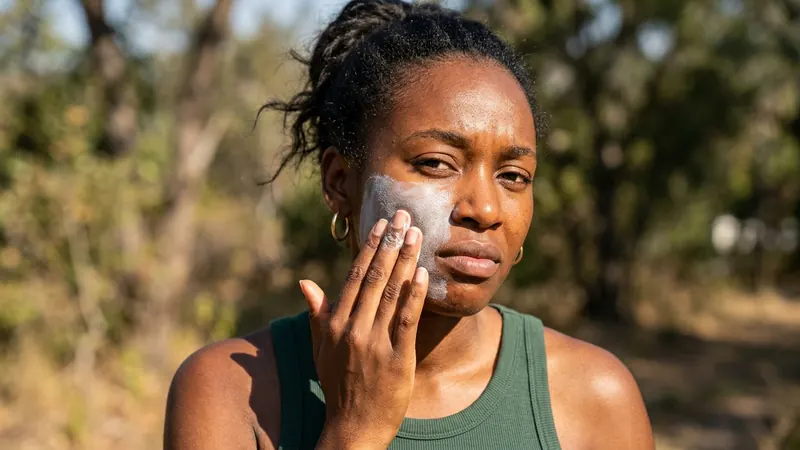
Sunscreen for dark skin is a real need and a partial one, and the sources behind both halves are worth separating. Melanin does filter ultraviolet light: a 1979 comparison of Black and Caucasian skin found about five times as much UV reached the upper dermis of Caucasian skin. But the figure most often quoted, a natural SPF of 13, does not appear in that study's abstract, and three recent reviews that repeat it all point back to that single paper.
The larger daily reason to protect dark skin is pigment, not sunburn. Visible light and long-wave UVA darken skin in phototypes IV to VI for days, and melasma and post-inflammatory hyperpigmentation are common. The relationship between sunscreen and skin cancer in dark skin is described by one 2026 review as unclear, and cancers there are often found late.
This article covers what melanin blocks and what it does not, the natural SPF figure traced to its source, why pigment is the bigger daily risk, where skin cancer shows up in darker skin and when to have a mark looked at, and how to judge a sunscreen you will wear. It describes evidence and guidance. It does not diagnose a mark, and a new or changing one is a question for your own clinician.
The Short Answer
Yes, with reasons that differ from the reasons for lighter skin, which is why the question "do Black people need sunscreen" has a layered answer. Darker skin is less likely to burn, and a review states that epidermal melanin attenuates sunlight and contributes to a lower incidence of skin cancer in skin of colour. The same review says people with skin of colour remain susceptible to the health consequences of sun exposure.
Three of those consequences are covered below: pigmentation that sunscreen can reduce, skin cancers that are less common but found later, and a figure about melanin that is quoted with more precision than its sources give.
What Melanin Blocks and What It Does Not
Melanin acts as a filter, and the 1979 study is the foundation. Researchers compared skin samples from Black and Caucasian people with biological and spectroscopic methods and found that, on average, five times as much UVB and UVA reached the upper dermis of Caucasian skin (abstract). They also found that melanin acts as a neutral density filter, reducing all wavelengths equally, that the main site of filtration is the stratum corneum in Caucasians and the deeper living layers of the epidermis in Black skin, and that the superior protection comes from the packaging and distribution of melanosomes as well as from the amount of melanin.
A 2009 review of skin cancer in people of colour reports a related figure: epidermal melanin filters twice as much UV as the epidermis of Caucasians, and the larger, more melanised melanosomes absorb and scatter more energy. The 5-times and 2-times figures differ, and neither source explains why.
What melanin does not block is the point of the next sections. The 2026 review of visible-light protection reports that visible light, and long-wave UVA together with it, darkens skin in phototypes IV to VI in doses that sunlight can deliver in 15 to 30 minutes. Pigment cells in darker skin respond to that light, so more melanin is not protection from this particular effect.

The Figure Audited: "Dark Skin Has a Natural SPF of 13"
The plan for this article was to present the range and what each figure measured. The range exists, and so does a problem with the best-known number.
What Each Figure Measured
13.4 versus 3.4 or 3.3. A 2023 narrative review states that black epidermis has an estimated SPF of 13.4 against UV-B, whereas white epidermis has an estimated SPF of 3.4, and that Black epidermis reduces UV-B transmission to the dermis by nearly 75% and UV-A by nearly 70% compared with White epidermis. A 2025 review gives 13.4 for dark epidermis against 3.3 for light. A 2026 review repeats 13.4 and 3.4. All three cite the 1979 study.
What that study's abstract says. The abstract reports the five-fold difference in UV reaching the upper dermis, as above. It does not contain the numbers 13.4, 3.4 or 3.3, or the words sun protection factor. The numbers may appear in the full 1979 paper, which could not be opened, so the claim here is narrower: three reviews attribute the figure to it, and the abstract does not state it.
What it is. The number describes the epidermis, a layer of skin, not a product, and the 2023 review specifies UV-B. A sunscreen SPF is a ratio of the dose that causes redness with and without a product, tested at 2 mg/cm². The two are different kinds of figure. As arithmetic, 13.4 corresponds to roughly 7% of UVB passing through, and 3.4 to about 29%, which is a ratio near four. That agrees roughly with the 75% reduction, and sits between the 2-times and 5-times figures above.
A mismatch in labels. The 1979 study compared Black and Caucasian skin. The 2025 review's abstract assigns the figures to Fitzpatrick types IV to VI and I to III. Type and race are not the same classification, a point our article on Fitzpatrick skin types makes.
A lower figure for tans. Our article on tanning with sunscreen reports an estimate of 1.5 to 2.0, possibly reaching 4, for the protection of a tan on lighter skin, and treats it as a different quantity from the constitutive figure. That figure comes from a source whose body text could not be opened for this article, so it is not re-verified here.
What the Figure Does Not Mean
Verdict: the figure is an estimate of what the epidermis does to UVB, restated by reviews from one 1979 paper. It is not a sunscreen SPF, it is one estimate and not a measured range, and it is not a guarantee for any person. It does not describe visible light, which the sources say pigments darker skin. It does not say whether sunscreen reduces skin cancer, and the 2026 review says that relationship is unclear. And a single mean figure for a diverse group hides variation: the reviews use Black, dark, skin of colour and phototypes IV to VI as if they were the same group.
Pigment Is the Bigger Daily Risk
Visible Light and Long-Wave UVA
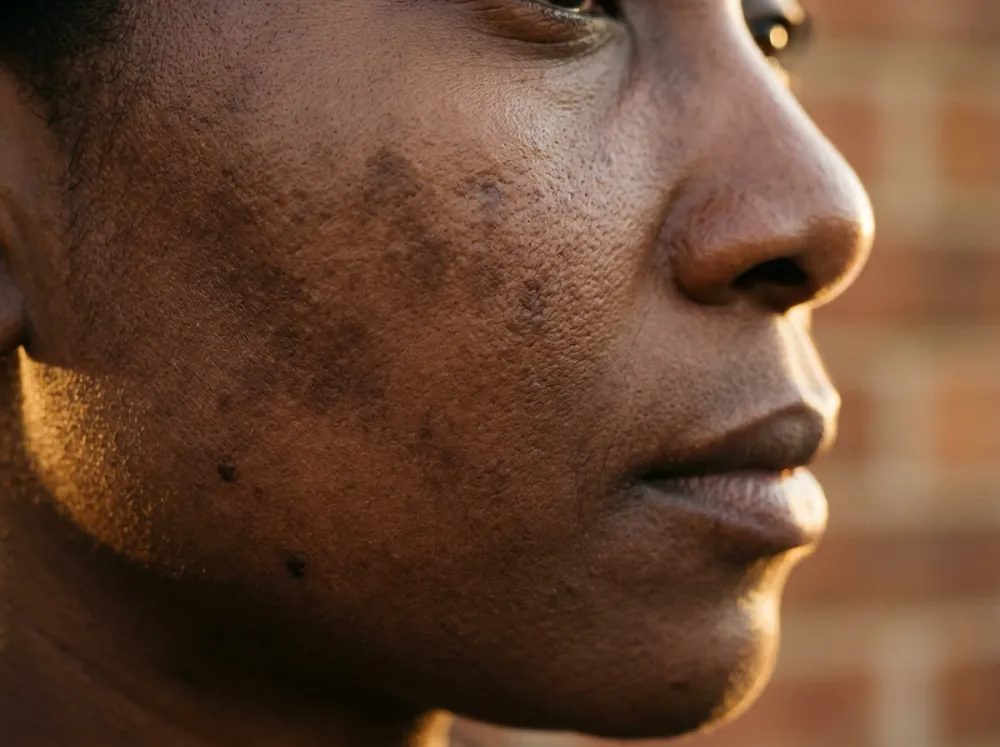
The 2026 review states that blue light is the most potent inducer of pigmentation at fluences of 40 to 80 J/cm², that such doses can be reached in 15 to 30 minutes of sunlight, and that visible-light pigmentation lasts 10 to 22 days and increases with repeated exposure. The 2023 review adds that one study found visible light induced more pronounced and persistent pigmentation than long-wave UVA in skin of colour, with no change in light skin. Our article on sunscreen for hyperpigmentation covers the evidence and why only tinted sunscreens block visible light.
Melasma and Post-Inflammatory Marks
A 2026 literature review states that post-inflammatory hyperpigmentation affects about 15% of people with skin of colour, and that melasma, whose prevalence varies by region, affects between 30% and 50% of women with skin of colour. It adds that post-inflammatory marks can be residual effects of prolonged UVA exposure. Our article on hyperpigmentation in brown and deep skin tones covers how treatments differ for deeper skin.
Skin Cancer in Darker Skin (Recognition)
Where It Shows Up
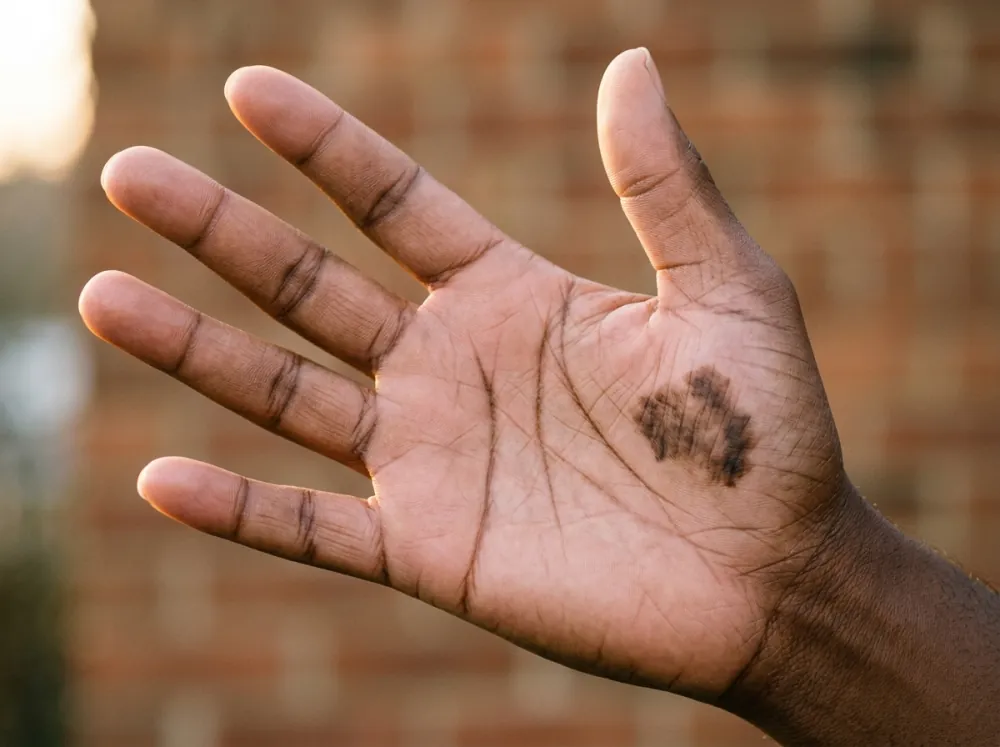
Skin cancer is less common in darker skin, but the pattern differs. A 2009 review reports that skin cancer represents about 35 to 45% of all neoplasms in Caucasians and 1 to 2% in Blacks. The 2026 review states that both melanoma and non-melanoma skin cancers are frequently detected in non-sun-exposed areas. Melanoma can appear as acral lentiginous melanoma on the palms and soles, as subungual melanoma under the nail, or as mucosal melanoma. Squamous cell carcinoma is the most common skin cancer in skin of colour and commonly arises in areas of chronic scarring and inflammation, and basal cell carcinoma in these groups is often pigmented or scar-like, so it is easily mistaken for a mole or a benign growth.
The same review states that UV is not a major risk factor for melanoma and squamous cell carcinoma in skin of colour, that it remains a major risk factor for basal cell carcinoma, and that acral, subungual and mucosal melanomas are driven largely by other factors. For these sites, UV-directed protection is unlikely to reduce risk much, and the review calls for education on recognising lesions in sun-protected and acral locations.
Why It Is Found Later
The 2009 review cites Florida data in which late-stage melanoma was more common in Black patients (52%) than in Caucasian patients (16%). A 2021 registry analysis from one US county gives a hint at why outcomes differ. Melanoma-specific death was higher in non-Hispanic Black patients, but after adjusting for stage, age and sex there was no increased risk (hazard ratio 1.00, 95% confidence interval 0.64 to 1.56), and the authors conclude the higher mortality is likely a consequence of late-stage diagnosis. It is one county and a small sample, and the interval is wide, so it is suggestive rather than settled. The 2026 review lists contributors: socioeconomic barriers, more aggressive subtypes, lower screening rates and less skin cancer education.
A new mark, or one that changes, in these sites is worth showing to a clinician: a dark streak or spot under or around a nail, a mark on a palm or sole, a sore that does not heal, or a scar that changes. This is a description of where the evidence says cancers are found, not a checklist for self-diagnosis.
A Sunscreen You Will Wear
The practical question is which dark skin sunscreen is worth wearing daily, and the sources address it as guidance and as barriers.
What Guidance Reports
Two reviews, from 2025 and 2026, report guidance for skin of colour of a sunscreen with SPF 30 or higher and an SPF to UVA-PF ratio below 1.5, against SPF 50 or higher and a ratio below 3 for lighter phototypes. Both cite other papers for it, which were not opened. A ratio below 1.5 is stricter than the European standard of 3 that our article on bemotrizinol sunscreen compares.
Barriers
Sunscreen for dark skin faces barriers that the 2026 review quantifies. It reports that daily sunscreen use in skin of colour populations was 25% against 31% among non-Hispanic Whites, that reapplication was 45% against 76%, that cost concerns were cited by 16% of people with skin of colour against 2% of Whites, and that white cast concerns affected 25% against 7%. The product problems are formulation problems, a point our article on sunscreen without the white cast covers. Evaluating a claim is simple: a visible tint is the sign of a visible-light blocker, and "no white cast" on its own says nothing about protection.
Conclusion
The answer to "do Black people need sunscreen" is that melanin is a real filter and a partial one. The five-fold figure from 1979 and the natural SPF of 13.4 describe the epidermis, not a product, and the second reaches readers through reviews that cite a paper whose abstract does not state it. The sources that matter more for daily life show that visible light and long-wave UVA darken skin in phototypes IV to VI, and that melasma and post-inflammatory marks are common.
Skin cancer is less common and often arises in places the sun reaches less, such as palms, soles, nails and scars, where UV protection may do little. It is found later, and recognition matters. Sunscreen for dark skin is worth choosing for the sake of pigment first, in a form you will actually wear, and any new or changing mark is worth having looked at.
Photographing a mark in the same place, distance and light, whether in a dated album or in an app like Skinic, shows whether it is changing and gives a clinician something to look at. It cannot say what a mark is. For that, ask your own clinician.
Frequently asked questions
5 questions · tap one to open the answer
Does dark skin need sunscreen?
Do Black people need sunscreen?
What is the natural SPF of dark skin?
Where does skin cancer appear in darker skin?
How do I choose a sunscreen for dark skin?
Medically reviewed by
Dr. M.M Hanaei
Aesthetic Physician, Dermatology Fellowship
- MD — Shahid Beheshti University of Medical Sciences (SBMU)
- MCC Licensure (Medical Council of Canada)
- Dermatology Fellowship, Switzerland
- Certified in advanced aesthetic procedures
Last reviewed 10 October 2026