Skinic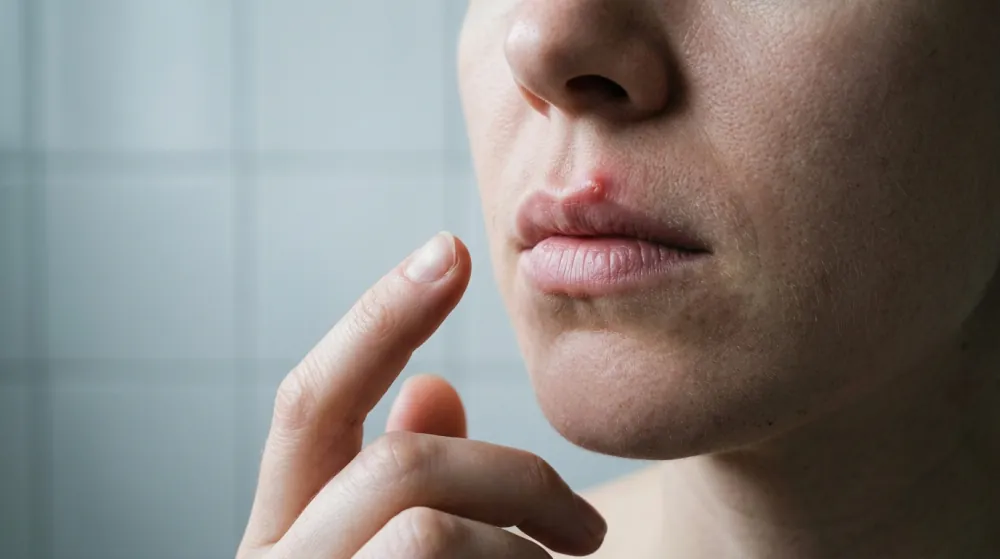
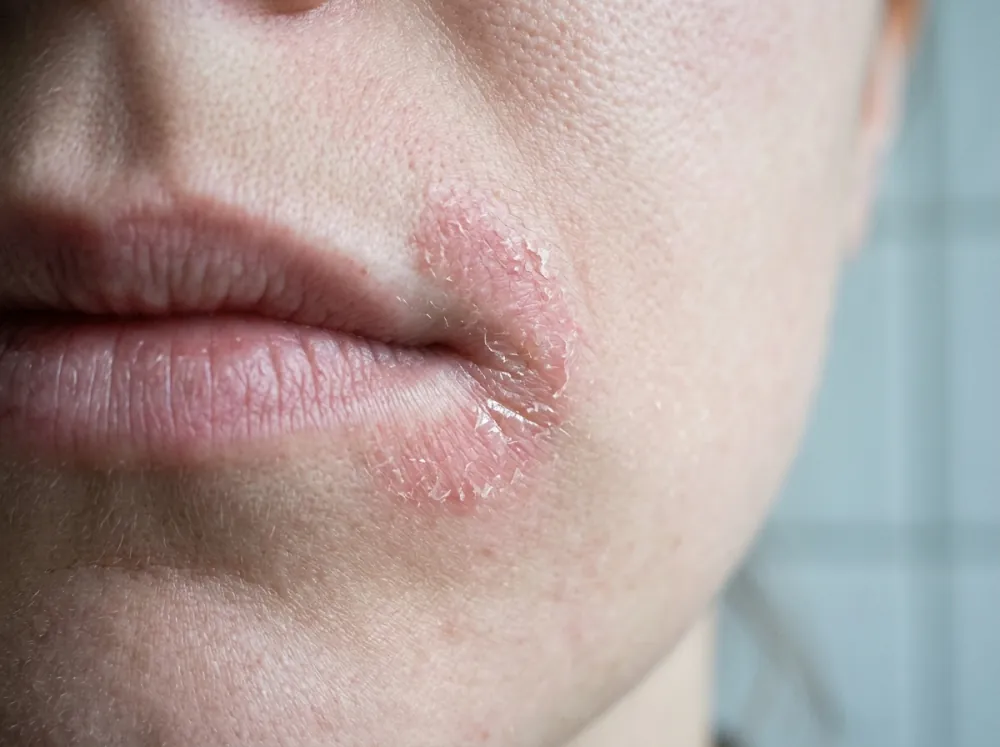
About two-thirds of people under 50 carry the virus that causes cold sores, according to WHO figures quoted in a 2023 review. Yet a clinical evidence summary puts the share of adults who ever get a cold sore at 20% to 40%. Carrying the virus and having a cold sore are different things. The confusion runs the other way too: around a quarter of facial cold-sore recurrences stall at a small bump, and a bump like that looks like a pimple on lip skin.
What separates the two in the first day is often what happened before anything showed. This article on pimples vs cold sores covers that, the shape each one takes, why the lip line breaks out, what squeezing the wrong one does, and one claim worth checking: that toothpaste dries out a pimple. It does not tell you what to put on a lip. When the diagnosis matters, a clinician makes it.
Tingle First or Bump First
A cold sore announces itself. DermNet describes itching or burning that comes first, followed an hour or two later by a cluster of small blisters on a red base. A 2023 review of herpes labialis lists the warning stage as stinging, tingling, burning, skin tenderness and itch, and says it lasts up to about 6 hours in 46% to 60% of patients.
Those two descriptions of the warning window differ: an hour or two against up to six hours. Both agree it comes before the blisters, and both describe it as sensation, not a visible spot.
An acne spot has no equivalent in what DermNet describes. Its account of acne lesions lists tender red papules, pustules and nodules, and says individual lesions usually last less than two weeks. Absence from a description is not proof that no one ever feels a spot coming, so treat the warning phase as a strong clue and not a test.
One Follicle or a Blister Cluster
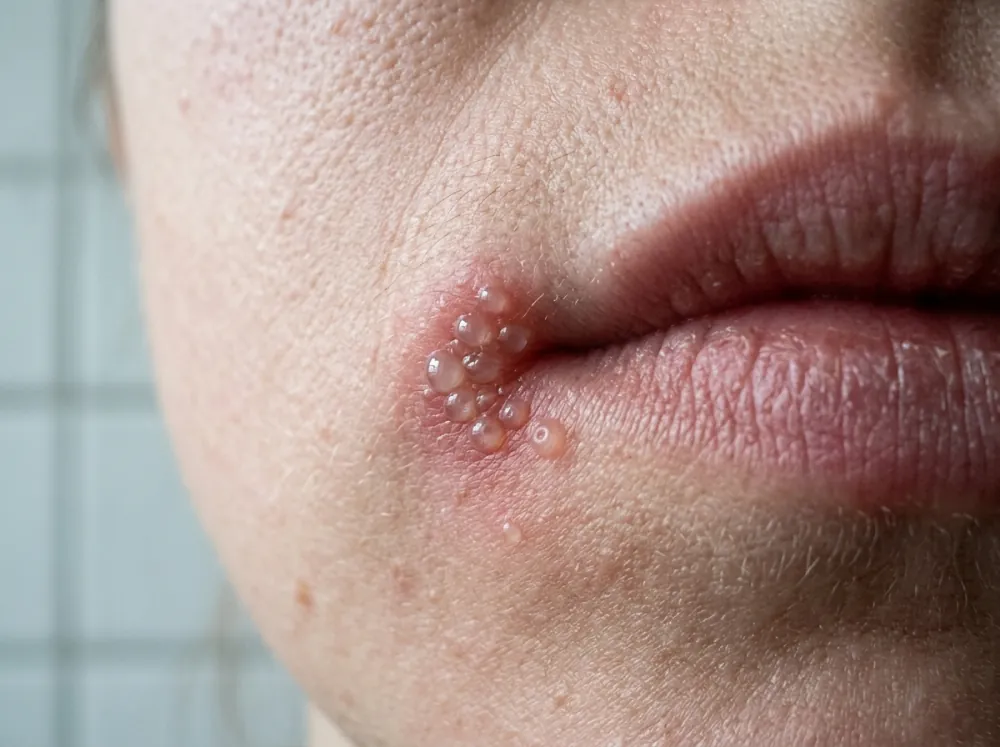
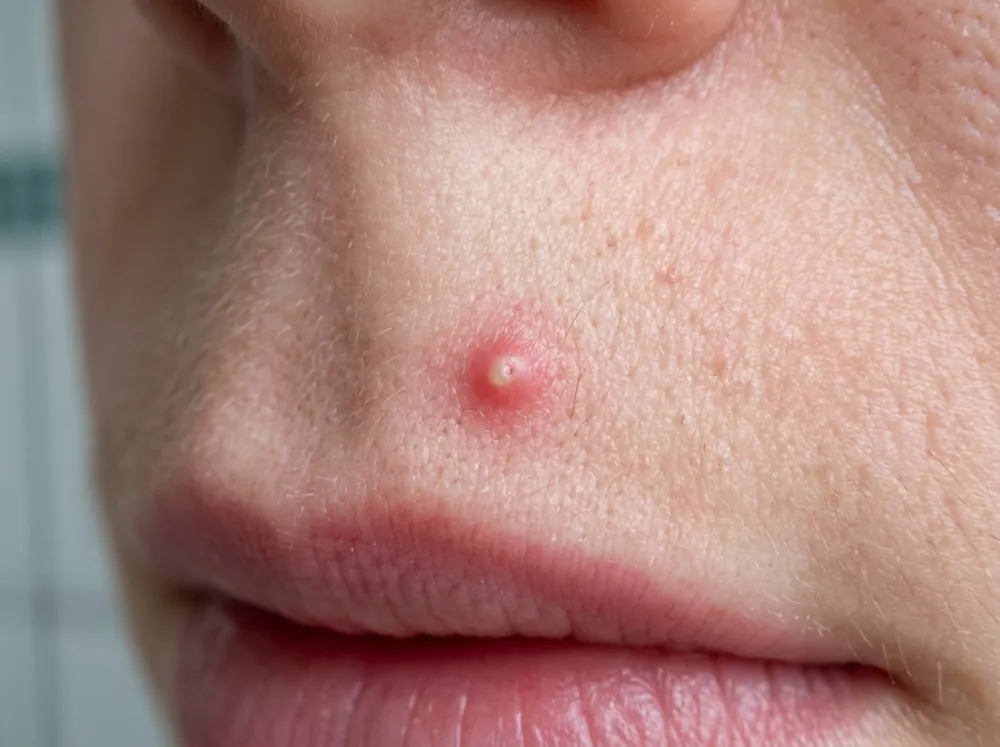
The shape is the second clue. DermNet describes a recurrent cold sore as an irregular cluster of small, closely grouped vesicles, often with a central dimple, on a red base. A pimple on lip skin is one lesion. DermNet says acne lesions are centred on the pilosebaceous unit, which is a hair follicle and its oil gland, so a pimple has a single centre.
| Clue | Cold sore | Pimple |
|---|---|---|
| Before anything shows | Tingling, burning, itching or tenderness | Nothing described |
| First visible sign | A cluster of small blisters on a red base | One red bump, sometimes with a pus tip |
| Centre | Several, close together | One hair follicle |
| Recurs | Usually at roughly the same site | Anywhere there are oil-gland follicles |
| Course | Blisters, then a soft scab, then a hard scab, healing in 7 to 10 days | Usually under two weeks, longer for deeper lumps |
The table draws on DermNet and the 2023 review. The review also says healing takes seven to ten days in one place and ten to fourteen days in another, so the range is closer to a week and a half than a fixed number.
The Cold Sore That Looks Like a Pimple
The overlap that causes the confusion is real. The same review reports that around 25% of facial recurrences stay at the papular stage, with the usual warning sensations but no blisters. A tingling bump that never blisters can therefore still be a cold sore, and the tingle is the clue that points to it.
Why the Lip Line Breaks Out
A pimple on lip line skin forms where hair follicles carry oil glands, and the pink-red part of the lip is an unlikely place for one. DermNet describes the oil glands that do occur on the lips as ectopic: Fordyce spots are visible sebaceous glands without hair follicles, sitting in the oral lining and on the vermilion border of the lips. They are 1 to 5 mm, slightly raised, yellowish or white, and present in 80% of adults. DermNet calls them a normal variant.
We could not open a source that states outright that the vermilion has no hair follicles, so that part is inference from the Fordyce description. What follows from it: a small yellow-white bump on the lip border may be a Fordyce spot, not a pimple, and a red bump on the skin just outside the lip line, like a pimple on upper lip skin, is on ordinary follicle-bearing skin. Around the mouth, irritants such as some toothpastes are also linked to rashes of small bumps, which the audit below covers. Our guide to identifying bumps on the face covers the other common lookalikes.
What Squeezing the Wrong One Does
The two lesions need opposite handling, and the difference is infectivity. DermNet says herpes simplex is infectious for 7 to 12 days and that during an attack the virus can be inoculated into new sites of skin, which can then blister. It adds that minor injury helps inoculation. The amount of virus shed from inactive lesions is 100 to 1000 times less than from active ones.
We found no study of squeezing a cold sore specifically, so the risk here is DermNet's general statement about inoculation, applied to the obvious case. For a pimple, DermNet lists picked or scratched spots as secondary acne lesions, and scars and dark marks among the lasting ones.
The Figure Audited: "Toothpaste Dries Out a Lip Pimple"
What Exists
We searched PubMed for studies of toothpaste used as a spot treatment for pimples and found none. What exists is evidence of toothpaste on skin as an irritant.
A double-blind study applied four commercial toothpastes under occlusion to the skin of 19 dental students. One, containing triclosan, a copolymer, SLS and propylene glycol, caused redness in 16 of 19 (abstract), while one with a non-ionic detergent caused a single mild reaction. The authors note skin testing is not directly applicable to the mouth.
In a case series of 20 women, burning and itching at the corners of the mouth were followed 4 to 14 days later by itchy patches of redness around the mouth (abstract), all after starting a tartar-control toothpaste, with improvement within 1 to 6 weeks of stopping. Our article on perioral dermatitis reports a similar series in which the rash came back in 11 of 11 people on rechallenge. That condition and the rosacea-like pattern around the mouth are sorted in our comparison of rosacea, perioral dermatitis and acne.
The Verdict
The claim has no evidence behind it, and the evidence that exists points the other way. Dryness is not the same as treatment, and a product that irritates skin can leave a red, flaking patch that looks worse than the spot. Toothpaste is also not tested on a cold sore. If a rash of small bumps appears around the mouth after a change of toothpaste, that is a recognised pattern for a clinician to assess.
When It Needs a Clinician
A short list, because this is the part to hit if you are skimming. DermNet lists the complications and groups at higher risk for herpes simplex:
- It is near or involves the eye. Herpes simplex can cause swollen eyelids, conjunctivitis and corneal ulceration.
- You have, or have had, atopic dermatitis or another skin condition that breaks the barrier. DermNet describes eczema herpeticum, a severe widespread infection, in people with a history of atopic dermatitis.
- Your immune system is weakened. DermNet and the review both describe longer, more serious episodes.
- It is your first cold sore, or you are not sure what it is. DermNet says primary infection tends to be more severe than recurrences, and that a swab can confirm the diagnosis when it is in doubt.
- It is not healing after two weeks, or it keeps coming back. The review gives ten to fourteen days as the usual course.
DermNet lists sun exposure among the triggers for facial herpes simplex, and our guide to sunscreen and the amount that matters covers protection in general. For a cold sore specifically, the review reports that antivirals moderately reduce the time to healing and that treatment works best started in the warning phase. Whether an antiviral is appropriate is a clinician's decision.
Conclusion
In the pimples vs cold sores question, the first day gives the best clue. A cold sore announces itself with tingling, burning or itching, then a cluster of small blisters on a red base, usually in the same place each time. A pimple on your lip area is a single follicle-centred bump with no described warning phase. Around a quarter of facial recurrences stall as a bump, so the tingle matters more than the look.
The lip line is also a place where other bumps live, including harmless Fordyce spots, and where irritants such as some toothpastes are linked to rashes. Toothpaste on a pimple has no evidence, and the evidence on skin points to irritation.
A dated photo each day, in any notes app or an app like Skinic, gives a clinician the sequence that settles the diagnosis. And if it is near the eye, if you have eczema, if your immune system is weakened, or if it is your first, ask a clinician before you wait it out.
Frequently asked questions
5 questions · tap one to open the answer
How can you tell a pimple on your lip from a cold sore?
Does toothpaste dry out a pimple on your lip?
How long does a cold sore last?
Is it safe to squeeze a cold sore?
When should a bump on the lip be checked by a doctor?
Medically reviewed by
Dr. M.M Hanaei
Aesthetic Physician, Dermatology Fellowship
- MD — Shahid Beheshti University of Medical Sciences (SBMU)
- MCC Licensure (Medical Council of Canada)
- Dermatology Fellowship, Switzerland
- Certified in advanced aesthetic procedures
Last reviewed 9 October 2026