Skinic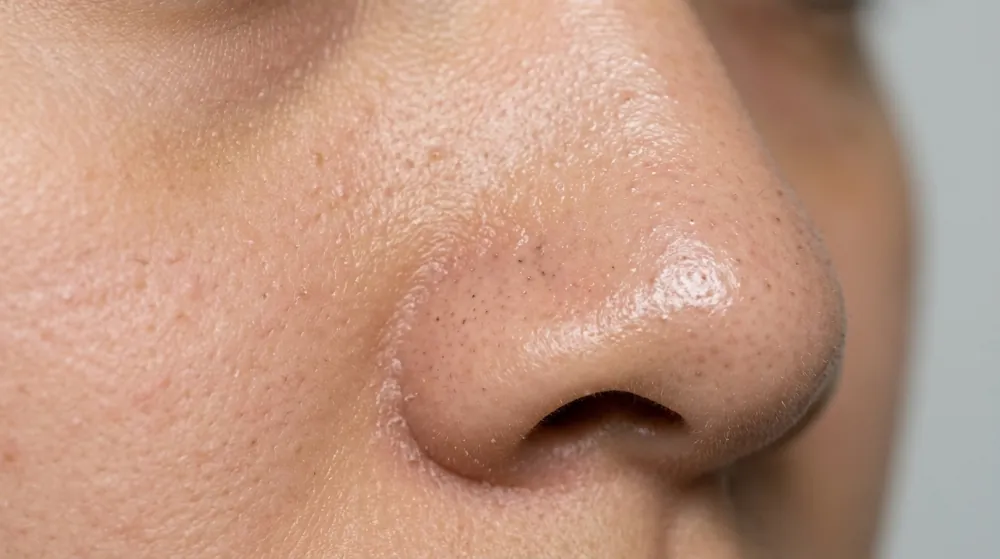
How to get rid of blackheads starts with a correction: the dark dot is not dirt. A review of acne management states that the black surface of an open comedo is oxidised melanin, not oxidised fat or dirt. A 1983 electron microscope study of expressed blackheads found no melanosomes at all. So the sources disagree about what the dark is.
The evidence on what clears a blackhead is narrower than the shelf. Retinoids have the strongest backing, salicylic acid is permitted by the FDA at 0.5% to 2% with limited controlled data at that strength in the sources opened, and extraction removes a plug without changing the process that forms the next one.
This article on blackhead removal covers how to tell a blackhead from a filament, what an open comedone is made of, the dirt claim traced, how salicylic acid and retinoids compare, what pore strips and extraction do, what sebum plugs and clogged pores mean, and a realistic timeline. It reports evidence and labels. It does not give a routine, and a persistent or unusual dark mark is a question for your own clinician.
Blackhead or Filament First
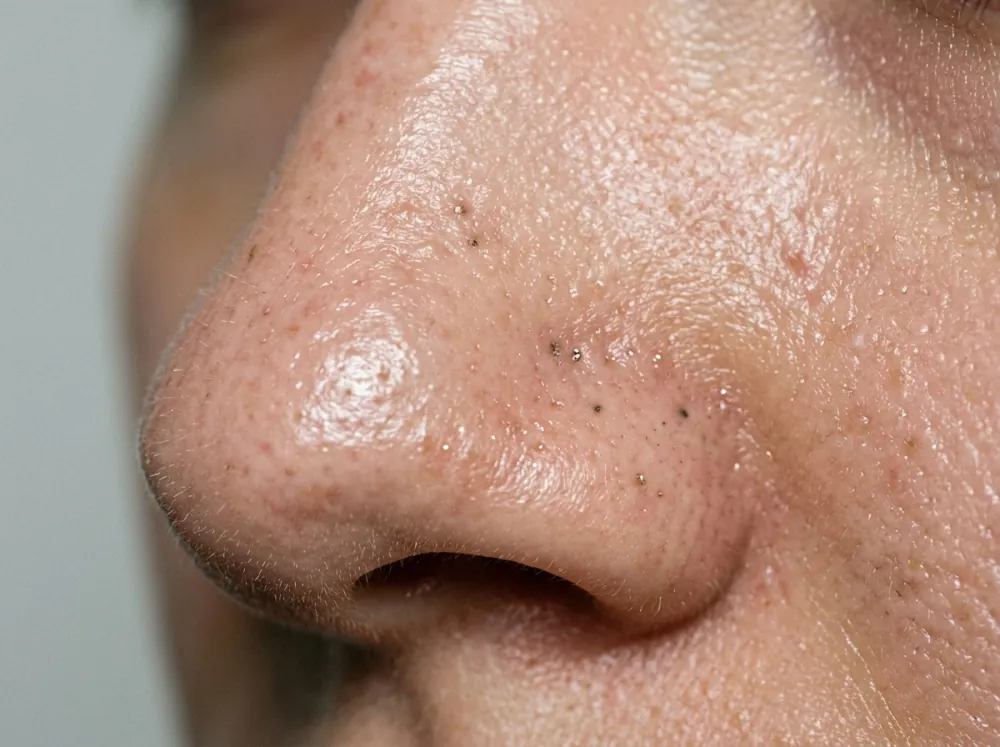
Many blackheads on nose skin are not blackheads at all. Our article on sebaceous filaments and blackheads explains that an even field of tiny pale or grey dots across the nose is usually the normal internal structure of oil-gland follicles, which refill after any extraction, whereas scattered, properly dark dots in dilated openings are the genuine kind. The rest of this article is about the genuine kind, called an open comedone.
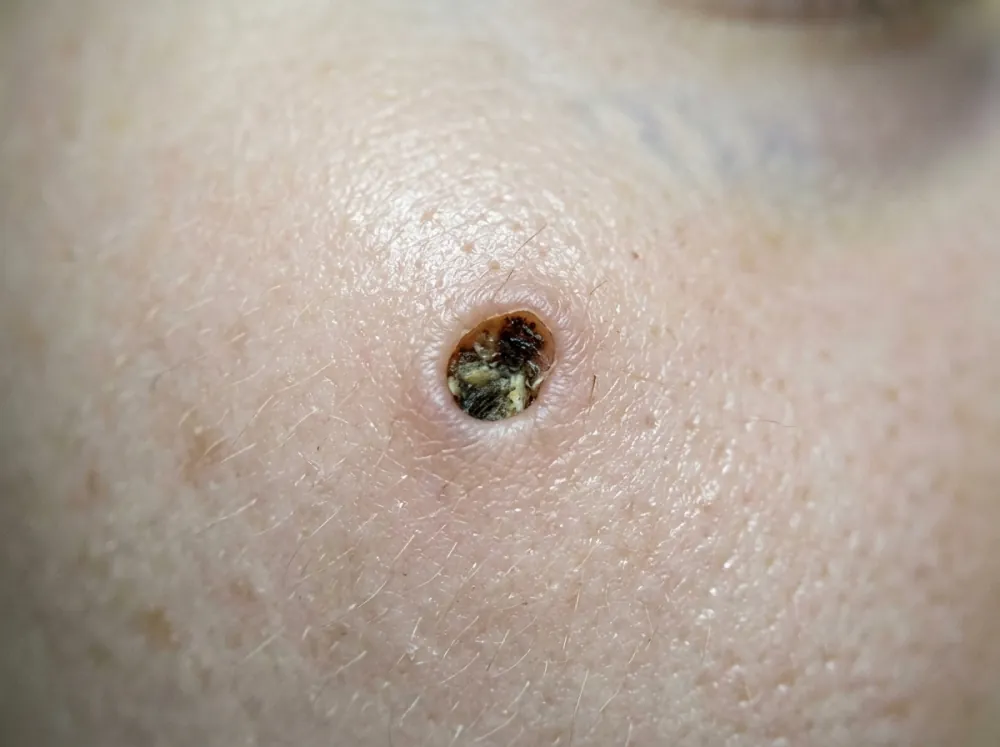
A review of acne management describes an open comedo as a flat or slightly raised black lesion with a central, dilated follicular orifice containing a black keratotic plug, typically 1 to 3 mm across. DermNet describes open comedones as grey, orange, brown or black papules whose contents can be expressed or extracted. The closed form, a whitehead, is a different problem, covered in our article on closed comedones.
What a Blackhead Is Made Of
A Plugged Follicle
DermNet defines a comedo as a plugged follicular orifice. The acne management review explains the sequence: a closed comedo forms first, and as the follicular opening enlarges with continued build-up of keratin and sebum, it opens to the surface and becomes an open comedo. The same review states that blackheads do not generally become inflamed unless the follicle is disrupted by external forces such as squeezing.
A 2026 imaging study looked inside the lesions. Using line-field optical coherence tomography on 52 facial acne lesions from 20 patients and 15 healthy controls, researchers found that open comedones appeared as markedly dilated, funnel-shaped follicular openings. The upper part of the plug was filled with amorphous material of low reflectivity, and the deeper part with bright granular material corresponding to densely packed keratin and sebum. The same study found bright perifollicular rings in 83.3% of microcomedones, absent in healthy skin, which it reads as early follicular hyperkeratinisation. Microcomedones are the invisible precursors, a point that matters in the extraction section.
Not Every Dark Dot Is Acne
DermNet lists other conditions that show comedones or look like them: solar (senile) comedones and Favre-Racouchot syndrome, hidradenitis suppurativa, discoid lupus erythematosus, a seborrhoeic keratosis (best seen on dermatoscopy), a comedone naevus, an epidermal cyst (the giant comedo) and a dilated pore of Winer. A single dark opening that is large, growing or unlike its neighbours is a different question from a scatter of blackheads on the nose, and a clinician can tell them apart.
The Figure Audited: "Blackheads Are Dirt"
The claim fails, and the interesting part is what the sources say in its place.
Three Accounts of the Colour
An acne review. A 2021 narrative review states that the black surface of the open comedo is oxidised melanin, not oxidised fat or dirt. It cites two other works for the statement.
A 1983 electron microscope study. Researchers examined expressed black open comedones and did not find any single melanosomes or melanosome complexes (abstract). They concluded that if any melanin is present in comedonal plugs the amount is minimal, and that it cannot be the source of the black colour. The abstract does not say what the source is.
The 2026 imaging study. It describes the low-reflectivity upper part of the plug as possibly corresponding to a compact melanin-rich cap. The word "possibly" is the authors' own, and imaging does not identify the pigment.
What They Agree On
Only the review says directly that the colour is not dirt. The other two place the colour in the plug's own contents and do not describe it as surface dirt. The sources do not agree on whether melanin is the pigment. The accurate statement is that the dark is in the plug's own material, that the identity of the pigment is disputed, and that an oxidised-melanin account is one view in a review and is contradicted by one electron microscopy study.
As reasoning, not a finding: if the colour is in the plug itself, there is nothing on the surface for a wash or scrub to lift. Our article on sebaceous filaments and blackheads states that the colour is oxidation and pigment, citing a paper whose text could not be read for this article.
Salicylic Acid and Retinoids, Compared
The evidence on how to get rid of blackheads with an active ingredient comes from three kinds of source: a regulator, pooled trials and a product label.
What the Regulator Allows
In the United States, over-the-counter acne drugs follow an FDA monograph. It lists salicylic acid at 0.5 to 2 percent, benzoyl peroxide at 2.5 to 10 percent and sulfur among the permitted actives, and it defines acne as manifested by blackheads, whiteheads, pimples and blemishes. It also lists the claims a label may make, such as "helps clear" or "reduces the number of" blackheads, and "penetrates pores to" clear or reduce them.
A label claim about blackheads is therefore a permitted monograph statement. It is not a measured result for that product. The monograph requires products to warn that skin irritation and dryness are more likely if another topical acne medication is used at the same time.
What the Trials Pooled Show
A systematic review and network meta-analysis for the UK guideline body pooled 179 randomised trials with about 35,000 observations. For mild-to-moderate acne, the most effective topical option was a combined retinoid with benzoyl peroxide, a mean difference of 26.16% (95% credible interval 16.75 to 35.36). Among physical treatments, chemical peels such as salicylic or mandelic acid had a mean difference of 39.70%, with a credible interval from 12.54 to 66.78. The review rated trial quality moderate to very low, reported high uncertainty for peels, and found benzoyl peroxide and topical retinoids less well tolerated than placebo.
Two cautions follow. The outcome is clinician-assessed acne morphology, not blackheads alone. And the salicylic acid evidence in this analysis is for chemical peels, a clinic procedure, with an interval wide enough to include small and large effects. It does not tell how a leave-on product at 0.5% to 2% performs, and no controlled trial of such a product turned up in the sources opened. Reviews do call salicylic acid keratolytic and describe peels with it as usable for comedonal acne.
The acne management review adds that topical retinoids are the drugs of choice for mild-to-moderate acne, that they inhibit keratinocyte proliferation, reducing follicular obstruction and preventing the formation of microcomedones, and that they are effective for comedones as well as inflamed lesions. Our articles on glycolic, salicylic acid and benzoyl peroxide and on tretinoin versus retinol cover how these actives differ and how retinoids are regulated.
What the Label Says About Retinoids
An over-the-counter adapalene 0.1% gel is sold in the United States with a Drug Facts label. Its label states the use as treatment of acne. It says that during the early weeks acne may appear to worsen before it improves, that irritation is more likely in the first few weeks and when more than one topical acne medicine is used, that it may take up to 3 months of once-daily use to see results, and to stop use and ask a doctor if there is no improvement after 3 months. It also says to stop use and ask a doctor if you become pregnant or are planning to become pregnant. Those are the label's statements, reported here.
The acne management review describes the same early worsening as retinoid flare during the first month, and lists dryness, flaking, redness, burning and irritation as the main side effects. Our article on purging versus breaking out covers how to read that early phase.
Pore Strips and Extraction
Blackhead removal by extraction is the most common answer to how to get rid of blackheads, so it deserves its own look. DermNet states that the contents of open comedones can be expressed or extracted. The acne management review lists manual extraction of comedones among procedures used in selected patients, and advises that people should not play with their lesions, since squeezing is what inflames a blackhead. No source opened tested pore strips, and the extraction comparison between clinic and home was not found.
The relapse after extraction is the part sources help explain. The 2026 imaging study found precursor rings in the large majority of microcomedones, and the review says retinoids work by preventing microcomedone formation. As reasoning, not a measured finding: extraction removes the visible plug, and the follicular process that builds the next one continues unless something addresses it. Our article on sebaceous filaments and blackheads covers why filaments refill within days, and why squeezing risks a mark.
Sebum Plugs and Clogged Pores
Sebum plugs and clogged pores on face skin are lay terms. A clogged pore is, in the sources' terms, a comedo: a plugged follicular orifice, closed or open. The acne review calls the comedo the first stage of acne, a clogged follicle.
The marketing phrase has a regulated form. The monograph permits labels to say a product "penetrates pores to" clear or reduce blackheads, which is wording permitted for products with the listed actives, not a finding about how deep an ingredient reaches in a particular formulation. The pale or grey even field on a nose that people also call sebum plugs is covered in the filament article above.
A Realistic Timeline
The sources give three markers, all for retinoids. The label says up to 3 months of once-daily use to see results. The acne review says an apparent worsening, called retinoid flare, can occur in the first month. And the label says to ask a doctor if there is no improvement after 3 months.
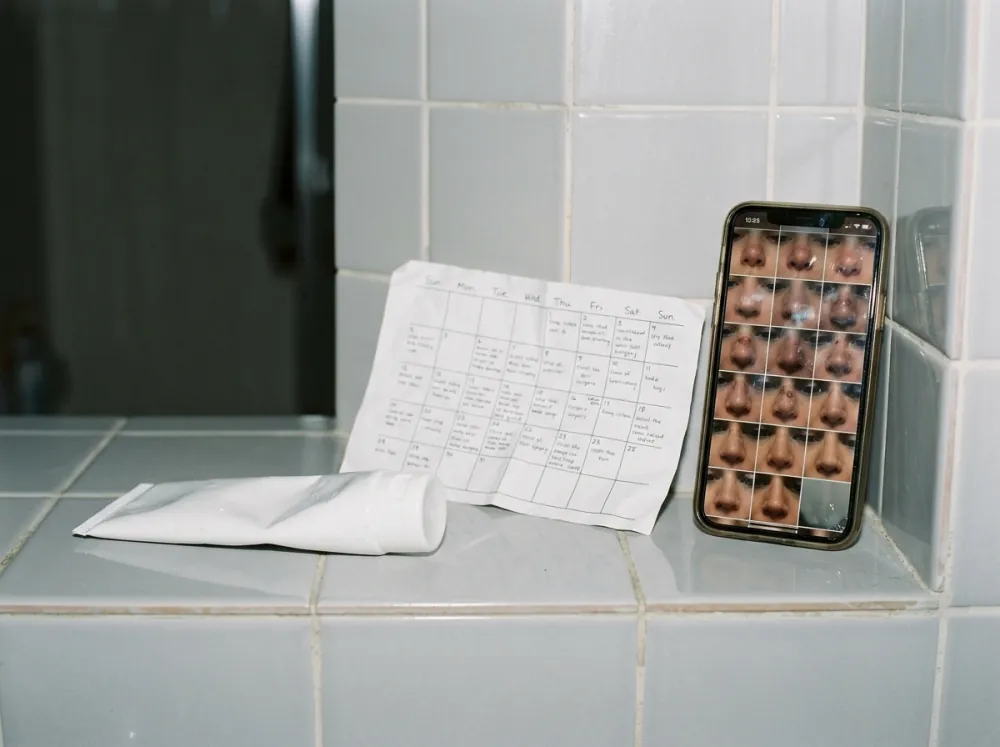
The monograph for salicylic acid does not give a time to results in the text opened, and no timeline was found in the controlled evidence for it. A photograph taken in the same place and light every few weeks shows more than memory does. Our article on purging versus breaking out covers telling an early flare from a reaction.
Conclusion
A blackhead is a plugged follicle that has opened to the surface. It is not dirt, and sources disagree about what makes it dark. Retinoids have the strongest evidence among the options and take up to 3 months by their own label. Salicylic acid is permitted at 0.5% to 2% and has less controlled evidence at that strength in what was opened. Extraction clears a plug and leaves the process.
If a mark is not a typical blackhead, is growing, or is different from its neighbours, have it looked at. Photographing the area in the same place, distance and light, whether in a dated album or in an app like Skinic, shows whether dots are reducing, holding or returning, and gives a clinician something to look at. For questions about a retinoid, including in pregnancy, ask your own clinician.
Frequently asked questions
5 questions · tap one to open the answer
How do you get rid of blackheads?
Are blackheads dirt?
Does salicylic acid get rid of blackheads?
Why do blackheads come back after extraction?
How long do blackheads take to clear?
Medically reviewed by
Dr. M.M Hanaei
Aesthetic Physician, Dermatology Fellowship
- MD — Shahid Beheshti University of Medical Sciences (SBMU)
- MCC Licensure (Medical Council of Canada)
- Dermatology Fellowship, Switzerland
- Certified in advanced aesthetic procedures
Last reviewed 10 October 2026