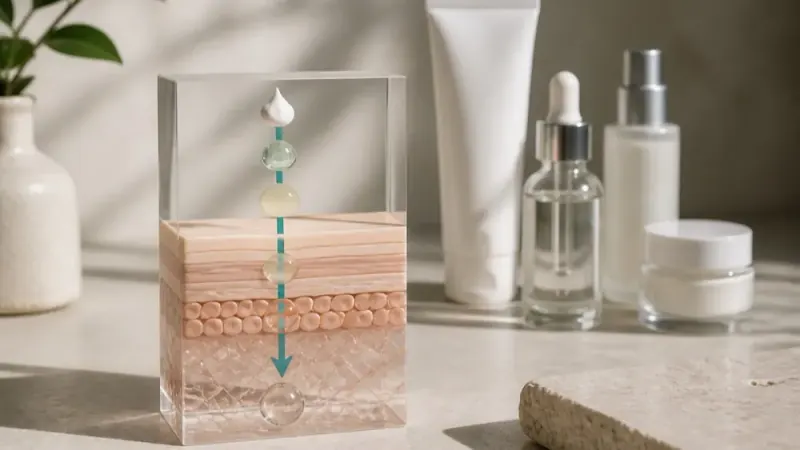
Skinic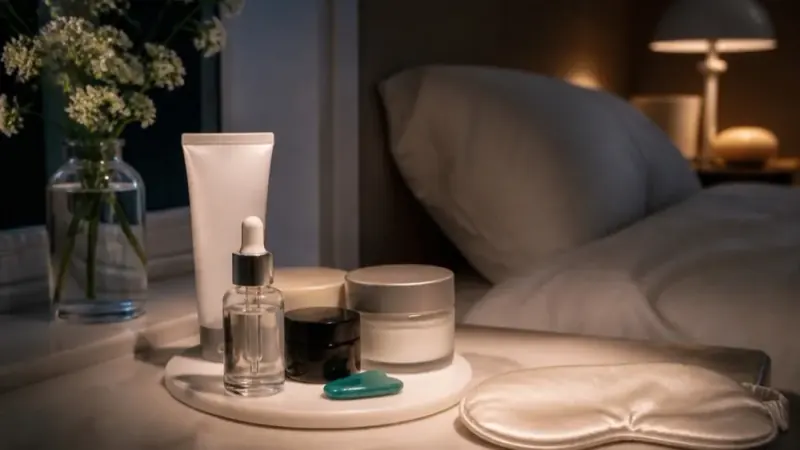
Most people treat their night skincare routine as an afterthought. A quick rinse, maybe some moisturizer if you remember, and then straight to sleep. But here is the thing: your skin is not resting while you sleep. It is actually doing some of its most important work.
While you are unconscious and dreaming, your skin is repairing DNA damage, ramping up cell turnover, rebuilding its protective barrier, and producing collagen. These processes follow a precise internal clock, and they peak during those nighttime hours. That means the products you apply before bed have a genuine biological advantage that your morning routine simply cannot match — see our full AM vs PM skincare comparison if you want the broader picture before diving into the night-specific biology here.
In this post, you will learn exactly what your skin is doing between roughly 10pm and 6am, why it absorbs ingredients differently at night, and how to build a simple PM routine that works with your skin's natural repair cycle rather than against it. You will also find out which ingredients belong in an evening routine for real physiological reasons, and which common nighttime habits are quietly getting in the way. Let's start with the clock running everything behind the scenes.
Your Skin Has Its Own Internal Clock
Your body runs on a 24-hour internal clock, and your skin runs on it too. Deep inside your brain, a small region called the suprachiasmatic nucleus (SCN) acts as the master timekeeper. It does not just tell you when to feel tired. It also signals your skin when to shift from defense mode into repair mode.
Light is what sets this clock. Your eyes detect natural light changes throughout the day, and that information synchronizes the SCN's rhythm. This is why consistent sleep timing matters as much as sleep duration for skin health. If you go to bed at wildly different hours each night, you are essentially giving your skin a shifting repair schedule rather than a reliable one.
Here is where it gets interesting: skin cells do not just passively wait for orders from the brain. They carry their own peripheral circadian clocks that respond to the SCN's signals and regulate local gene expression tied to repair, renewal, and barrier function. Think of it as a national headquarters coordinating thousands of local offices, each running their own timed operations.
Scientists are still actively mapping how this works at the cellular level. As recently as October 2025, researchers and dermatologists across Asia-Pacific convened under industry-backed sponsorship specifically to investigate circadian skin mechanisms, which tells you how much is still being discovered.
The practical takeaway: your skin's receptivity is not the same at 8am as it is at 11pm. Applying an active ingredient at night versus in the morning is not just a timing preference; the circadian regulation of skin barrier function and surface lipids means the biological environment genuinely differs between those windows.
What Is Actually Happening to Your Skin Between 10pm and 6am
So what is that internal clock actually triggering? Here is what is happening in your skin right now while you sleep.
Cell turnover shifts into a higher gear at night. Your skin is continuously shedding old, damaged cells and replacing them with fresh ones, but that process accelerates during sleep hours. The circadian clock upregulates the genes responsible for this renewal cycle, meaning your skin is more actively rebuilding itself at 2am than at 2pm.
Collagen synthesis increases. Collagen is the structural protein that keeps skin firm and elastic. UV exposure and environmental stress chip away at it during the day, and nighttime is when the body ramps up production to compensate. Supporting that process is one of the strongest arguments for a deliberate PM routine.
Blood flow to the skin rises. As your body temperature and cortisol levels drop during sleep, circulation to the skin increases. More blood flow means better nutrient and oxygen delivery to the cells doing repair work overnight.
Cortisol falls significantly. Cortisol is the stress hormone that actively suppresses inflammation responses and slows tissue repair. Its drop during sleep creates a lower-inflammation window, which is genuinely more favorable for recovery than anything your skin experiences during waking hours.
Barrier lipid synthesis follows the circadian rhythm. With no UV radiation or pollution to defend against, skin can redirect resources toward barrier rebuilding, replenishing the ceramides, fatty acids, and cholesterol its protective layer depends on. This process is regulated by the circadian clock at the cellular level.
DNA repair activity is part of the overnight maintenance cycle. The skin works through accumulated UV-induced oxidative damage while external stressors are paused, making the overnight window the period when that backlog can actually be addressed.
All six of these processes overlap in the same window, which is exactly why what you apply before bed matters more than most people realize.
Why Your Skin Absorbs Ingredients Differently at Night
All that repair activity happening overnight? It only translates into results if your skin can actually receive what you apply to it. And here's where nighttime biology works in your favor.
Skin permeability increases during sleep. Research tracking circadian changes in transepidermal water loss and stratum corneum hydration found measurable amplitudes of roughly 20% and 14% respectively across the 24-hour cycle, confirming that the skin barrier behaves differently at night. That shift means active ingredients, retinoids, AHAs, peptides, have a greater opportunity to move beyond the surface layer compared to a morning application on a fully defended barrier.
There is a catch, though. The same permeability that helps actives penetrate also lets moisture escape faster. Elevated transepidermal water loss overnight is a real concern, which is why sealing your routine with an occlusive moisturizer is functional rather than optional.
With daytime UV and pollution demands gone, skin can focus on processing what you've applied.
The UV piece matters for specific ingredients too. Retinoids and certain AHAs are photosensitive, meaning UV exposure degrades them and makes skin more vulnerable to sun damage after application. Using them at night removes that risk entirely, and puts them to work precisely when the cell renewal they support is already running at its highest rate.
One more thing worth knowing: morning cleansing removes whatever is still on your skin. Actives applied at night work for the full overnight window, not just until you fall asleep.
How to Build a Nightly Skincare Routine That Works With Your Skin's Biology
So now that you understand why the nighttime window matters, here's how to actually use it.
Step 1: Cleanse thoroughly
This isn't optional prep. Sunscreen, makeup, and the day's pollutants sitting on your skin overnight actively block the barrier repair and ingredient absorption the previous sections described. A consistent PM routine starts here: a clean surface is the foundation for everything that follows. If you wore SPF or makeup, double cleansing (an oil-based cleanser first, then a gentle foaming or gel cleanser) ensures nothing is left behind. If your skin runs oily, the same barrier-safe logic applies at night as during the day — see our guide on choosing a cleanser for oily skin without stripping your barrier.
Step 2: Apply treatment actives
Retinoids go on next. Retinoids align with cell turnover already running at night. AHAs like glycolic or lactic acid serve a similar purpose, loosening the surface layer of dead cells so renewal can proceed more efficiently.
Step 3: Follow with a peptide serum
Peptides signal your skin to support collagen and structural protein synthesis. Peptides find collagen synthesis already elevated, apply them after actives have absorbed.
Step 4: Seal with a barrier-focused moisturizer
Ceramides, fatty acids, and cholesterol are the three lipid classes your skin barrier is actively trying to rebuild overnight. A moisturizer or overnight mask containing these replenishes exactly what barrier lipid synthesis is working to restore. An occlusive layer on top reduces transepidermal water loss and keeps the repair environment intact. For a full breakdown of which ingredients actually deliver on that promise, see our guide to reading a moisturizer label for humectants, emollients, and occlusives.
Optional: Facial oil or occlusive balm as a final step
For dry or compromised skin, a finishing oil or balm adds another layer of moisture protection without disrupting the actives underneath.
Sequence is functional, not arbitrary. Occlusives reduce skin permeability. Apply them last, after actives have already absorbed, so the increased nighttime permeability window actually works in your favor. This same absorption logic, smallest and most chemically demanding first, sealing agents last, governs your entire routine, not just the night-time steps; our deep dive on skincare routine order walks through exactly why.
Ingredients That Belong in a PM Routine (and Why They Do Not Belong in the Morning)
Now that you know the sequence, here is the reason each of those ingredients earns its spot in your PM routine specifically.
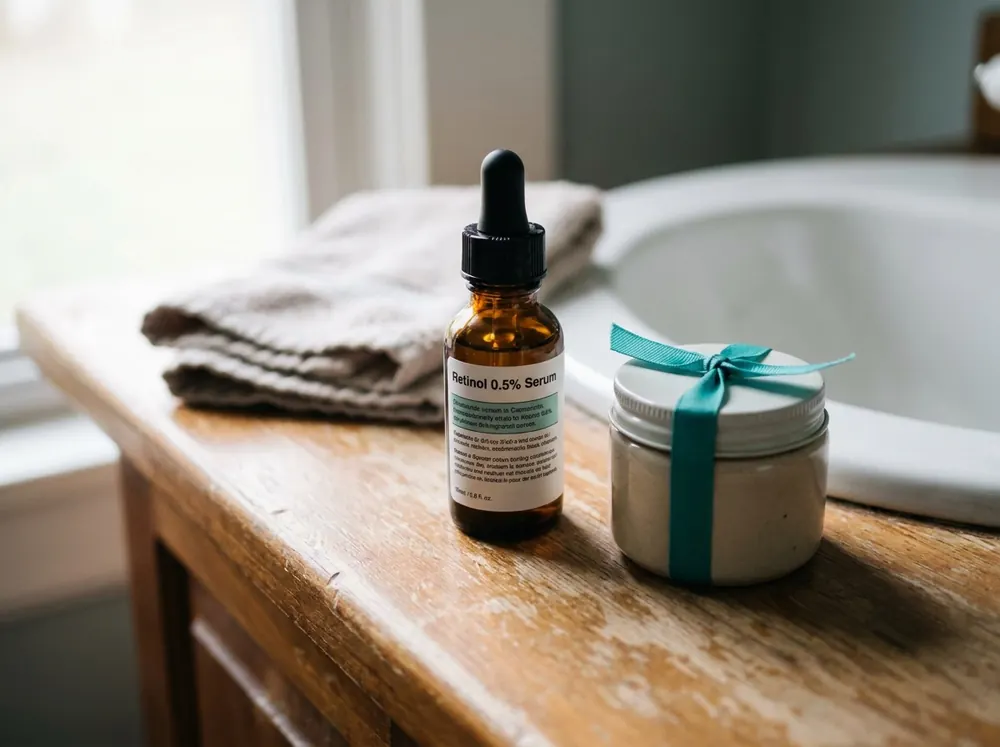
Retinoids (retinol, retinal, tretinoin) are photolabile, meaning UV exposure actively degrades them. Applying retinoids in the morning wastes a portion of the product before it can work. There is a second problem: retinoids increase the skin's photosensitivity, so daytime use raises sunburn risk. At night, both issues disappear, and you get the added benefit of applying them exactly when cell turnover is already naturally elevated.
AHAs like glycolic and lactic acid are best used at night, not because their photosensitivity is as well-documented as retinoids', but because they work on a surface the skin is already renewing overnight, aligning with the biology rather than working across it.
Ceramides, cholesterol, and fatty acids are not just moisturizing ingredients. Skin barrier lipid synthesis follows a circadian pattern, with skin freed from daytime UV demands to prioritize this rebuilding. Applying these topically means the skin has to divert fewer internal resources to that process, which is a different and more accurate way to think about what they are doing.
Peptides signal the skin to produce collagen and structural proteins. Collagen synthesis is already elevated during sleep, so peptides applied at night are prompting a response in tissue that is biologically ready to give one.
Occlusives (petrolatum, shea butter, squalane) slow transepidermal water loss overnight, they hold moisture in rather than adding it, which is why they belong last in the sequence.
Common Nighttime Skincare Mistakes That Work Against Your Skin
Knowing which products belong in your PM routine only pays off if you're not also making mistakes that cancel out that work. These are the most common ones.
Skipping the cleanse leaves sunscreen, pollution particles, and makeup as a physical barrier to the overnight repair cycle, cleansing is not optional prep.
Copying your morning routine at night. Vitamin C is typically recommended for daytime use because it works against UV-generated oxidative stress. Applied at night, it simply takes up space that repair-phase actives, retinoids or peptides, would use more productively. Those actives have no equivalent daytime window, so displacing them at night is a real trade-off.
Applying an occlusive before serums blocks the permeability window, actives first, occlusives last.
Irregular sleep timing. Research published in 2025 confirms that disrupting the skin's circadian balance impairs hydration, barrier protection, and regeneration. A well-chosen PM routine applied at an inconsistent bedtime operates on a shifted repair cycle, which reduces how reliably those ingredients hit their biological window.
Harsh products every night. Alcohol-heavy toners and aggressive exfoliants used nightly can outpace the barrier's recovery rate. The overnight goal is reconstruction; anything that compounds barrier stress works against that directly. Keep reading to understand how identifying your skin's specific vulnerabilities can help you calibrate how much your barrier can actually tolerate.
Does Everyone's Skin Follow the Same Nighttime Schedule?
The circadian repair blueprint is the same for everyone, but how intensely your skin needs each part of it is not.
Age is one of the biggest variables. Older skin still accelerates cell turnover at night, but that acceleration is more modest than in younger skin. The baseline rate has already slowed, so the nighttime boost has less to build on. This is precisely why retinoids earn their place in a mature skin PM routine: they aren't introducing something the skin no longer does, they're amplifying a process that has simply quieted down.
Skin type shifts the equation too, particularly around barrier repair. Dry or compromised skin loses more moisture overnight because a weakened barrier can't hold water as effectively. That vulnerability makes occlusives and ceramide-rich moisturizers genuinely critical in those routines, not optional extras. For oily or normal skin, the same products are still useful, just less urgent.
Chronotype adds another layer. Whether you're naturally a morning person or a night owl may shift the timing of peak repair activity by an hour or two. That said, current research hasn't reached the point of offering personalized timing guidance at that level of precision, so it's worth knowing but not worth rearranging your sleep schedule over.
This is where knowing your own skin closes the gap between general advice and a routine that actually fits. Skinic's AI skin analysis can identify visible signs of barrier compromise, dryness, or congestion, pointing toward which parts of your skin's overnight repair cycle may need the most support.
Build a PM Routine That Earns Its Place
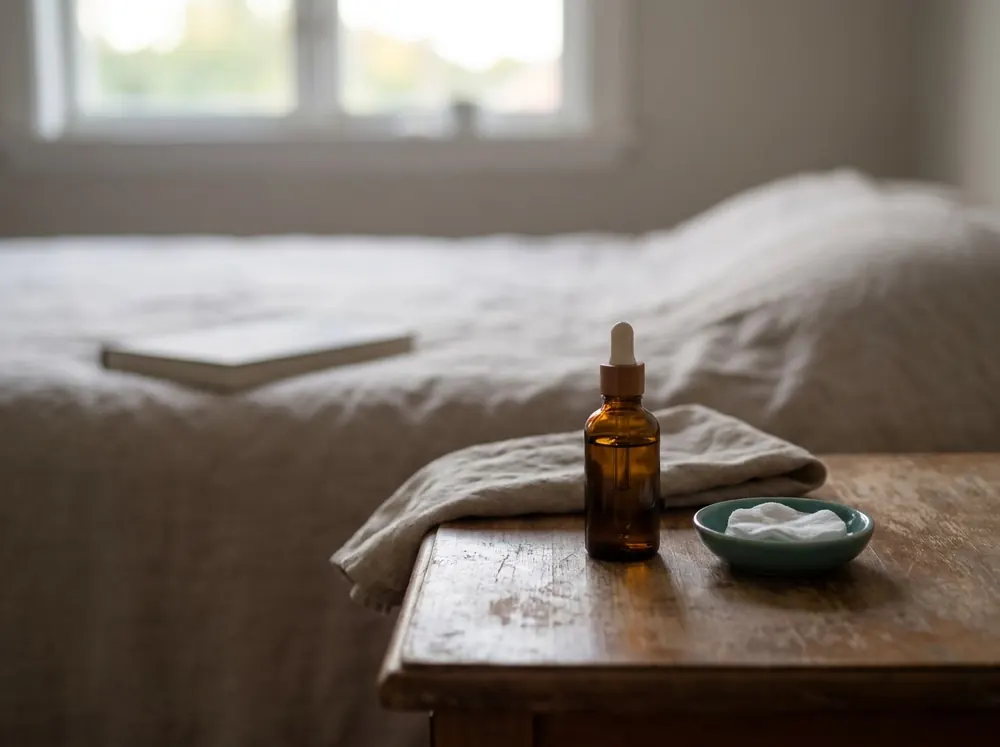
The science throughout this post isn't theoretical. Elevated cell turnover, collagen synthesis, cortisol decline, and increased ingredient permeability all peak in the same overnight window. Barrier lipid rebuilding, ceramides, fatty acids, cholesterol, is also a priority overnight, with the skin freed from daytime UV demands.
Retinoids, peptides, and ceramide occlusives each align with a specific process already running, and applying actives before occlusives keeps the permeability window open.
The circadian biology applies to everyone, but the right routine is still personal. Your skin type shifts which of these steps deserves the most weight, covered in the section above.
That's where a skin profile becomes genuinely useful. Skinic's free analysis is a practical first step: it identifies your visible skin attributes so you can map what you've learned here onto your actual skin, not just the science in general.
Conclusion
Your skin does not wait for you to take action. Every night, it runs a coordinated repair cycle whether you support it or not. The difference a thoughtful PM routine makes is simply whether your products work with that biology or against it.
The key takeaways are worth holding onto: nighttime permeability makes actives more effective after dark; retinoids, peptides, and ceramides each align with a specific biological process already running; sequence and timing shape how well ingredients actually absorb; and your skin type determines which steps deserve the most weight.
That last point matters most. General knowledge only goes so far. The real value comes from applying it to your specific skin. Start with Skinic's free skin profile analysis to identify your visible attributes, then build a PM routine that genuinely earns its place in your nightly routine.
Frequently asked questions
5 questions · tap one to open the answer
Why is a night skincare routine more important than a morning one?
Why should retinoids be used at night instead of in the morning?
What order should I apply products in a nighttime routine?
Is it bad to use vitamin C at night instead of during the day?
Does everyone need the same nighttime skincare routine?
Medically reviewed by
Dr. M.M Hanaei
Aesthetic Physician, Dermatology Fellowship
- MD — Shahid Beheshti University of Medical Sciences (SBMU)
- MCC Licensure (Medical Council of Canada)
- Dermatology Fellowship, Switzerland
- Certified in advanced aesthetic procedures
Last reviewed 9 September 2026