Skinic
Most people apply their skincare products in roughly the same order they were told to by a brand, a beauty editor, or a well-meaning friend. The problem is that none of those sources are working from the same framework, and that framework rarely has anything to do with how skin actually absorbs what you put on it.
Your skincare routine order is not a matter of preference or brand loyalty. It follows predictable, measurable rules rooted in absorption science: pH windows that open and close within minutes, molecular weight hierarchies that determine how deep a compound can travel, and occlusive effects that physically seal the surface against anything applied afterward. Apply products outside those rules and active ingredients either fail to penetrate or degrade before they reach their target depth.
This tutorial breaks down exactly how skin absorption works, identifies the three governing rules that apply to every product in every routine, and builds a correct sequence directly from that science. By the end, you will have a transferable mental model you can apply to any product, not just a static list to memorize and eventually forget.
Why Skincare Routine Order Is Not Arbitrary

Most people learn their skincare routine order from packaging inserts, brand-specific guides, or a step-numbered label on a product box. These sources tell you what to do but never explain why the sequence exists. That omission keeps you dependent on brand instructions rather than a principle you can apply to any product you buy.
The science telling a different story has existed for decades. Peer-reviewed research on skin penetration, including studies examining inter-formulation and inter-active effects on ingredient bioavailability, confirms that application sequence directly determines how much of an active ingredient actually reaches its target depth in the skin. A standardized penetration study measuring 56 cosmetic chemicals conducted by researchers from major industry labs documents that penetration rates vary dramatically by molecular structure and surface conditions at the time of application. This is not fringe research; it is the framework cosmetic chemists use to develop products. It simply never gets translated into consumer language.
The consequences of wrong sequencing are concrete. Applying products out of order can prevent an active from crossing the stratum corneum entirely, trigger pH interference that renders an acid or vitamin C chemically inert before it penetrates, or deposit an occlusive film that physically seals the surface against anything applied afterward. These are not minor efficiency losses; they can make an expensive active functionally useless.
This guide replaces the static list with a transferable mental model built on three rules: pH windows, molecular weight hierarchy, and occlusion effects. If you want to build a skincare routine that actually sticks, understanding the physics behind the sequence is the only foundation that holds across every product, brand, or concern you will ever work with.
How Skin Absorption Actually Works
To understand why sequence matters, you need to understand what your skin is actually doing when you apply a product.
The outermost layer of the epidermis, the stratum corneum, is the primary barrier to everything you put on your skin. It is not passive packaging. Most topical actives must cross it to reach viable skin tissue where they can actually exert their effects. Getting an ingredient onto your skin and getting it into your skin are two different outcomes.
Penetration Is Governed by Physics, Not Volume
Applying more product does not improve penetration. What governs whether a molecule crosses the stratum corneum is its physicochemical profile: molecular weight, lipophilicity (fat-solubility versus water-solubility), and charge. The stratum corneum's intercellular matrix is lipid-rich, so fat-soluble compounds move through it more readily than charged, water-soluble ones. Smaller molecules diffuse through these channels more efficiently than larger ones.
A benchmark widely cited in dermatology formalizes this: molecules under approximately 500 daltons have meaningful transdermal penetration potential, while larger compounds remain at or near the surface. This is not a cosmetic industry claim; it is a principle used to guide pharmaceutical development of topical drugs.
Your Prior Products Change What Comes Next
Here is where routine sequence becomes a measurable variable. Research on predicting skin penetration from complex formulations confirms that inter-formulation effects are real: ingredients applied earlier in a routine directly alter the bioavailability of ingredients applied later. The skin's surface is not reset between steps. What you applied three minutes ago has already begun modifying the penetration environment.
That environment has three critical variables at any moment of application: surface pH, hydration level, and whether a film has formed. Each one affects what the next product can and cannot do.
In vivo absorption studies, which measure recovered active ingredients from tape strips, urine, sweat, and expired air, establish that ideal total recovery sits between 95 and 102 percent of the applied dose. These methods confirm that sequence-dependent surface conditions produce measurable differences in penetration outcomes, not theoretical ones.
The mechanism is clear. The three rules that follow are its direct practical consequences.
The Three Rules That Govern Every Skincare Routine

Rule 1 (pH Windows) covers how surface pH at the moment of application determines whether acid-dependent actives can function at all; the full mechanism is in the next section. Rule 2 (Molecular Weight Hierarchy) establishes that smaller molecules must access intercellular channels before larger ones close them off; the sequencing logic follows from there. Rule 3 (Occlusion Effects) shows that film-forming ingredients seal the surface against anything applied after them, which is why occlusives belong last.
These three rules share one important quality: none of them are brand opinions. They reflect the measurable physicochemical properties of ingredients and skin tissue, which is why they hold regardless of product format or price point. Keep reading to see how individual skin profiles affect which of these rules matters most in your specific routine.
Rule 1: pH Windows and Acid Interference
Healthy skin surface pH sits between approximately 4.5 and 5.5, a range that is physiologically active, not merely descriptive. That mildly acidic environment drives ceramide-producing enzyme activity, maintains stratum corneum integrity, and supports a microbiome that favors beneficial bacteria over pathogens. Disrupt it, and barrier function deteriorates before a single active ingredient enters the picture.
The problem is that several common products push pH in the wrong direction. Baking-soda-based cleansers, certain micellar waters, and heavily buffered moisturizers all sit well above 5.5. Applied immediately before an acid, they neutralize the surface environment the acid depends on.
AHAs, BHAs, and the protonation window. Glycolic acid, lactic acid, and salicylic acid must exist in their protonated, uncharged form to cross the stratum corneum. That form is most stable at a clearly acidic surface — formulators and cosmetic chemists commonly cite a target below pH 4, though precise thresholds vary by specific acid and formulation. Above that range, the molecule loses its charge state and its ability to penetrate, meaning the exfoliating effect you are paying for does not reach its target depth.
L-ascorbic acid follows the same logic. Vitamin C in its most bioavailable form requires a clearly acidic surface for effective absorption — conditions that a high-pH preceding product disrupts. Apply it over any product that has raised surface pH, and absorption drops measurably. The serum sits on the skin rather than reaching the melanocyte layer where it inhibits pigmentation.
The practical rule is direct: pH-sensitive actives belong on freshly cleansed skin, applied before anything that could buffer or raise the surface environment. If a pH-correcting toner is part of your routine, it goes first, then the acid or vitamin C follows. Nothing alkaline touches the skin beforehand. Sequence here is not a preference; it is the condition under which the active either works or does not.
Rule 2: Molecular Weight Hierarchy
Where pH determines whether an active functions, molecular weight determines how deeply it can travel.
Molecular weight is measured in daltons, and size governs access. The stratum corneum's primary penetration route runs through narrow, lipid-filled channels between corneocytes. Smaller molecules diffuse through these channels efficiently; larger ones cannot. Research in Experimental Dermatology established that molecules above roughly 500 daltons have negligible transdermal penetration potential, a threshold now standard in cosmetic and pharmaceutical formulation science.
Hyaluronic acid makes the hierarchy visible. High-molecular-weight hyaluronic acid cannot cross the stratum corneum; it functions at the surface as a humectant, drawing moisture to the outermost skin layer. Smaller hyaluronic acid fragments reach deeper epidermal layers. Same ingredient, same molecule, completely different behavior based solely on size. The version in your product determines what it can actually do.
Retinoids, niacinamide, and most peptides occupy an intermediate range, small enough to penetrate but only through channels that are unobstructed. This is where sequence creates or destroys efficacy. When you apply a ceramide-rich cream or a thick emollient before a retinol serum, the heavier ingredients occupy the limited intercellular lipid matrix before the small-molecule active can access it, reducing its available penetration pathway.
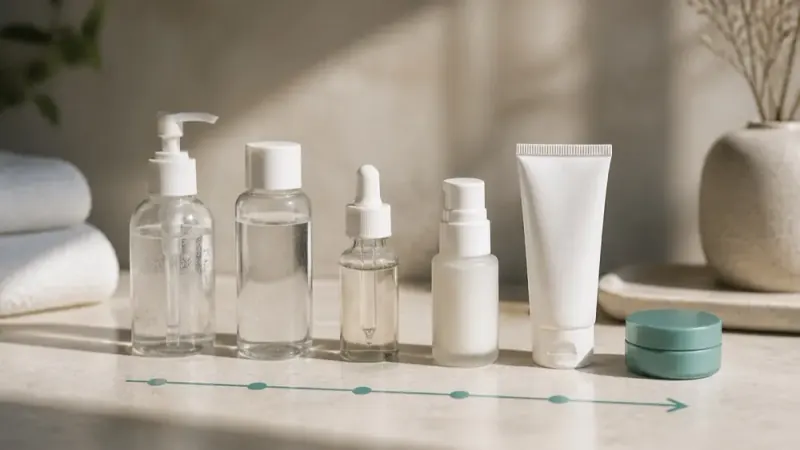
The practical rule follows directly: sequence from smallest molecular weight to largest, which maps onto texture closely enough to use — though thinnest to thickest is a proxy rather than the rule itself. Watery actives and light serums go first, followed by heavier serums, then emollients, then creams. Occlusives are last because they close the surface entirely, which is the subject of Rule 3.
Rule 3: Occlusion Effects and the Sealed Surface
Molecular weight determines the order in which ingredients enter the skin. Occlusion determines whether the door stays open at all.
Occlusion is the formation of a physical film on the skin surface. That film does two things simultaneously: it reduces transepidermal water loss (TEWL), and it reduces transepidermal absorption of anything applied afterward. The same mechanism responsible for sealing in hydration also seals out subsequent ingredients.
Common occlusive ingredients — including petrolatum, mineral oil, and silicones such as dimethicone — form a physical film; mineral UV filters like zinc oxide and titanium dioxide create an analogous surface barrier. The occlusive classification of specific ingredients is widely established in cosmetic chemistry; readers can verify via ingredient function databases. The last two are also the active UV filters in mineral sunscreens. That dual function is precisely why SPF belongs at the end of a morning routine: zinc oxide and titanium dioxide physically block both UV radiation and any ingredient you apply over them.
Occlusion exists on a spectrum. Petrolatum is highly occlusive. Waxes and certain silicones in primer-like formulas are semi-occlusive. Even a ceramide-rich moisturizer with high lipid content creates enough surface film to significantly slow penetration of any water-soluble active applied afterward. The occlusive threshold does not require a thick balm.
The most consequential sequencing error here involves layering order relative to SPF. Applying actives over SPF is the higher-risk error: the UV-filter film is in place before the active arrives, reducing available penetration pathways significantly.
Occlusion is not a problem to eliminate. It is a tool to deploy at the right moment. The same sealing effect that blocks later penetration also locks in the hydration and actives already absorbed. Final routine steps use occlusives intentionally for exactly this reason: to preserve what has already been delivered, not to add more. Sequence your actives first, then close the surface deliberately.
The Correct Order of a Skincare Routine, Built from the Rules
With the three rules established, here is how they translate into a sequence that actually delivers.
Step 1: Cleanser A pH-balanced cleanser (roughly 4.5 to 5.5) removes sebum, debris, and sunscreen residue while preserving the acid mantle. An alkaline cleanser leaves a temporarily elevated surface pH that works directly against any pH-sensitive active applied next.
Step 2: Toner or pH-prep (optional) Strategic, not mandatory. A hydrating or pH-correcting toner re-establishes optimal surface acidity and adds a thin humectant layer before actives. The key constraint: it must not deposit enough film density to slow small-molecule penetration. Lightweight and fast-absorbing is the standard here.
Step 3: Targeted actives (acids, vitamin C in AM; retinoids in PM) This is the highest-leverage step in the skincare routine order. The stratum corneum is open, surface pH is appropriate, and no occlusive film is present. These are precisely the conditions that maximize penetration for small-molecule ingredients. Apply actives here, and the three rules are all working in your favor simultaneously.
Step 4: Serums (niacinamide, peptides, growth factors) Still water-based and lighter than emollients, but heavier than pure actives. Applying them after targeted actives prevents competition for the intercellular channels, where displacement by larger molecules reduces how deep a small active can travel.
Step 5: Moisturizer Ceramides, emollients, and humectants begin forming a surface film here. Hydration is delivered and partially locked in, but the full occlusive cap is not yet in place. This partial seal supports barrier recovery without fully closing the skin surface ahead of the final step.
Step 6: SPF in the morning; occlusive balm in the evening The final seal closes the delivery window. Mineral SPF, with its zinc oxide or titanium dioxide film, must sit on top of everything else in the morning routine. In the evening, a petrolatum-based or ceramide-heavy balm serves the same purpose: locking in everything delivered in steps one through five.
If you want to understand how your specific skin profile affects which of these steps carry the most weight for your concerns, keep reading to see how a personalized skin analysis can sharpen your approach.
Common Sequencing Mistakes and What They Actually Cost You
Knowing the correct sequence is only useful if you can spot where your current routine breaks it. These five mistakes are common precisely because they feel logical on the surface, but each one violates one of the three rules in a way that directly reduces what your actives can do.
Vitamin C applied after niacinamide. Applied immediately before vitamin C, niacinamide can shift the surface environment away from the acidic conditions L-ascorbic acid requires for effective absorption. The result: your vitamin C sits largely inert rather than reaching the melanocyte layer where it inhibits pigmentation. Apply vitamin C first, on freshly cleansed skin, then follow with niacinamide once absorbed.
Retinol immediately after an AHA toner, no wait interval. An acid toner temporarily disrupts the stratum corneum's surface. Applying retinol before that disruption settles changes its penetration kinetics unpredictably and stacks irritation risk without a proportional efficacy gain. Allowing the stratum corneum surface to settle before applying retinol — or separating the two into AM/PM routines — reduces stacked irritation risk.
SPF placed in the middle of the routine. Zinc oxide and titanium dioxide form a physical film on application. Anything layered over that film has its penetration significantly reduced. SPF is not a serum; it is an occlusive by design and must be the final skincare step before makeup, every morning.
Facial oil before a water-based serum. Oils are lipophilic and form a partial occlusive film immediately on contact. A water-based serum applied afterward must penetrate through a lipophilic film — an environment that is less favorable for hydrophilic actives. Oil always goes after water-based products, not before.
High-pH cleanser immediately before an acid. Cleansers formulated at high pH leave an elevated surface environment that can blunt the exfoliating activity of an acid applied immediately afterward. An AHA or BHA applied within minutes of that residue is working against an unfavorable pH baseline before it starts. Switch to a pH-balanced cleanser, or allow time for the skin's surface pH to recover.
Each of these errors reflects the same underlying principle: inter-formulation interaction research confirms that application sequence directly alters ingredient bioavailability. Wrong sequence is not a minor efficiency loss; it can render an expensive active essentially ineffective.
When Your Skin Type or Concerns Change the Sequence

Those mistakes share a common thread: a generic sequence applied to a specific person's skin. The three rules are universal, but which rules carry the most weight in your routine depends on your individual skin characteristics. Stratum corneum thickness, baseline surface pH, and sebum production all vary meaningfully from person to person, and all three directly influence penetration kinetics.
Sensitive or compromised barrier skin demands the strictest sequencing discipline. When the stratum corneum is partially disrupted, its lipid organization becomes less dense, reducing the normal diffusion resistance that slows active penetration on intact skin. Actives reach deeper layers faster and at higher effective concentrations than the product label anticipates. Stacking multiple actives without adequate spacing becomes genuinely risky, not just theoretically suboptimal.
Oily or acne-prone skin introduces a different variable: sebum. Oily skin presents a different sebum-rich surface environment for lipid-soluble actives like retinoids, which may affect how a product performs compared to dry skin. Retinol applied to sebum-rich skin may be more potent in practice, which affects whether a barrier-supporting moisturizer step before the active is a preference or a necessity.
Dry or dehydrated skin creates the opposite problem for water-soluble actives. Reduced stratum corneum hydration can affect the diffusion environment for water-soluble actives — making the hydrating toner step before actives a functional rather than optional step for dry skin types.
Combination routines using multiple actives require one additional clarity: when vitamin C is used in the morning and retinol at night, the sequencing logic for each belongs to its own routine window. Evaluate the AM sequence on its own absorption logic and the PM sequence on its own. They do not interfere with each other across time, but each must independently follow the three rules.
This is precisely where a personalized approach becomes useful. Skinic's AI-powered skin analysis identifies your skin profile, the concerns you're targeting, and the ingredients in your routine, then generates sequence guidance built around your actual skin state rather than a one-size-fits-all product order.
The Mental Model: One Rule to Apply to Any Product
The three rules covered throughout this guide resolve into one transferable principle: apply products from the most chemically demanding and structurally smallest to the least demanding and structurally largest, and end with a seal. Every sequencing decision in every skin care routine order follows from that single sentence.
Three Questions for Any New Product
When you add a new product to your routine, place it with three questions:
- Does it require a specific pH environment? If yes, it goes early, on freshly cleansed skin before anything that shifts surface pH.
- Is its molecular weight smaller or larger than what I've already applied? Smaller goes first; larger follows.
- Does it form a film? If yes, it belongs late in the sequence or last, because it begins closing the delivery window for everything that comes after it.
Those three questions locate any product in the correct position, regardless of brand, format, or price.
Why This Model Isn't on the Label
Whether the gap between sequencing science and consumer marketing is deliberate or simply a function of how marketing works, the practical result is the same: consumers receive step-counts instead of principles. The absorption science behind correct sequencing has existed in peer-reviewed cosmetic and dermatological literature for decades and simply never gets translated into consumer language.
A Delivery Window, Not a Layering Ritual
Think of your routine as a delivery window rather than a stack of products. Each step either opens the window for the active that follows or begins to close it. Your job is to get every active onto skin during its optimal open window, before occlusion, pH shift, or molecular competition reduces its penetration depth.
Routine efficacy is not a function of product count or cost. It is almost entirely a function of whether each active reaches its target depth at the right concentration, and that is a sequencing question first.
Build Your Routine on Absorption Science, Not Brand Instructions
You now have the framework. Put it to work.
Run a quick audit against the three rules before your next application. Does every pH-sensitive active, your AHAs, BHAs, or L-ascorbic acid, land on a cleanly acidic surface with no alkaline residue preceding it? Are you sequencing from lightest molecular weight to heaviest, small-molecule actives before emollients, emollients before occlusives? Is your final step the only occlusive in the sequence, placed there deliberately to seal what has already been delivered?
If any answer is no, that is not a minor inefficiency. It is the difference between an active reaching its target depth in the stratum corneum and sitting largely inert on the skin surface.
Which of these rules weighs heaviest in your routine depends on your actual skin profile — which is where personalized analysis earns its place. Skinic's AI-powered skin profile identifies your skin state, flags the actives most relevant to your concerns, and generates a sequence built around your actual biology rather than a generic product order.
The science behind correct skincare routine order has been available in peer-reviewed literature for decades. Start with it, not the shelf.
Conclusion
Skincare routine order is not a preference. It is a delivery system, and sequence determines whether your actives reach their target or never penetrate at all.
The three rules — pH windows, molecular weight, and occlusion — govern every step. Apply them in order, every time, with every product. The brand on the label does not change the biology of absorption.
Use Skinic's AI-powered skin analysis to build a sequence calibrated to your actual skin state and active ingredient stack.
Stop layering by instinct. Start sequencing by science. Your skin will show the difference.
Frequently asked questions
5 questions · tap one to open the answer
Does skincare product order actually matter?
What is the correct order to apply skincare products?
Why should vitamin C go before niacinamide, not after?
Why does sunscreen have to go last in a morning routine?
Does molecular weight really affect how well an ingredient absorbs?
Medically reviewed by
Dr. M.M Hanaei
Aesthetic Physician, Dermatology Fellowship
- MD — Shahid Beheshti University of Medical Sciences (SBMU)
- MCC Licensure (Medical Council of Canada)
- Dermatology Fellowship, Switzerland
- Certified in advanced aesthetic procedures
Last reviewed 6 September 2026