Skinic
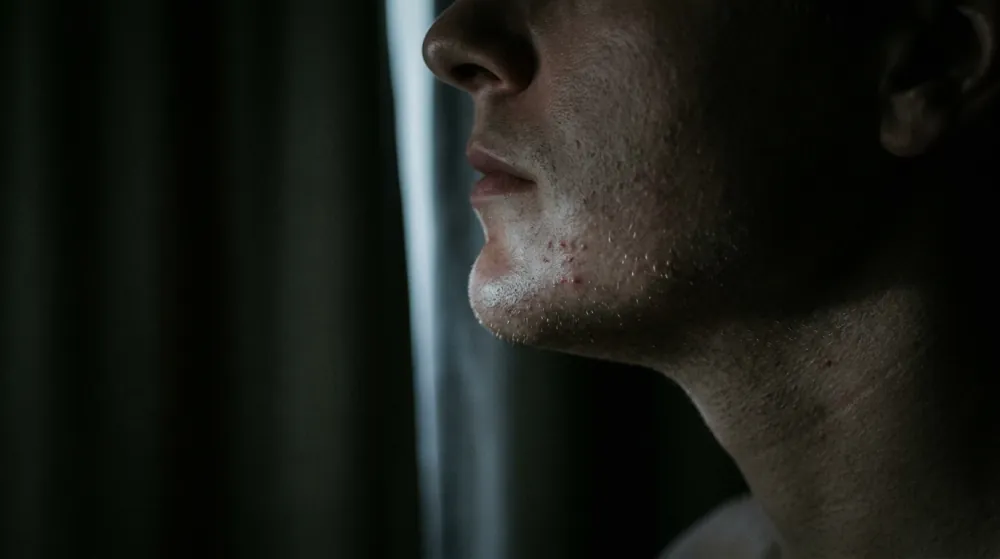
Hormonal pimples is a popular name for breakouts on the chin and jawline in adult women, often worse before a period. Hormones do act on every pimple, so the label is true of almost all acne, and a chin or jawline pattern does not show that something is wrong with hormone levels. Cycle timing is stronger evidence than location, and a handful of other signs are what justify a blood test.
The claim this article tests is the face-map rule that a chin breakout means hormones and a forehead breakout means digestion. It covers what hormonal means in acne, what studies of the jawline found, how cycle timing counts, which signs are paired with hormonal disorders, and what clinicians may offer. It describes and evaluates. It does not diagnose a breakout or advise taking any medicine, and a pattern that worries you is a question for your own clinician.
"It Is Hormonal": What the Phrase Means
Hormones Act on Every Pimple
A 2024 review of androgens and the skin in women with polycystic ovary syndrome states that the link between androgen excess and acne is well established. Acne often begins at puberty, when androgens rise. Androgens promote sebum production and change its lipid profile, and areas prone to acne show more androgen receptors and more activity of the enzyme that makes the active androgen. In that sense nearly all acne has a hormonal component.
Normal Blood Tests Do Not Rule It Out
In the other direction, most adults with acne do not have a measurable hormone disorder. A 2018 review of adult-onset acne says most of these patients do not present an endocrine disorder able to cause the lesions, that biochemical hyperandrogenism was found in only 37% in one study, and that over half of patients with isolated acne in another showed no clinical or biochemical hyperandrogenism. The 2024 review adds a study of 835 post-adolescent women with acne in whom 43.47% had normal androgen profiles. It concludes that acne formation seems to depend on local androgen concentrations and on how sensitive the sebum-making cells are, and notes that up to 60% of adult women with acne and normal androgen levels have raised levels of a metabolite that suggests heightened sensitivity.
So hormonal can be true even when blood results are normal. The label does not mean abnormal levels. In polycystic ovary syndrome the same review cites a meta-analysis of 31 studies finding acne in 42% of adult women with the condition against 17% of controls.
What the Jawline Studies Found
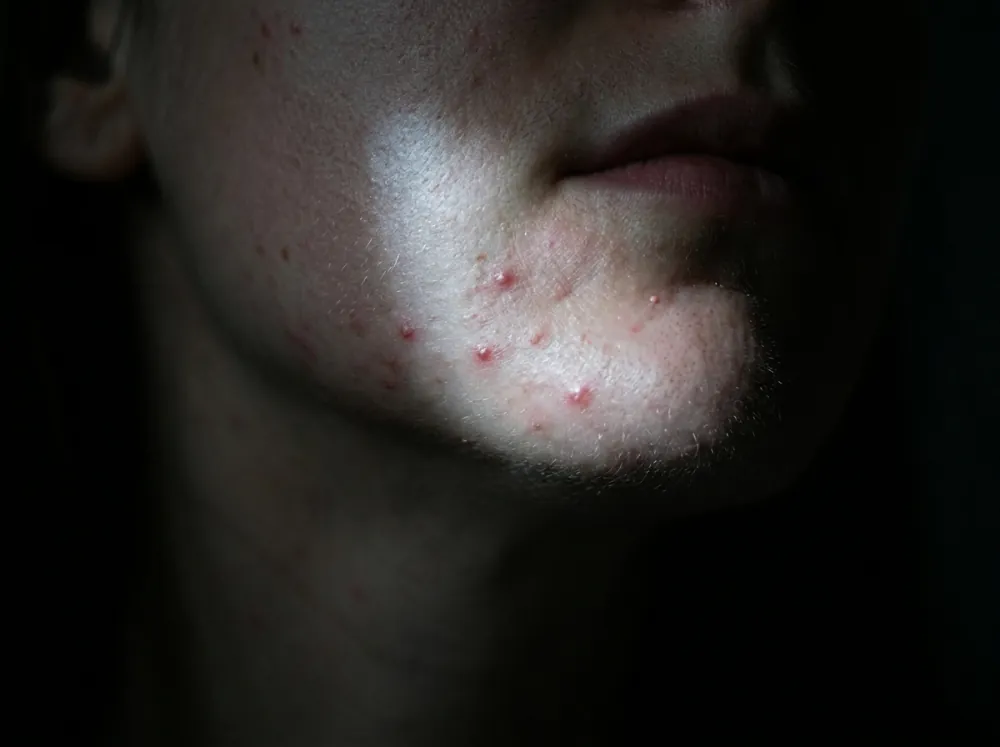
The 2018 review describes adult female acne as mostly mild to moderate and inflammatory, tending to sit in the lower third of the face: the mandibular line, the perioral region and the side of the neck. It says the distribution is not yet completely understood. It then cites a multicentre study of 374 women aged 26 to 66, in which 89.8% had several facial regions involved and only 11.2% had acne exclusively along the jaw, a finding it describes as contrary to most earlier studies, with most of the acne comedonal.
A 2021 study of 208 women (abstract) aged 25 and over found lesions mostly on both cheeks (87.0%) and around the mouth (81.7%). PCOS was identified in 48.1%. Younger age, premenstrual flare and irregular periods were associated with PCOS, and hirsutism and androgenetic alopecia were not. The abstract does not list lesion location among the associated factors.
Zone labels also differ between papers. In a Korean study of 67 patients with acne and 50 controls, the T-zone includes the forehead, nose and chin, and the U-zone is the cheeks. The U-zone-dominant group had higher sebum levels than controls and the number of lesions correlated with sebum in the U-zone, not the T-zone. The study was retrospective and at one centre. In that paper the chin counts as T-zone, which sits awkwardly with the folk rule that the chin is the hormonal zone.
Non-hormonal contributors sit on the same skin. Our article on closed comedones covers phone and hand contact on the chin and jaw, and the one on a pimple cyst covers deep lumps along the jaw.
Cycle Timing as Evidence
Timing is a stronger signal than place. A 2004 case series (abstract) counted lesions across the follicular and luteal phases of two cycles in adult women aged 18 to 44 with normal periods who were not treating their acne. Most, 63%, showed a 25% premenstrual increase in inflammatory lesions. So the pattern is common, and 37% did not show it.
Self-report gives higher figures. In the 208-woman study, premenstruation was named as an aggravating factor by 72.6% of patients, and the 2018 review cites a French study in which 78% described worsening premenstrually. The measured figure and the reported ones differ because they ask different questions, a counted rise against a remembered one.
What the pattern shows is that hormone shifts influence lesions. It does not show abnormal hormone levels. In the 208-woman study a premenstrual flare was among the features associated with PCOS, which is why it is a flag and not a diagnosis. Tracking when breakouts rise, and photographing them in the same light each week, is the record a clinician can use. Our article on why a face is oily covers the sebum side.

Signs Worth a Blood Test
This section reports what sources pair with hormonal disorders. It is not a checklist for self-diagnosis, and a blood test is a clinician's decision.
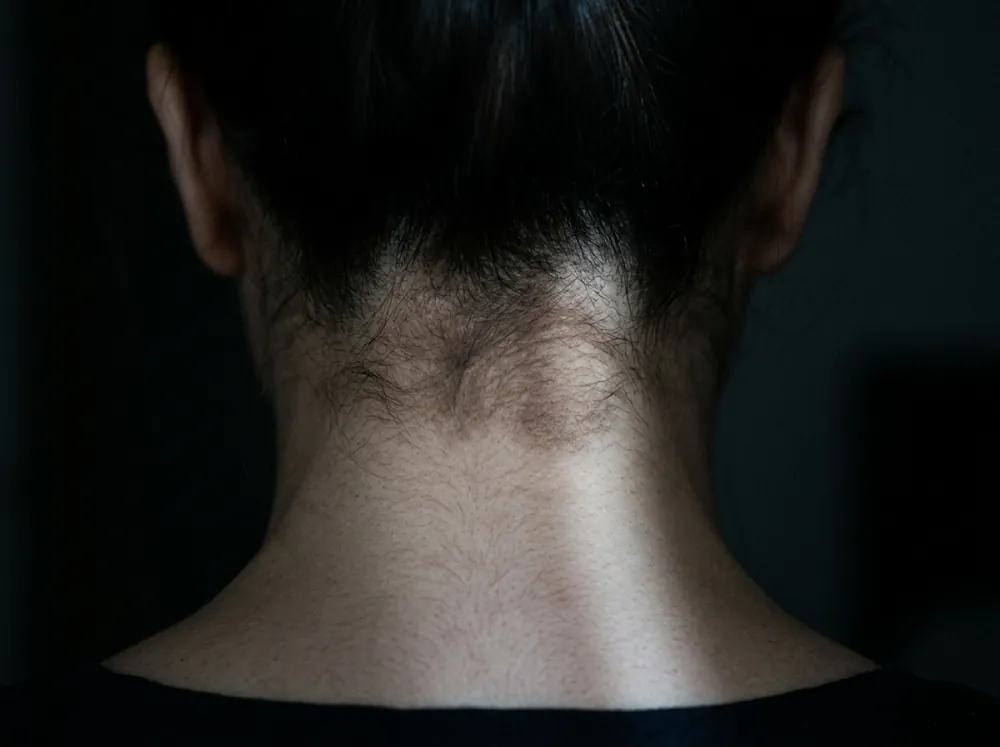
The 2024 review states that PCOS is diagnosed under the 2023 international criteria when at least two of three features are present: menstrual irregularity, clinical or laboratory hyperandrogenism, and polycystic ovaries on ultrasound or a raised anti-Müllerian hormone level. The 2018 review says that when PCOS is present, acne is rarely the only skin sign. Hirsutism (coarse hair growth in a male pattern) and acanthosis nigricans (dark, velvety skin in folds) are often present. It lists, as signs of hyperandrogenism, hirsutism, scalp hair loss, change in the voice, irregular periods and infertility, and names virilising tumours and congenital adrenal hyperplasia as rare causes.
Younger age, premenstrual flare and irregular periods were the features associated with PCOS in the 208-woman study, whose authors suggest screening for PCOS in that group. The sources disagree on hirsutism, which the other reviews list as common and that study did not find associated, so the signs are a pattern to discuss and not a rule.
Testing has its own rules. The 2024 review says androgen levels vary with age, cycle day and time of day. For total testosterone it recommends an early-morning sample in the early follicular phase and outside hormone-modulating therapy, and it notes that tests are limited by cost, availability, differing reference ranges and laboratory variation. The 2018 review also gives a morning sample early in the cycle.
What Clinicians May Offer (Reported)
This section reports trial results and gives no dose, regimen or advice to take any medicine.
Spironolactone
The SAFA trial in England and Wales randomised 410 women with facial acne of six months or more, judged to need oral antibiotics, to spironolactone or placebo, and analysed 342. Acne-specific quality-of-life symptom scores favoured spironolactone, by 1.27 points at week 12 and 3.45 at week 24. Self-assessed improvement was 82% against 63% at week 24, and clinician-rated treatment success at week 12 was 19% against 6%. Headaches were more common on spironolactone (20% against 12%), and no serious adverse reactions were reported. The authors write that it has been prescribed off-licence for acne for many years. Women at risk of pregnancy had to use contraception, and the trial excluded people taking potassium-sparing diuretics or certain blood-pressure drugs and those with raised potassium or reduced kidney function. The National Institute for Health and Care Research funded it. Remote follow-up during the pandemic limited the assessments.
Combined Oral Contraceptives
A Cochrane review searched in 2012 included 31 trials and 12,579 participants. In placebo-controlled trials, combined pills reduced inflammatory and non-inflammatory lesions, severity grades and self-assessed acne. It found few consistent differences between pill types, and said how pills compare with other acne treatments is unknown because only one trial addressed it. It measured acne outcomes, not the other health considerations that a prescriber weighs. The 2018 review calls both pills and spironolactone good options for women with acne.
The Figure Audited: "Chin Means Hormones, Forehead Means Digestion"
Verdict: unsupported as a rule. Location describes a pattern and does not identify a cause. Findings:
- No face-map study found. No source opened tested whether a facial zone predicts a cause of acne.
- The lower face is common in adult women, not exclusive. In the 374-woman study 89.8% had several regions involved and 11.2% only the jaw.
- Location cannot read hormones. Biochemical hyperandrogenism was found in 37% in one study, and 43.47% of 835 women had normal profiles in another.
- Zones are defined differently. One study counts the chin as T-zone, and its findings tied sebum to lesions in the cheeks.
- Non-hormonal causes sit on the same skin. Contact and friction on the chin and jaw are covered in our closed comedones article.
- The forehead half is not tested here. No source opened examines digestion and forehead acne, so this article neither supports nor refutes it.
Conclusion
Hormonal pimples is a fair name for acne that responds to hormones, and every acne does. A chin or jawline pattern does not show abnormal levels, and most adults with acne have normal tests. Flares before a period are common, measured in 63% of women in one series. Irregular periods, extra hair growth, scalp thinning, dark velvety patches or a voice change are the features that sources pair with hormonal disorders and justify a conversation about a blood test. Prescription options exist, with trial results to weigh and exclusions to respect.
Recording breakouts by date, photographed in the same light, in an app like Skinic or in an album, makes the cycle pattern visible to you and to a clinician. For irregular periods, extra hair growth or breakouts that do not settle, ask your own clinician.
Frequently asked questions
5 questions · tap one to open the answer
What are hormonal pimples?
Do pimples on the chin and jawline mean a hormone problem?
Why do pimples flare before a period?
Which signs go with a hormonal disorder such as PCOS?
What treatments do clinicians offer for hormonal acne?
Medically reviewed by
Dr. M.M Hanaei
Aesthetic Physician, Dermatology Fellowship
- MD — Shahid Beheshti University of Medical Sciences (SBMU)
- MCC Licensure (Medical Council of Canada)
- Dermatology Fellowship, Switzerland
- Certified in advanced aesthetic procedures
Last reviewed 17 October 2026